This is my tenth A to Z Challenge. My first was in 2013, but I missed 2021. This April I am going through the alphabet using snippets about my family through the generations.
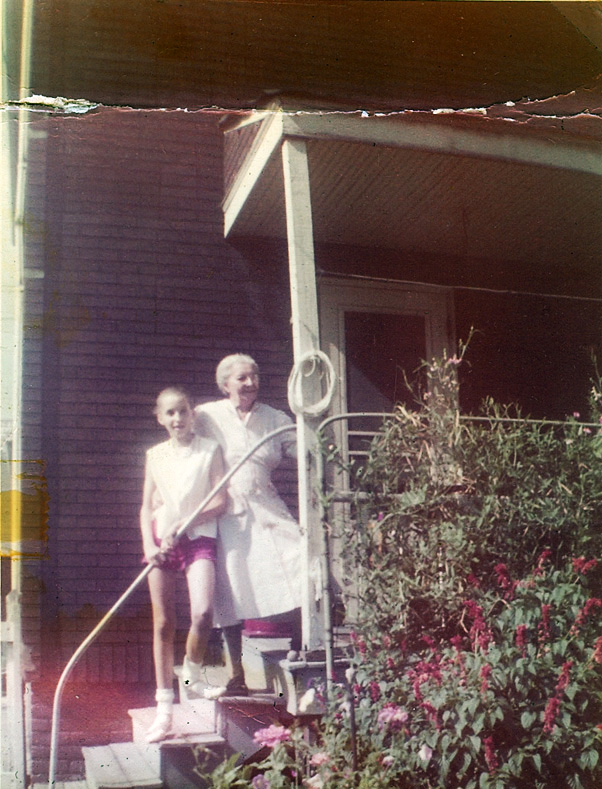
“On our back porch 1959. Kris 13 & Nannie. She’s just turned 13.” Nanny was 71.
When I was growing up in Detroit, my birthday was often celebrated at my grandparent’s house because it fell on August 30, during our school vacation. My grandmother, Nanny, would make my birthday cake. When we celebrated at home, my mother made one using Nanny’s recipe.
The recipe below was written on the back of a picture in the ‘frosting’ section of my mother’s falling apart cookbook.
Click to enlarge or read recipe transcribed below.
Mother’s Cake
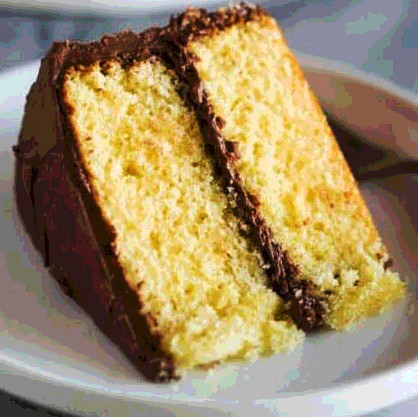
A stand in for the real thing.
1 1/2 c. butter 2 c. sugar 3 c. cake flour, unsifted 4 large eggs 1 c. milk 3 t. baking powder 1/2 t. salt 1 t. lemon extract 1 t. vanilla “ 1/2 t. nutmeg
Sift dry ingredients together. Proceed as usual.
Easy Chocolate Frosting
Melt 2 or 4 sq. unsweetened chocolate and 3 Tb. butter over hot water. Measure 1 lb. sifted confec(tioner). sugar, add 1/8 tsp. salt, 7 Tb. milk, and 1 tsp. vanilla. Blend. Add hot chocolate mixture and mix well. Let stand. Beat until of right consistency to spread on cake.
This is my tenth A to Z Challenge. My first was in 2013, but I missed 2021. This April I am going through the alphabet using snippets about my family through the generations.
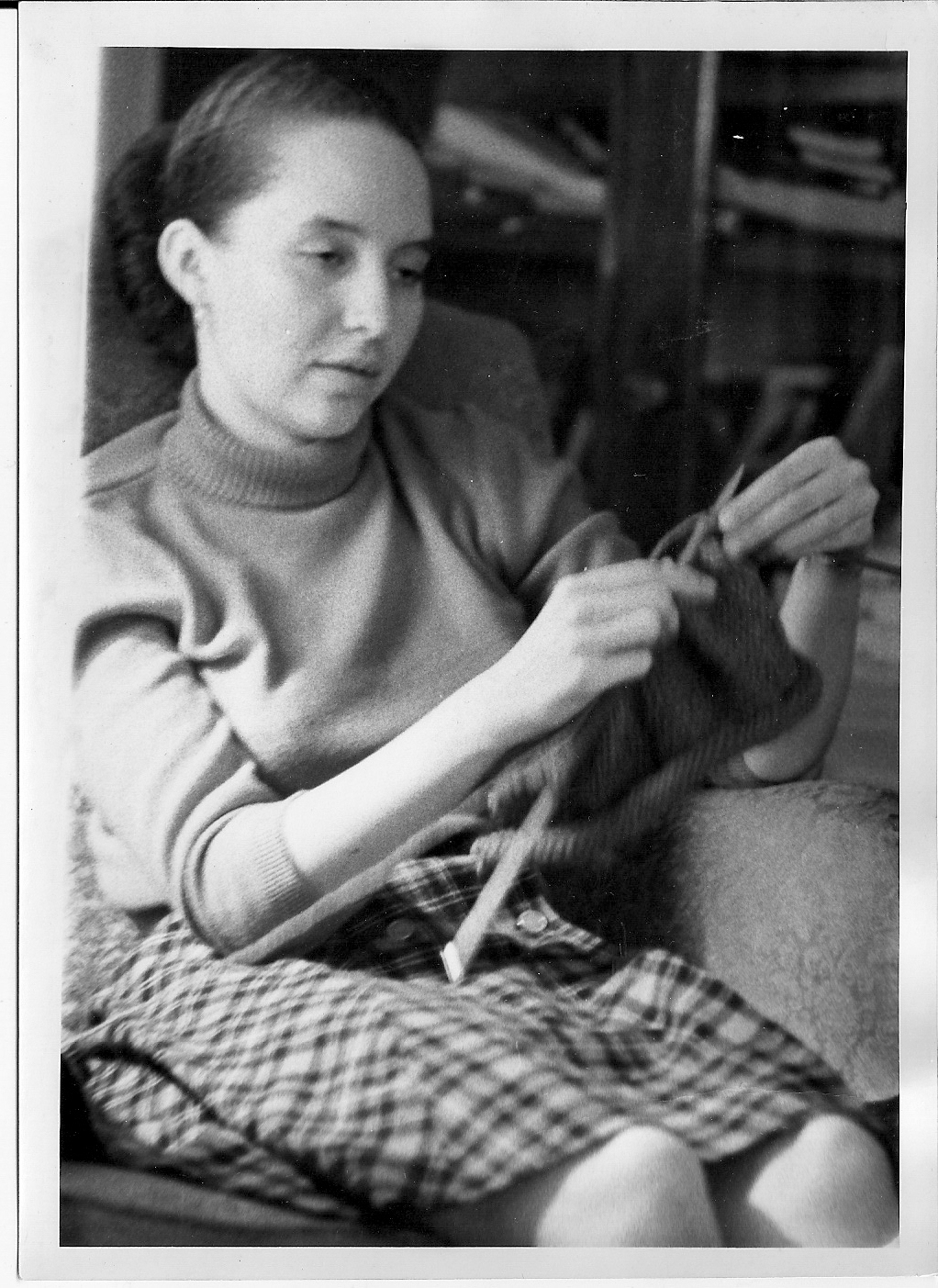
Knitting a scarf 1966.
The only thing I ever knitted was a pale blue very long scarf that I wore for years through Detroit winters. I don’t remember why I started knitting it and why I never had an interest in knitting anything else.
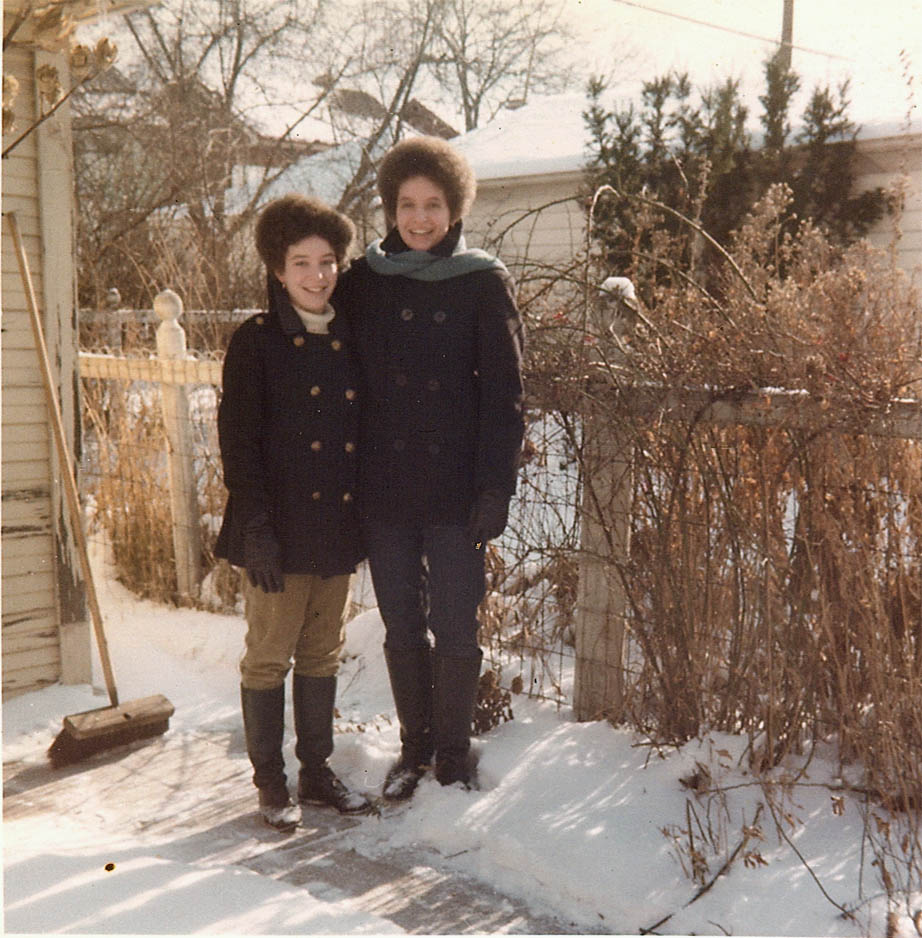
I’m wearing my scarf here in the winter of 1968/1969, between graduation from Wayne State University and my cross country trip. I am the tall one.
This is my tenth A to Z Challenge. My first was in 2013, but I missed 2021. This April I am going through the alphabet using snippets about my family through the generations.
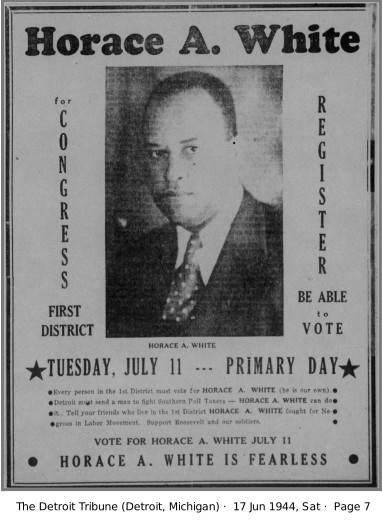
Rev. Horace White was the pastor of Plymouth Congregational Church from 1936 until his death in 1958. Both of my parents were members and met at Plymouth. My father credited Rev. White with turning him to the ministry. I decided to look for information about him and the article below is one that I found. It reminded me of some of my father’s writings.
The Facts in Our News
By Horace White
The Michigan Chronicle
Detroit, Michigan · Saturday, November 03, 1945
It ain’t yet – The Negroes have jumped overboard because one Negro has been assigned to get ready to play baseball in the white organized baseball fraternity. We always jump overboard at the least provocation in such matters. We make too much out of such events in our news. Of course it is an achievement to get such an assignment. But it is not any great step forward yet. The assignment of the young Negro ballplayer has in it only the fact that he is a very promising player.
Negroes are not accepted yet on the basis of their merit. It will be a long time comparatively speaking before we will be so accepted. It is no fault of the Negro players that such is the case – our American race prejudice causes this particular situation as race prejudice causes many other un-American acts on the part of Americans.
click to enlarge
It is nothing short of pathetic to see a race of people so eager for acceptance that the least little crumb dropped to them causes so much excitement. Maybe that is the way it has to be. There is one thing sure, about giving so much importance to the ordinary and common place events of our lives, we set our sights lower than we ordinarily would. Young people accept little achievement in terms of something really important. You and I have seen how easily a whole race gets vicarious pleasure and a sense of achievement from the fact that one Negro has been given some ordinary job or position.
Many times young people are given the wrong evaluation of achievement when they see their parents making such a fuss over small things. When small things are assigned to us as a race let’s be big enough with ourselves to accept small things as small things. It is nothing short of weakness on our part when we get and give so much publicity to any little incident of acceptance.
How can we get over this seeking of approval from the majority at almost any cost? This is no easy task. We have been denied and we have looked for our satisfactions from the people who have denied us so very long. We feel sometime that approval from the majority group is worth any effort that we may make.
Of course we can understand why we seek so much approval. The reasons are not far to seek. Any people living as a minority group in all ways. The majority group does its domination through education, social mores and economic controls.
The minority groups usually succumb to these controls of the majority group. One way of succumbing to the controls of the majority is to bite for every sop that the majority group hands out. The assigning of a Negro to a berth in organized baseball is an example of what is meant here. The Negro population has been led to believe that Negroes have gained something by the very fact that the young man has been assigned to play with the Brooklyn Dodgers. Still, nothing has been gained.
The boy is good. It is good business for the team to sign him to play. More than this fact we should as Negroes take the position that the recognition of the abilities of Negro players is long overdue. Therefore, Negroes should not express so much joy over the fact that the very fine young man has been signed. We are glad for him and that is all.
This unusually overrated incident is no different than the “hell” that some Negroes are “raising” over the fact that Jane White is taking the lead in “Strange Fruit.” The protest of Negroes is so silly to say the least. Yes, it is possible for a Negro woman who has gone to college to fall in love with a no-good white man. Negro women who have gone to college fall in love with no-good Negroes. “Strange Fruit” is a real novel.
The protest over a Negro woman playing “Nonnie” in “Strange Fruit” is a sign of our total insecurity. We cannot face a situation without “tears” of wishful thinking. We always try to put our best “foot” forward even to the point of being ridiculous.
Our family life must provide the way for us to escape the basic need for acceptance. Young people must learn how to find inner emotional strength within themselves. Our families must provide a real basis for Negroes to free themselves from a need to seek acceptance from the majority group. We must seek brotherhood. Brotherhood means giving of selves equally. Anything else is subjugation.
This is my tenth A to Z Challenge. My first was in 2013, but I missed 2021. This April I am going through the alphabet using snippets about my family through the generations.On Saturdays I’ve combined my usual Sepia Saturday post with the letter of the day. A double challenge.
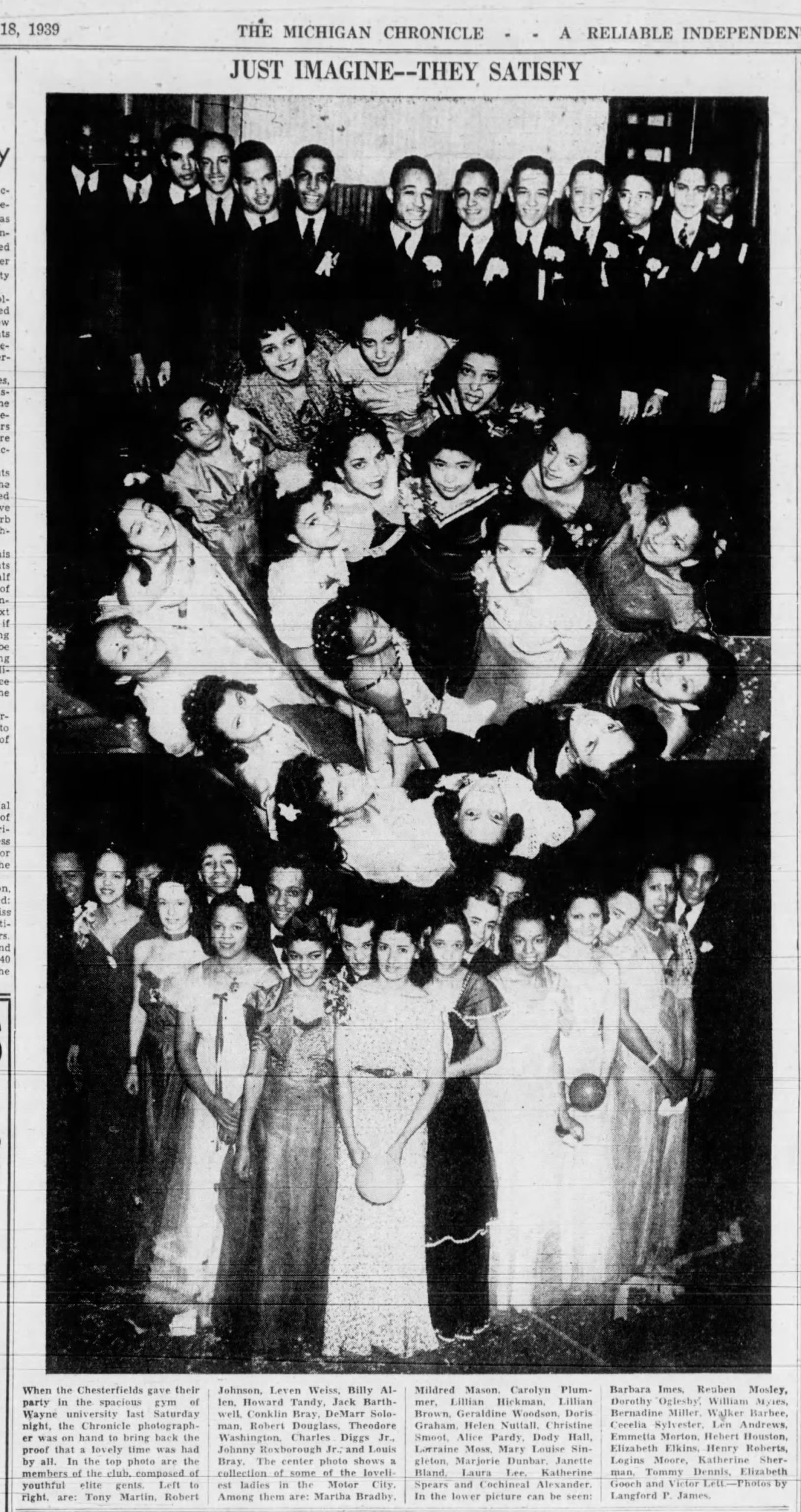
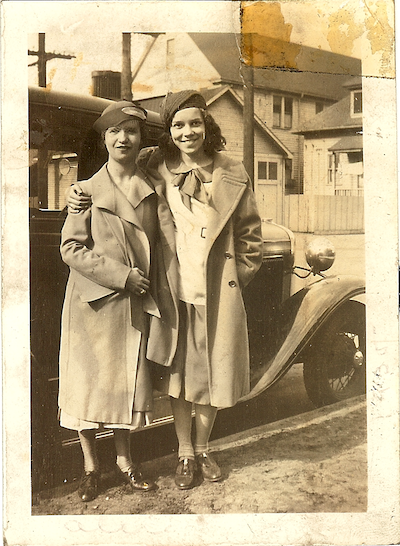
Several years ago I shared the photograph below from my grandmother’s scrapbook of my mother dancing at a formal dance. The other day I decided to see if I could find any more information in the newspapers. I was overjoyed to find two articles in two different Detroit papers with photos and mentions of my mother. Both were African American newspapers. The Tribune was published by my maternal grandmother’s first cousin, James McCall.
From my grandmother Fannie’s scrape book. An article from The Tribune March 18, 1939
I am sharing the photo from the Michigan Chronicle and the original photograph from my grandmother’s album and the article from the Detroit Tribune, because it mentions what my mother was wearing.
In March 1939, my mother was 16 and a senior at Eastern High School. She graduated in January 1940, and entered Wayne State University.
The Michigan Chronicle, March 18 1939. My mother is in the center of the circle looking up at us.
Glimpses… In Detroit’s Mirror
By Sylvia Penn
The Detroit Tribune, March 18, 1939, page 4
Hello , Folk! The hour for twisting and turning our “little ole” mirror for you to catch reflections of the doings of Detroit, is at hand again. We have always heard that the weather is a safe topic of conversations at any time; so right here for a second or two, we shall discuss the weather Sunday and Monday of this week, we were tempted to think of Detroit as the “Crystal City,” instead of the Motor City for the handiwork of nature stretched before our gaze a picture of dazzling beauty with trees, houses and streets encased in ice. The sparkling beauty of it all equaled the splendor of the jewels in the King’s Crown. It was a magnificent sight, but it is all gone now, except the memory of it and in it’s stead we have warm sunlight, which reminds us that spring is just around the corner.
Yes, Folk, but there have been other scenes of beauty in Detroit other than that afforded by Dame Nature. Such was the Chesterfields ball at Wayne university last Saturday evening. The affair was as colorful as a rainbow and was distinctly an occasion for dress. The frilly crisp gowns worn by the young ladies were as beautiful and picturesque as springtime. The gowns were rampant in color, ranging from polka-dots to mulberry taffetas, sky blue satins and black and gold nets. Then there were the many lovely corsages, also orchids for two of the Chesterfieldians chose and pinned gorgeous orchids on the gowns of their company. The members of the club identified themselves by wearing green and gold ribbons in their lapel, these being Wayne’s colors. They further used the same color scheme in the. ceiling decorations. Of course, there were multi-colored balloons and a profusion of confetti. The swingy, swingy music brought forth the usual group of jitterbugs doing their number on the sideline with maybe one or two doing the “Boogey.” The Chesterfieldiana and their invited girl friends were: Bobby Douglas and Doris Graham, Doris looking very sharp in peach chiffon and corsage of sweet peas and roses, Howard Tandy and Martha Bradby, Martha very cute in black and white net, Jack Barthwell and Marjorie Cook, Marjorie being quite smart in black chiffon; Leven Weiss and Helen Nuttall, Helen very sophisticated in black taffeta striped with gold; Theodore Washington and Margaret Book, Billy Allen and Alice Tandy. Alice very ravishing in red and wearing orchids too; Tony Martin and Lorraine Porter. Louis Bray and Shirley Turner, Shirley lookin lovely in white crepe; Conklin Bray and Harriet Pate. Harriet quite charming in blue and white. Demar Solmon and Lillian Brown; John Roxvourgh and Mary L. Singleton; Robert Johnson and Veralee Fisher, Vera very stunning in her new gown of aqua-blue chiffon, embroidered with silver; Charles Diggs Jr. and Christine Smoot. …
Today I did two “G” posts, unawares. The other isG-Gardening.
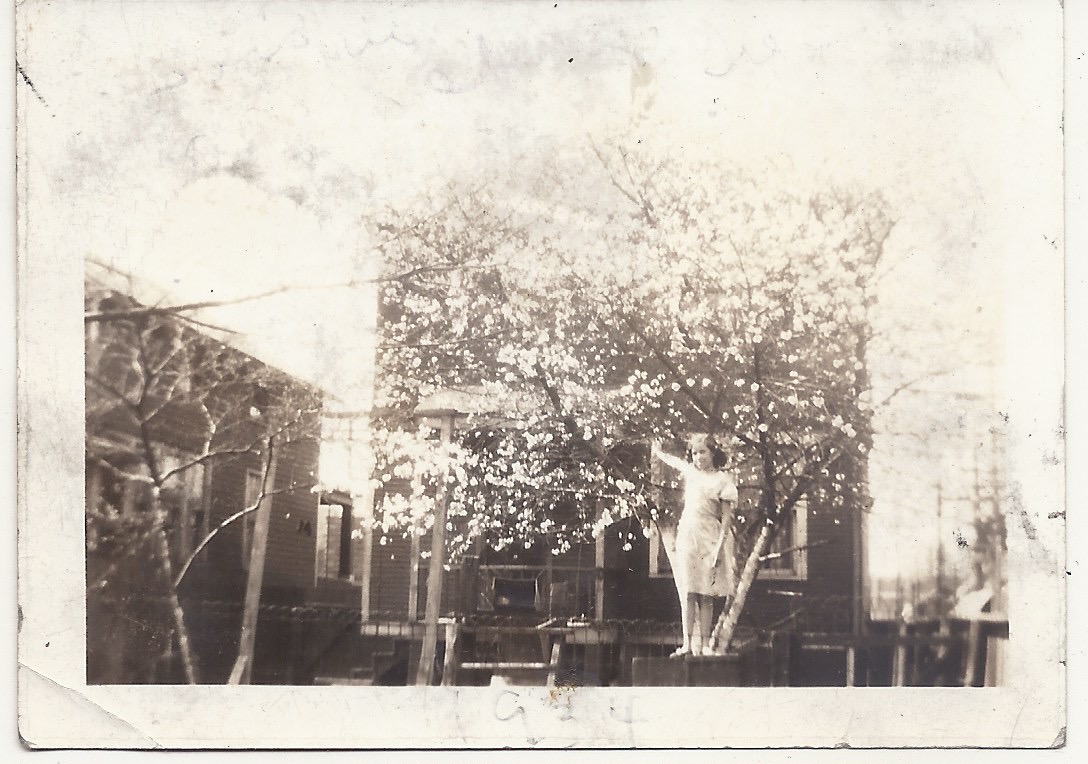
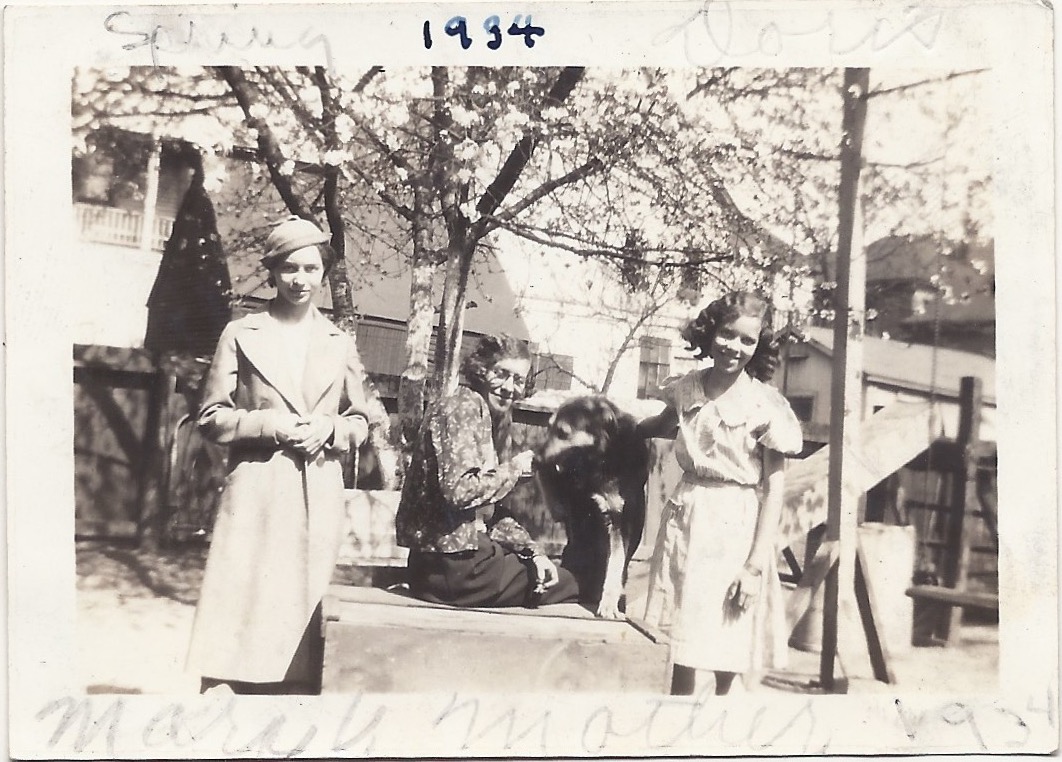
My mother in the spring of 1934 standing on a box by the cherry tree in the backyard.
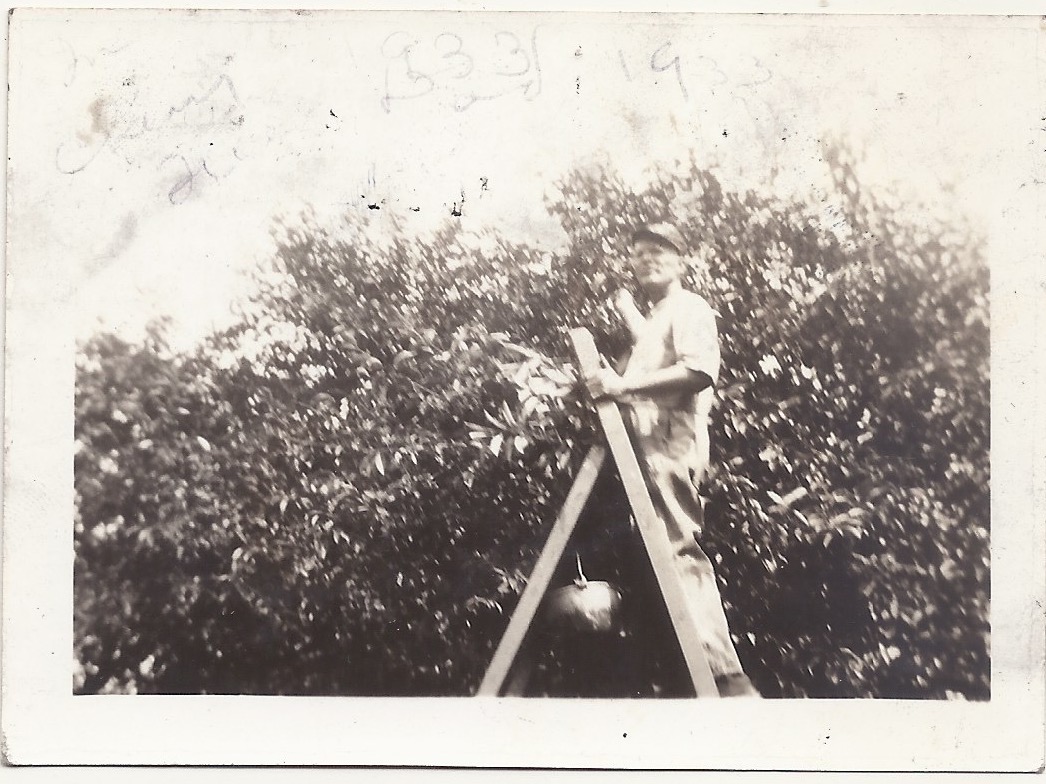
Mershell C Graham picking cherries.
I’m not sure what kind of cherries these were, but here is a picture of my grandfather picking cherries the year before. If they were pie cherries, I’m sure my grandmother made pies. There was also an apple tree, a garden and chickens in their Detroit backyard.
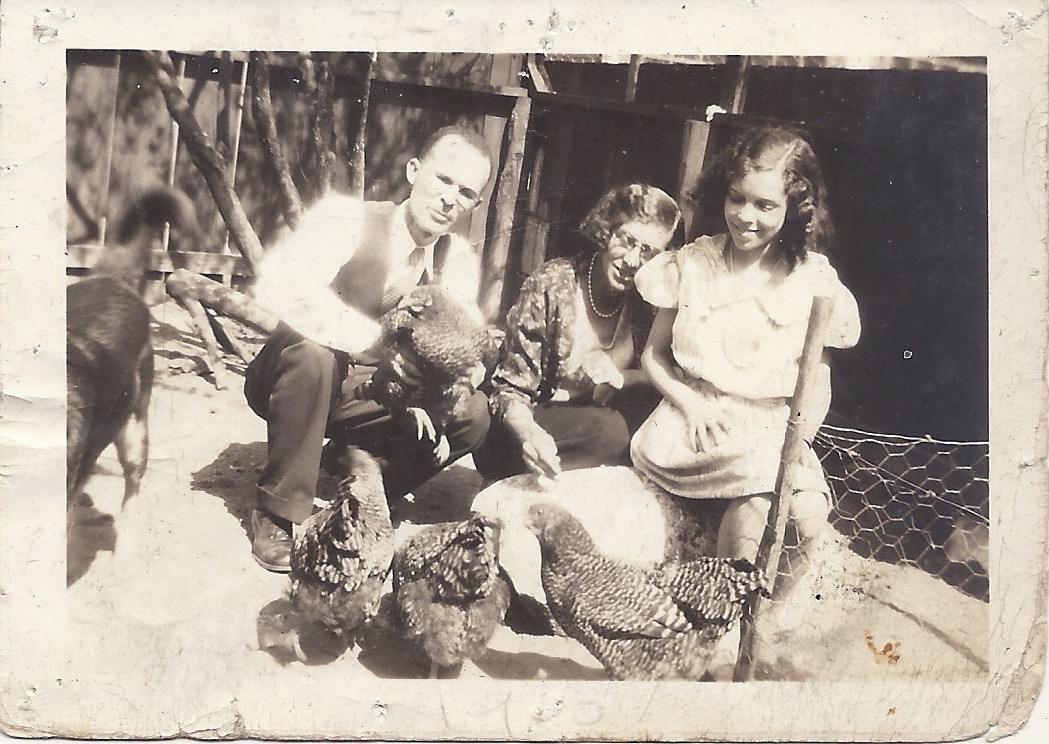
With the chickens Mershell, Fannie and Doris.Spring 1934. Mary V, mother, Bonzo and Doris .
My aunt Mary Vee was 13 years old. My grandmother Fannie was 46. My mother Doris was 11. Bonzo was five years old. It looks like they are just back from church service at Plymouth Congregational Church.
In 1934 they got their first car, a model A named “Lizzie”, which I wrote about a few weeks ago. My grandfather worked as a stock keeper at the Ford Motor Company Rouge Plant. My grandmother didn’t work outside of the home. Mary Vee attended Eastern high school and Doris attended Barber Intermediate school.
I remember a summer in the 1990s when my husband worked for the Michigan Department of Transportation. One year they were building Highway 31 from Pentwater to Ludington. The route went through some orchards which were doomed to be bulldozed. One July weekend we went and picked so many cherries! There were red and black and yellow and they were fully ripe. We went a few times. Never have we eaten so many cherries. So delicious and so sad the trees were destroyed.
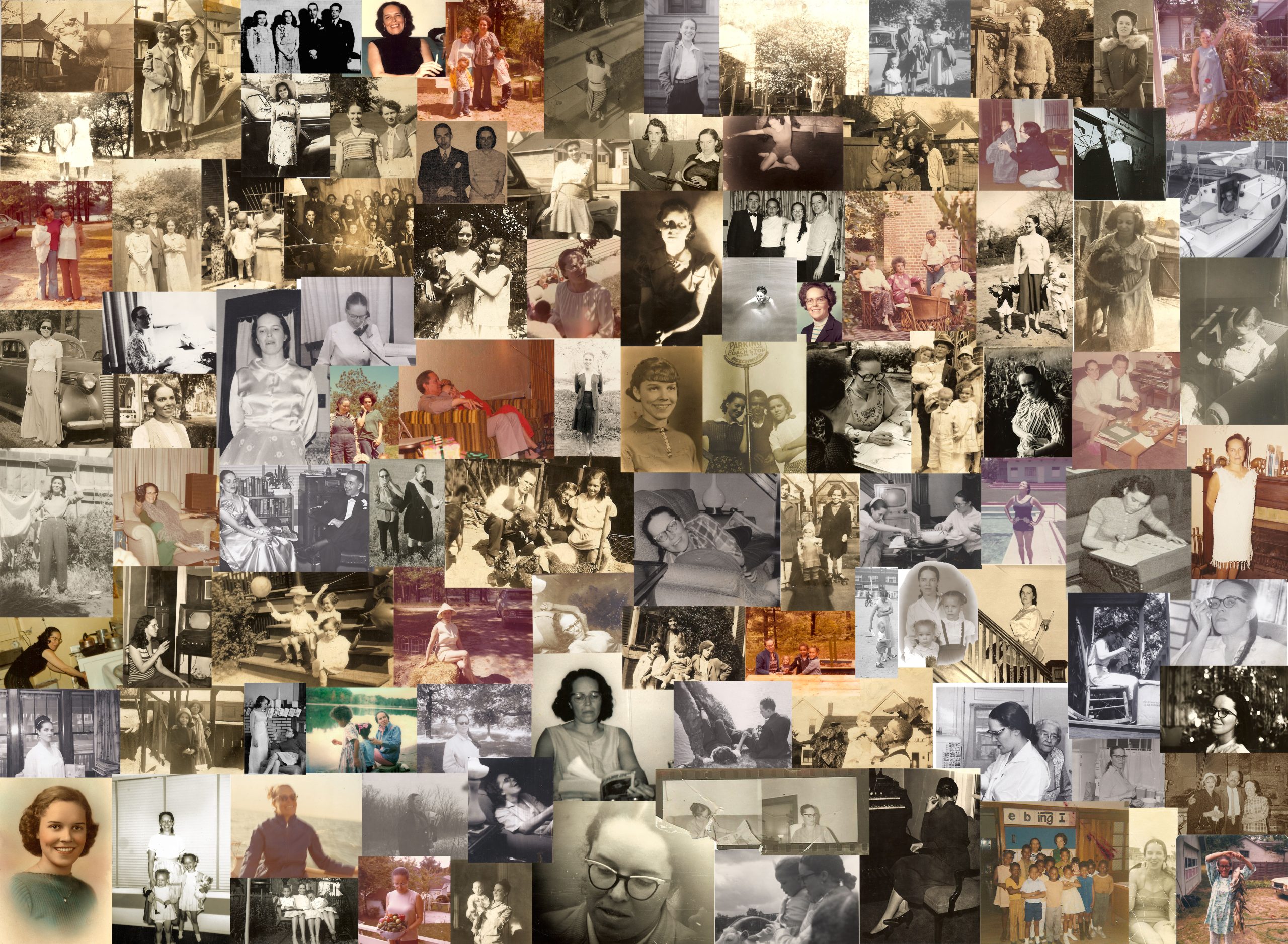
My mother was born in Detroit in 1923 to Mershell and Fannie (Turner) Graham. This year marks 100 years since her birth. Below are 101 photos of her. Beneath the photo are some of the posts I have done about her life.
Doris Juanita Graham Cleage 1923 – 1982. Click to enlarge.
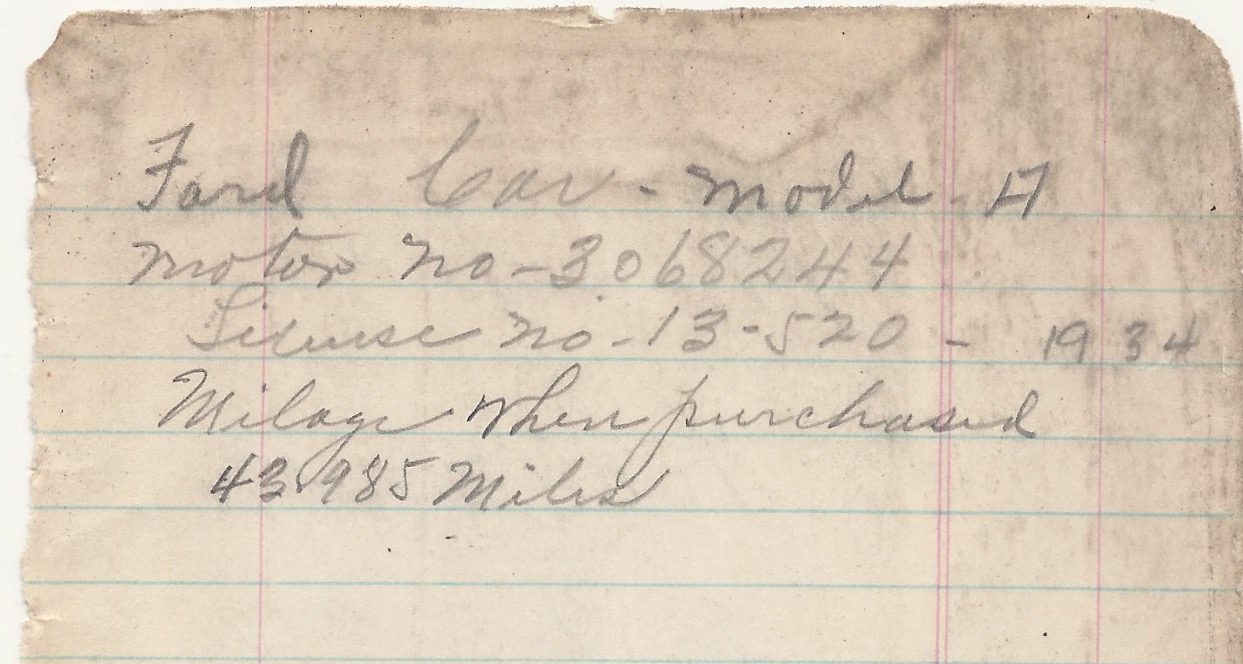
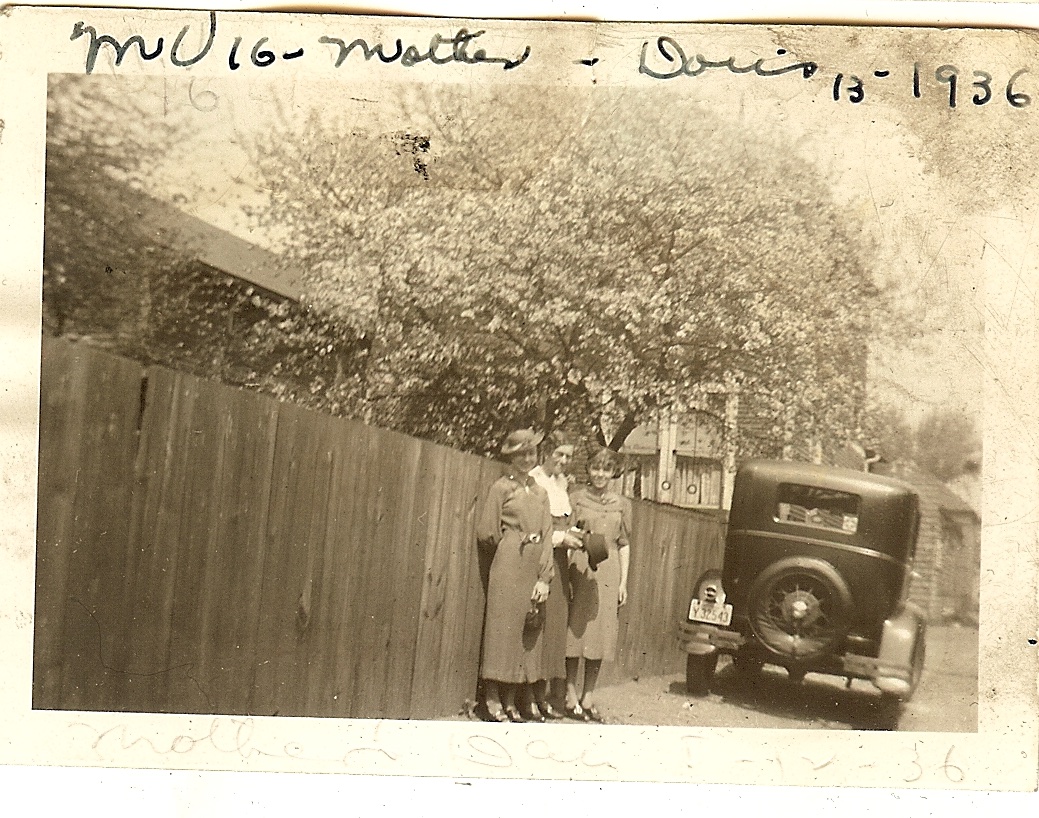
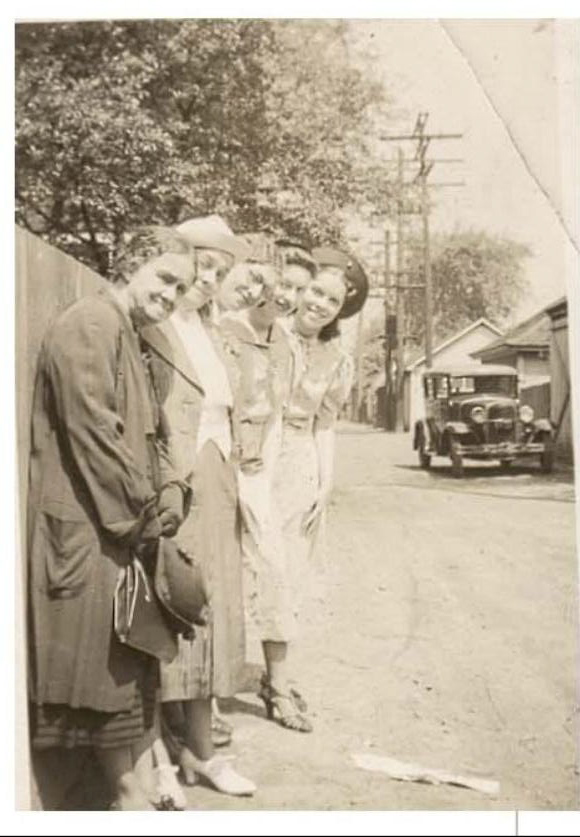
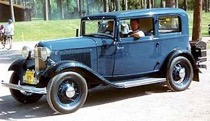
When I decided to write about my grandfather Mershell’s car, Lizzie, I thought it was a model T, but when I went looking at pages that tell you how to tell whether a car is a model “A” or model “T”, and what year it was made in, I found that based on the shape of the headlights, the bumper, the running board and the doors, that it was a Model “A” Tudor sedan and built in 1931. I was happy to find the note below in my grandfather’s little notebook. I remembered various stickers on the back window and thought it must have been purchased used and the note also mentions that.
From Poppy’s notebook – Ford Car – Model AMotor No – 3068244License No. 13-520 – 1934Mileage when purchased43.985 miles
My grandmother, aunt Mary Vee and Doris (my mother). Lizzie from the back. Click to see full photo.Lizzie from the front in the background. My great grandmother, Great Aunt Daisy, Grandmother Fannie, Aunt Mary V. and my mother Doris.
Lizzie, my grandfather Poppy’s old Model A Ford, was the first car that was a regular part of my life. We didn’t have our own family car until I was eight. Lizzie was black with a running board and awning-striped shades on the windows. We pulled them down when we changed for swimming at Belle Isle.
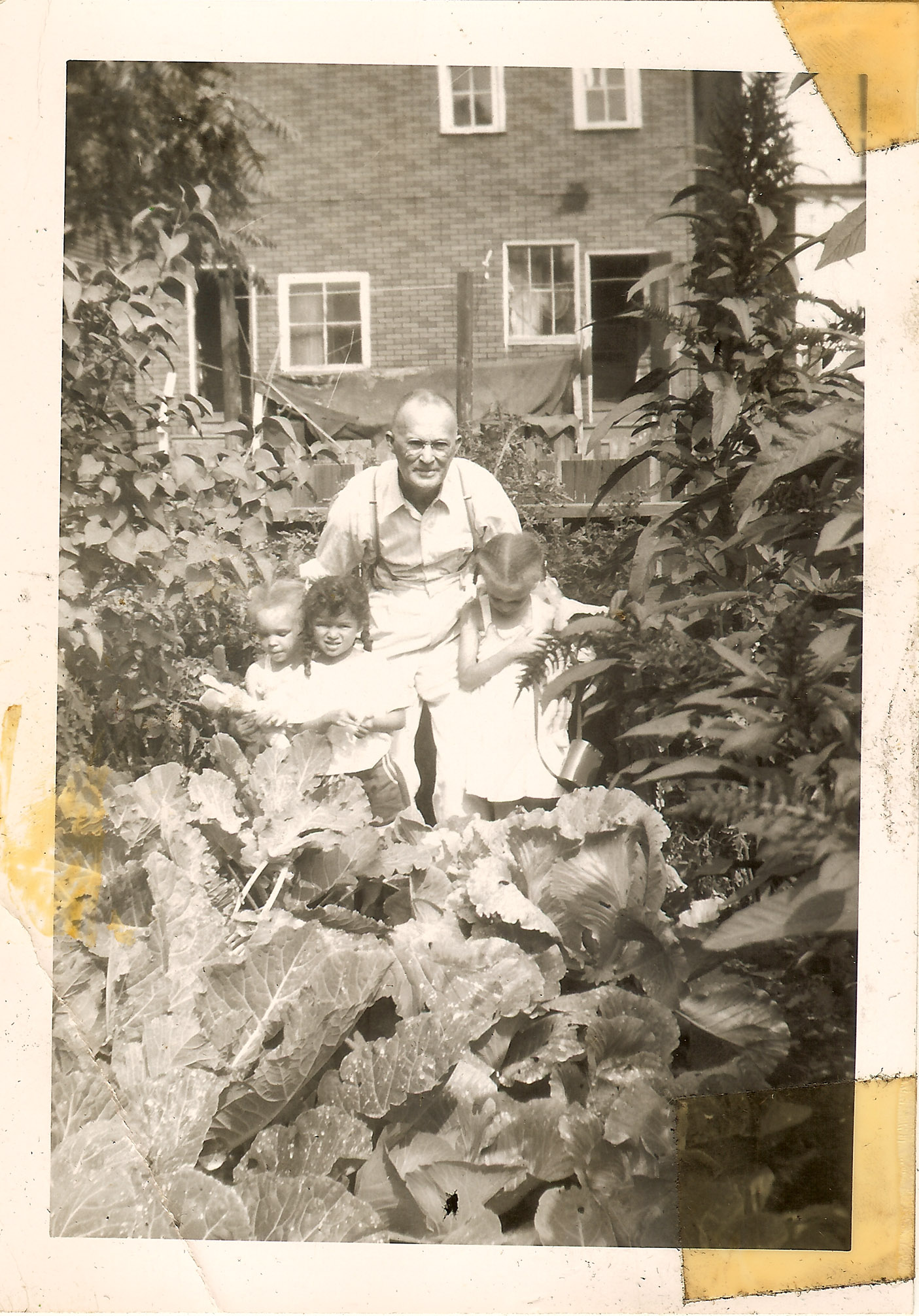
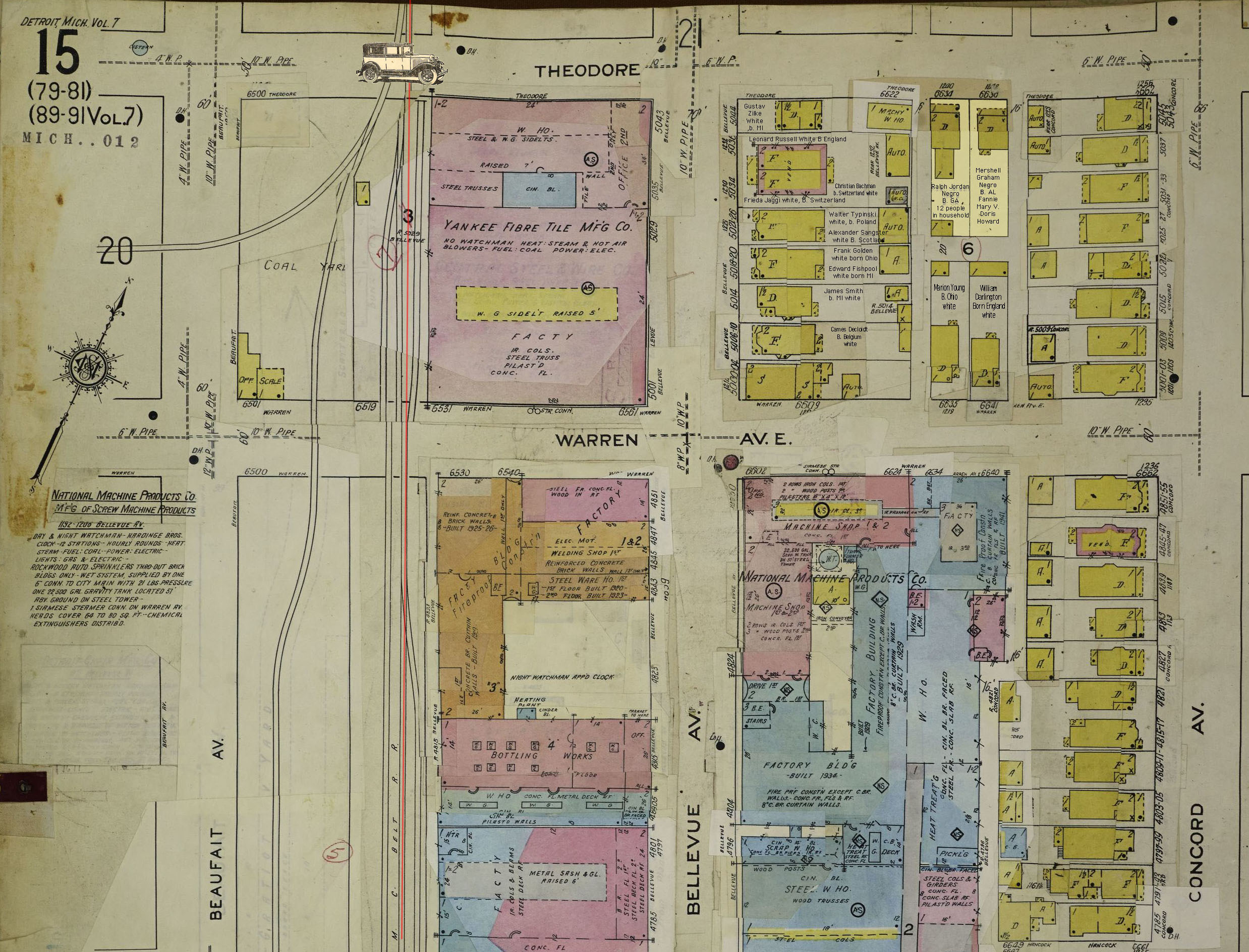
Poppy didn’t have a garage. The back of his yard was taken up in a large vegetable and flower garden with a winding path and bird feeder, so he rented a garage from a neighbor across the alley. Was it the family with all the kids? I don’t remember. I do remember my mother telling me one of their sons mentioned to Poppy something about his pretty granddaughter and I figured she was going to say Dee Dee, my older, beautiful cousin. At the time I was skinny with glasses and hair in two braids. I was truly surprised when she said he was talking about me. Come to think of it, he was skinny with glasses too. Anyway, I don’t remember ever talking or playing with him or any of my grandparent’s neighbors. We stayed in the house or yard making up plays, building fairy castles, playing imaginary land and swinging.
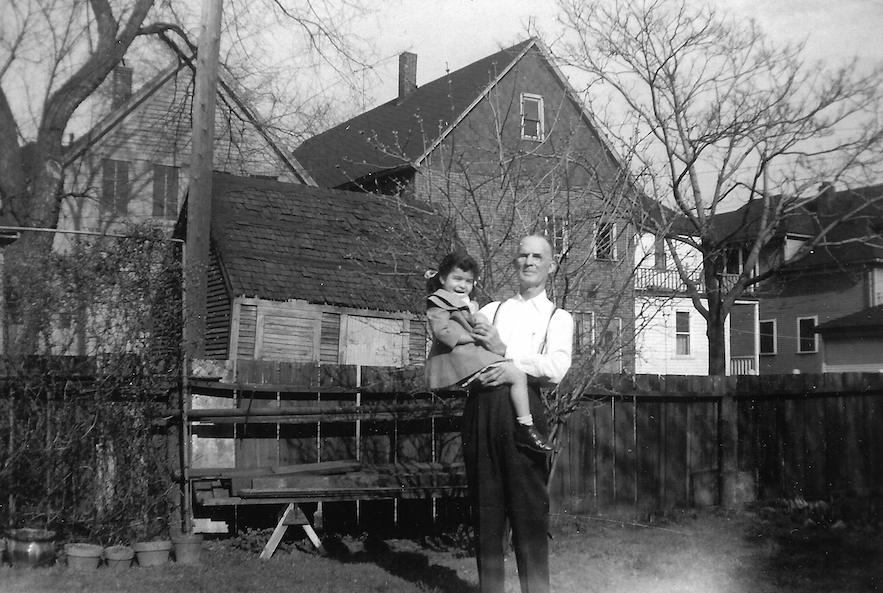
Pearl, Barbara, Kristin with Poppy in the garden.
Back to Lizzie. Poppy did not drive to and from work. He worked as a stock clerk at the River Rouge Ford Plant, quite a distance from home. He caught the bus. According to Google maps that trip takes over an hour now. Bus or streetcar service might have been more direct in the old days. I hope it was. The car was used on the weekends to do errands on Saturday and to go to Church on Sunday. I remember riding in Lizzie with my grandfather to go to Plymouth Church where he was a founder, a Deacon and the man who fixed the furnace and put up bulletin boards and everything between. We would run around and explore the empty church while he worked.
My sister Pearl’s memory
I remember the back window had a little shade you could pull down. I remember loving the running board because you could stand up on them and look around before climbing in. And I remember when we went with Ma and Poppy to trade it in and one of the doors flew open. I wish they’d kept it. (Note: As I remember it, the car door the door of our old gray Ford Betsy flew open as we drove into the parking lot to trade it in on a later model used car, not Lizzie.)
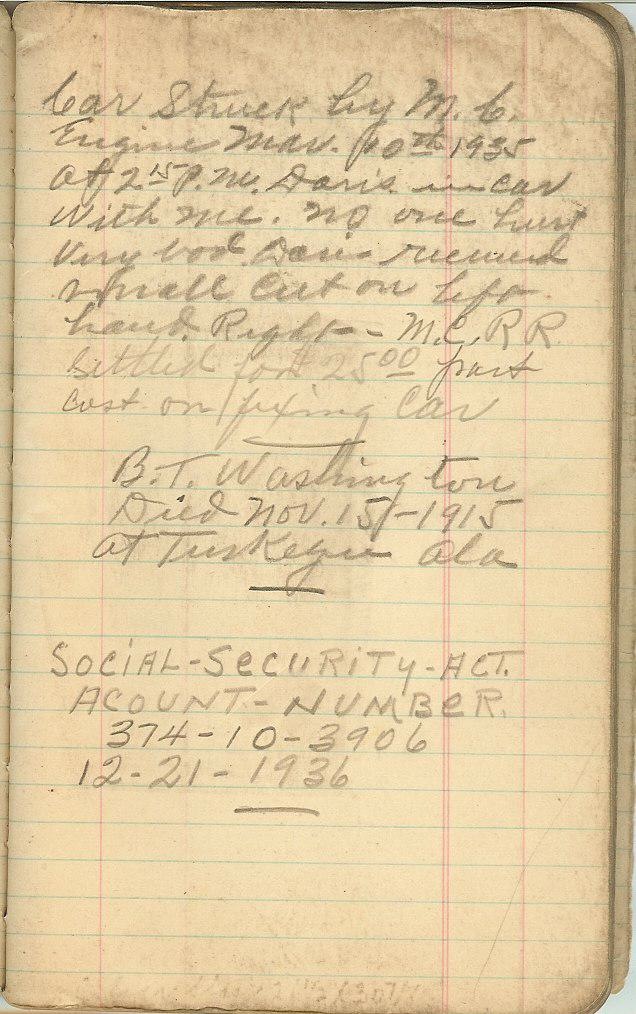
From my grandfather’s notebook.
Car struck by M.C. (note: Michigan Central) engine Mar. 10th 1935 At 2:15 P.M. Doris in car with me. No one hurt very bad. Doris received small cut on left hand M.C. RR settled for $25.00 part cost on fixing car.
Sunday, March 10, 1935 was a cold, rainy spring day. My grandfather and my twelve year old mother, Doris were on the way home. They were crossing the railroad tracks when they were struck by a Michigan Central railway engine.
My sister Pearl remembers: The train was backing up. They were crossing the tracks headed home. Poppy didn’t see it because it was on his blind eye side. Ma saw it but didn’t want to hurt his feelings by telling him. How crazy is that?!?!?
Lizzie crosses the tracks a few blocks from home before being struck.
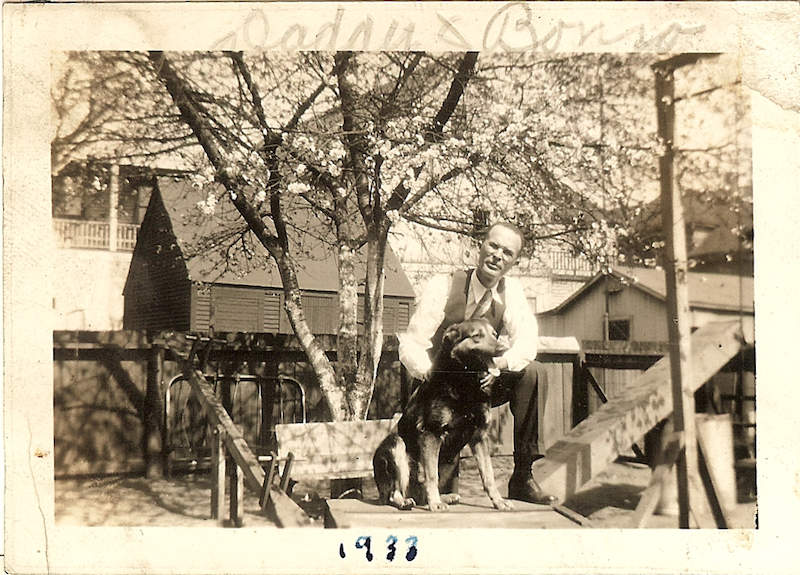
My mother with her aunt Alice. 1935. With Lizzie.Poppy and Bonzo in yard. 1933
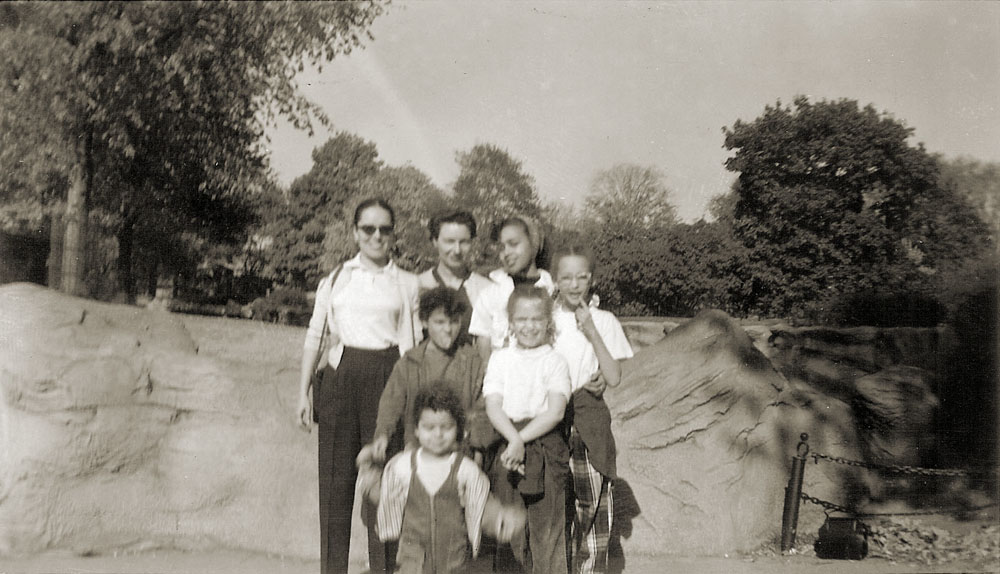
Some of us rode in Lizzie to the zoo. Marilyn in front, Barbara and Pearl next; in back row, my mother, my aunt MV, Cousin Dee Dee and me. About 1956.
Cousin Marilyn’s memories
My cousin Marilyn was the youngest of the cousins. Before she started school she used to spend the week at my grandparents while her parents worked. Poppy would drive her back home for the weekend. Her memories are below.
Marilyn and Poppy about this time.
Hey cuz, yes I remember LIzzie, the dark blue car!? I was always embarrassed to be in that old car when Poppy would bring me home to Mama’s for the weekend. I was just a little girl. I remember ducking down in the seat when we would come down Calvert. Those mean kids would say “Why your Grandpa got that old car? It’s so ugly!” Or something to that effect.
These are my cousin Dee Dee’s memories of Lizzie. You can see more about Lizzie in Part 1
My cousin Dee Dee McNeil remembers Lizzie
Our grandfather called his Model T Ford “Lizzie.” I always referred to Poppy’s car as a Model T Ford, but when I looked up the photos, I think his car might have been a little later Ford Model B or Model 40. This I decided after looking at photos of the Ford Motor Company 4- cylinder engine, 2-door cars. Lizzie was all black.
Just about every Sunday morning, me, my sisters (and sometimes our two cousins, Kris and Pearl) climbed up on the running board and piled into the backseat of Poppy’s historic black Ford that rumbled down Theodore Street on the East Side of Detroit, Michigan, towards Plymouth Congregational Church. Our grandfather, who we called ‘Poppy,’ always drove, with his wife Fannie Graham sitting proudly in the passenger seat by her man’s side. Unlike the youthful looking grandmother’s of today, our soft spoken, proud grandma always looked like a grandmother. Her gray hair was always neatly braided into two braids that were bobby-pinned across the top of her head. Her blue veins shown through slender hands with long, delicate fingers and when she was upset, her lips were pursed in a straight, stubborn line across her sweet face. Every Sunday, in the summertime, (when we often stayed at our grandparent’s home) we rode in Lizzie to church and then to the cemetery to visit the graves of my mother’s two brothers who died as children. In our innocence, we thought that lovely, well-kept cemetery was our private park, as we body-rolled down the slightly sloping hillsides, arms and legs flailing past the cemetery markers.
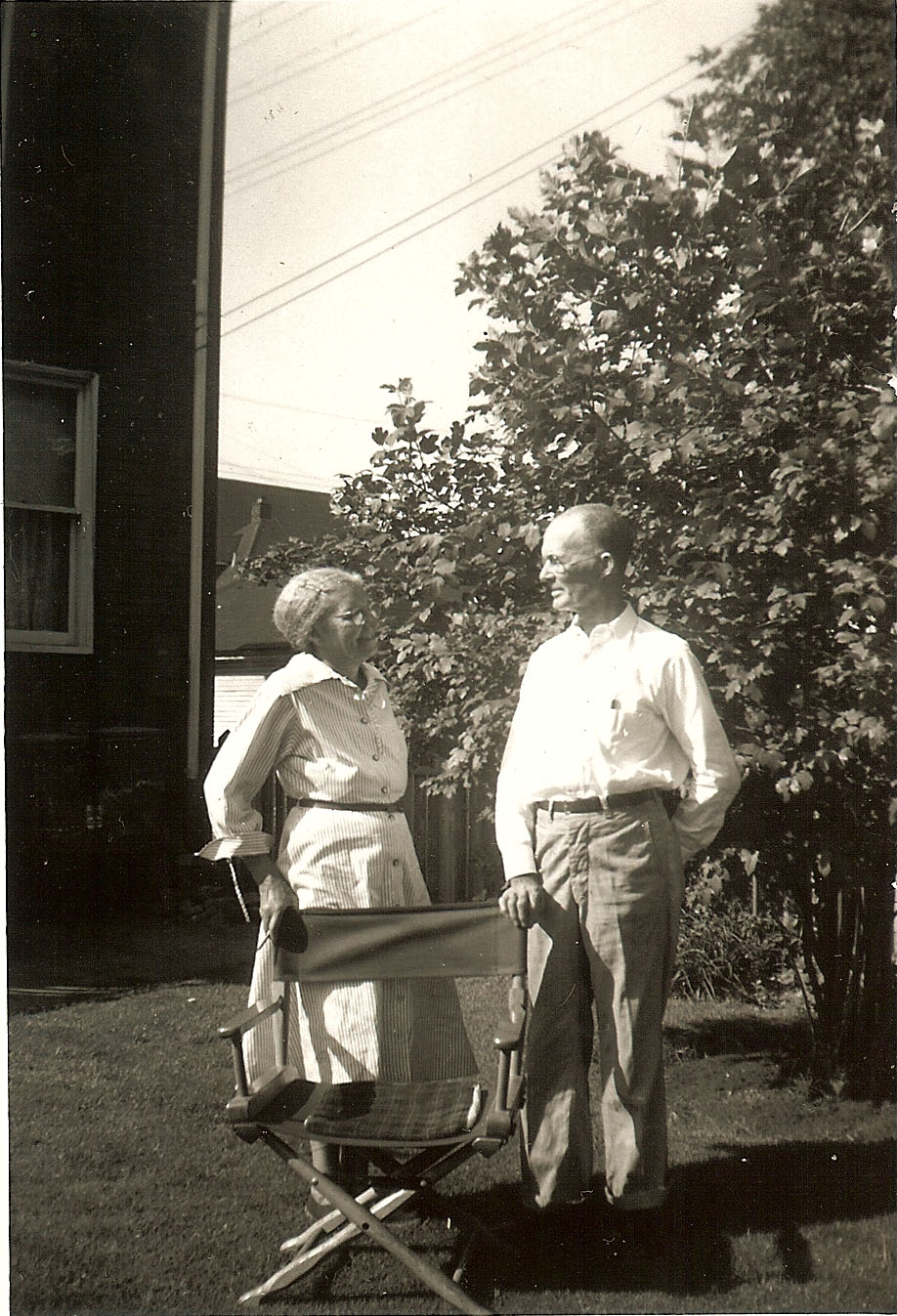
My grandparents, Fannie & Mershell Graham in their yard, 1958.
I don’t remember Lizzie having leather seats or being fancy. The seats were of some sort of cloth, because Nanny (our grandmother) used to sew and repair the small rips and tears. She also darned Poppy’s socks, using a plastic egg and she taught me how to do the same as a young child of maybe eight or nine years old. I remember, when I was older, nearing my teen years, several hippie looking, young, white boys used to drive up next to Poppy’s old iron car and roll down their windows to shout at him.
“I’d love to buy your car. Is it for sale?”
Poppy always kept Lizzie sparkling clean and well kept. If it was a cold morning before church, he’d have to let her run for 2-3 minutes before we took off.
“She’s got to have her engine warmed up,” he’d tell me as he adjusted the ‘choke.’ Those cars had a throttle and a choke you adjusted by hand. I think that old collectible car lasted so long because of Poppy’s good care and the fact that he never took it on the freeway. He always putt-putted down the avenues at about twenty-five to thirty-miles per hour, much to the frustration of those driving behind him. Several times I saw impatient, rude, and irate drivers pull around him and call him everything but a child of God for driving the speed limit. I’d cringe, but he’d just whistle a tune, as though they were invisible and keep driving at his slow rate of speed. There was always the slightest smell of gasoline and oil in the backseat of Lizzie. Underneath the carpeted floor there were wooden floors. All four cousins could curl up in that back seat of Poppy’s old Ford and we’d sing songs or giggle, the way little girls do, over little to nothing. I remember there was a little switch on the wall inside the car that could turn on the overhead, inside light. Lizzie was a familiar ride and we felt safe and comfortable in that Ford Model “A”, until my Aunt Doris, (my mom’s sister) finally persuaded her dad to sell that car and step into the 2nd half of the twentieth century. Today, those old Fords are a hot-rodder’s dream.
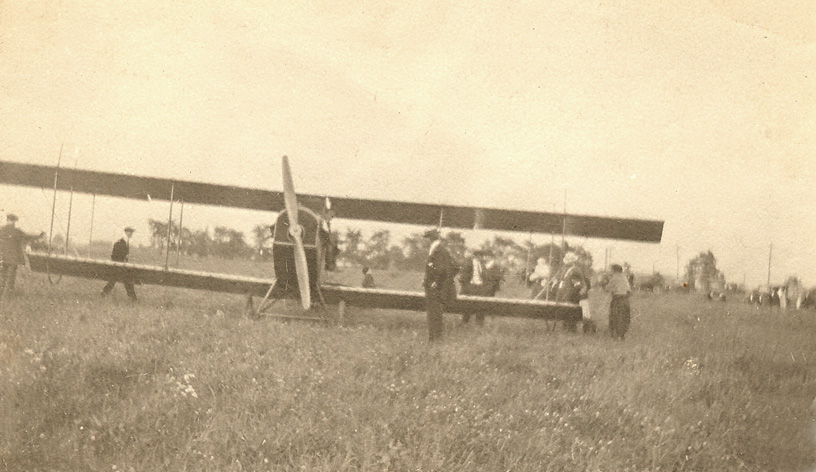
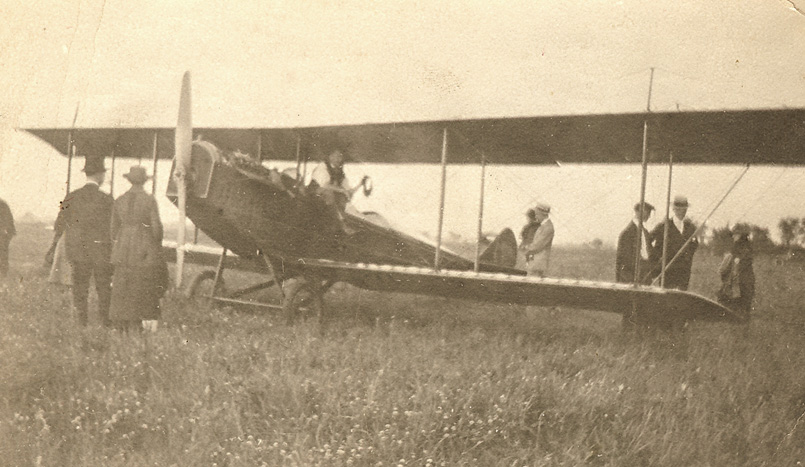
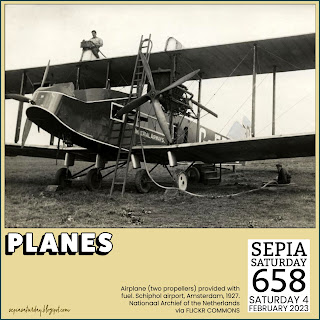
This week’s Sepia Saturday features an old airplane. I have two photographs of a small, old plane in my Cleage collection. Unfortunately there is nothing written on the back of either photo but I recognize my aunt Barbara – the baby in white, and the edge of my great grandmother Celia on the right edge.
Another view of the plane.
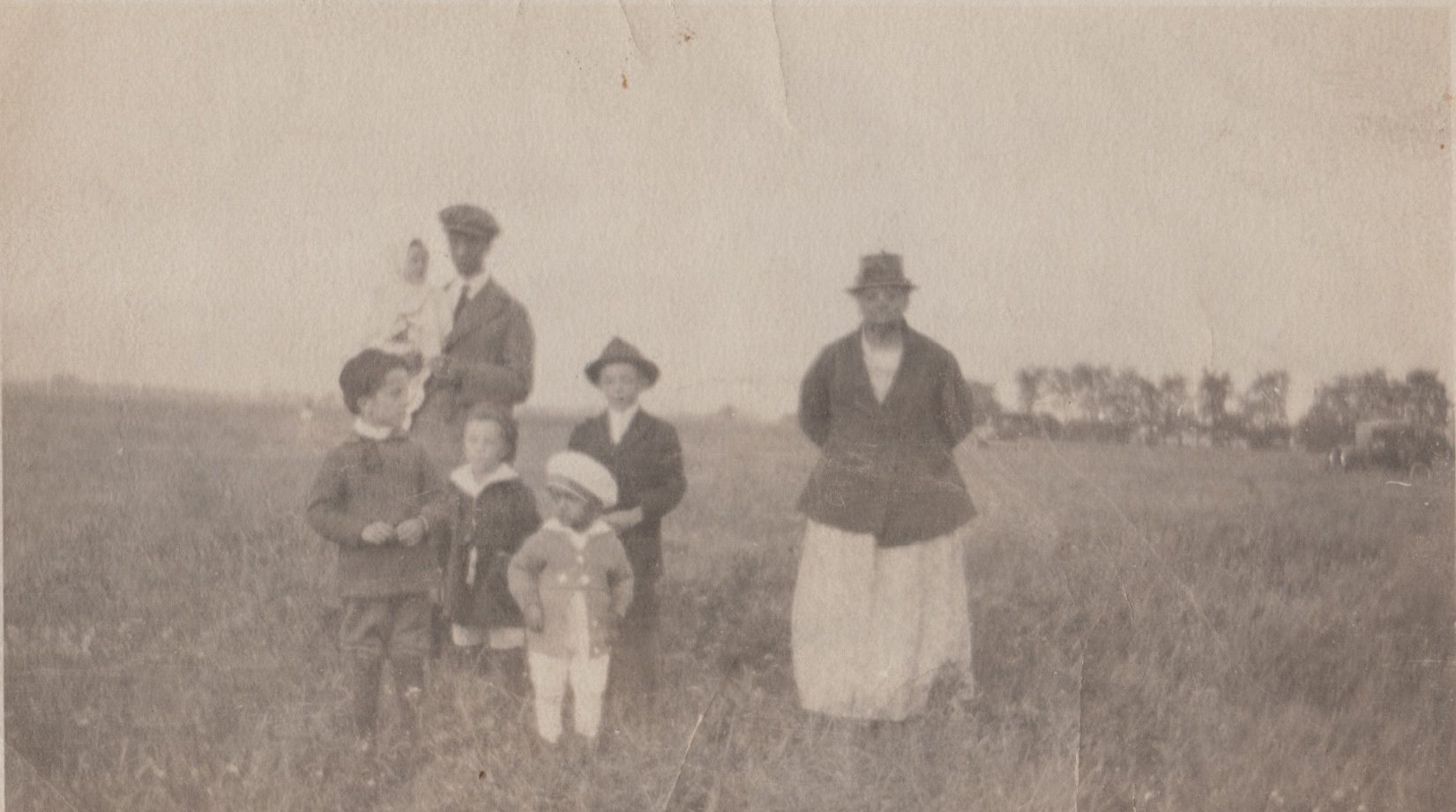
Here is a photograph of my family standing in a field in Detroit, about 1921.
Standing in a field
My grandfather Dr. Albert B. Cleage, Sr holding baby Barbara. next to him in my father Albert Jr, standing to the far right is my great grandmother, Albert Senior’s mother. My uncle Louis is front left, Henry is between Louis and Hugh who is standing with his hands on his hips.
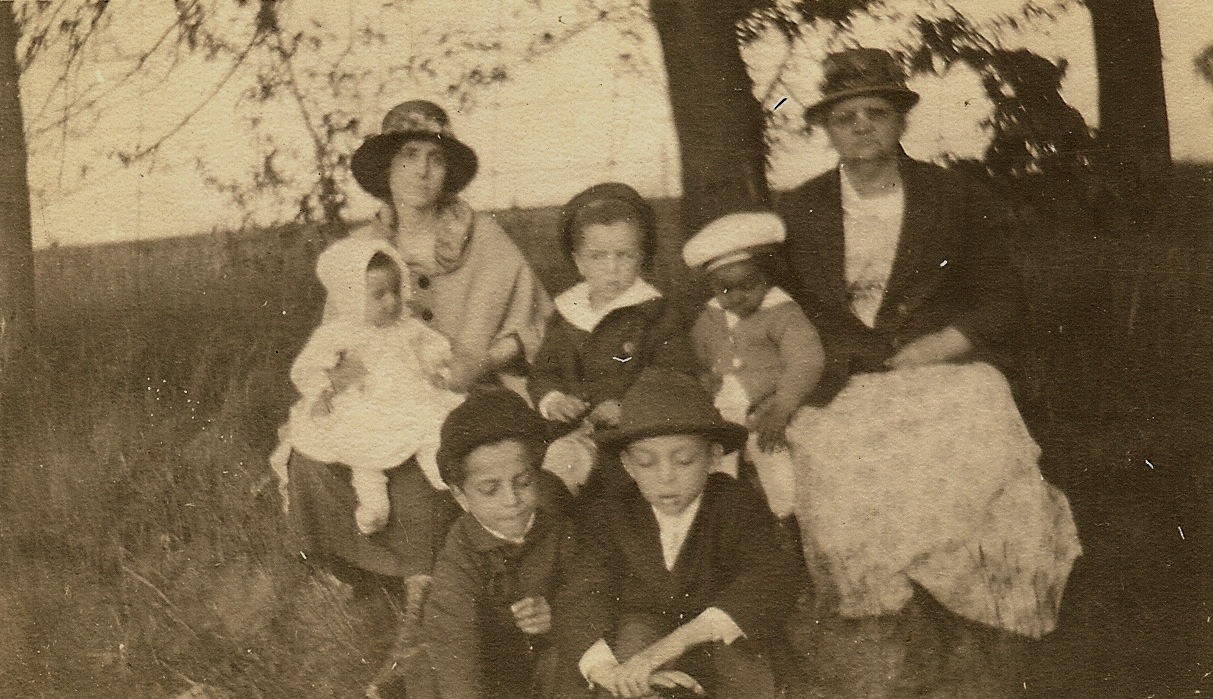
My grandmother and great grandmother look tired out.
Front row: my uncle Louis and my father Albert. In the back row: My grandmother Pearl holding baby Barbara, Henry, Hugh, Great grandmother Celia. My aunt Barbara was born July 10, 1920 in Detroit, Michigan.
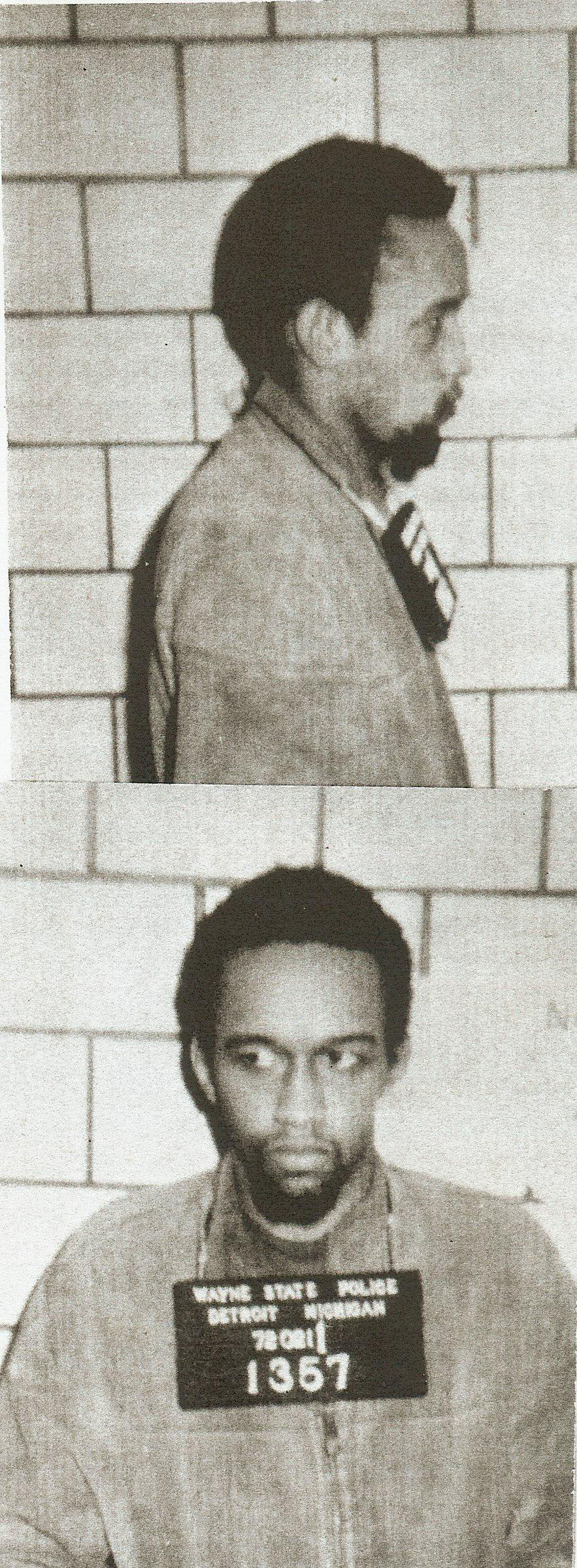
IN 1972 James Edward Williams was arrested for driving without a license in Detroit, in March of 1972. This mugshot was included in his ‘red file’ which included local police files and FBI information from the 1970s. He was regularly arrested for driving without a license or minor traffic infractions in those days. Although he didn’t spend time in jail, there would be bail and fines to pay. Don’t ask why he didn’t keep up with his license considering he kept getting stopped. Some 50 years later, he just shakes his head when asked.
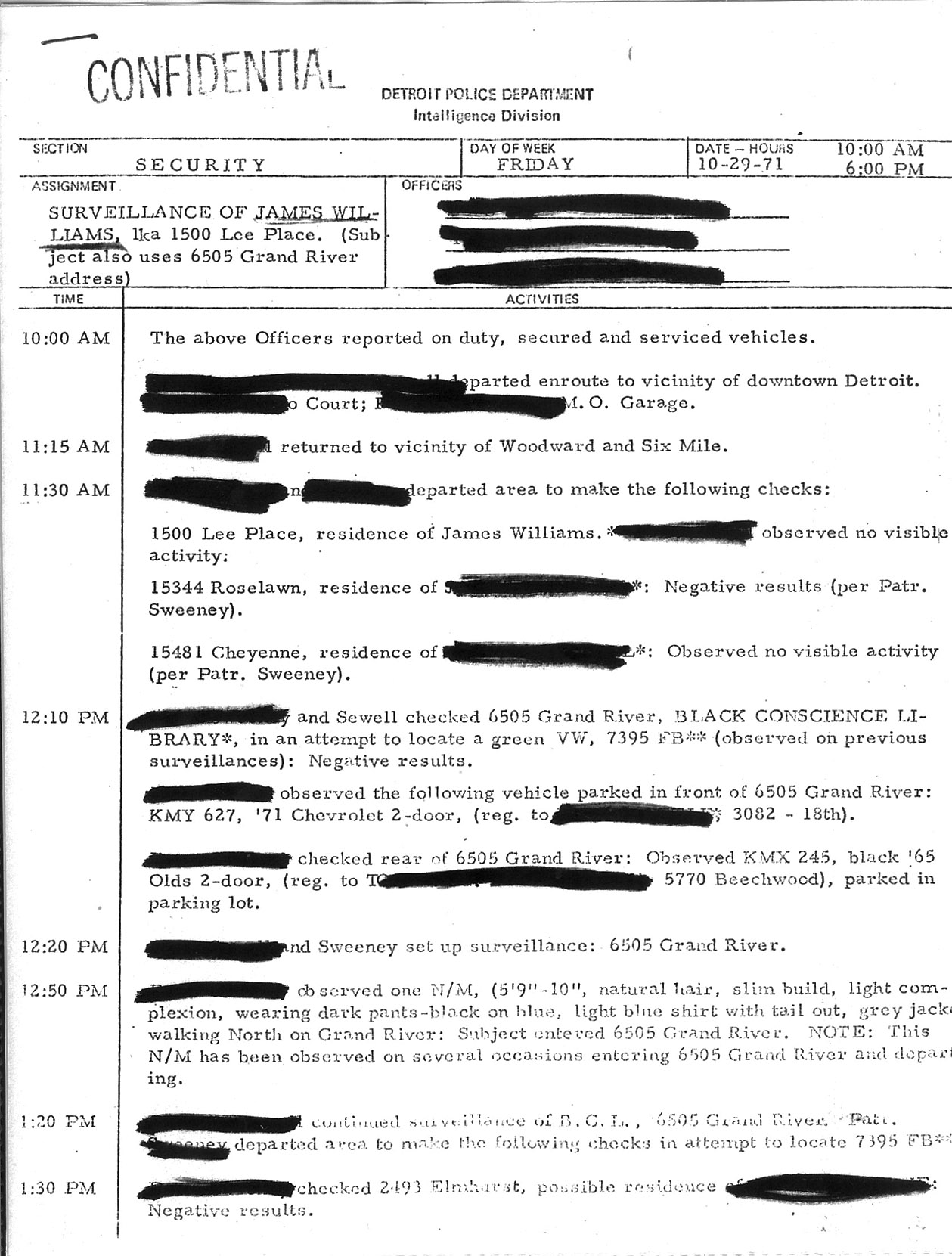
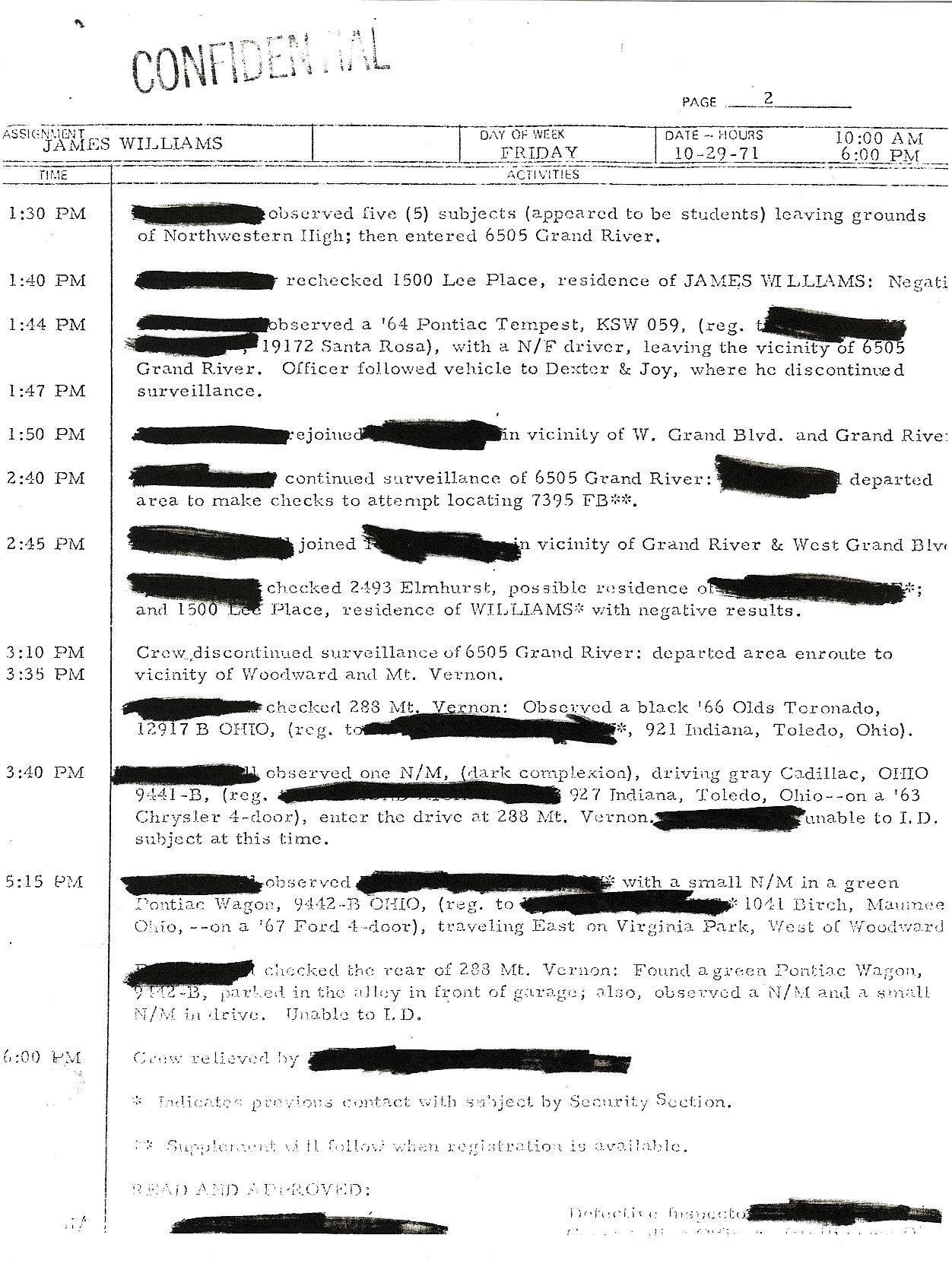
Below is a record of the police surveillance of James Williams on October 29, 1971. It happened about a year before the mugshot above was taken.
N?M = Negro Male. Most names are blacked out.
At 10:33, J. Williams and that could be my name blocked out as we went to my apartment in Brewster Projects and didn’t exit. I didn’t know they were following us, sitting down there in the parking lot in the fog, watching and waiting.
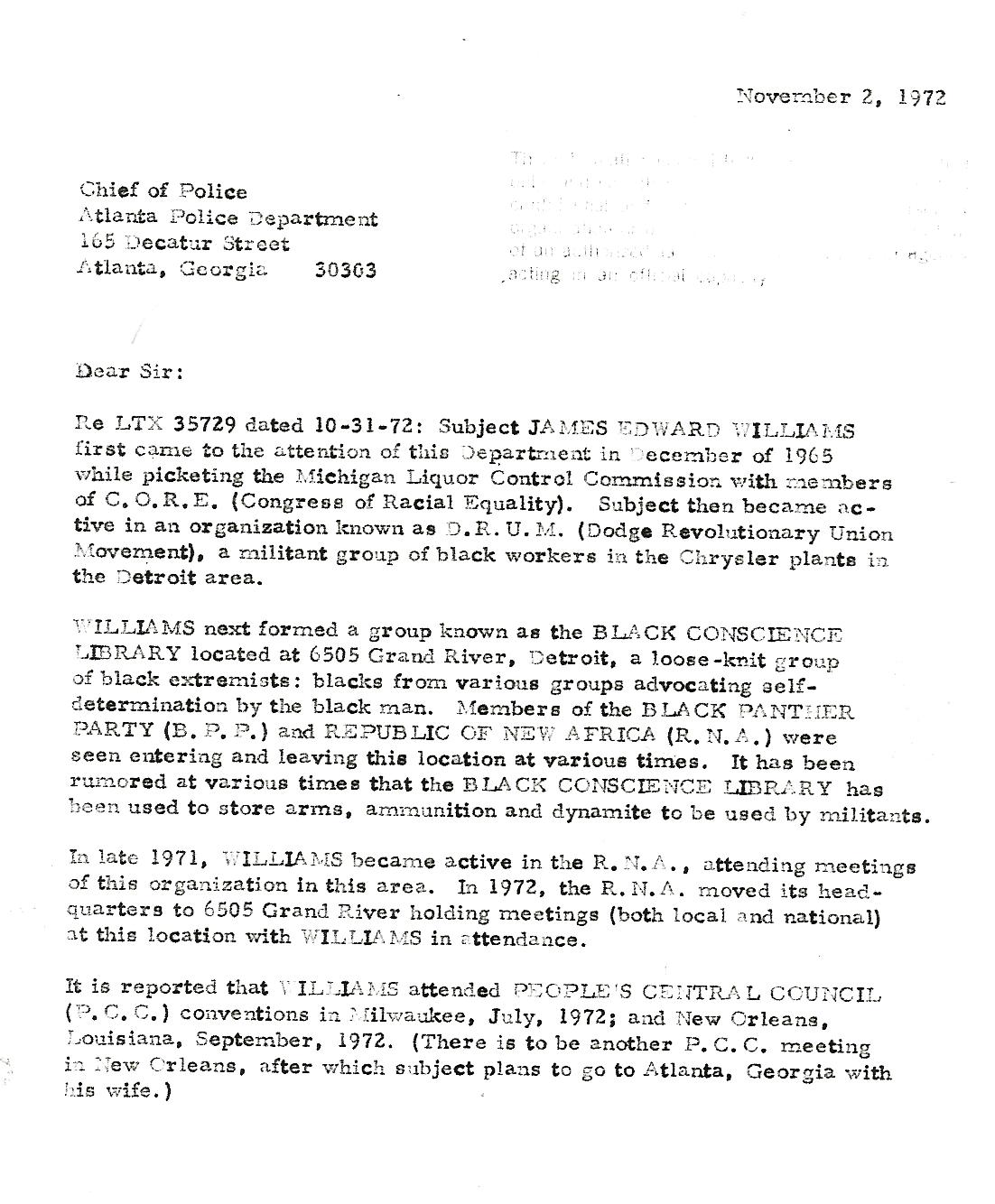
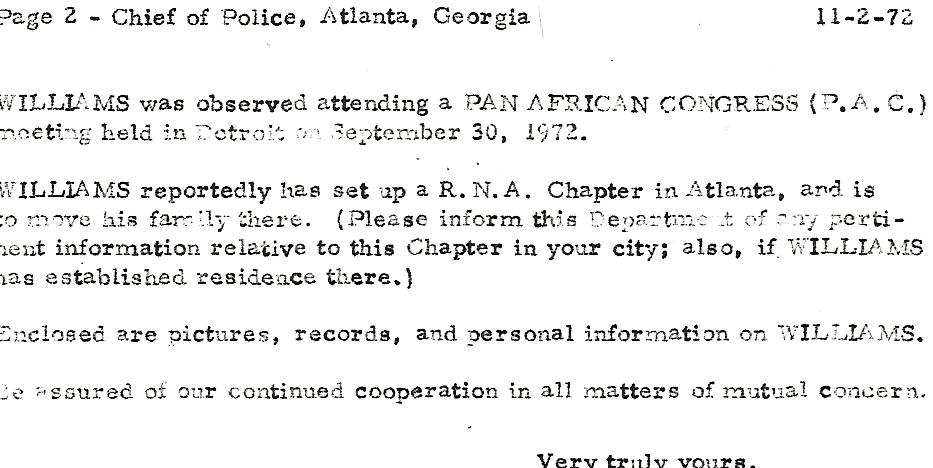
Why would they go to all this trouble. Because he was a black activist. Here is a letter sent to the Atlanta police department in 1972 as we were relocating from Detroit to Atlanta.
We got this information by sending for my husband’s Red Squad File. You can find more information at the link below.
“Editor’s Note: For more than 30 years (1944-1974), the Detroit Police Red Squad, a secret arm of the Detroit Police Department, was tracking citizens to “root out” and “expose” subversives. Their targets were political activists, Vietnam War opponents, Black nationalists, labor unionists, civil liberties advocates and many others engaged in social, cultural and other dissent activities.
Names of approximately 1.5 million people and organizations who either lived in or visited Detroit appear in secret files kept by the Detroit Police Department’s Red Squad. The Detroit files were also made available to the Michigan State Police and much of the Red Squad’s surveillance was coordinated with federal agencies, other state and local agencies and private organizations.
The Red Squad files are now being released to the public as a result of court orders issued in a lawsuit begun in 1974 by plaintiffs who argued that they were subjects of illegal political surveillance.
The case was finally resolved on April 23, 1990, when the Detroit City Council agreed to a $750,000 settlement which would cover costs to notify and deliver copies of retrievable information to those individuals and organizations who were under surveillance.”