All posts by Kristin

E – EDELWEISS

How did this club come to have the name of “Edelweiss”? The women that were members were African American, not of German heritage. World War 1 was ongoing when the club started in January 1918. The song “Edelweiss” from the Sound of Music had not yet been written. The only book I found that may have been around at that time is Edelweiss: A Story By Berthold Auerbach, published in 1861. The edition I found online was published in 1878. There are modern editions so it might have been around in the early 1900s.

I found this synopsis of the story at Edelweiß: “One of the most famous stories about the edelweiss is of a young man risking his life climbing the steep rocky face of a mountain to gather edelweiss flowers for a woman as a demonstration of his love and bravery. In the 1861 novel ‘Edelweiss’, German author Berthold Auerbach exaggerated the difficulty of acquiring the flower, claiming: “The possession of one is proof of unusual daring.” This presentation was a reinterpretation of the story following an invitation to perform at F14 Gallery in Dresden, Germany.”

The Emancipator, Montgomery, Alabama · Saturday, February 09, 1918

“The Edelweiss Club met last Friday evening with Miss Juanita Davis on South Union Street, and was delightfully entertained.”

Juanita Davis was born in 1893.   She was the youngest of the six children Samuel and Mary (Hardaway) Davis. Juanita and her siblings attended school growing up. They all lived to adulthood.

Samuel Davis was a literate carpenter. They lived at 609 Grove Street, on the corner of S. Union. It was down the block from First Congregational Church and about a block south of Madeline Abercrombie and a block north of Fannie and Daisy Turner. Swayne School, Booker T. Washington School and the Montgomery Training School were very nearby. They owned their home free and clear of mortgage.

Her mother, Mary Hardaway, was born free to Josephine Hassell a free woman of color who in 1845 had been granted, the right to remain and live in Montgomery as a free person. The law was free people of color had to leave the state without such an Act by the Senate and House of Representatives of the State of Alabama.

When Juanita was twelve, her father died of uremic convulsions in 1905. He was 53. Uremia is caused by extreme, irreversible damage to your kidneys. This is usually from chronic kidney disease.

Juanita’s oldest sister, Viola, taught at Cemetery Hill School from 1904 until she married in 1911. After their father died, Viola was the only one working outside of the home. She continued teaching at Cemetery Hill until 1911, when she married.

Juanita started teaching in 1910.  She was 22 when her mother died. Juanita continued teaching up to 1922. She was active socially, attending club meeting and whist parties.  She may have married or died, but I was unable to find her after 1922

D – DELIGHTFUL Luncheon

Every meeting of the Edelweiss Club included a delightful luncheon of some kind. Sometimes it was a salad, sometimes an ice, sometimes a two course luncheon.

I wish I knew what the delicious foods prepared were, but I do not. I looked at some old recipes and realizing that most of these meetings occurred in the evenings after work on a weeknight and that they did not have cooks to prepare the delightful treats, they or a female relative must have prepared the meal. What delightful luncheon can I find?

Dyanne Dillon of the blog Backsies is What There is Not suggested in the comments for “C” that congealed salads may have been on the menu. In the cookbook “Dainty Desserts for Dainty People” by Knox Gelatine, published in 1917, I found not only desserts but main dish recipes like the one below.

The Montgomery Times, Montgomery, Alabama • Tue, Jan 22, 1918
Some of the ingredients needed for tuna dish underlined in red

My sister suggested pimento cheese sandwiches and my daughter suggested cake. These delights will be covered in future posts.

C- CEMETERY School

Jessie Freeman was born in 1888 in Montgomery. She was the eighth child of Rufus E. and Alice (Larkins) Freeman. Two of the children died young. Jessie’s mother died before 1900, when we find Jessie living with her Aunt Mary and two younger sisters. They were attending school. She graduated from St. Normal school in 1911 and started teaching at Cemetery Hill School the following year. She was 24 years old.

“The Cemetery Hill school building (for colored pupils) was erected in 1888 at a cost of $2,100.  Subsequently the Council expended about $800 dollars more in furnishing and improving the building. This building is well located on the hill just south of Oakwood Cemetery, where the city owns several acres of valuable property. The building has seating capacity for 300 students and the property is valued at $3,000.” The Montgomery Advertiser Montgomery, Alabama · Friday, May 29, 1891

The Montgomery Times Montgomery, Alabama Mon, Sep 30, 1912 · Page 5. Edelweiss members – Jessie Freeman, Willease Simpson, Annie Wimbs and Naomi Rodgers.

There were three fires that burned African American buildings in January 1913. Cemetery Hill School, which burned to the ground, Swayne School that was not a complete loss and the Negro Lodge Hall. There was talk of arson, and the fire marshal decided that the Swayne School fire and the Lodge fire were of incendiary origin. The Cemetery Hill School fire was ruled accidental with the blaze beginning in the basement and spreading upwards to the roof until the whole building was engulfed. Windy conditions fanned the fire. No one was injured in any of the fires.

The cost of replacing the building was estimated at $4,000 ($2,000 covered by insurance) and $800 for the desks, black boards etc. The school relocated temporarily to a church building and seems to have been rebuilt in a timely fashion.

Jesse Freeman taught second grade at Cemetery Hill for several years and then taught fifth grade at Day Street School for several years. By 1919 she was teaching eighth grade at Booker T. Washington school where she taught until her death at age 60.

The Emancipator, 26 January, 1918

“The Edelweiss Club was entertained last Friday evening by Miss Jessie Freeman. After whist the members of the club were served to a delightful luncheon. The guests were Misses Alice Snow, Lucile Caffey and Ophelia Peterson. The prizes were won by Miss Juanita Davis and Miss Annie Wimbs.”

I wonder what constituted “a delightful luncheon”? Sounds like a good topic for the letter “D”.

B- Booker T. Washington School

Daisy Pearl Turner

Fannie’s younger sister Daisy graduated from State Normal School in 1912 at age 20. She began teaching the following year at the State Normal School. She taught several years in Selma, Alabama and had to board there, only coming home for holidays and summer. In 1919 she was assigned to teach at Booker T. Washington elementary school, right next door to her home.

I wonder if she was happy about that or if she was sorry to lose the the freedom she probably had and the friends she had made in Selma. Her lost love, Duncan IRBY was in Selma, which could have made it harder or easier to leave, depending on if she had already refused his proposal of marriage.

A Short History of Booker T. Washington School

“Booker T. Washington School Named for one of the nation’s premier educators, Booker T. Washington School began through the efforts of an expanding Swayne College. Its large enrollment forced Swayne’s officials in 1916 to erect a new building which they named for the great educator. And even larger enrollment propelled officials in 1925 to add a junior high department with the same name. Three years later, the Montgomery Industrial School, which had been sold to the city, became a part of the junior high department and the site of the first high school. In May 1940, 88 students became the first graduates, and, in 1948, the old Swayne building was demolished to make way for the new $250,000 high school at Union and Grove Streets. A dedication program was held on 3 April 1949, and an auditorium-gymnasium was added in 1954. Only two principals – Pro. J. A. Edwards, who resigned in May 1942, and former basketball coach and teacher, C.T. Smiley, who assumed his duties in September 1942 – served the school. The school’s nickname was Yellow Jackets and its colors blue and gold. It was known for its excellent faculty, students, school spirit, marching band, and athletic teams.” Information from Alabama Historical Association markers 2003

The Montgomery Advertiser Sunday, June 8, 1919. Associated with the Eldelweiss Club were Effie Mae Todd, Cecile Walton, Daisy Turner, Anita Nesbitt, Madge Brown, Juanita Davis, Jessie Freeman, Naomi Rodgers and Janie Binford

Although Booker T. Washington school was built to relieve the horrendous overcrowding at Swayne School, there were 100 students to a classroom at the time with some on half days and still all of the African American students that wanted to attend school were not able to squeeze in, almost immediately Booker T. was also overcrowded. According to an article in the Montgomery Advertiser of October 2, 1917, “Negro Schools Crowded

At the negro (sic) schools, there is hardly room for the proverbial one more. Booker Washington school, which includes the three schools – old Swayne school, the new eight-room brick building and a cottage in the school yard; there are 1,022 pupils. Day street has an enrollment of 556; Cemetery Hill, 292, and Vesuvius, 124.”

More about Swayne School when we get to S.

All buildings eventually included in the Booker T. Washington “complex” are labeled. Also labeled are Fannie and Daisy’s house, Tulane Groceries, First Congregational Church and their grandparent’s house – Dock and Eliza.

Many African American schools were named after Booker T. Washington, who rose from slavery to be the head of Tuskegee Institute, in Tuskegee Alabama. You can click on his name for a look at his autobiography.

More posts about Daisy Pearl Turner

Daisy Turner Dead at 70. Nov 24, 1961
Daisy Turner and Duncan Irby
Joe Turner – Land, Mules and Courts

A – Abominable Weather

It all began during a January cold wave with snow expected across Alabama. My grandmother Fannie Turner held the first meeting of the Edelweiss Club. She was 29 years old and lived with her mother, a seamstress and two sisters, Daisy a teacher and Alice a school girl. They lived in the African American Centennial Community of Montgomery, Alabama.

"Jennie Allen Turner and Daughters"
Fannie, Jennie (mother) Alice. Daisy standing.

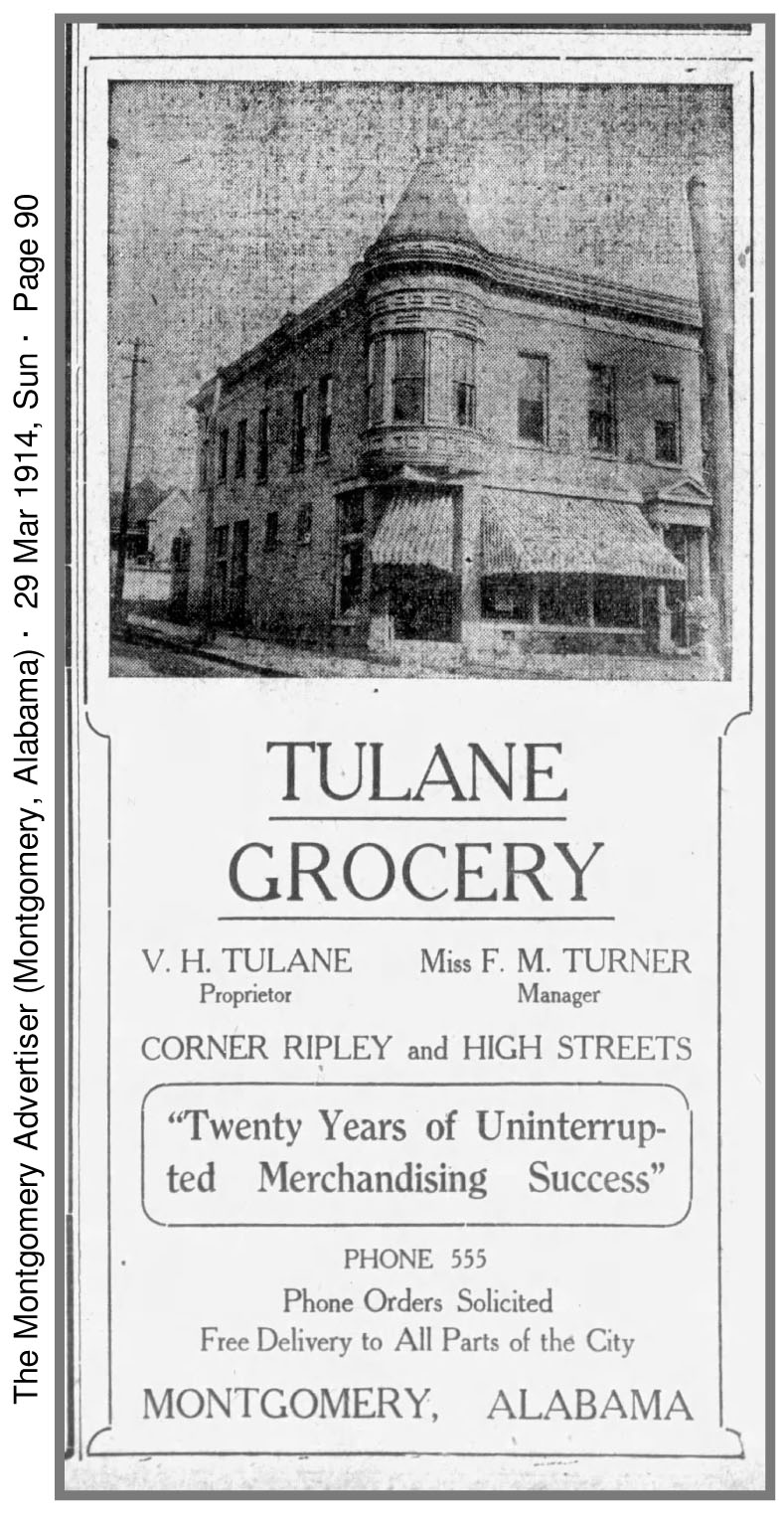
Most of the members of the Edelweiss Club were teachers. Fannie was one of the few who worked in family businesses. She managed her Uncle Victor Tulane’s grocery store.

Click to enlarge. Advertisment for Tulane Grocery

Below is my mother’s description of her mother Fannie’s job.

“She never tired of telling me about taking inventory, counting money, keeping books, dealing with the help and customers and demanding respect from the drummers. Drummers were white salesmen trying to get orders for their products and you can imagine how difficult it was for a handsome black woman doing a man’s job to get respect from them.  But she knew the power of her ability to give or withhold orders and she used it without apology.  Her whole tone when she straightened her back and raised her head to tell it was not of asking for respect, but demanding it – and loving the demanding!     She managed the store for the twelve most satisfying years of her life.  Then she married in 1919.”
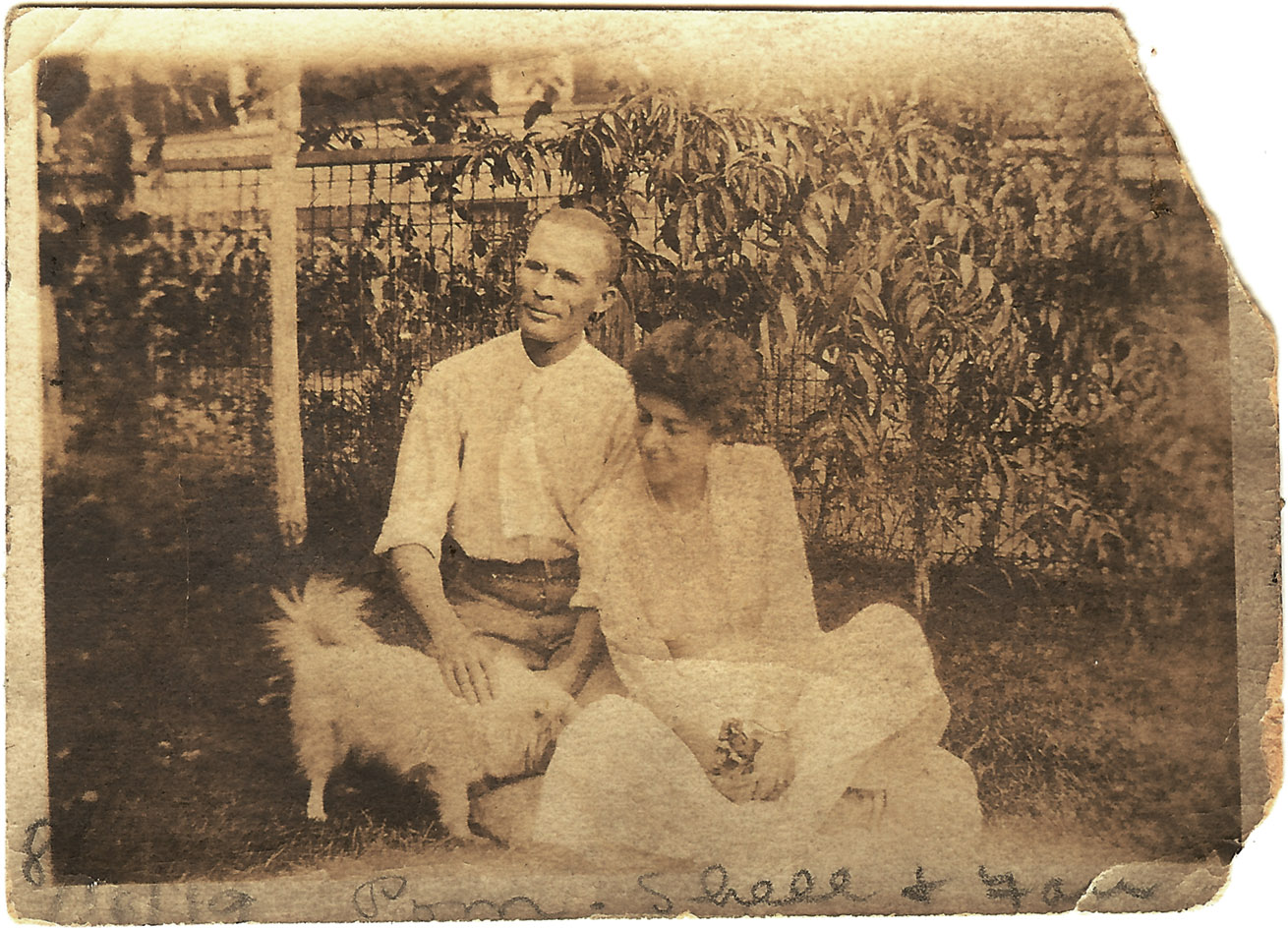
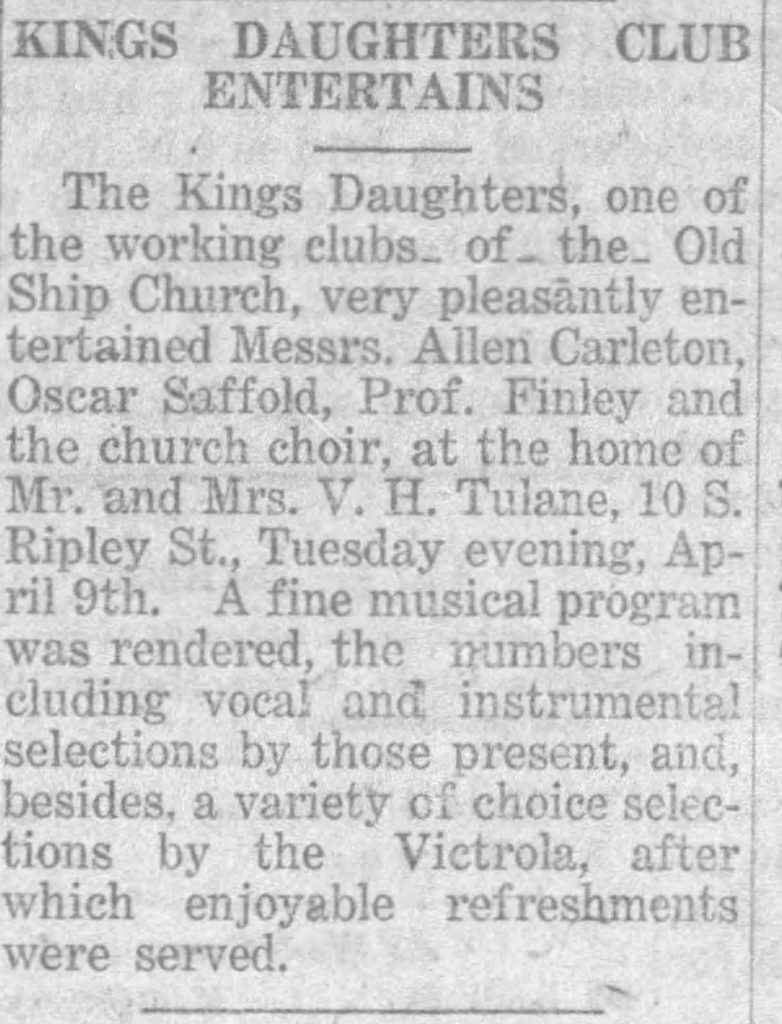
Transcribed below. Click to enlarge.

Edelweiss Club Entertained by Miss Turner

On Friday afternoon, the 11th inst. ( ie. ‘of the current month’), the Edelweiss Club, composed of a number of prominent young women of this city, was delightfully entertained at the residence of Miss Fannie M. Turner, 712 East Grove Street. Several invited guests were present. After the games were played a delightful luncheon was served.

The bad weather made page one of the Montgomery Times January 12, 1918. Click to enlarge.

More posts about Fannie Turner

Fannie Mae Turner, Enumerator 1910
Grandmothers 1912
My Social Butterflies – 1911 & 1937
The Proposal – 1918
The Proposal Accepted – 1918
Fannie Mae Turner about 1919
Fannie Turner Animated
Announcement – 1 February 1919
From Montgomery to Detroit – Plymouth Congregational Church – 1919
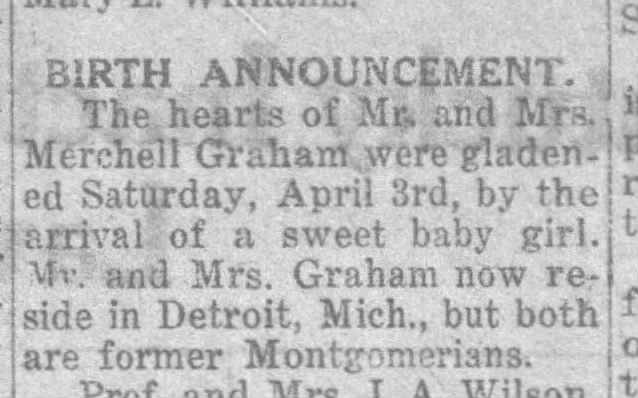
Mershell Graham and Fannie Mae Turner Marriage License – 11 June 1919
Graham-Turner Wedding – 1919 Montgomery Alabama

The Edelweiss Club

Some of the members of the Edelweiss Club.

This year am finally going to write about the Edelweiss Club of Montgomery, Alabama.

This will be my eleventh year participating in the A to Z Challenge. I am going to present the lives of some of those women as my A to Z theme.

Who were the members of the Edelweiss Club?  They were thirty seven women who attended the monthly meetings, starting January 12, 1918 and continuing monthly during the school year until  May 3, 1919. Thirty of them were teachers. One was a seamstress. Three worked in family businesses.  The majority of the members were single. Most married as time went on. Some moved out of town.  A good number never married.

Their parents were born in the mid 1850s to the  1870s and would have been teenagers when slavery ended or were born during Reconstruction. All of them came from literate homes. Most of their parents owned their homes. Some owned them free and clear. Others were mortgaged. Their fathers tended to work for themselves as barbers, carpenters and plasterers. Bertha Loveless’ father was an undertaker. Madge Brown’s father was a farmer. Alberta Boykin’s father was a mail carrier. Several lived with their widowed mother or an aunt. At least two were from out of town and boarded. Most had multiple siblings.

There were no more reported meetings after May 3, 1919.

AtoZChallenge theme reveal 2024 #atozchallenge

Death, War and Slavery 1860 Autauga, Alabama

In November 1859 Crawford Motley Jackson, large slave holder, became ill. Bronchitis set in. On February 26, 1860, he died at age 43. He held 136 people in slavery.

Death of Gen. Crawford M. Jackson

The Autauga Citizen Prattville, Alabama · Thursday, March 01, 1860

It becomes our melancholy duty to announce to our readers the death of our distinguished fellow citizen, Gen. C. M. Jackson, who died at his residence in this county, on Sunday last, 26th inst. His unexpected death has cast a gloom over this whole county, in which he was universally known and esteemed. The Confederation, in commenting on the untimely end of one whom we all loved and respected so much, uses the following language: Gen. Jackson was a man of marked ability and intelligence and commanded great respect and influence among his fellow men whenever thrown into consultation and deliberation with them. He frequently represented Autauga county in the State Legislature; and two years ago was unanimously elected Speaker of the House; the duties of which he discharged with an ability, success and popularity rarely equaled by any of his predecessors. He has been sent upon two occasions to represent the Democracy of his District in the National Convention of the Democratic party, and always discharged his duties to the entire satisfaction of his constituents. Being a gentleman of varied information, of a kind, social and charitable disposition, his intercourse with his friend and neighbors was as charming and agreeable as it was useful and instructive. In him they have lost a friend indeed – one whose place will not be easily supplied, or soon forgotten.

The Autauga Citizen Prattville, Alabama · Thursday, Dec. 20, 1860

The death of such a man as Gen. Jackson is a public calamity. Endowed by nature with a mind and social qualities of the highest and most attractive order, he filled the duties of a patriotic and upright citizen in a manner that reflected credit upon himself and benefit to the State. Alabama had no more worthy son, and she has cause to mourn at his loss.

His remains were attended to the grave by the neighboring Masonic and Odd Fellows Lodges, and a host of relatives, friends and acquaintances.

The Autauga Citizen Prattville, Alabama · Thursday, March 01, 1860

Crawford Motley Jackson belonged to one of the largest slave holding families in Autauga County. He owned 136 people when he died in 1860. His brother-in-law, Lunceford Long held 161 people in slavery. Jackson’s older brother, Absalom enslaved 61 people.

My 2X great grandmother, Prissy and her six children were among those enslaved on General Crawford Motley Jackson’s plantation. Using DNA evidence, at least some of her children were fathered by Crawford.

During the next several years, the estate was probated. Because he left no wife nor white children, his brother, and various nephews and nieces were his heirs. Several of them died during the process and the enslaved would have to be shuffled around to those still living, or sold off. The probate record is quite large and includes several lists of those enslaved among the mules, farm implements and household items.

Families were kept together until children reached the age of about 12 – 15, at which time they were often placed in a different household than the rest of their family.

1860 Map of Alabama with percentage of enslaved population based on 1860 census data.

According to U.S. Census data, the 1860 Autauga County population included 7,105 whites, 14 “free colored” and 9,607 slaves. 57.6% of the population was enslaved.

On November 8, 1860, Abraham Lincoln was elected 16th president of the United States. The Slave holding South was enraged at the possibility of losing their enslaved workforce. Succession soon followed. On January 1, 1863, Lincoln issued the Emancipation Proclamation. As you can see below, no one was freed by it.

“Big Prices, – At a sale of negroes (sic) in this place on Saturday, 10th inst., five negroes, two boys 20 years old each, one woman 50 years old, one woman 25 years old, and her child aged four years, sold for $6,500, an average of $1,300 to the negro (sic). This would seem to indicate that the people in this region have very little faith in old Abe’s proclamation. It certainly beats any sale ever before made in this county.”Big Prices, – At a sale of negroes (sic) in this place on Saturday, 10th inst., five negroes, two boys 20 years old each, one woman 50 years old, one woman 25 years old, and her child aged four years, sold for $6,500, an average of $1,300 to the negro (sic). This would seem to indicate that the people in this region have very little faith in old Abe’s proclamation. It certainly beats any sale ever before made in this county.”
The Autauga Citizen (Prattville, Alabama) 15 January 1863

The New Negro

Publisher and Poet -James Edward McCall and wife Margaret. 1938

by James Edward McCall

He scans the world with calm and fearless eyes,
Conscious within of powers long since forgot;
At every step, new man-made barriers rise
To bar his progress—but he heeds them not.
He stands erect, though tempests round him crash,
Though thunder bursts and billows surge and roll;
He laughs and forges on, while lightnings flash
Along the rocky pathway to his goal.
Impassive as a Sphinx, he stares ahead—
Foresees new empires rise and old ones fall;
While caste-mad nations lust for blood to shed,
He sees God’s finger writing on the wall.
With soul awakened, wise and strong he stands,
Holding his destiny within his hands.

From Caroling Dusk (Harper & Brothers, 1927), edited by Countee Cullen. This poem is in the public domain.

Below other posts about the poet, James Edward McCall, my maternal grandmother’s first cousin. Their mother’s were sisters, daughters of Eliza for whom this blog is named.

“She was owned before the war by the late Colonel Edmund Harrison of this county.”
An “At Home” In Honor of Chicago Visitors
1940 Census – James and Margaret McCall and Family
Poems by James E. McCall
James Edward McCall, Poet and Publisher 1880 – 1963
Winter In St. Antoine

Poppy at Ford’s

We called my maternal grandfather, Mershell C. Graham, “Poppy”. My grandmother, Nanny, and his friends called him “Shell”. His co-workers called him “Bill”.

Poppy, 1919 Detroit, Michigan, newly married and working at Ford’s.

In the summer of 1953 my mother, sister and I stayed with my grandparents while my father was organizing a new church and parsonage across town. He stayed with his parents. We didn’t have a car and each morning we walked our mother around the corner to the bus stop where she caught the bus to Wayne State University. She was taking classes to get her teaching certification.

Pearl and Kris in the backyard with our horses. 1953.

I was almost seven and my sister Pearl was four. I remember spending most of the summer playing in the backyard. My grandmother would be doing what she did in the house, my great aunt Abbie mostly stayed up in her room looking out of the window. After 35 years, my grandfather was working his last months at Ford Motor Company. He retired on December 31.

My grandparent’s house and yard was surrounded by an alley on two sides. On the third side was the Jordan’s house next door and on the other side of them was the third arm of the alley. You can see on the map below that the long arms of the alley went through from Theodore to Warren Ave, which is where the bus stop was. My grandfather did have a car, but he didn’t use it to go to work. He caught a streetcar and it took him right to the River Rouge Plant. He had built a little ramp against the back fence against the wooden fence. We could see him coming home through the alley carrying his lunch box.

The Graham and the Jordan’s houses are in the light yellow area. You can see how the alley makes and “H”.

My grandfather began work at Ford’s Highland Park Plant on May 10, 1918, as a machinist. He was 30 years old and single. During that time Ford’s was paying five dollars a day, to qualifying workers, for a forty hour week. There were no benefits.

He returned to Montgomery and married my grandmother, Fannie Mae Turner, in 1919, they returned to Detroit the same day. In the 1920 census his occupation was an “auto inspector”. He was transferred from the Highland Park plant to Rouge plant on March 14, 1930 and went to work as an electrical stock clerk, which is the position he held until his retirement in 1953.

He was at the Rouge Plant during the May 26, 1937: Battle of the Overpass and the unionizing of the auto plants. My mother told me that after he joined the union, he carried a gun to work for protection. Unfortunately, I never heard my grandfather talk about any of this.

In September 1949 the UAW won a $100-a-month pension, including Social Security benefits , averaging $32.50 a month, for those age 65 with 30 years of employment with Ford’s. My grandfather was among the earliest workers to receive the pension when he retired at age 65 after working there for 35 years. His Social Security benefit was $85 a month. My grandmother received $42.50 as his homemaking wife.

Other posts about my grandfather’s life.
One Way Ticket
From Montgomery to Detroit – Plymouth Congregational Church – 1919
Mershell Graham and Fannie Mae Turner
Graham-Turner Wedding – 1919 Montgomery Alabama
F – FAMILY, MY GRAHAMS in the 1920 Census
The Graham’s in the 1930s
Mershell Graham’s Notebook – 1930s
Lizzie – 1934
1940 Census – The Grahams
The Graham’s in the 1950 Census