Ransom Allen was the oldest son of Dock and Eliza (Williams) Allen. He was born free in Alabama about 1860. He and his 7 siblings grew up in Montgomery. He was my great grandmother Jennie’s older brother. His father was a carpenter. His mother was a seamstress. He became a barber.
In 1883 Ransom married Callie Whitaker in Troup County, GA. I don’t know how or where they met, but she was born in Georgia. In 1888 their son, John Wesley, was born in Montgomery. John was the only one of their three children to survive childhood.
The family relocated to Chicago, IL about 1917 where Ransom continued to barber and John worked as a Mechanic. John married Bobbie Conyer and their only son, Harold Thomas, was born in 1932 in Chicago, IL.
In 1933 Ransom’s wife Callie died. The following year Ransom died at age 74. Their only grandson died in 1946 at 14 years of age. That was the end of Ransom’s branch of Dock and Eliza’s family.
In the latest episode of Many Rivers To Cross, the Great Migration was briefly discussed. It got me to thinking about my family who pretty much all left the south in the early 1900s. I wrote an earlier series about the Graham side of my family and their move from Montgomery, Alabama to Detroit in 1917. You can read about that at these links:
To continue the story, I will start by writing about my Grandfather Albert B. Cleage and his siblings move from Athens, TN to Indianapolis, IN and finally to Detroit, Michigan, with mention of Uncle Edward Cleage and his family who remained in Athens.
Next I will cover my Grandmother Pearl Reed Cleage and the Reed family’s move from Lebanon, KY first to Indianapolis in the 1890s and on to Benton Harbor and Detroit, Michigan, with Uncle Hugh (Reed) Averette moving out to Los Angeles California.
Finally I will write about Eliza and Dock Allen’s children leaving Montgomery for Chicago, Detroit and New York.
I wanted to add my husband’s family, not sure if I will write them up soon though. They started in Dermott, AR. Catherine Williams went to Seattle, WA. Vennie Jean Williams went to Arkadelphia. Sterling Williams spent time in Little Rock before going to Chicago. Chester and Theola (my in-laws) moved to St. Louis, MO. Members of both the Davenports and the Williams migrated to Chicago. Many relatives remained in rural AR, although none of my husband’s aunts or uncles.
As I write I will probably come up with stories within stories. This should provide me with writing material for weeks!
To see other posts I’ve written about this series , click this link My Responses to Many Rivers to Cross. You will also find links to other bloggers responding to this series by sharing their own personal family stories.
For those interested, I found the map I used at this site about the Great Migration.
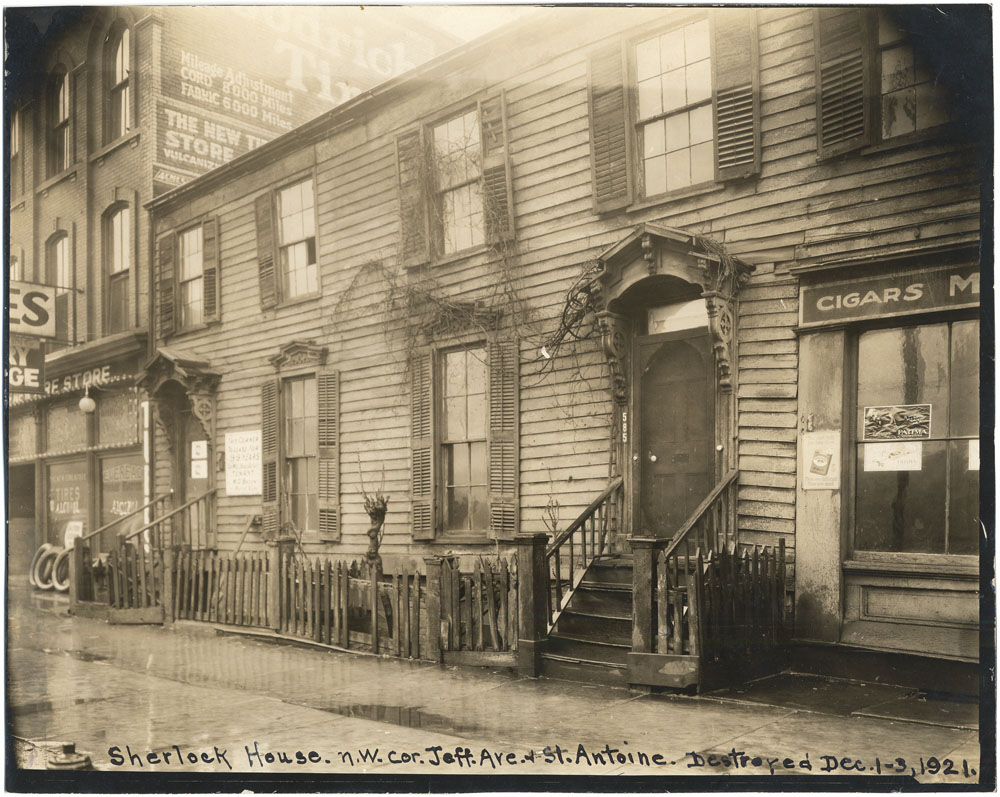
In St. Antoine the snow and sleet Whiten and glaze the drab old street And make the snow-clad houses gleam Like crystal castles in a dream. There, many swarthy people dwell; To some, ’tis heaven, to others, hell! To me the street seems like a movie stage Where Negros play and stars engage. They laugh and love and dance and sing While waiting the return of spring. Some drown their heart-aches deep In winter time on St. Antoine.
There, on the gutters frozen brink A dope-fiend lies, with eyes that blink And from a neighboring cabaret come sounds of song and music gay. At windows, tapping, here and there, Sit dusky maidens young and fair, With painted cheeks and brazen eyes. and silk clad legs crossed to the thigh Upon the icy pavements wide, Gay brown-faced children laugh and slide While tawny men in shiny cars Drive up and down the street like czars.
Into a church across the way There goes a bridal party gay. While down the street like a prairie-fire, Dash a bandit car and a cruising flyer. Around the corner whirls a truck, An old coal-peddler’s horse is struck; The horse falls on the frozen ground, The dark blood spouting from its wound. A motley crowd runs to the scene; A woman old, from shoulders lean, Unwraps a quilt her hands have pieced And spreads it o’er the shivering beast.
Among the swarthy folk who pass Along the slippery street of glass, Are some in furs and some in rags; Lovely women, wretched hags, White-haired migrants from the South; Some wrapped in blankets, pipes in mouth; Some smile while others seem to shiver, As though they long for Swanee River; But though they dream with tear wet eyes Of cotton-fields and sunny skies. They much prefer the heaven and hell On St Antoine, where free men dwell.
******
James Edward McCall
James Edward McCall was my Grandmother Fannie Turner Graham’s first cousin. He was a poet and a publisher. He lost his sight due to illness while a medical student at Howard University. He and his family migrated from Montgomery Alabama to Detroit Michigan about 1923.
While watching “Many Rivers to Cross” this week, an episode full of stories of resistance, escape and fighting back, this is the family story that came to mind.
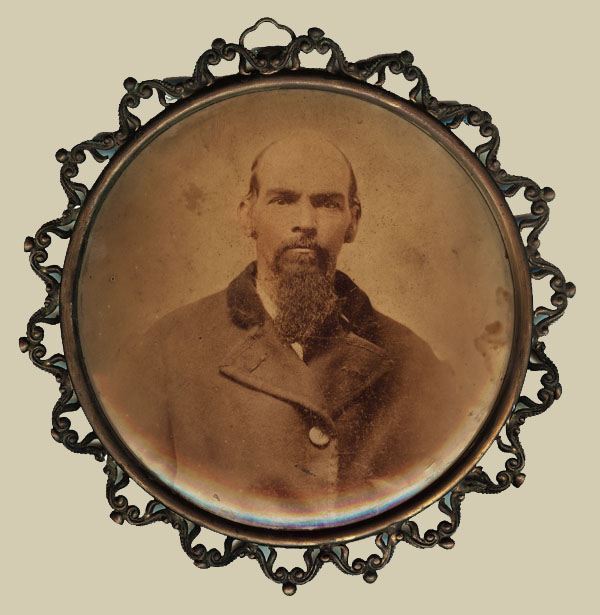
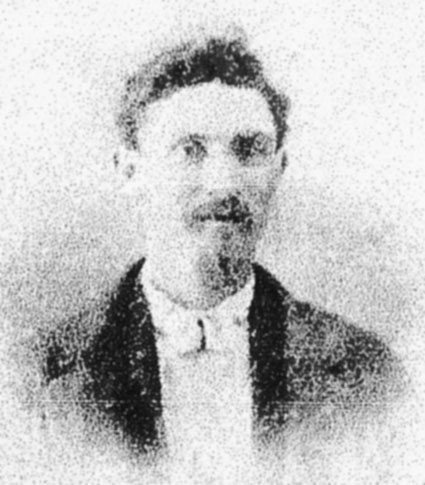
Dock Allen – tintype with frame attached.
It had been a wet spring, that 1861 in Dallas County, Alabama. Dock Allen was 21 years old and already a good carpenter. He was a white man’s son, but the man who now held him in slavery was not his father. His owner was known as a cruel man who kept vicious dogs to instill fear in his slaves. He wanted them to be afraid to run. When Dock made up his mind to escape, he had a plan to throw the dogs off of his track. There was a swampy area where wild ramps grew. He rubbed himself with them, poured the water on himself and rolled around in the field so the strong onion odor would hide his own human smell.
He had been running and running. He was bone tired. He could hear the dogs tracking him in the distance when he came to a small farm near Carlowville. He couldn’t go any further. He climbed up into the hay loft, covered himself with hay and lay there barely breathing. The dogs came into the hay room. He could feel their breath as they walked over him, but they didn’t smell him because of the ramps. Eventually they left.
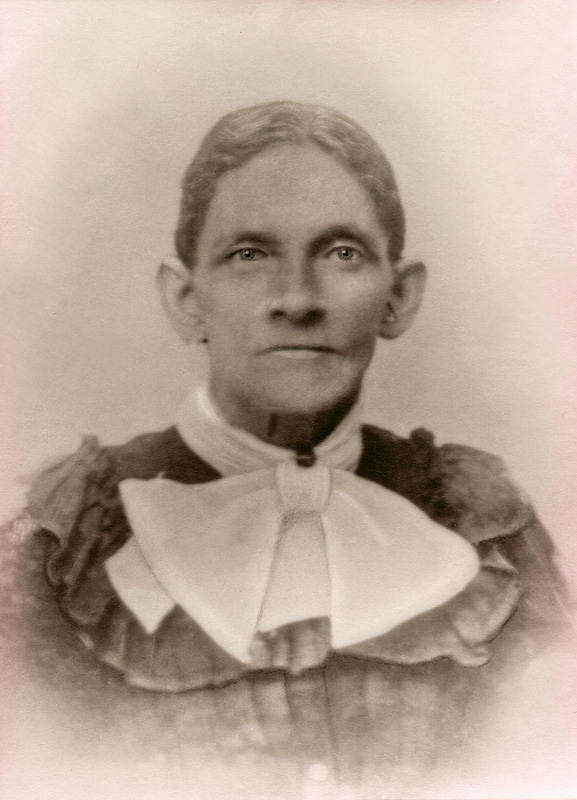
Eliza
This was the same place where Eliza and her small daughter Mary, lived. Eliza had been freed several years before. She lived on the farm of Nancy Morgan. Did Eliza hear the dogs and see Dock stumble into the yard? Did she silently direct him to the hide in the hay?
Later Dock decided to give himself up. Nancy sent a message to his master. It wasn’t long before he came to the house. He said that no one had ever out smarted his dogs and that any man who was smart enough to do that deserved to be free and he freed Dock. Dock stayed on that place and he and Eliza married. They stayed together until he died in 1909. He was 69.
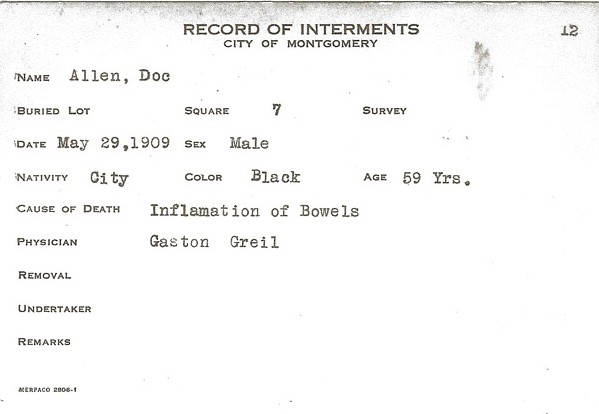
Doc Allen in the record.
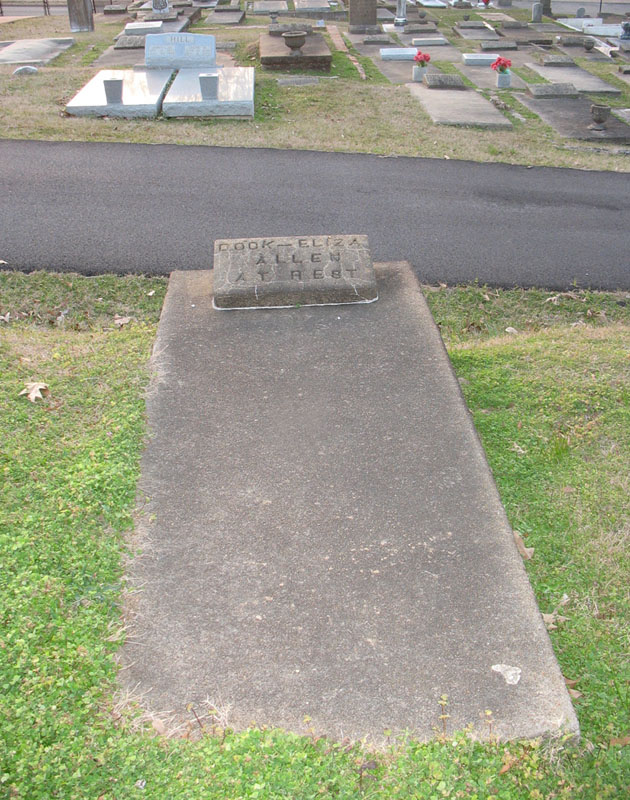
Dock and Eliza (Williams) Allen’s grave.
I found Dock Allen in in the 1867 voter registration database living in Montgomery, AL. He appears with his family in the 1870, 1880 and 1900 census in Montgomery. According to the records he was a carpenter born in Georgia. He owned his own home. In the 1900 census he and Eliza had been married 40 years which puts the beginning around 1860.
I have three addresses for him, 237 Clay street, 216 Holt street and finally 444 S. Ripley street where he lived for the five years before he died March 29, 1909 of “inflammatory bowels” after being ill for several weeks. His mother is named as Matilda Brewster on his death certificate. No father is listed. He is buried in Oakwood Cemetery in Montgomery.
I don’t know if this is exactly how Dock Allan escaped from slavery. This is the oral history that we have. I never knew this story until my cousin Jacqui Vincent and I made contact years ago. Dock and Eliza (Williams) Allen were my 2X Great grandparents. I’ve written more about Eliza’s story in these posts.
This is the 19th post for the April A-Z Challenge. Finding a small New Testament inscribed to Jacob Graham in my grandfather Mershell C. Graham’s belongings raised questions that I am still trying to answer. To read what I wrote earlier, follow these links, Jacob Graham,Abraham Graham, and William Graham and Mary Jackson. I have been unable to connect any of them with my grandfather with more than circumstantial evidence.
Annie Graham
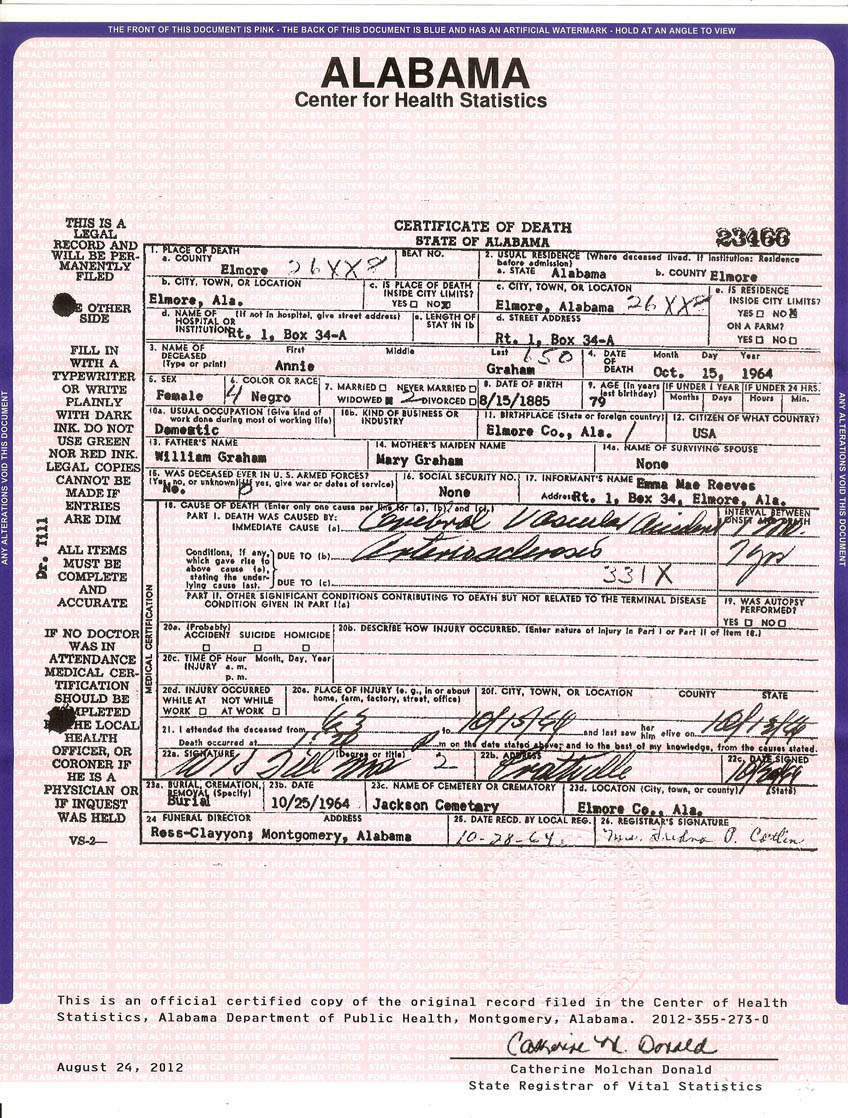
Today I’m going to write about Annie Graham, another possible sibling of my grandfather Mershell C. Graham. Annie was born in 1885 in Elmore County, Alabama. She first appeared in the 1900 Census with Zacharies, Abraham and Jacob in Robinson Springs, Elmore County, Alabama. She was 15 years old, was literate and attended school within the last year.
Annie’s first son, Clyde Graham was born in 1905. William was born in 1906 and Emma Mae was born in 1907. In the 1910 Census Annie and her children were living in the household of Oscar P. Barron and his wife Emma (Jackson) Barron. as servants. Annie was listed as a cook. She was listed as a widow and she and her children all used the surname Graham. The Barrons were identified as white and the Grahams were listed as mulatto.
Emma B. Jackson Zimmerman Barron
Emma was the daughter of Absalom Jackson. He owned a large plantation in Autauga County, Alabama. In 1865, Elmore County was made from part of Autauga. In 2002 I wrote to a descendant of Absalom asking for a copy of the names of slaves owned by James Jackson and divided among his heirs after his death in 1832. I thought that these Jacksons may have enslaved my Jacksons. I wasn’t able to make a connection between the Mary Jackson that may be my grandfather Mershell’s mother and the list at the time but I think I should take another look. That was 11 years ago! In 1860 Absalom Jackson held 62 slaves and lived in Robinson Springs.
Emma Boling Jackson married John Zimmerman in 1867. They had two children. He died in 1873. In 1879, she married Oscar P. Barron. They lived in Robinson Springs, AL. It was in their household that Annie and her children were living in 1910.
Back to Annie Graham
In 1911 Annie gave birth to her fourth child, a son named Michele. Another story, my mother told us that her father, Mershell, had been named Michele by his mother but that when he was a child he was a servant to a little white girl. He had to sleep on the floor outside of her room in case she needed anything. She said Michele was a foreign name and she changed it to “Mershell”. So, Annie’s youngest son was named Michele, the same as my grandfather.
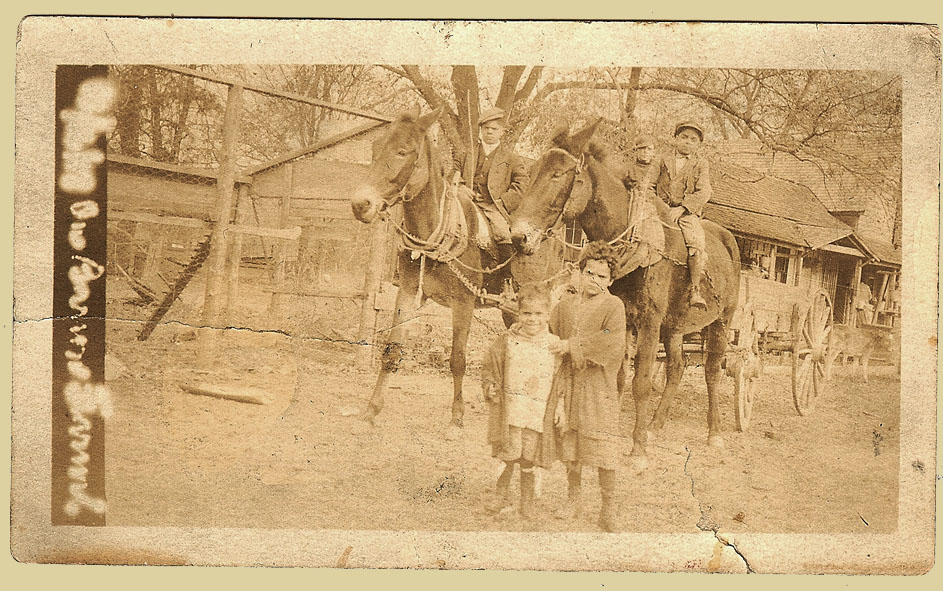
Who are they?
This is an unidentified photograph from my Graham Photographs. I don’t know if any of Annie’s children are in the photo. A few years ago I tried to make out what was written underneath, which isn’t easy. For more information about the camera used to take this photo follow this link to the Photo-Sleuth’s post about the Autographic camera.
“13/2/18 on Barrons farm.”
In 1920 Annie and her four children – Clyde 15, William 14, Emma 13 and Michele 9 were again living in the household of Oscar Barron and his wife, Emma. The household has swollen to include a daughter and granddaughter, husbands and children. Annie is listed as a servant working on her own account. That means she’s not getting wages, but in this case I don’t know what that even means. Her three oldest children are listed as “helpers”, the boys as farm labor. Michele is listed as an “errand boy”. Once again the Grahams are all identified as “mulattoes” and the Barrons as white. All of the Barrons are literate or in school. Annie is literate but none of her children are and none of them are in school.
From Grahams to Jacksons – 1930 to 1940
In the 1930 Census Annie is living with two of her sons next door to the Barrons. Emma Barron is dead but her daughter, Emma Powers, is running the house and Annie is working as her servant. Clyde, 25 and Michiel 16 are both working as laborers doing general farm work. Both are still illiterate and both are now using the surname of “Jackson”. Annie is listed as single and still a Graham. William is not to be found. Emma is now married to Captain Reeves and still living in Elmore County. Emma is also using the name “Jackson” on her marriage record.
I cannot find Annie, William or Michele in the 1940 census. Clyde 35, is married to Edith 29. They have four children, Hettie May Jackson 8, Clyde Jackson 7, William Jackson 4 and Alice Lee Jackson 4/12. He’s never attended school and earned $250 the previous year in the private sector working 52 weeks. They are still living in Robinson Springs, Elmore County.
Emma remains married to Captain Reeves and they have no children surviving. Their one son, Clyde Junius Reeves lived one month, born in November 1927 and dying in December the same year. Emma had zero years of schooling and her husband had three. She is keeping her own house, for no pay. He is farming his own land.
The Wrap Up
Annie died in 1964 of a stroke. Her parents are listed as William Graham and Mary Jackson. Her daughter, Emma is the informant. She died in Elmore County and is buried in the Jackson Cemetery in Coosada, Elmore County.
Emma died in Columbus Ohio in 1993. Her work was cleaning houses. She was an 86 year old widow. Her father’s surname was “Jackson” and her mother’s maiden name was “Graham”. She is buried in Jackson Cemetery, along with her husband.
Clyde died in 1965 in Montgomery of heart disease. His father is listed as Paul Jackson and his mother as Annie Graham. He is buried in Long Cemetery in Coosada, Elmore County.
This is my fifteenth post for the April A-Z Challenge. I began with the intention of writing about my first cousin twice removed, Alma Otilla McCall Howard. I started by going to my Ancestry.com family tree page and pulling up her profile. I noted she was the 5th of 6 children and that her wedding date was missing. I opened my Reunion family tree software, hoping it was there. Her marriage date read 1911. That couldn’t be right. Her husband’s son by his first wife wasn’t born until 1912. There was no date for that marriage either. In fact there wasn’t even a name for Otilla’s husband, Joseph Howard’s, first wife.
Top row: Doorway to Otilla’s Chicago house. Siblings – Jeanette, Otilla, Roscoe, Annabelle, James. 2nd row: Students at Mississippi Industrial College(MIC) 1908; Otilla’s mother, Mary Allen McCall; postcard of the girls dorm at MIC; 1908 photo of MIC. 3rd row: Joseph, Jr. with drums and friends; Otilla’s apt house in Chicago; Otilla and her husband Joseph Howard about 1939. 4th row: MIC building now; my grandmother Fannie and friends in Holly Springs.
I searched on Ancestry.com. No luck. Tried Family Search, no luck. Then I remembered listening to an interview that my cousin Margaret McCall Ward did with Otilla’s step-son, Dr. Joseph H. Howard, JR, about his amazing drum collection. Maybe there was something there. Looked for the interview in my itunes list and listened. Unfortunately, he speaks sort of quiet at the beginning when he is telling us his mother’s name and I can’t quite get it. I think he said “Evie” and then changed and spelled it out as “Dama”. Turned that off.
Joseph Jr.’s drum collection sounds interesting. Maybe there is something out there with biographical information. I google Dr. Joseph Howard drums. Several articles come up. I read them and learn the extent of his collection, his wife’s name and his two children’s name. And there are even photographs of him. Nothing about his mother. Unfortunately, he isn’t even actually related to me and none of this is about Otilla.
I remember another interview that Margaret did with her Uncle Roscoe’s wife, Stella. Stella’s daughter and Joseph Jr. were both there and putting in comments. Maybe the information is there. It only takes a few minutes to find the transcript of the tape on my computer and open it up. Yay! That is what I was remembering. Right at the start of the interview, Margaret starts talking to Joseph and he tells where he was born and how his parents met in Guyana. His mother lived there and his father was working on a ship. He gives his mother’s name and even spells her last name, Sempert. I try looking for her using first name of first Evie and then Dama, hoping to find a death record. Nope.
About this time I decide to check in on facebook. I find that I was chosen by Family History Magazine as one of the Top 40 Genealogy Blogs! I was shocked and thrilled. I spent some time going to the Family History Magazine website, congratulating other bloggers I know who were on the list and thanking others for their congratulations. But, eventually, I had to get back to the post.
Later in the transcript, Joseph talks about how his step mother, Otilla and his father, Joseph Howard met. She was teaching at Mississippi Industrial College in Holly Springs, MS. Joseph Howard SR was a physician and I don’t know if he was practicing in Holly Springs or if he was in school. Unfortunately, just as Margaret was getting ready to go deeper, she stopped herself and got back to her task of trying to find out where her grandfather was buried. I wondered what Mississippi Industrial College looked like? I googled and found a few photographs from 1908, a brief history, and a lot of information and photographs of how the beautiful, historic buildings are falling down before our eyes. There doesn’t seem to be any money to save them. An architect who worked on a rehabilitation project years ago writes about how he hated to stop when the funding ran out. Someone warns about walking up the steps of the auditorium and finding themselves looking two stories down to the basement.
Having read some articles about “ruin porn” while I was off on a tangent when writing a different post, I tore myself away from the wrecked buildings. Holly Springs? I remember a photograph of my grandmother and some of her friends that was taken in Holly Springs. I wonder if they were visiting Otilla? I find the photo and find nothing except place and names on the back.
I remembered an email exchange with my cousin, Ruth about her memories of Otilla and her large house in Chicago. I go back and find the emails and re-read them for any interesting information. She talks about her parents bringing her home from the hosptial to that house and the other family members who lived there. It was a multi-unit dwelling. I found a photograph of the house on google maps when I was going to write Otilla and family up for the 1940 census. There was some confusion about whether the house I found was actually the house. I looked up the address on the 1940 census and googled it. I found several real estate descriptions and photographs of the house. I’m satisfied I found the right place.
At that point I started thinking about all the side roads I took and decided to write about that. I still owe Alma Otilla McCall Howard a post. It shouldn’t be too difficult because there can’t be any other side roads to go down, right?
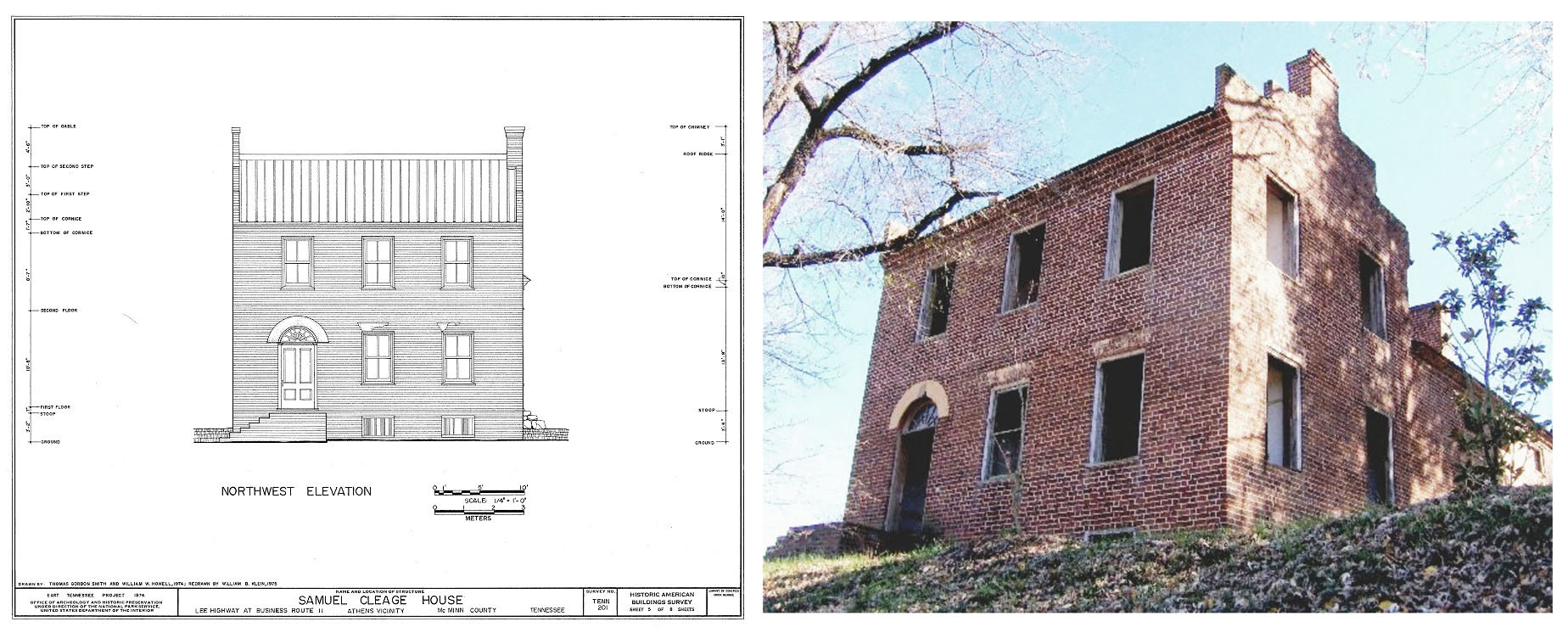
This is my third post for the April A-Z Challenge. I am blogging every day in April using the letters of the alphabet as prompts. Today I am going to write about Samuel Cleage’s building operation. Samuel Cleage owned the plantation where my Cleage ancestors were held as slaves. When he died, the slaves were divided between his sons. I am writing about the time before this today.
Samuel Cleage, who spelled his name “Clegg”, was born in Lanchaster County, PA in 1781. He moved with his parents and siblings to Botetourt County, VA. After his parents died he moved with his family and slaves to McMinn County, TN.
Samuel Cleage
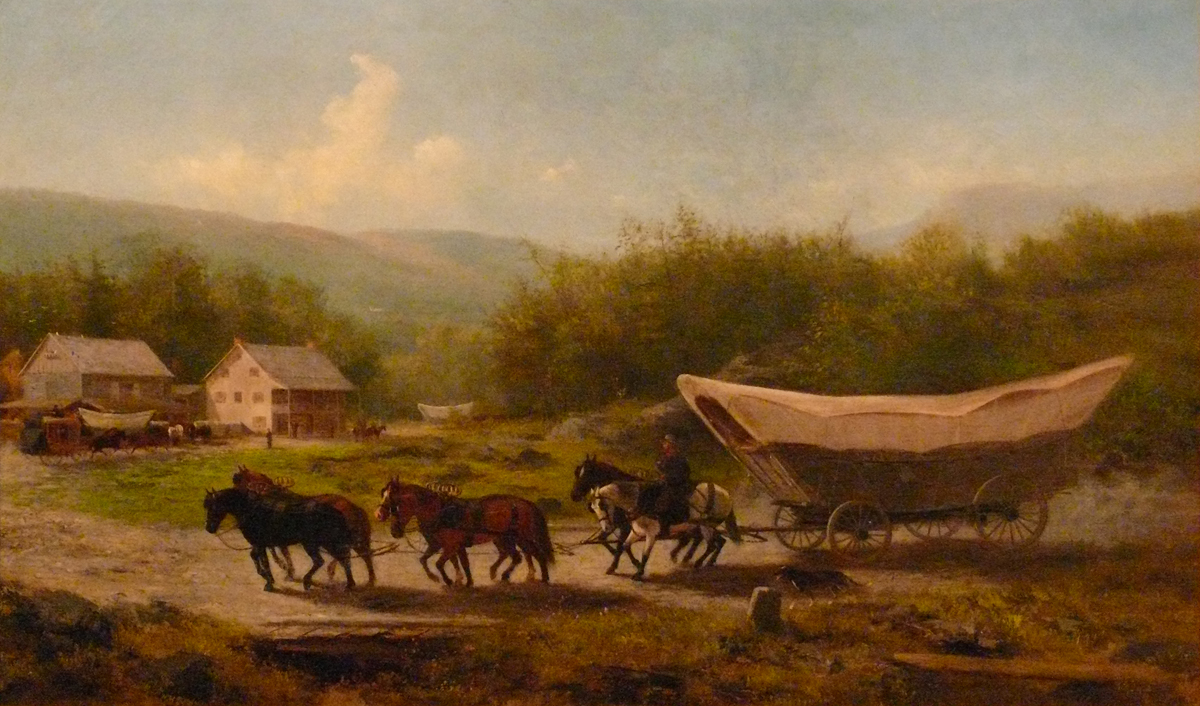
As I was getting ready to write this I realized that he didn’t just get on the train and move, that they must have traveled by wagon down well worn, but primitive roads. Not only was he moving his whole little community of married children and slaves, 339 miles through the Blue Ridge Mountains, he also carried the tools of his trade – whatever he needed to build brick houses. As he traveled he would convince farmers along the way that they needed a fine brick home to go with their fine farm. For payment he accepted slaves, gold or livestock. They say that some of these houses are still standing. I can’t imagine how long it took the group to travel this way. A fully loaded Conestoga wagon, the usual method to move through the mountains in the early 1800s, could travel 5 miles a day. That would take about 4 months if you traveled straight through. They didn’t. They were stopping and building brick houses. And they had to make the bricks! How could that work? All sources agree that by the time he reached McMinn County, Samuel Cleage was a very wealthy man, both in slaves and gold. I think I will have to check into this a little further. Here is a description of the way traveling worked. To read more, click the title.
First the word, Conestoga, America’s first big truck. It was made in Conestoga, Pennsylvania, and it was one huge wagon: 26 feet long, 11 feet high, with the capability of carrying 8 tons. Pulled by five or six horses and followed by as many as a dozen packhorses, the Conestoga wagon became any traveling family’s best friend.
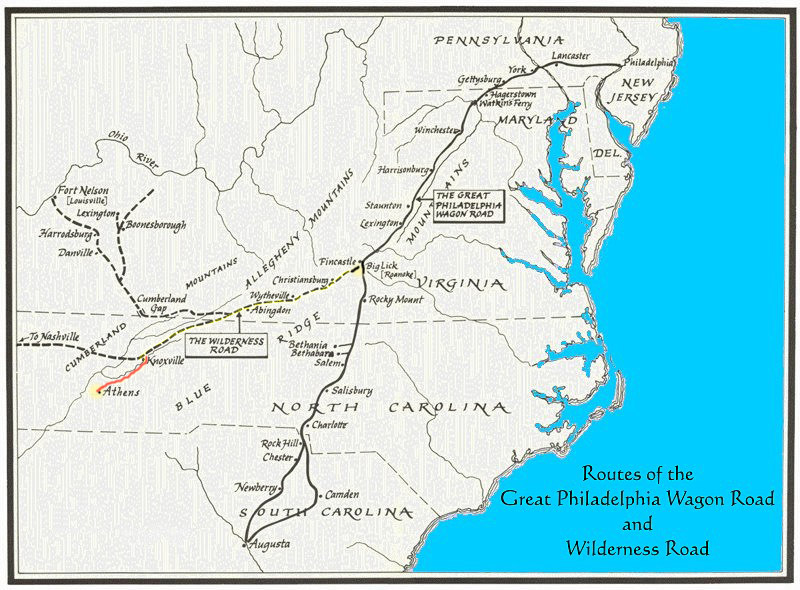
It became the expected sight along the road known by many names: the Warrior’s Path, the Carolina Road, the Valley Pike, the Great Philadelphia Wagon Road, or simply the Great Wagon Road.
With a body the shape of a swaybacked horse, Conestogas could float across a river as long as the wheels were taken off. And those wagons were so heavy and laden with a family’s every possession, they created deep wheel ruts all along the Great Wagon Road…
I outlined the section of the Wilderness Road they would have taken to Knoxville, TN, where the road turns west. At that point they would have continued south to Athens TN in McMinn county.
Above I mentioned that they had to make the bricks before they could build the houses. “They” being the highly trained and skilled slaves that were traveling too. It was not easy to make the bricks. And it wasn’t a quick process. Here is how Joe Guy described it in his book “The Hidden History of McMinn County” There is also a link to this chapter in the title.
Samuel Cleage, the itinerant contractor who traveled into the Tennessee Valley from Virginia in the 1820’s, is generally credited for the construction of several historic homes and buildings in East Tennessee, especially in McMinn County. While it is true that Cleage was the driving force behind his construction business, it is important to remember who, in fact, was actually performing the labor.
Besides livestock and gold, Cleage was often contracted to be paid in slaves after having completed a house or building. Many of Samuel Cleage’s slaves later adopted the Cleage name when they obtaining their freedom, and several black families in East Tennessee still trace their lineage to these Cleage slaves. Cleage was a wealthy landowner besides being a builder, and so he used his slaves almost exclusively as bound workers in his construction business. One of the duties often exclusively regulated to the slaves was brickmaking.
By the time Samuel Cleage was involved in building, the art of making brick had been around since 3500 BC. Essentially, 19th century brickmaking involved five steps: winning or digging the clay, preparation, molding, drying, and firing.
East Tennessee is well known for having the natural clay useful for brick production. Once dug by the slaves (normally in the fall), the clay was exposed to the weather so that the winter freezes could break the clay down, remove unwanted impurities, and allow it to be worked by hand. In the spring and summer, water was added and the clay was worked by the slaves’ hands and feet in large open pits until it obtained a smooth consistency and most of the rocks and sticks were removed.
The clay was then taken to the moulding table, where the slave designated as brickmoulder directed several assistants in the process. A skilled brickmoulder would work at the moulding table for twelve to fourteen hours, producing 3500 to 5000 bricks in a day. A clot of clay was rolled in sand and “dashed” into a sanded mould, which prevented the clay from sticking. Once the clay was pressed into the mould, the excess clay was removed from the top of the mould with a flat stick. Moulds ranged from single to six bricks at a time, but single brick moulds were often desired because even the slave women and children could be employed in carrying the “green” bricks from the table to the drying area. The “green” bricks were then stacked and dried for about two weeks.
Once most of the moisture had dried out, Cleage’s slaves stacked the bricks in a kiln, or clamp. Rows of bricks were built up to construct tunnels, which were filled with wood and set fire. For two to five days the bricks were cooked, the slaves feeding the fires and getting very little sleep. After the bricks cooled, the slaves removed them from the clamp and sorted them as to their degree of quality, the best being chosen for the building’s outside walls. Bricks which were closest to the fire sometimes received a natural glaze from the sand that fell into the flames, and were used in the interior courses of the walls. Some bricks would be left with a salmon color, were only slightly underfired, and made for good insulation in the inner parts of the walls. Bricks that were over burned, cracked, or warped were called clinkers and were saved to be used in garden walls or paths.”
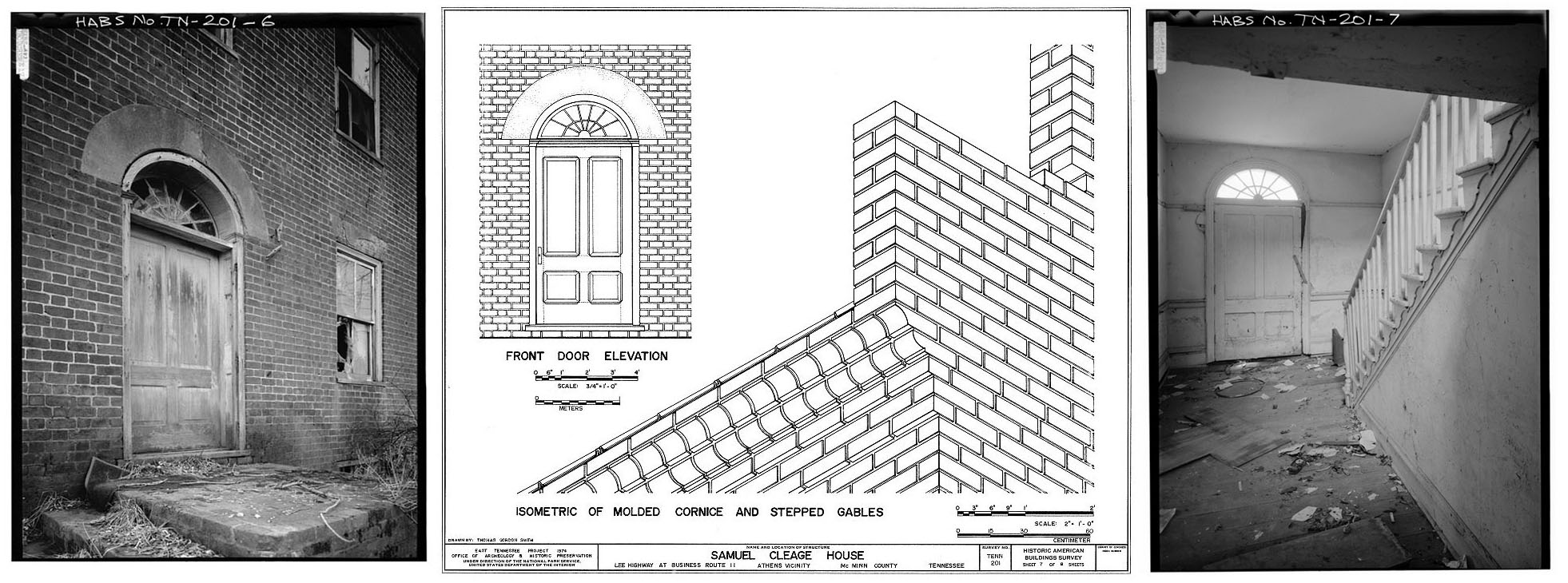
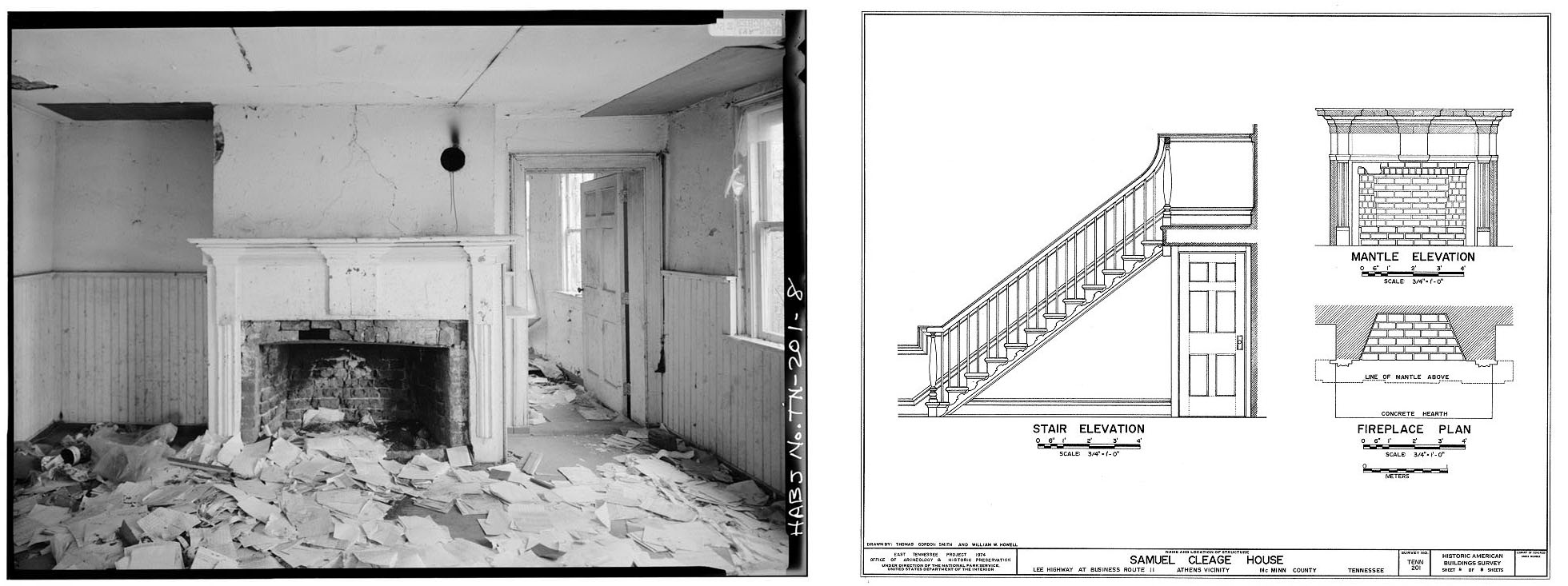
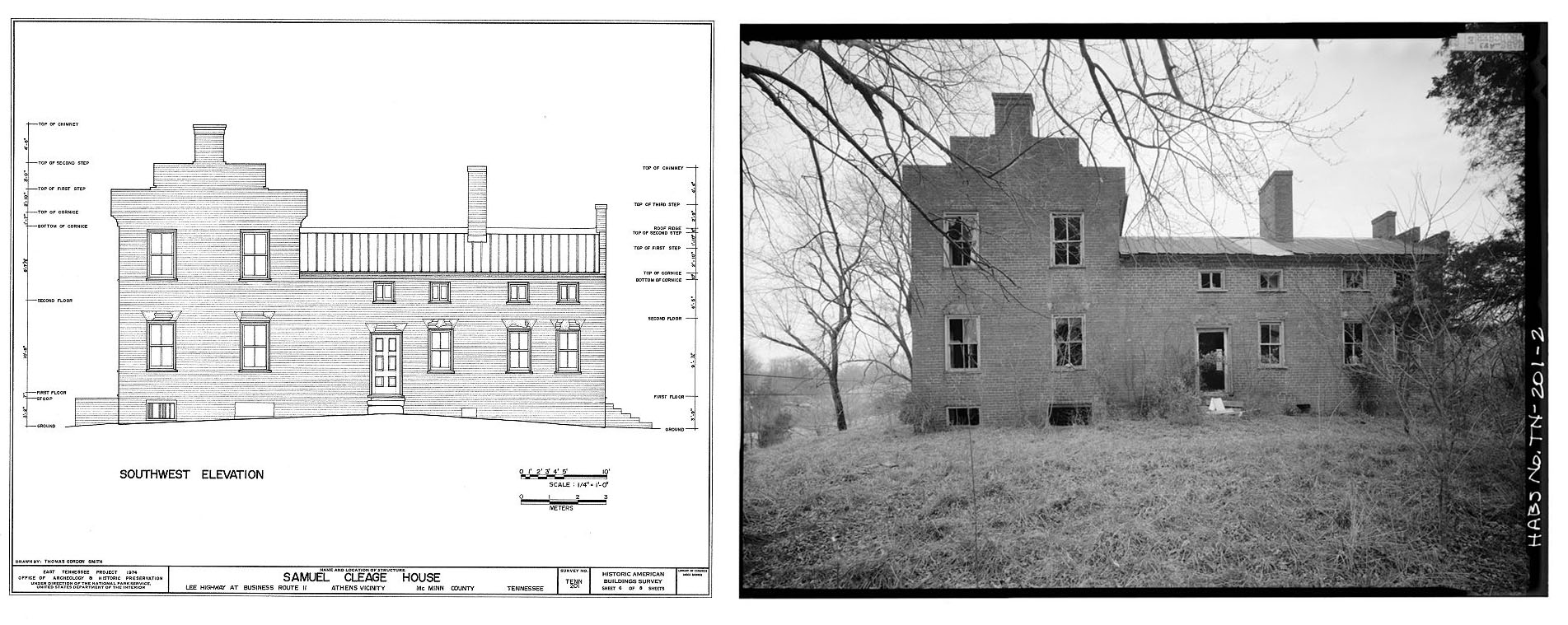
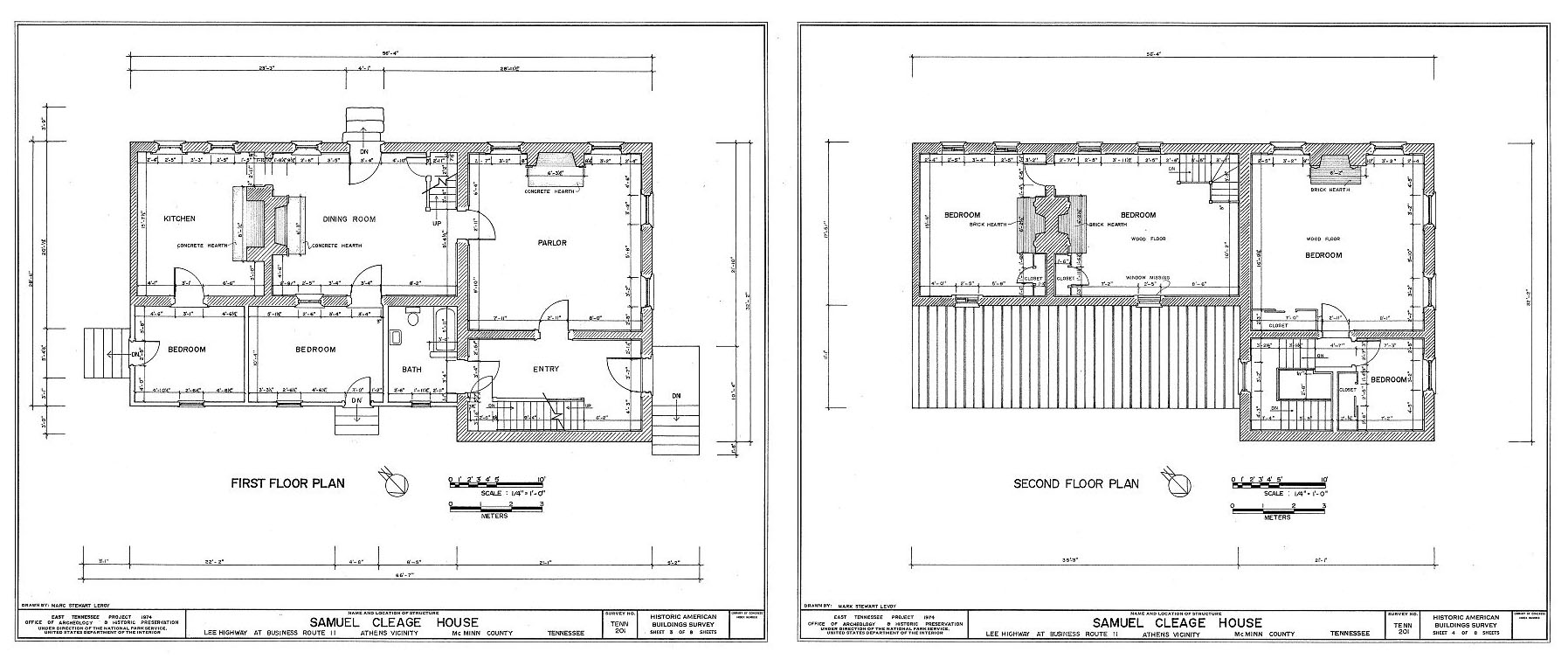
After arriving in McMinn County, Cleage picked out a spot and built the house below, which is still standing. The black and white photographs were taken during the 1930s. The color photo is more recent. I read an article online that described the renovations the new owners were carrying out to make the house livable again. Unfortunately, I cannot find the article again.
Josephine “Josie” Cleage was my grandfather Albert B. Cleage’s older sister and today I will tell what I have learned about her.
Josephine “Josie” Cleage Cleage
Josephine Cleage, who was always called Josie, was born in 1873 in Louden County, Tennessee. She was the first child of Louis and Celia (Rice) Cleage. In the early years, Louis worked on a farm and Celia kept house. Eventually there were four younger brothers – Henry, Jacob, Edward and Albert. Josie’s father Louis was remembered as a drinker who didn’t always bring his pay home. He started working on the railroad and several years later her parents went their separate ways.
Left to right: Albert, Josephine, Edward. Back L Henry, back R Jacob
In September 1894, twenty year old Josie married 22 year old James Cleage. Although they were both named Cleage, it was not because they were related. Josie’s family was enslaved on Alexander Cleage’s plantation while James Cleage’s family was enslaved on David Cleage’s plantation. James’ parents were Jerry Cleage and Charlotte Bridgeman. You can read more about them here -> Jerry Cleage and Charlotte Bridgeman and here -> Jerry Cleage, A Slave for Life
Both were born after the Civil War. Their first daughter, Henrietta was born in 1897 with second daughter Lucille following in 1899.
In April of 1897 Josie’s mother, Celia, married her second husband William Roger Sherman of Athens, Tennessee. By 1900 the whole family was living in Athens. Josie, now 27, and her family were living next door to her mother, step-father and brothers. Husband James, 29 was teaching school. According to the 1900 census Josie was able to read and write.
Sometime after 1890 Jacob Lincoln Cook, founded the Athens Academy. James Cleage was one of the small group of dedicated educators that worked with him and taught there in the early years. In 1900 J.L. Cook was appointed president of Henderson Normal Institute in Henderson, North Carolina. James also went to North Carolina and began teaching at the Institute. In 1901 Josie and James first son, James Oscar, was born there. My grandfather, Albert, lived with his aunt’s family while he was attending high school at Henderson Normal. He graduated in 1902. By the time Albert David (called David) was born in 1907, the family was back in Athens, Tennessee, but not for long.
By 1905 Henry and Jacob Cleage had relocated to Indianapolis, Indiana and in 1908 James, Josie and their growing family joined them there. Their youngest daughter, Hattie Ruth was born in Indianapolis in 1909. James worked a porter and later at a printing shop. Josie stayed home and raised the children and kept the house.
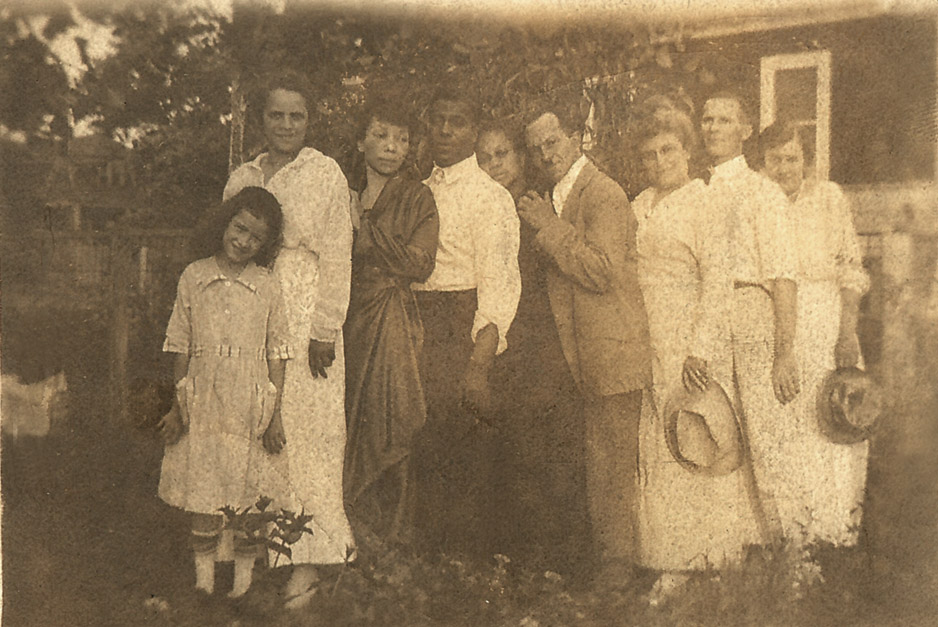
Josephine Cleage is wearing the dark dress, on the far right.
Both James and Josie were active in Witherspoon Presbyterian Church. I found these short items in the Indianapolis Star “News of The Colored Folk” during 1911.
March 11, 1911 Officers of the Witherspoon United Presbyterian Church entertained its members at the church at a banquet Tuesday night. Dr. H.L. Hummons was toastmaster. Addresses were made by Henry and James Cleage, Mrs. Lillian T. Fox and Mrs. M.A. Clark.
April 9, 1911 Sunday The Witherspoon United Presbyterian Church will give its annual musicale Friday evening at the church on North West street. The following program will be given: Solo, Mrs. T.A. Smythe; reading, Mrs. James Cleage; clarinet solo, Philip Tosch; reading, Mrs. Harriet Mitchel; quartet, Messrs. Lewis, Thompson, Chavis and Thompson. The church choir will render three selections. Mrs. Daisy Brabham has program in charge.
My uncle Henry Cleage remembered family visits to Indianapolis during the summers. He said his Aunt Josie was a real intellectual who read a lot and could talk about a variety of topics. He also remembered catching fireflies and that someone in the family had a goat. My aunt Anna Cleage Shreve remembered her uncle James as a very quiet, gentle man who helped around the house. Uncle Edward’s daughter Juanita Cleage Martin wrote in her memoirs that she remembered her aunt as being tall with a pleasant smile, easy going with a lot of hair.
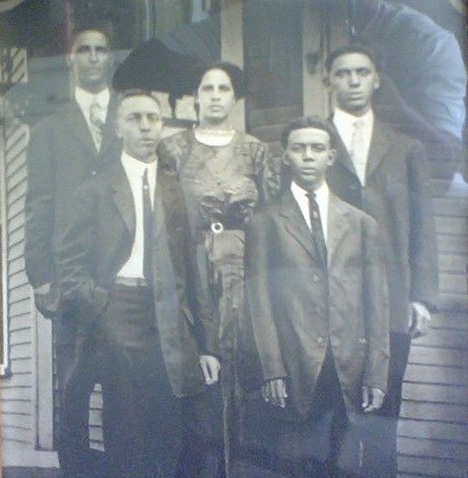
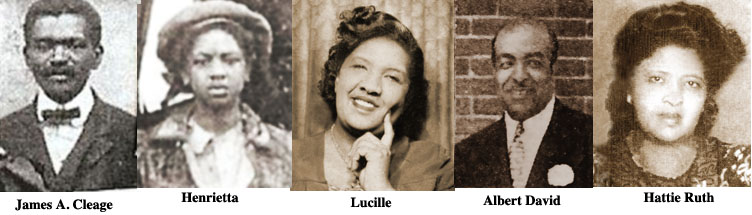
Josie’s husband and four of her children. I do not have a picture of James Oscar. Special thanks to my cousins from Aunt Josie’s line for sharing photos with me!
Josie’s children all finished several years of high school and then got married or started working or both. Lucille seems to have been the first to relocate to Detroit where her uncles Albert, Jacob and Henry settled. After Josie’s husband James A. Cleage died in 1933, Josie also moved to Detroit. In 1940 she was living not far from her brothers with her son David and his family on Stoval.
Josephine Cleage died in July of 1956 at age 82 and is buried in Detroit Memorial Park East Cemetery.
On June 11, 1919 Mershell Graham and Fannie Mae Turner applied for a marriage license in Montgomery, Alabama. They were married by Rev. E.E. Scott at First Congregational Church in Montgomery on June 15. I have no photographs of the marriage or memories that were handed down. I could find no record of their marriage license in the Montgomery Advertiser. They seemed to have no section devoted to “News of the Colored Folk” as some newspapers did.
Soon after the ceremony my grandparents left and returned to Detroit where Mershell was working. I assume they took the train, which would have been segregated at that time. They roomed with friends from home, Moses and Jean Walker. There were other roomers, all of them saving up to be able to purchase their own homes.
To read Mershell’s letter of proposal read The proposal To read Fannie’s letter of acceptance read – The acceptance
I found several marriage related, handwritten poems in my grandparents papers and have printed them below. I wonder if they read these during the ceremony or exchanged them.
The gift Yes, take her and be faithful, still, and may your bridal bower, Be sacred kept in after years, and warmly breathed as now, Remember tis no common tie that binds your youthful hearts Tis one that only truth should breath and only death should part.
Remember tis for you she leaves her home and mother dear, To have this world with you alone, your good and ill to share, Then take her and may future years mark only joys increase And may your days glide sweetly on in happiness and peace.
The Brides Farewell
Soon, soon I’ll go – from those I love You, Mother, Sister, among the nest, Where I will often think of you, Far in the distant west.
Farewell, Mother, though I leave you Still I love you, Oh! believe me and when I am far away Back to you my thoughts will stray. Oft, I’ll think of you and home Though in other lands I’ll roam. Yes, though miles may intervene, I will keep thy memory green Mother, sister, from my heart Thoughts of thee shall never depart.
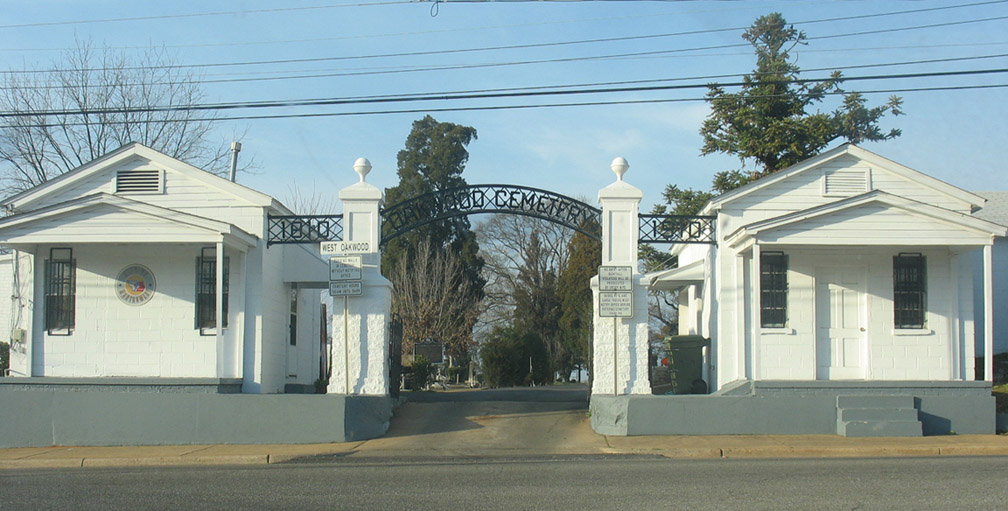
On Sunday, February 9, 2009 my daughter, Ife and I drove over to Montgomery, AL. It’s only a 2.5 hour drive from Atlanta. She had to pick up some art work and I wanted to see if the store my Grandmother Fannie managed before she married was still standing. I also wanted to find Eliza and Dock Allen’s graves in Oakwood Cemetery.
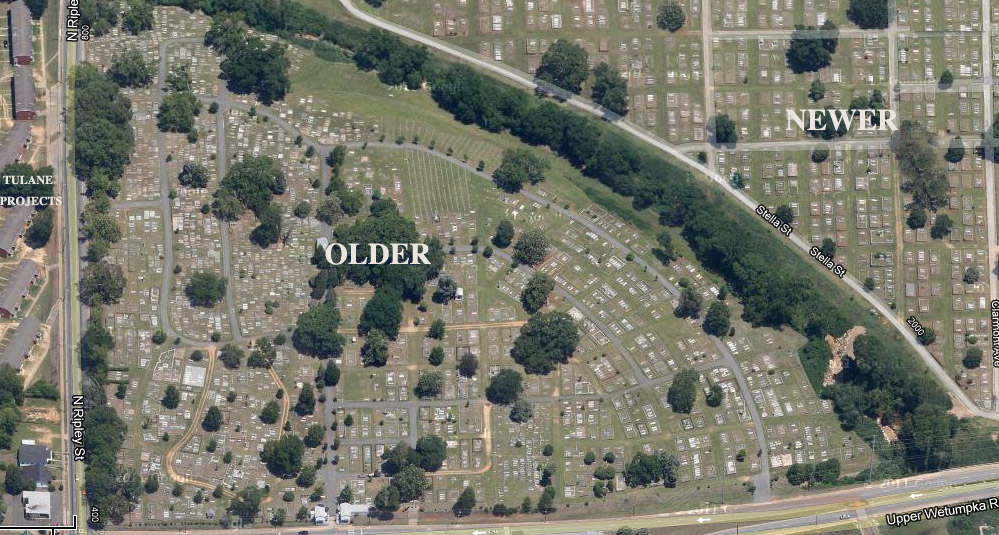
Oakwood Cemetery layout from Google Maps. The older section has Dock and Eliza’s graves. The Newer one holds the Tulanes. The Tulane housing projects, named after Victor Tulane, are across from the cemetery.
First we picked up the art. The artist’s husband gave us directions to the cemetery and the store. We found the cemetery easily. It was open and there was a man walking into a little office near the entrance. Ife parked and I went in and showed him the information I had, a location for the grave site of Victor Tulane. He told us to follow him to the place we could look. It was out of that section of the cemetery and around a few blocks and over the tracks to the newer part of the cemetery, which he drove up into, us following. He finally stopped and said it should be there in that area, waving vaguely around.
Ife and I got out and started looking. There were old graves, some newer ones from the 60’s and even 70’s and some from the 1800’s. We walked up and down hills and probably over graves and couldn’t find it. He came back with a map and asked if we’d looked further down. So we went in that direction. I told him I had some death certificates and asked if he could tell me where the graves were located if I gave him the names. He said I should bring them up to the office and he would copy them and look in the file.
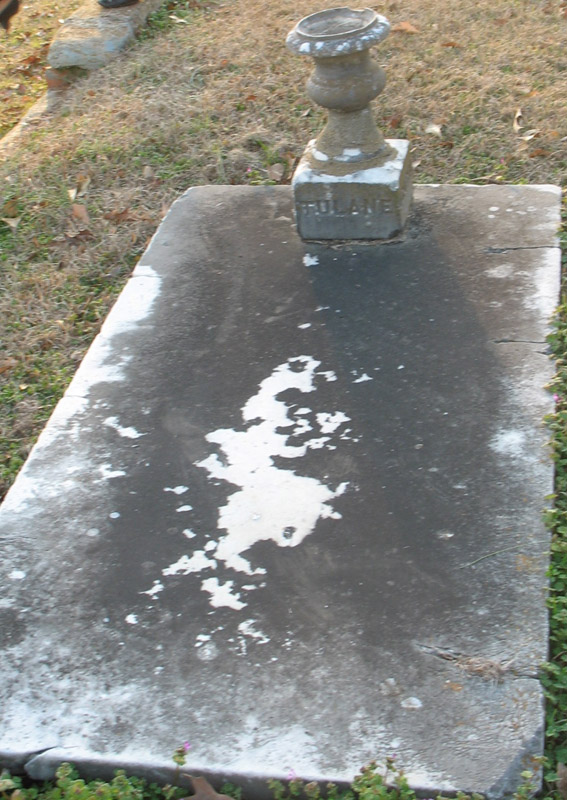
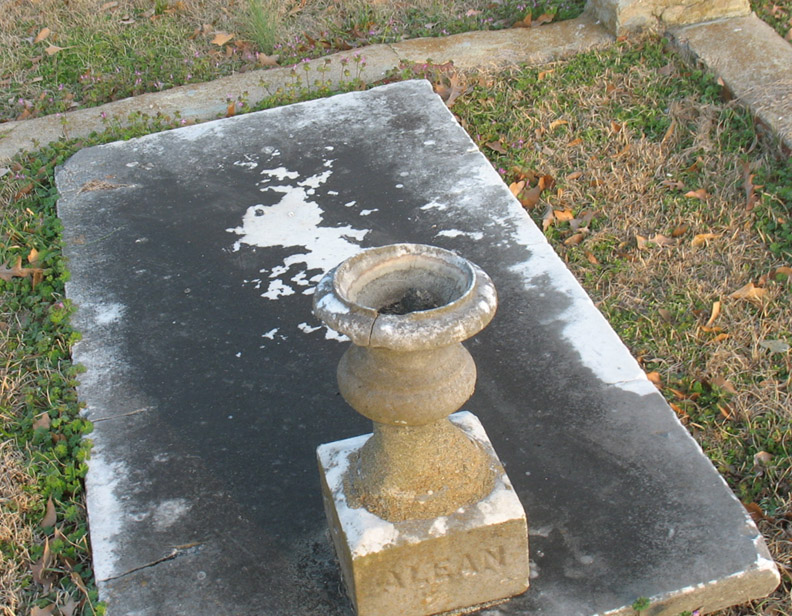
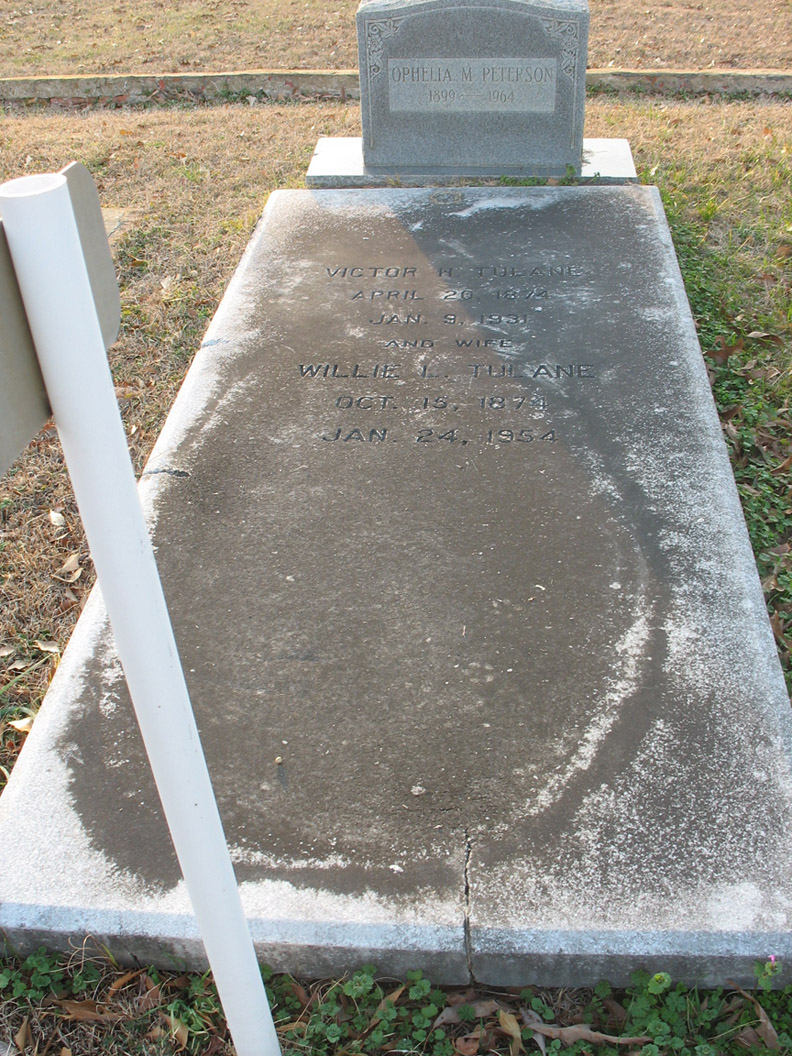
We continued to look and finally Ife saw this grave with the name we were looking for “Tulane”. It was a child’s grave. On the other side it said “Alean”. She looked next to it and there was the grave we had spent all that time looking for. We had walked by that place several times but there was an upright grave marker that said “Ophelia M. Peterson” so we just went by without looking at the flat, cement slab, which was the grave we were looking for. I still don’t know why Ophelia’s stone is right up above it or who she was.
We then went up to the office and I took my death certificates in. He copied them and asked if he could copy Dock Allen’s photograph, which I had stuck in the mylar pocket with the death certificate. After making copies, he got out his file drawers and found Victor Tulane and two children, age 2 and 10 months. My mother used to talk about how spoiled their daughter Naomi was, but she never mentioned or maybe even knew that they had lost two babies. I think that might help explain the spoiling. He found Dock and Dock Allen (father and son) and Eliza. He said they were buried on that side in Scotts Free Burial Ground – when it started they let people bury for free. He drove ahead of us and showed us the section where the graves were and we walked around and finally found the grave marker for Dock and Eliza. We regretted not bringing flowers or something to leave but we hadn’t expected to even get in.
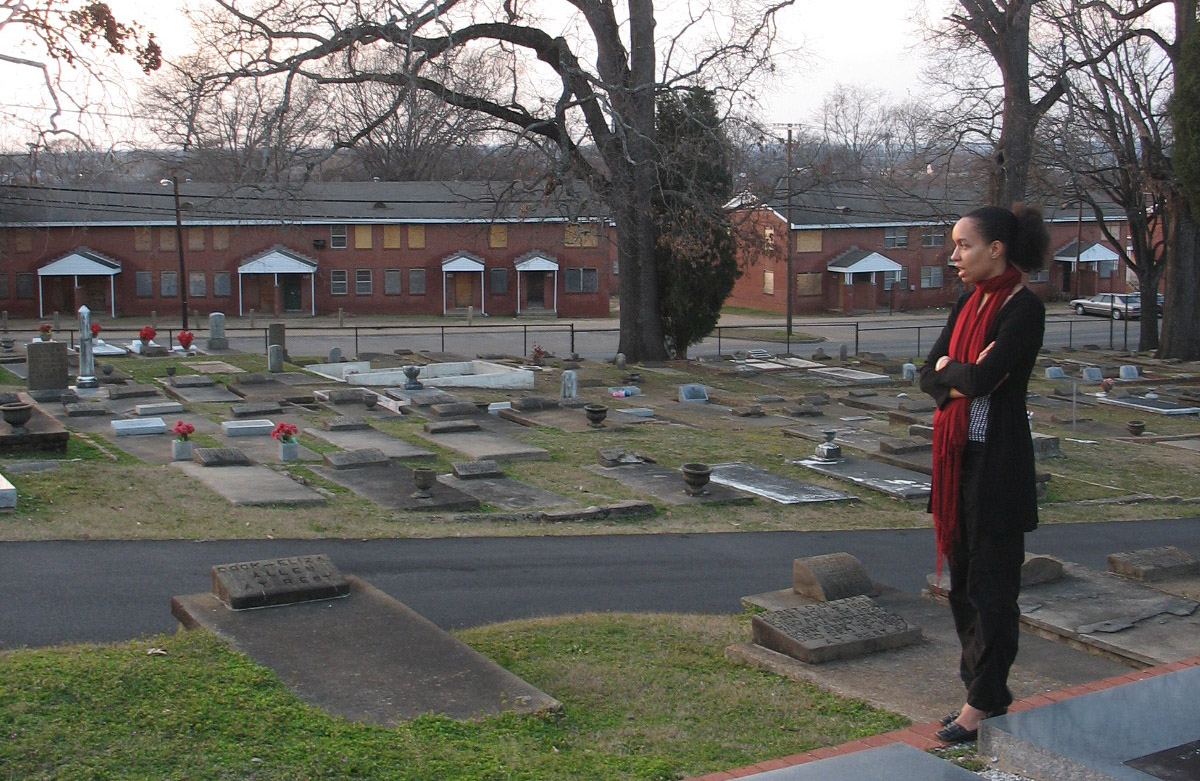
Ife standing to the right of Dock and Eliza’s grave. Tulane Homes in the background.
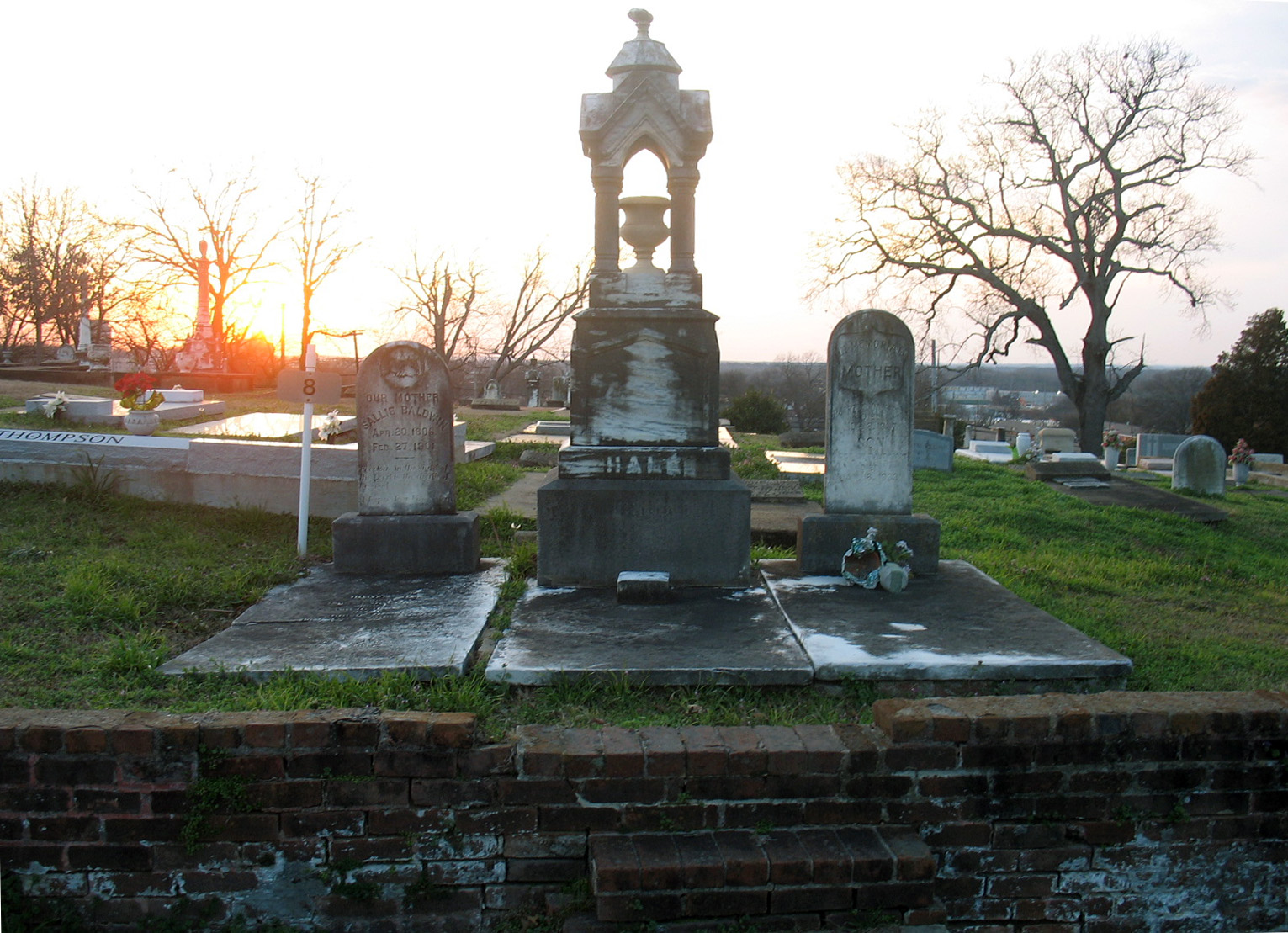
As we were leaving the Cemetery, wishing we had brought some flowers or an offering of some kind, I noticed a name out of the corner of my eye, “Sallie Baldwin.” It was like finding another relative. A cousin of a cousin and I spent weeks, months figuring out how our families connected and about her relatives. Her mother was alive then and kept giving us information that my friend didn’t believe but it always turned out to be true. James Hale, a well known and well to do black Montgomery businessman contemporary with the Tulanes, was her son-in-law and is buried here also.
Sallie Baldwin and family.
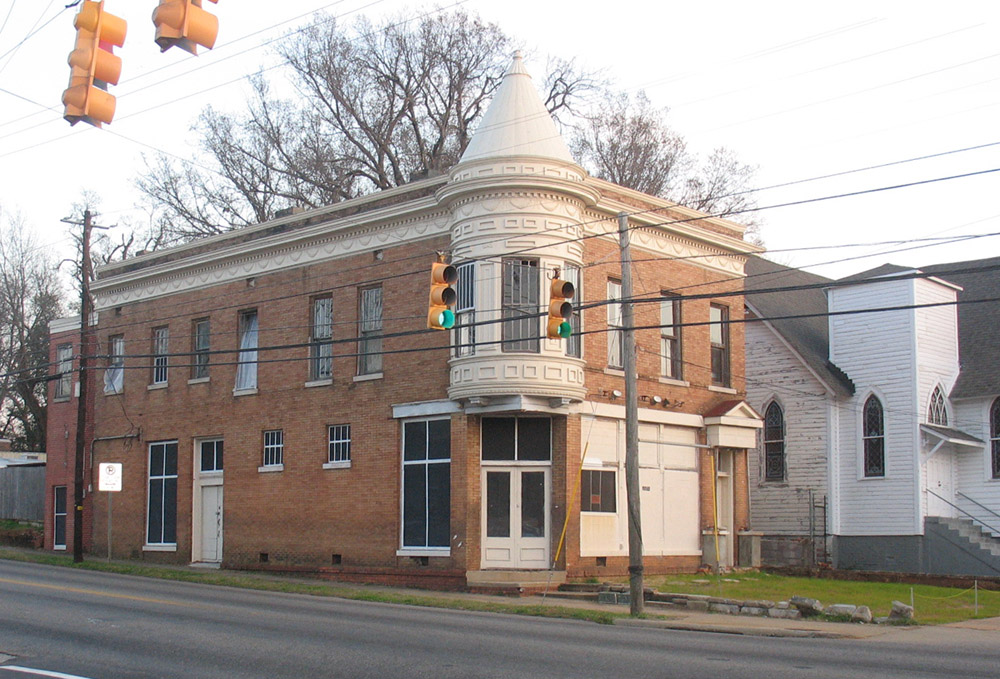
When we left the cemetery we drove down Ripley Street towards the Tulane Grocery store. Ripley runs next to Oakwood Cemetery. The block where my grandmother and her family lived with Dock and Eliza Allen is now paved over for parking lots and government buildings. The store is still there and looking good. I feel that it’s time for another trip to Montgomery.