Even though it’s now Sunday night so I’m 24 hours late, I decided to do the Saturday Night challenge. The question on Genea-Musings Saturday Night Genealogy fun was to decide which of my genealogy research adventures in 2011 was my “very best” and to write about it.
My most exciting find of 2011 was discovering a newspaper article that validated my family’s oral history that my great great grandmother, Eliza Allen and her daughter Mary came off of the plantation of Colonel Edmund Harrison. My cousin Margaret and I looked for years for something to prove the connection without any luck. You can read all about it in my blog post here. My only regret is that Margaret is no longer here to share my find.
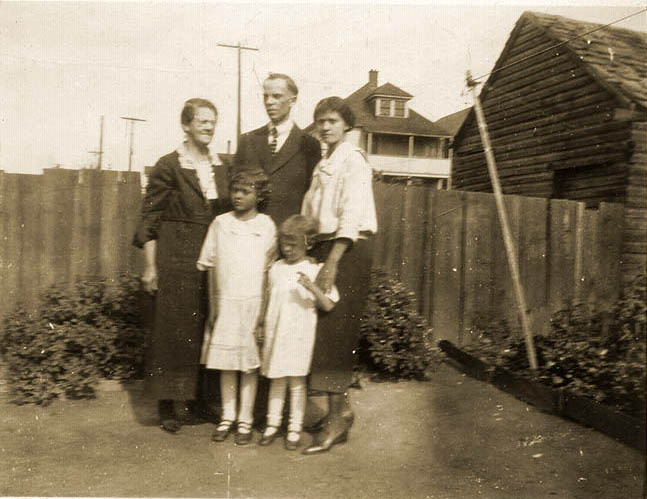
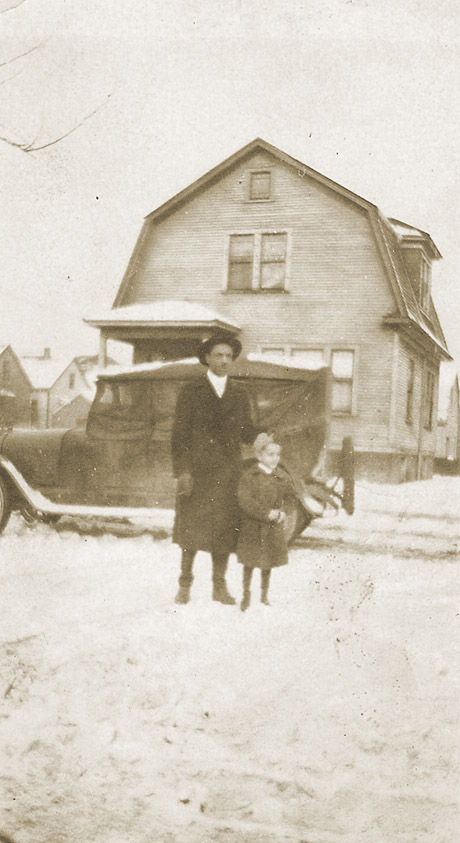
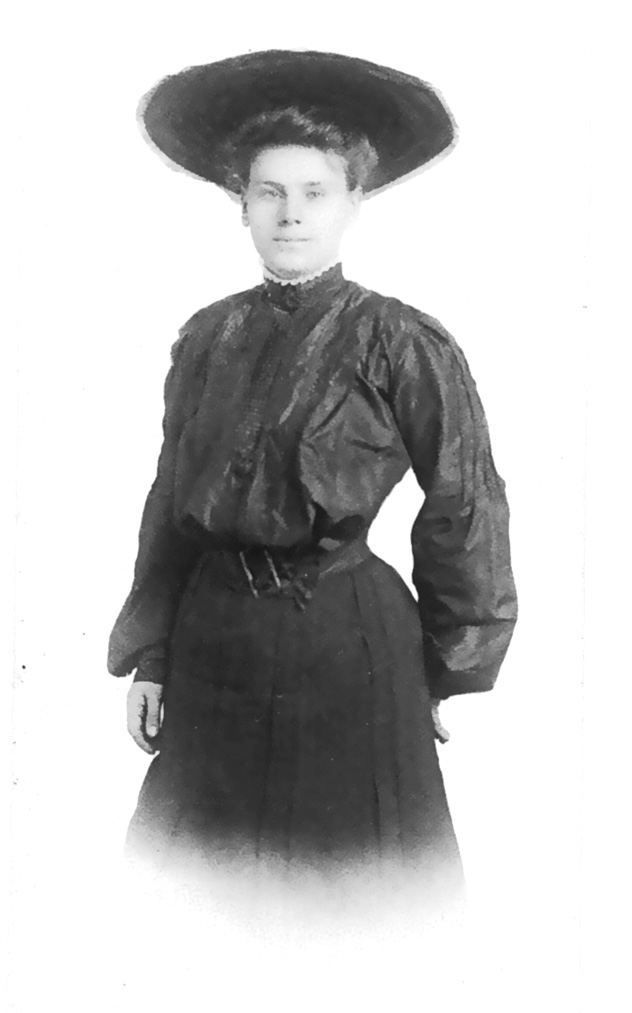
Mary Allen McCall with son James and his wife Margaret. Front row - his daughters Victoria and Margaret. Detroit about 1924.
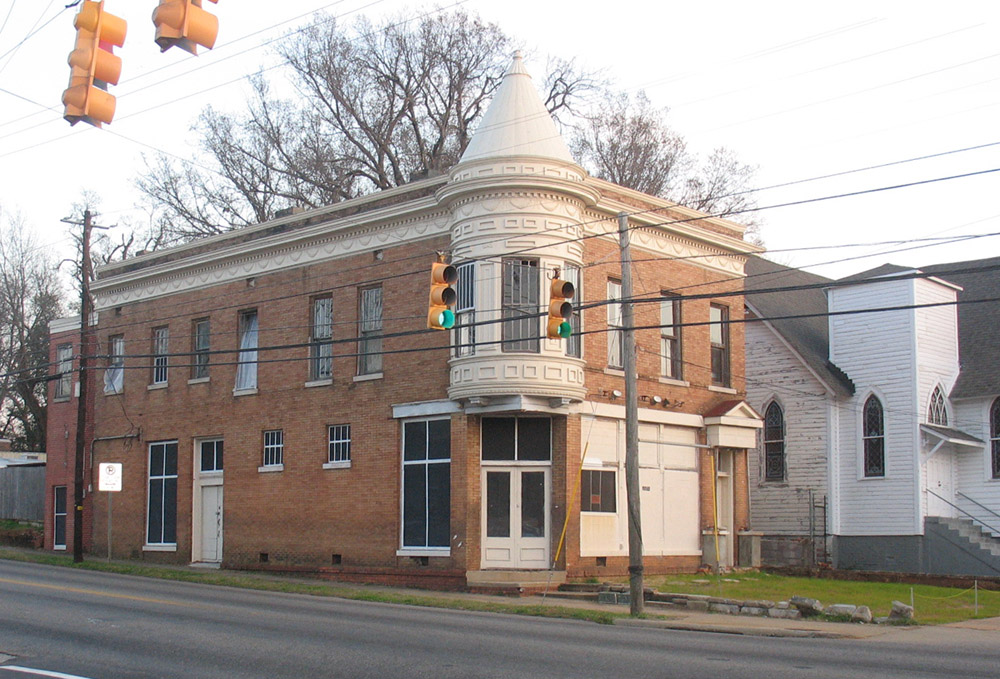
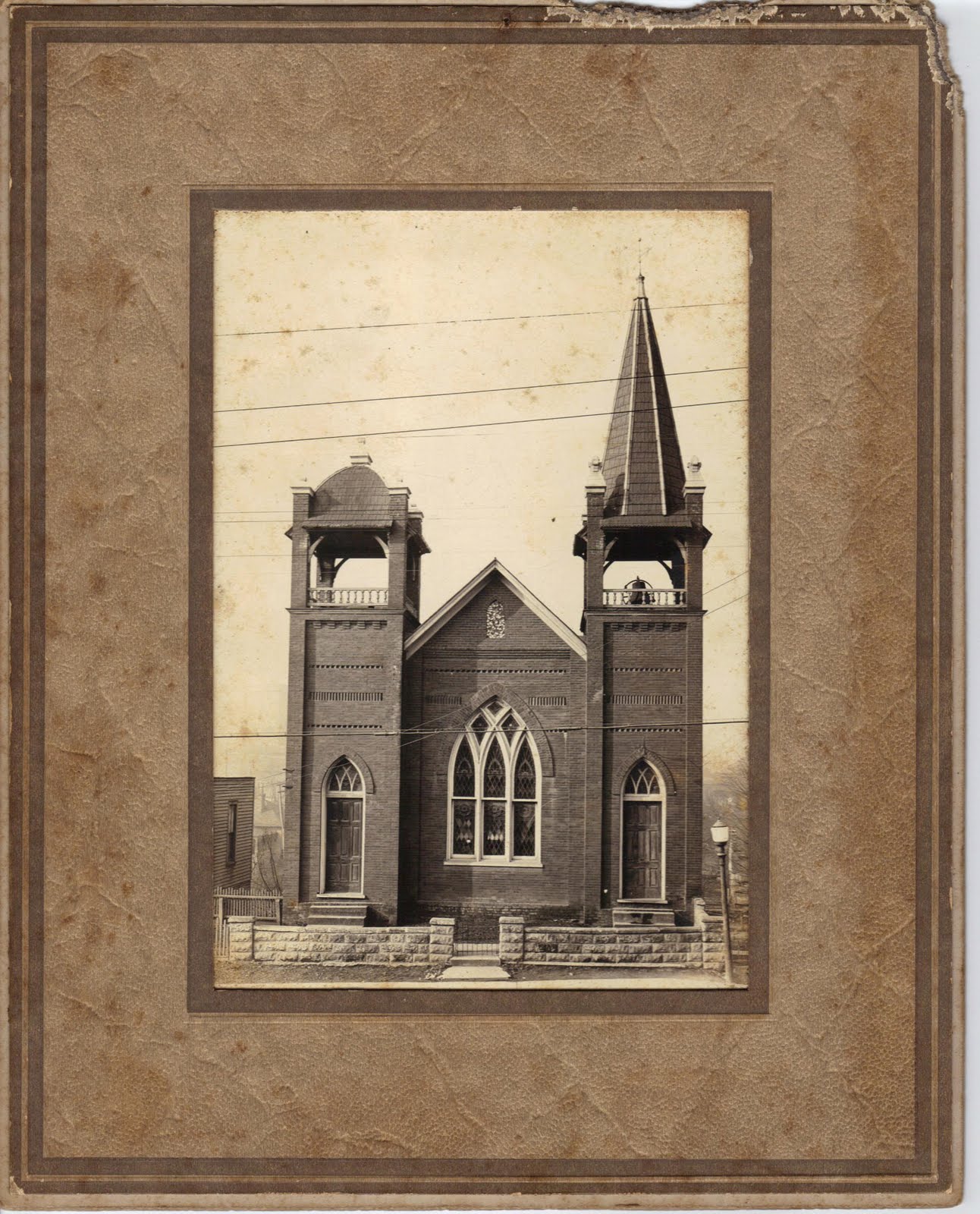
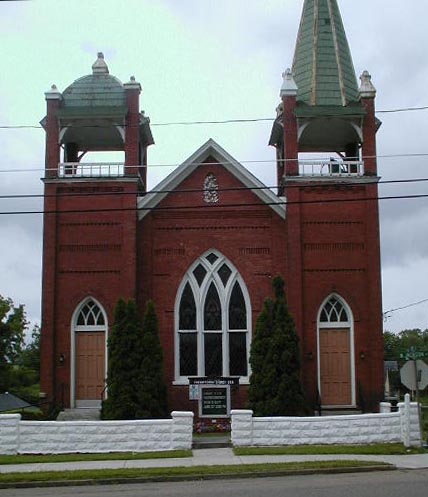
The Tulane building in 2004. During the time of this event the Tulane family lived upstairs and the store was downstairs.
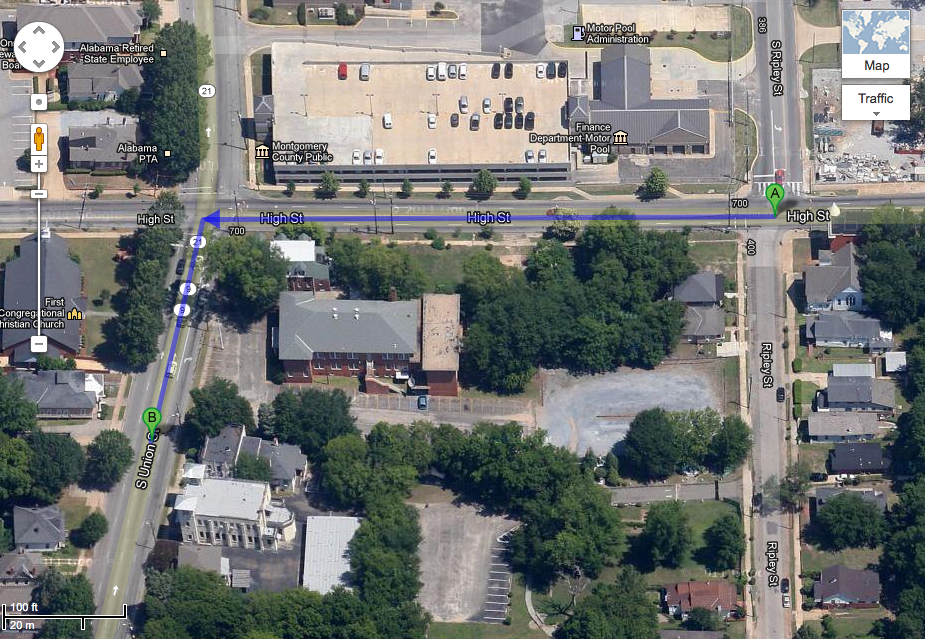
Here is a story my cousin Jacqui told me about her grandfather, Victor Tulane and his rescue of Dr. William Watkins in Montgomery, Alabama. This story was told to her by her mother, Naomi Tulane Vincent. Naomi was twenty and the family was living above the store on Ripley and High Street when it occurred. The Watkins family lived several blocks away on Union Street.
Walking distance between the Tulane’s @ A and the Watkin’s @ B was about 3 minutes according to Google Maps.
It was the middle of the night when the Tulane family woke up to car lights shining in the windows. They got up and looked out into the yard. It was full of cars and trucks. Victor Tulane told his wife, Willie Lee and daughter, Naomi to go back to bed, everything would be all right.
He let the white men in and they told him they were looking for William F. Watkins, a black dentist who lived several blocks away. Mr. Watkins, they said had insulted one of their wives and they wanted him. Was he there, they asked? Victor told them that nobody was there except his wife and daughter. They could look for themselves. They went through the whole house looking everywhere. Finally, satisfied that Dr. Watkins wasn’t there, they left.
As dawn approached, Victor brought Dr. Watkins out from his hiding place beneath the floor. He put him in the car, piled produce on top of him, drove him to the train station and put him on a train heading north to Chicago.
___________
Jacqui remembers meeting William Watkins in New York when she was a child. He was an old man with a white beard. He looked just like Colonel Saunders, she said, and asked if I could find out anything about him, if he was married, did he have children, when did he die? Using various online sources, I was able to put together the following timeline.
Timeline for William Franklin Watkins
1879 – Williams Franklin Watkins Jr. born to William and Sarah (Fauntleroy) Watkins in Montgomery, Alabama.
1880 Census – Montgomery, Alabama – William Watkins Sr. was a carpenter. William was 1 year old.
1900 Census – Montgomery, Alabama – The family lived at 518 Union Street. William Sr. was a carpenter. There were 6 children at home, including 21 year old William Jr. who was at school. The oldest daughter, Lula was 26, a widow and teaching. She had a 4 year old son.
1910 Census – Montgomery, Alabama – Williams Watkins is living at home with his parents and four other siblings.
1914 – William Watkins, Sr. Dies
Obituary from the Montgomery Advertiser – March 11, 1914 William Watkins Dead
William Watkins, well known negro (sic) of Montgomery, died at his residence, 518 South Union Street, Tuesday evening at 5 o’clock. He had been living in Montgomery nearly fifty years and was thoroughly identified with negro church, society and business life. He was a contractor and builder and stood well in business circles. He was a member and deacon of the Negro Dexter Avenue Baptist Church and a trustee of Swayne School
1917 – William Watkins Jr and Gussie Rue Harris marry in Birmingham, Alabama (Gussie’s home town.)
1918 – WWI draft registration card information. William is a dentist in Montgomery, Alabama. Address is the family house on 518 Union St. He is married to Gussie Rue Watkins. His eyes are brown and hair is dark. He’s of medium height and build.
1918 – Son William III born in Alabama
Between the draft card in 1918 and the 1920 census – the event described happened.
1920 Census
*William is a Lodger in Washington DC and practicing dentistry. Identified as Mulatto. He was 40.
*Wife Gussie living with her parents with their son William in Birmingham, AL.
*William’s brother Charles is living in Los Angeles, CA. He is a carpenter.
1924 – Daughter Alice born in Washington DC.
1930 Census – Los Angeles, CA William F. Watkins 51 years old. His wife Gussie and their two children, Williams and Alice, are also in the household. He practices dentistry in his own office.
1936 – His mother dies and is buried in Montgomery, AL
1954 – William F. Watkins died
I found some of William Watkins extended family on Ancestry.Com and was able to see some photos of the family. The person I contacted said he did look like Col. Saunders. Unfortunately they had never heard this story.
Yesterday I was working like mad to complete an entry for the “Carnival of Genealogy – Our Ancestors Places of Worship”, by the midnight deadline when I came across two interesting pieces of new information.
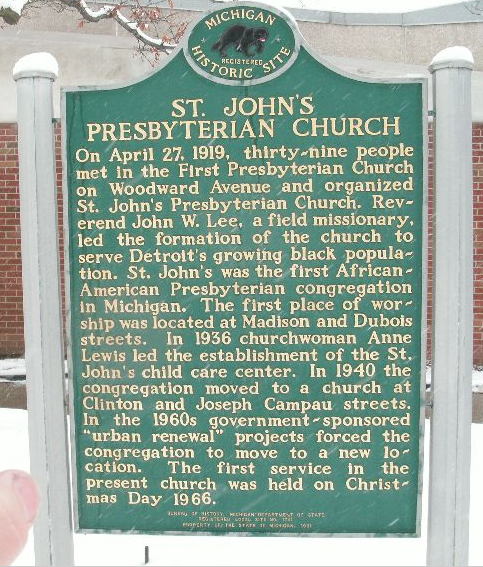
First, even though I thought I had done this before with no success, I asked my cousins to ask their mothers what church they had attended as children in Detroit. The answer came back – St. John’s Presbyterian Church. At first I thought there was some confusion because I knew that my father had been pastor of St. John’s Congregational Church in Springfield, Mass. and St. Mark’s Presbyterian Church in Detroit but St. Johns Presbyterian? I didn’t remember ever hearing of it before. So, I googled it and found that not only was there a St. John’s Presbyterian Church in Detroit but that my Cleage grandparents were among founders and that it was founded in 1919, the same year my Graham grandfather was participating in the founding of Plymouth Congregational Church, also in Detroit, also on the East side. I looked for more information on St. Johns. I searched for even one photograph of the old church. I came up with very little. I looked through the family photos for something that looked like it was taken at a church but also found nothing aside from a few where the family is on their way to church. I did find the information below.
“We, the believers in Christ members, are very proud of our rich heritage. We rejoice always; give praise and thanksgiving to our Lord for His abundant blessings of the faithful shoulders we stand on. We accept our charge of ensuring an African-American Presbyterian witness for our Lord in the city of Detroit, Michigan and beyond to the glory of God! St. John’s Presbyterian Church was among the new congregations formed because of the migration. In the winter of 1917 Reverend J.W. Lee, “field secretary for church extension among colored people in the North,” came to Detroit hoping to establish a Presbyterian church. He was disturbed by the fact that many migrants of the Presbyterian faith had turned to other denominations because there were no Presbyterian churches in Detroit. In April 1919 Lee organized thirty-nine believers into a new congregation. He served as pastor until 1921, when he recruited a southern preacher front Alabama to take his place. By 1925 the Sunday services at St. John’s were so popular that some people arrived as much as three hours early in order to secure seats. Hundreds of persons had to be turned away at both Sunday and weekday services.” One clarification, there were Presbyterian churches in Detroit but they were white.
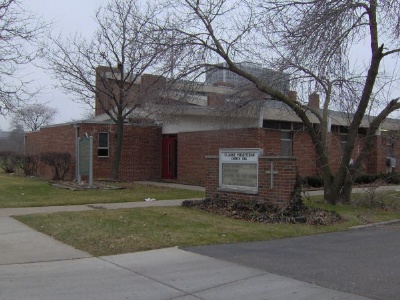
Something the churches my grandparents helped fond have in common is that they were both urban renewed and torn down to make way for, in the case of Plymouth, a parking structure and I’m not sure what for St. Johns but neither of the historic church buildings are standing today, although both churches are still going strong in their new buildings.
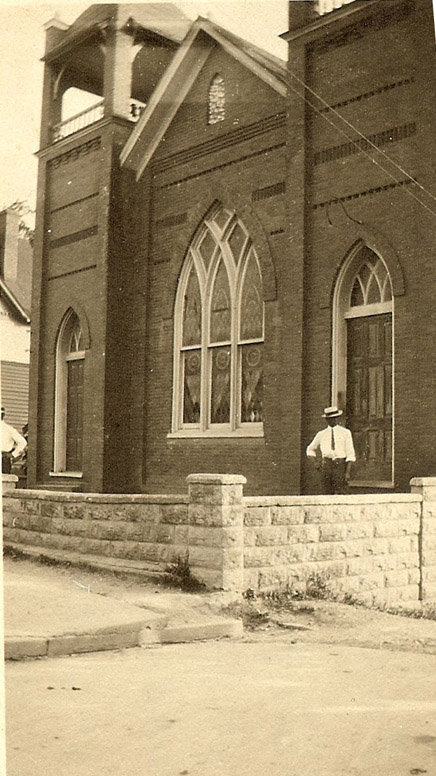
Next I decided to google the church my grandfather, Albert Cleage attended when he was growing up in Athens Tennessee. I found that he was too young to have helped start First United Presbyterian Church, it was founded in 1890 and he was born in 1883. However, his step-father, my great grandmother Celia Rice Cleage Sherman’s second husband, Rodger Sherman, is listed as the architect of the church on Wikepidia. Amazed? Yes, I was. Mr. Sherman and Celia Cleage weren’t married until 1897, First United Presbyterian church had been standing for 5 years by then. The church is still standing and still looking good today.
First United Presbyterian Church – 2004
From the Website “J. Lawrence Cook – An Autobiography” “After a short time at Fisk, just how long I do not know, my father (note: J.L. Cook) entered Knoxville College in Knoxville, Tennessee. [5] He worked to pay his expenses, and was also aided by donations from individuals back in his home town of Athens. In 1888 he received his bachelor’s degree from Knoxville College and entered Allegheny Theological Seminary in Pittsburgh, Pennsylvania to prepare for the Presbyterian ministry. [6] On 9 April 1890 he was licensed as a minister by the Allegheny Presbytery, and with this credential returned to Athens to establish a United Presbyterian mission. Fresh out of seminary, he began holding services in an old dance hall. [7]”
On Monday, 9th January next, we will sell at the Artesian Basin, in the city of Montgomery, at public auction, the following described personal property of the estate of John H. Murphy, deceased:
Seventy-five Shares of Stock in the Montgomery Insurance Company:
Fifty Shares of Stock in Alabama and Florida Rail Road Company
Six Shares of Stock in the Montgomery Gas Light Company.
Also, twenty-three NEGROES, among which are three good brick-layers, and plasters and several fine house servants, cooks, &c. The negroes will be sold in families, and catalogues funished on the day of sale.
Also, a fine Carriage and pair of Horses.
The Stocks will be sold for cash. The Negroes and Carriages and Horses on credit of 6 months, for approved Bills of Exchange with interest from date.
EDMUND HARRISON,
HENRY G. SEMPLE,
Executors of J.H. Murphy, dec’d.
dec 26 – d&wtds [M.]
“Victor Tulane, chairman in charge of the negro (sic) patriotic demonstration to be held here next Wenesday, prior to the registration of the classes of 13-21 and 31-45, has issued the following appeal for a 100 per cent registration to the members of his race:
“As chairman of the colored division of the great “Man Power” celebration, which is to be held in Montgomery Wednesday afternoon, September 11, I desire to take this opportunity to urge all colored male citizens between the ages of 8 and 44 years, who are not already registered, to take advantage of the privilege of participating in this parade.
“Our loyalty and patriotism as a race cannot be questioned.
“We have gladly responded to every call that our country has made upon us during the present struggle for world democracy, and have also demonstrated our loyalty in every previous war in which our country has been engaged.
“The purpose of this Man Power celebration is to arouse public enthusiasm and patriotism so that on registration day, Thursday, September 12, Montgomery and Montgomery county will be successful in having a 100 percent registration of all male citizens within the new draft limit.
With this end in view I beg to impress upon our ministers and race leaders, in the city and throughout the county, to exert their broad influence in helping to make this undertaking a success.”
*****************
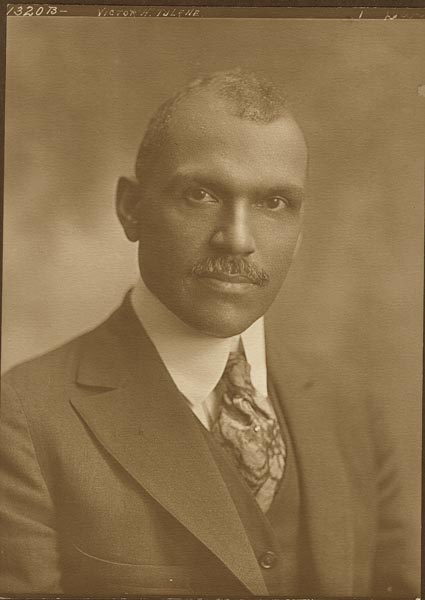
Victor Tulane
I was going to add some facts and figures about how many lynchings of black people took place in the US and Alabama during September of 1918 and that the men he was calling on to step forward and register could not vote or sit where they liked on the streetcars. Not to mention the large upswing in lynchings after WW1, especially of returning soldiers wearing their uniforms. Looking at the statistics and the pictures and thinking about it got too depressing. Did you know they sold postcards of actual lynchings? That one had slipped by me. So, I decided to just run the story and the photo of Victor Tulane and remind you of a few links to letters written in 1918 by young men who were called up or about to be, “Migration story part 2 – Letters from home – Montgomery to Detroit 1918” and “To be Where You can Breathe a Little Freedom”. And to stories of “Victor H. Tulane Dead” and “He Had Hidden Him Under The Floor“.
Here are my mother’s memories of her great Aunt Abbie, who lived with my grandparents until I was twenty. Aunt Abbie became very frail and was no longer mobile. My aging grandparents were unable to care for her and she was sent to a nursing home where she died several months later.
Abigail Allen Brown
By Doris Graham Cleage
Aunt Abbie married a Mississippi Riverboat gambler, swarthy and handsome and no good, who stayed home on two visits long enough to give her two sons and then sent her trunks of fine clothes to wear or to sell to take care of herself and the boys. Whenever she talked about him she sounded like she hated him. She resented the lack of money. Said once the oldest boy Earl (named for his father) screamed for days with toothache and she could not take him to the dentist, who didn’t want any fancy clothes or jewelry. She resented raising the children alone. I got the feeling she hated them and they hated her and she resented him being off having a good time while she stayed home with the problems.
She talked about him in a completely different way than she talked about her Jewish policeman, who bought her a house on Ripley St. Spent much time there, for whom she loved to cook and keep house. She came to live with Mother to take care of Daddy(!) so Mother could come to Springfield and help me when Kris was born. In later years when they lived on Fairfield, Mother and Daddy used to argue about this and they would call me in to referee. He’d say he took Aunt Abbie in out of the goodness of his heart like all the rest of her family. And she was not supposed to stay on (!) them forever but was to go to live with Aunt Margaret. Mother would say Aunt Abbie came to take care of him because (here she would make a mouth at me) he could not take care of himself and work even though he could cook better than she and do everything else in the house too. (I think we are always angered at the way men can say this is the limit. I can’t or I won’t do this or that and we seem to have lives where you do what is to be done since you have no one who will hear you if you say you can’t or won’t. Hold my hand Charlie Brown!) And that he knew very well she was going to live with them and visit Margaret occasionally. Mother was right. He said Aunt Abbie came to have cataracts operated on and to be taken care of. He was wrong. Her eye operations came years later. He said to me once that he had always taken care of Mother’s people and she would have nothing to do with his. I know how Grandmother depended on him to fix things around their house. And he was most agreeable and I always thought he loved it. They made over him when he came with his box of tools. I was always there as helper, but he got very tired and mistreated about having both Alice and Aunt Abbie to take care of. He didn’t like either one. But I never could get him to send them to a nursing or residence home to live. He always said “What would people say if I did that?” When people talk like that I give up because they are obviously making the choice they prefer.
Back to Aunt Abbie. She loved to cook and do everything else about the house. Mother would not let her do anything except clean her own room and do her own washing and ironing…..and Mother hated everything about housekeeping except cooking; but she said her husband expected her to take care of him and his house and (she didn’t say this,) she’d be damned it she’d let anyone else do it as long; as she could. I couldn’t talk to her about it.. Aunt Abbie tried to get her sons to let her come to NY and live with them. They wouldn’t even answer her letters. Sad.
Note: I remember her son Alphonso visiting several times. Aunt Abbie was fixing him tongue because he really like it. KCW
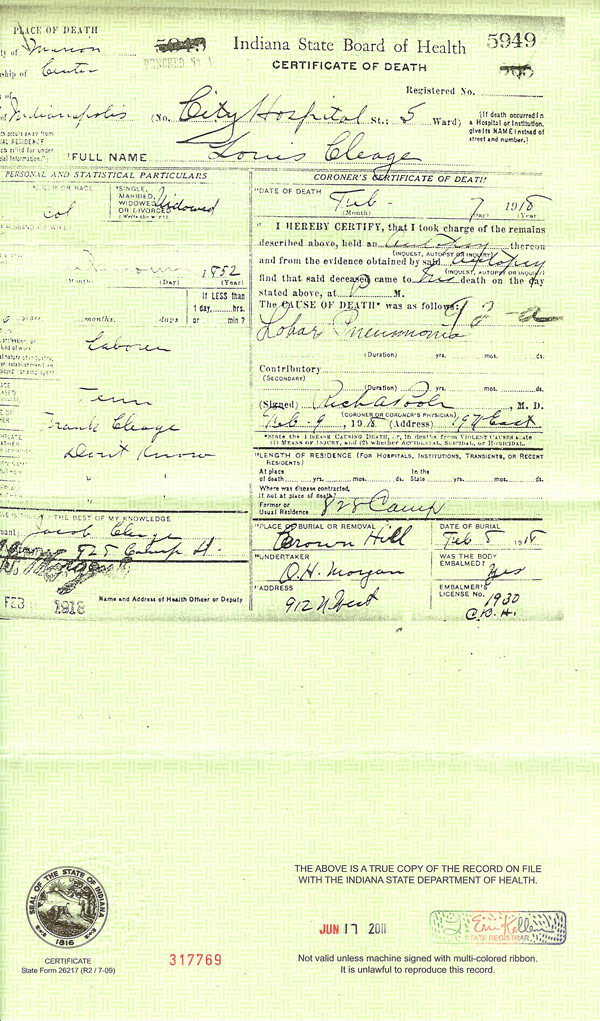
I recently found out that my Great Grandfather Louis Cleage died in Indianapolis, Indiana in 1918 through a listing for Crown Hill Cemetery. I previously found him listed in the 1918 Indianapolis City Directory living son Jacob Cleage.
The death certificate says he died in Marion County, Indianapolis, Center Township at City Hospital and his full name is Louis Cleage. He was Colored and widowed. He was born in 1852 in Tennessee. He was a laborer. According to the informant, his son Jacob Cleage, Louis’ father’s name was Frank. Mother’s name unknown.
There was an autopsy performed and he died on February 7, 1918 in the P.M. of Lobar Pneumonia. His son Jacob lived at 925 Camp Street and Louis’ last address is listed as 828 Camp. He was buried at Crown Hill Cemetery Feb. 8, 1918.
What new information did I learn or have confirmed from this death certificate? I found that his father’s name was Frank Cleage. In the 1870 US Census Louis Cleage, born around 1852, was living with an older adult named Frank Cleage in Athens, TN. I assumed that Frank was Louis’ father, but relationships were not noted in the 1870 US Census.
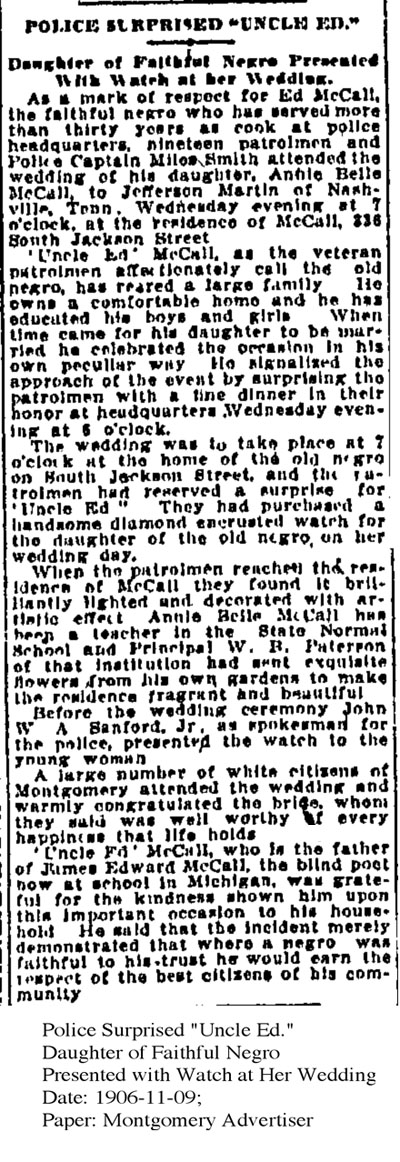
Here is another article I found recently on Genealogy Bank about Edward McCall and his family. I appreciate the information I find in these articles, I had been unable to find the date of Annie Belle’s marriage to Jefferson Martin before. I appreciate the atmosphere of the times that I get but I find the condescending racism very grating. At any rate, this article certainly gave me a picture of their large house decorated with lights and flowers and glowing for their oldest daughter’s wedding. Annie Belle was the first of the McCall children to marry and the first of Eliza’s grandchildren to marry. Mary Allen McCall was a fine seamstress and I’m sure the wedding gown was beautiful. Maybe one day a photograph will surface!
POLICE SURPRISED “UNCLE ED.” ________________ Daughter of Faithful Negro Presented With Watch at her Wedding.
As a mark of respect for Ed McCall, the faithful negro who has served more than thirty years as cook at police headquarters, nineteen patrolmen and Police Captain Miles Smith attended the wedding of his daughter, Annie Belle McCall, to Jefferson Martin of Nashville, Tenn. Wednesday evening at 7 o’clock, at the residence of McCall, 336 South Jackson Street.
“Uncle Ed” McCall, as the veteran patrolmen affectionately call the old negro has reared a large family. He owns a comfortable home and he has educated his boys and girls. When time came for his daughter to be married he celebrated the occasion in his own pecullar way. He signalized the approach of the event by surprising the patrolmen with a fine dinner in their honor at headquarters Wednesday evening at 6 o’clock.
The wedding was to take place at 7 o’clock at the home of the old negro on South Jackson Street, and the patrolmen had reserved a surprise for “Uncle Ed”. They had purchased a handsome diamond encrusted watch for the daughter of the old negro on her wedding day.
When the patrolmen reached the residence of McCall they found it brilliantly lighted and decorated with artistic effect. Annie Belle McCall has been a teacher in the State Normal School and Principal W.B. Paterson of that institution had sent exquisite flowers from his own gardens to make the residence fragrant and beautiful.
Before the wedding ceremony John W.A. Sanford, Jr, as spokesman for the police, presented the watch to the young woman.
A large number of white citizens of Montgomery attended the wedding and warmly congratulated the bride, whom they said was well worthy of every happiness that life holds.
“Uncle Ed” McCall, who is the father of James Edward McCall, the blind poet now at school in Michigan, was grateful for the kindness shown him upon this important occasion to his household. He said that the incident merely demonstrated that where a negro was faithful to his trust he would earn the respect of the best citizens of his community.
This article appeared in The Montgomery Advertiser, November 9, 1906 For photographs and more information about Annie Belle McCall Martin and her family click Their Own Marching Band and More About Annabell’s Family.