Category Archives: Cleages

Prelude to Freedom

Slavery on the Cleage Plantations

This is a brief summary of Samuel, Alexander and David Cleage from 1810 to 1870 as the family went from enslaving no one, to collectively owning over 120 people. These are the plantations on which the people in this series lived during slavery.

Samuel Cleage
Samuel Cleage

Samuel Cleage

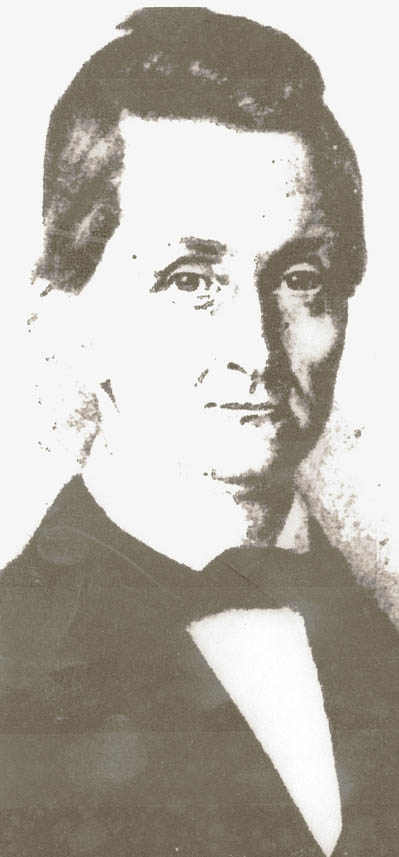
Samuel Cleage was born in 1781 in Pennsylvania.  The family later moved to Botecourt, VA.  His father, Alexander Cleage, had no enslaved persons according to the Federal Censuses he appeared in.

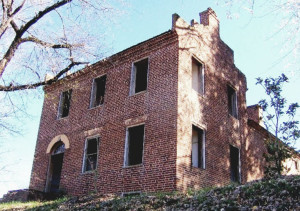
Samuel worked as a building contractor in Virginia. In 1810 he was 29, had a household consisting of 7 white people and 1 enslaved person.  After his parents died in 1823 he moved his whole household to McMinn County, Tennessee.  He was about 42 years old. Read about the move at C is for Cleage Bricks.

The trip took several years because he stopped to build brick houses at farms along the way, collecting pay in gold and enslaved people.  Although some sources say that he arrived with hundreds of enslaved and barrels of gold, the 1830 Census lists a household of 4 free whites and 15 enslaved blacks. After arriving, Samuel picked out a parcel of about 1,125 acres and using enslaved labor, built a fine brick house.  The land that Samuel Cleage bought was part of the land opened for white settlement when some Cherokee, hoping to profit from the already occurring influx of whites, signed the Calhoun Treaty.  It was called the Hiwassiee Purchase.

In a 1834 agreement between Samuel Cleage and his overseer, 7 enslaved persons were named and 2 little boys were unnamed. Some of the tasks mentioned in the agreement are clearing land, distilling and planting. Article of Agreement Between Samuel Cleage and Overseer – 1834.

By 1840 the household consisted of himself and his wife and 23 enslaved people.  Eleven are involved in agriculture.  In the 1850 census Samuel and his wife shared their home with his son David, his wife and 2 small sons.  They now owned 31 slaves, 1,200 improved acres and 20 unimproved with a value of $20,500.  That translates to about $560.000 in today’s dollars. Samuel Cleage died in 1850 at age 69.

Alexander Cleage
Alexander Cleage

Alexander Cleage

Alexander Cleage, born in 1801, was the oldest son of Samuel and Mary Cleage.   He married Jemima Hurst in 1832 when he was 31.  She brought 4 enslaved women to the marriage.  One was my 2X great grandmother. They were named in her father Elijah Hurst’s Will.  The first census I found him was for 1840. There were 6 white family members and 4 slaves – 3 women and a boy. That is 1 less woman than the 4 that came to the marriage.

By 1850, Alexander was a bank officer.  There were 9 white family members and 31 slaves, 24 women and 7 males.  His real estate was worth $5,750.  In 1852 there was some moving around of slaves from Samuel Cleage’s estate and Alexander came into possession of 12 named slaves.  In 1857 there was a bill of sale for an unnamed slave.

In 1860, Alexander was a farmer with estate was worth $43,500 and a personal estate worth $55,000.  There were 7 family members, 52 slaves and 8 slave dwellings.  He wrote his Will that year and gave the names of the 12 slaves his wife received at her marriage and “their increase”, plus two men.  I only recognize 2 of the names as being the same as those in Elijah Hurst’s  Will.

In 1870, Alexander was a 69 year old farmer.  He owned land worth $40,000 and his personal estate was worth $20,000.  Two of his 2 children, a young man 23 and a girl 13, at home and both attended school during the past year. Everyone in the family was literate.  There are no slaves in the household, but the 16 year old live in black servant is illiterate and she has not attended school during the past year.

David Cleage
David Cleage

David Cleage

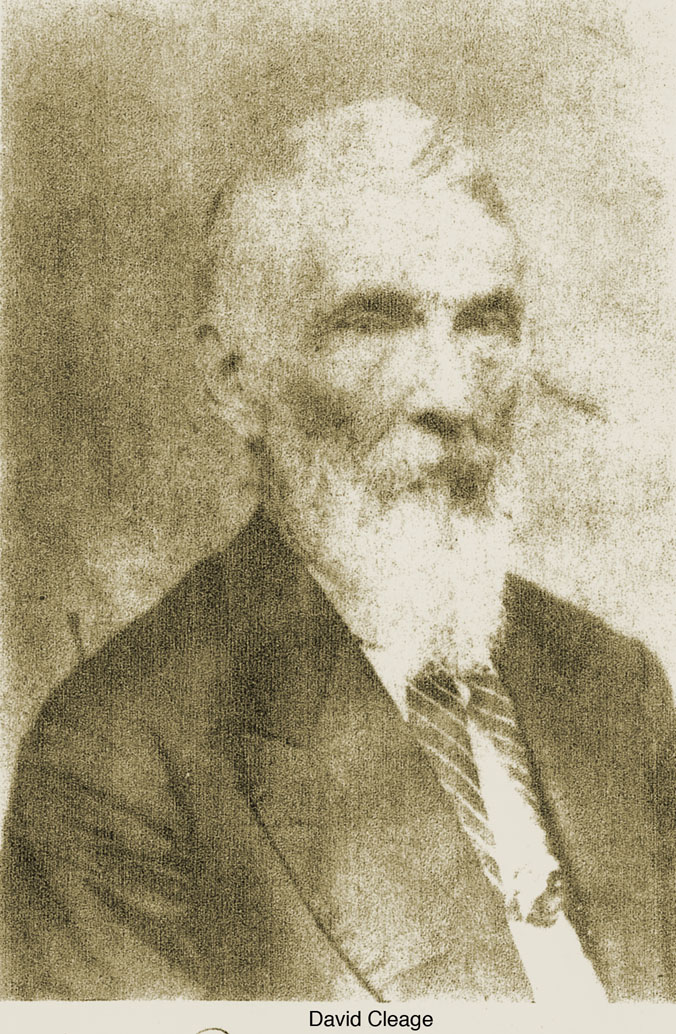
David Cleage was born in 1806 in Virginia.  I have 2 bills of sale for 3 named slave boys, ages 10, 11 and 13 for 1841 and 1842.  In 1846 David married Martha Bridgman.  She brought at least 1 enslaved girl with her, Charlotte who was about 10.

In 1850, David Cleage was 44. He was a cashier at the bank in Athens, TN.  His real estate is valued at $1,000.  He and his family are sharing a home with his parents.  He owns 32 slaves.

By 1860, the number has risen to 75 slaves living in 8 slave dwellings. He is still a cashier at the bank, real estate worth $2,000 and personal estate worth $90,000.  The household includes 5 family members and an overseer.

In 1870 David was 64,a   retired banker with real estate worth $18,700 and a personal estate worth $41,995.  All 7 people in the household are literate. The children between ages 21 and 8 attended school within the last year.

 Sources:  I used documents founds on Ancestry.com and Familysearch.com, several bills of sale that I have copies of, “The Cleage Slaves and the Bricks of History” by Joe Guy and “Botetourt County, Virginia Heritage Book – 1770-2000”

From Slavery to Freedom – 56 Former Cleage & Hurst Slaves

I pulled this list together using documents from the plantations of Samuel, Alexander and David Cleage and Elijah Hurst. All four were located in McMinn County, Tennessee. During 2015, I am going to go through the list and write about each person that I can find after Freedom in 1865. I completed 4 earlier.  You can read their story by clicking on the linked names.  I will start tomorrow with a general description of each plantation.

  1. Bill Cleage – 1807
  2. Henry Cleage – 1824
  3. Lea Cleage –
  4. Fannie Cleage –
  5. Peter Cleage – 1817
  6. Jerry Cleage – 1831
  7. Bob Cleage- 1830
  8. Jim Cleage 11832
  9. Big Annie Cleage
  10. Matilda Cleage
  11. Charity Cleage – 1838
  12. Caroline Cleage – 1836
  13. Jim Cleage  – 1822
  14. Joe Cleage  – 1844
  15. Sally Cleage  – 1842
  16. Arch Cleage  – 1836
  17. Margth Cleage   – 1838
  18. Charles Cleage  – b.1828
  19. Mary Cleage  – 1821
  20. Henry Cleage  – 1848
  21. Lydia Cleage   – 1851
  22. Joe Cleage  – 1808
  23. Jane Cleage  – 1834
  24. Lynd Cleage  – 1841
  25. Frank Cleage  – 1813
  26. Phillip Cleage  – 1831
  27. Lewis Cleage  – 1830
  28. Sam Cleage  – 1850
  29. Jeff Cleage  – 1837
  30. Martha Cleage  – 1831
  31. Lea Cleage  – 1818
  32. Julian Cleage  – 1809
  33. Patsy Cleage  – 1847
  34. Amy Cleage – 1825
  35. Jeff Cleage – 1858
  36. Juda Cleage – 1814
  37. Charles Cleage – 1848
  38. Angelen Cleage – 1850
  39. Lewis Cleage – 1852
  40. Laura Cleage – 1859
  41. Frank Cleage – younger than Laura
  42. Jane Cleage –
  43. Adaline Cleage –
  44. Tom Cleage –
  45. Frank Cleage – 1816
  46. Tom Lane Cleage –
  47. Harry Hurst
  48. Jeff Hurst
  49. Rachel Hurst
  50. Peter Hurst
  51. Auston Hurst
  52. Tom Hurst
  53. Nancy Hurst
  54. Judi Hurst
  55. Jerry Hurst
  56. Dorcus Hurst (bill of sale 29 Jan 1827)

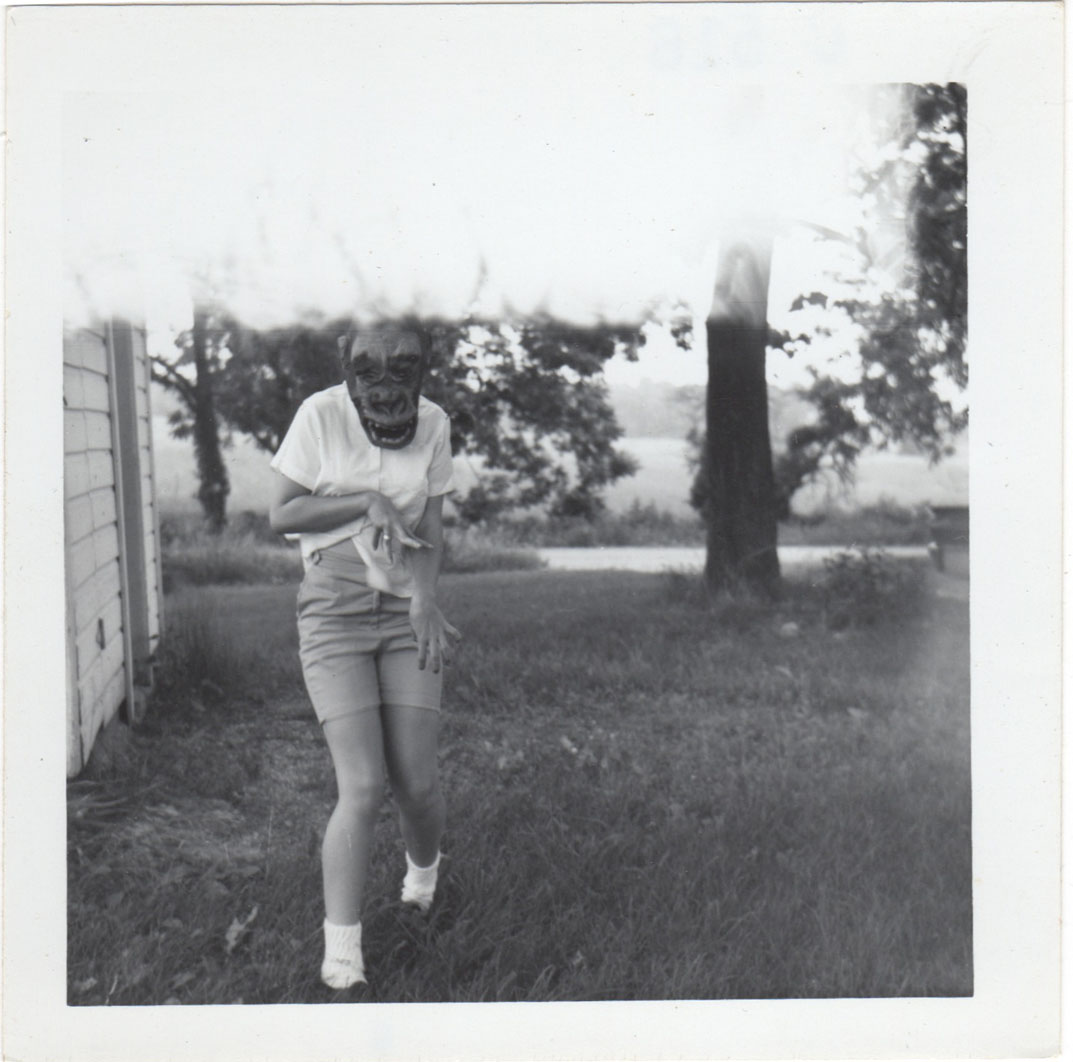
“Anthropoid, anthropoid, don’t kill me yet!”

antrhopoid

My sister Pearl as the anthropoid, about 1961 at Old Plank.

My family had a tradition of chasing the children around while acting like a monster.  My Uncle Louis was the master and didn’t need any sort of mask or costume to send us screaming into the lake at Idlewild.  He just twisted up his face and hands and came towards us and that was it.

My uncle Henry got the mask above from somewhere and incorporated that into the scary chases.  You had to holler out “Anthropoid, anthropoid, don’t kill me yet!”  when he got too close, in order to escape.  Aside from putting on the mask for photo ops, I remember once time we put it on, wrapped in a blanket and sat on the lawn toward the road where we hoped to scare drivers passing the house.  I don’t remember any wrecks so I guess no harm was done.

By the time my children came along, my cousin Warren used to take them on a bear hunt. I remember one time that he worked it out with another cousin to be out in the woods where he drove and stopped and told the kids, who as I remember were in the back of a pickup with a camper, that they were waiting there to see the bear.  The other cousin starting growling and knocking on the truck and finally my cousin drove off, it was dark or almost dark. He said they had a close escape.  Later, when we were all inside, the other cousin came around tapping on the windows.  The bear!

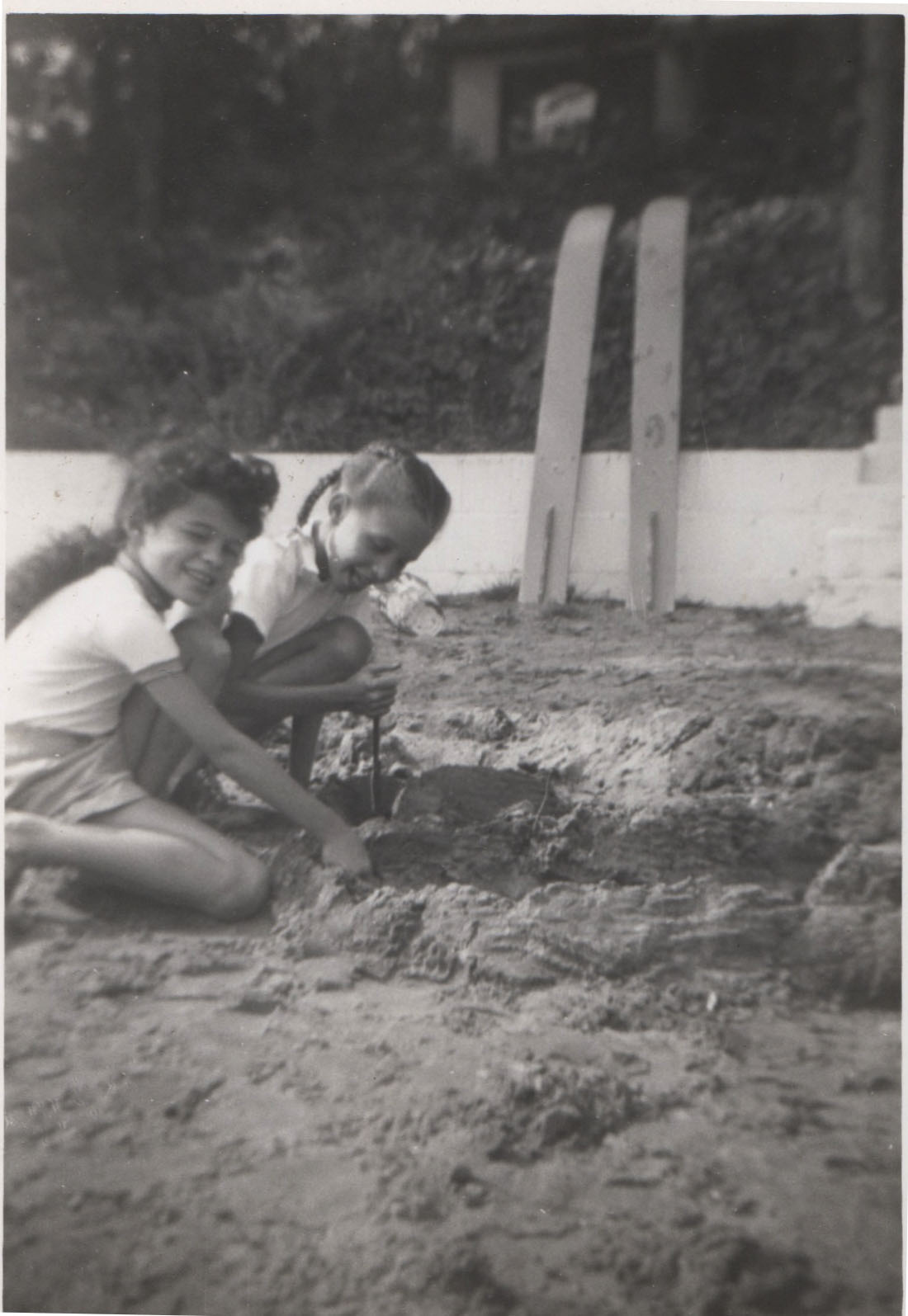
My cousin and me playing in the sand during the visit Louis chased her into the lake.
My cousin and I playing on the beach in Idlewild. During the visit my uncle Louis chased her into the lake. July 1955.

Nobody was terrified of the bears or monsters, well maybe my cousin Barbara who did run into the lake, but mostly it was the enjoyable kind of being scared while knowing you are safe.

The Death of Sam Cleage – part 2

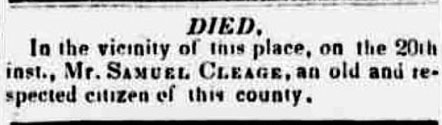
sammuel cleage deadI have looked for the original article about the death of Samuel Cleage in 1850 with no results, other than this short item.  After reading the obituary, I noticed the following items along with ads for ink, land, “newest goods” and the Forest Hill Academy.  There was an article about the new President Filmore and the ads below, which jumped out at me.

The newspaper came from this site Library of Congress Historical Newspapers, The Athens Post.

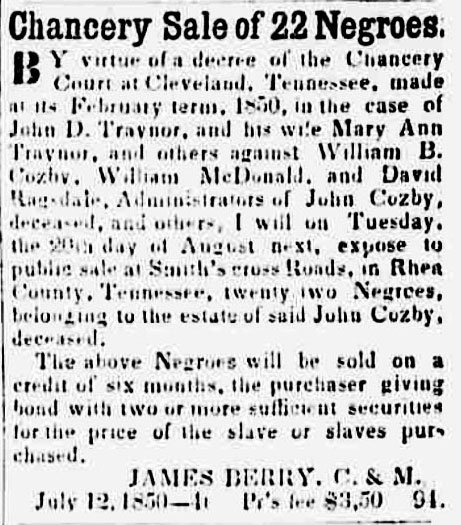
Chancery Sale of 22 Negroes

chancery sale of negroes
Click to enlarge.

“By virtue of a decree of the chancery court at Cleveland, Tennessee made at __ February term, 1850 in the case of John D. Traynor and his wife Mary Ann Traynor and others against William B. Cozby, William McDonald and David Ragsdale Administrators of John Cozby deceased and others.  I will on Tuesday, the 20th day of August next, expose to public sale at Smith’s cross Roads, in Rhea County, Tennesseem twenty two Negroes belonging to the estate of said John Cozby, deceased.

The above Negroes will be sold on a credit of six months the purchaser giving bond with two or more suffcient securities for the price of the slave or slaves purchased.  James Berry C. & M.  July 12, 1850 – 4 Pr’s fee $3.50     94.”

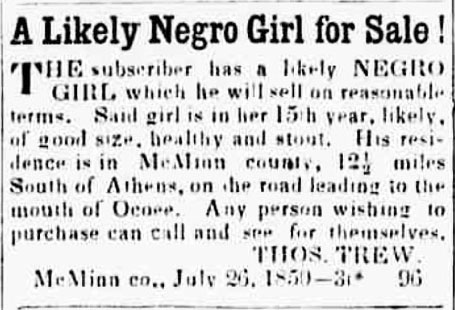
A Likely Negro Girl for Sale!

likely negro girlThe subscriber has a likely NEGRO GIRL which he will sell on reasonable terms.  Said girl is in her 15th year, likely, o good size, healthy and stout.  His residence is in McMinn county, 12 1/2 miles South of Athens on the road leading to the mouth of Ocoee.  Any person wishing to purchase can call and see for themselves              Thos. Trew  McMinn co., July 26, 1850 – 3   96

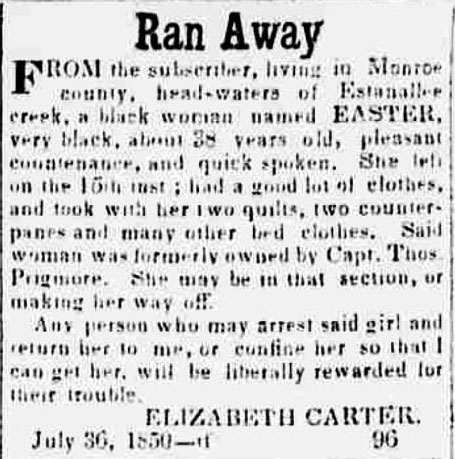
 Run Away

ran away“From the subscriber living in Monroe county, head-waters of Estanallee creek, a black woman named EASTER, very black, about 38 years old, pleasant countenance, and quick spoken.   She left on the 15th last; had a good lot of clothes, and took with her two quilts, two counterpanes and many other bed clothes.  Said woman was formerly owned by Capt. Thos. Pagmore. She may be in that section or making her way off.

Any person who may arrest said girl and return her to me, or confine her so that I can get her will be liberally rewarded for their trouble.  ELIZABETH CARTER, July 30, 1850-   96″

Death of Sam Cleage – July 20, 1850 Athens, TN

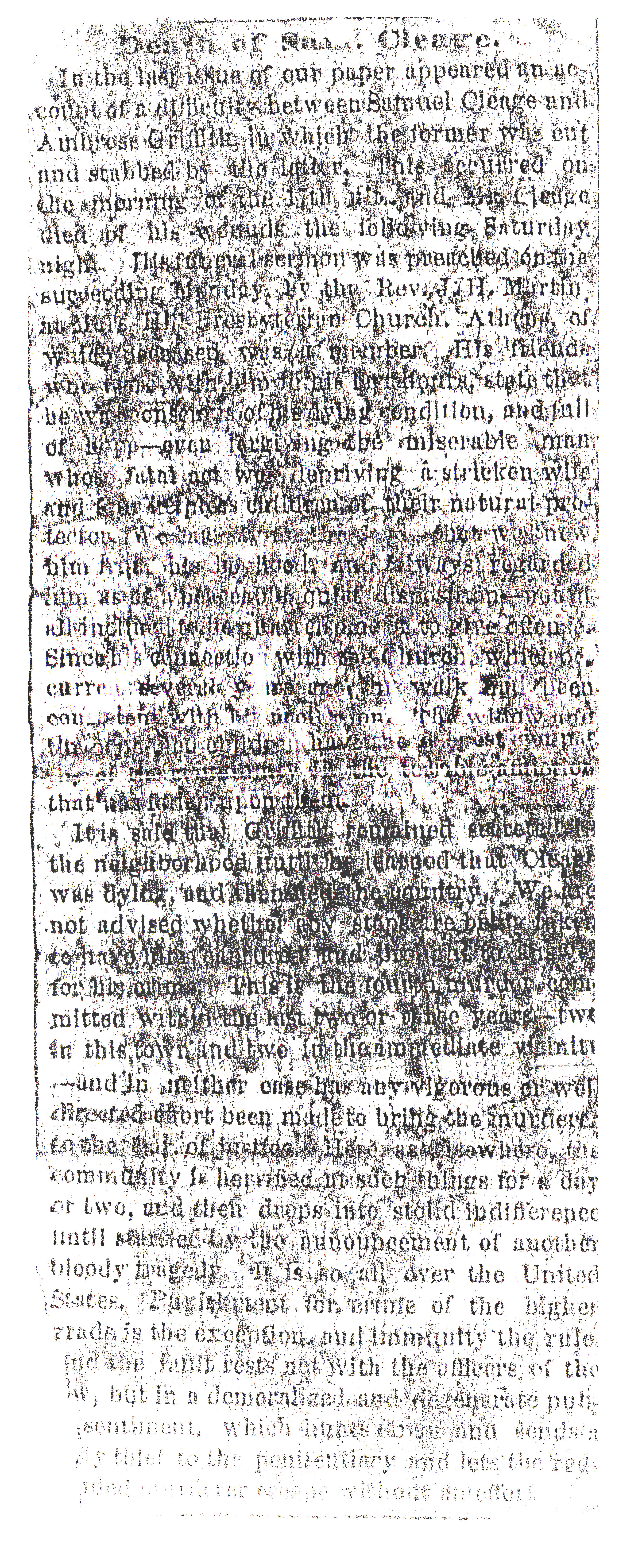
Samuel Cleage was the owner of my 2 X great grandfather, Frank Cleage. In July of 1850, Samuel Cleage was killed by Ambrose Griffith. Unfortunately the only information that I have is a very splochy xerox copy of an article from (I think) a 1850  Athenian Post.  I do not have the previous article that talks about the reason for the argument that led to the murder.  I looked for Ambrose Griffith in the 1840 and 1850 and 1860 census.  The only person by that name was a young man born in 1842 (too young to have been the murderer.)  In 1860 he was overseer for Samuel Cleage’s son, David. 

After Samuel’s death, my great grandfather, Frank ended up with Samuel’s other son, Alexander. He was mentioned in these three documents: A letter to the overseer from Samuel Cleage in 1834,  Bill of sale from David to Alexander Cleage in 1852, The Will of Alexander Cleage in 1860.

Samuel Cleage
Samuel Cleage

Sam cleage dead complete
Click to enlarge.

“In the last issue of our paper appeared an account of a difficulty between Samuel Cleage and Ambrose Griffith in which the former was cut and stabbed by the latter.  This occurred on the morning of the 17th June.  Sam Cleage died of his wounds the following Saturday night.  The funeral sermon was preached on the succeeding Monday by the Rev. J.H. Martin at Mars Hill Presbyterian Church, Athens of which the deceased was a member.  His friends who were with him in his last hours state that he was conscious of his dying condition and full of hope – even forgiving(?) the miserable man who’s fatal act was depriving a stricken wife and  _____  children of their natural protector. We are __________ with him ___ and_____ was regarded him as ________ Since his connection with the church which occurred seven  years ago, his walk had been consistent with _____ actions.  The widow and the ______ children ___ the ___ this afternoon that was___upon them.

It is said that Griffith remained secreted in the neighborhood until he learned that Cleage was dying and then fled the country.  We are not advised whether any steps are being taken to have him captured and brought to ______ for his crime.  This is the fourth murder committed within the last two or three years – two in this town and two in the immediate vicinity-  and in neither case has any vigorous or well directed effort been made to bring the murderer to the seat (?) of justice.  Here as elsewhere the community is horrified at such things for a day or two and then drops into stolid indifference until  startled(?) by the announcement of another bloody tragedy.  It is so all over the United States.  Punishment for crime of the higher grade is the exception and immunity the rule and the fault rests not with the officers of the law, but a demoralized and degenerate public sentiment which hunts down and sends a  petty thief to the penitentiary and lets the red handed murderer escape without an effort.”

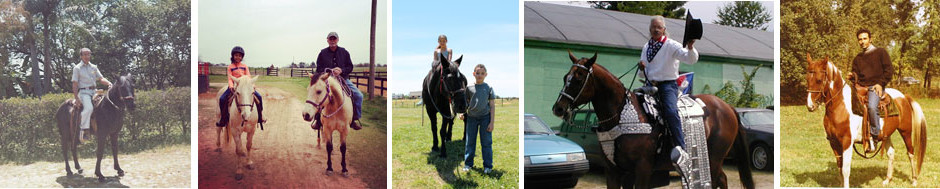
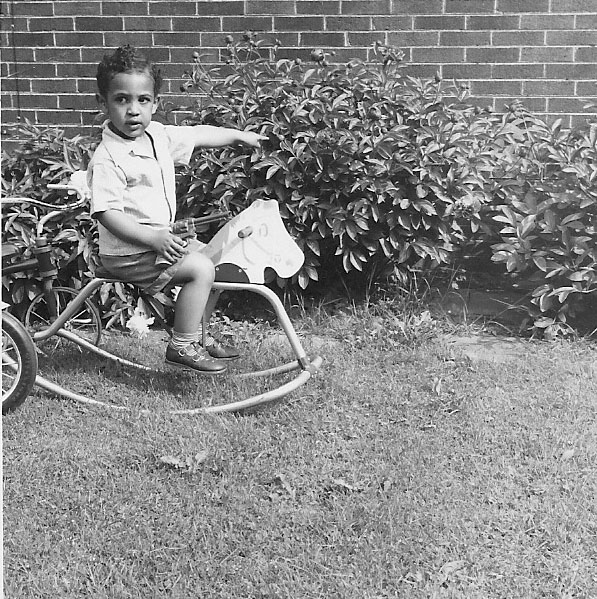
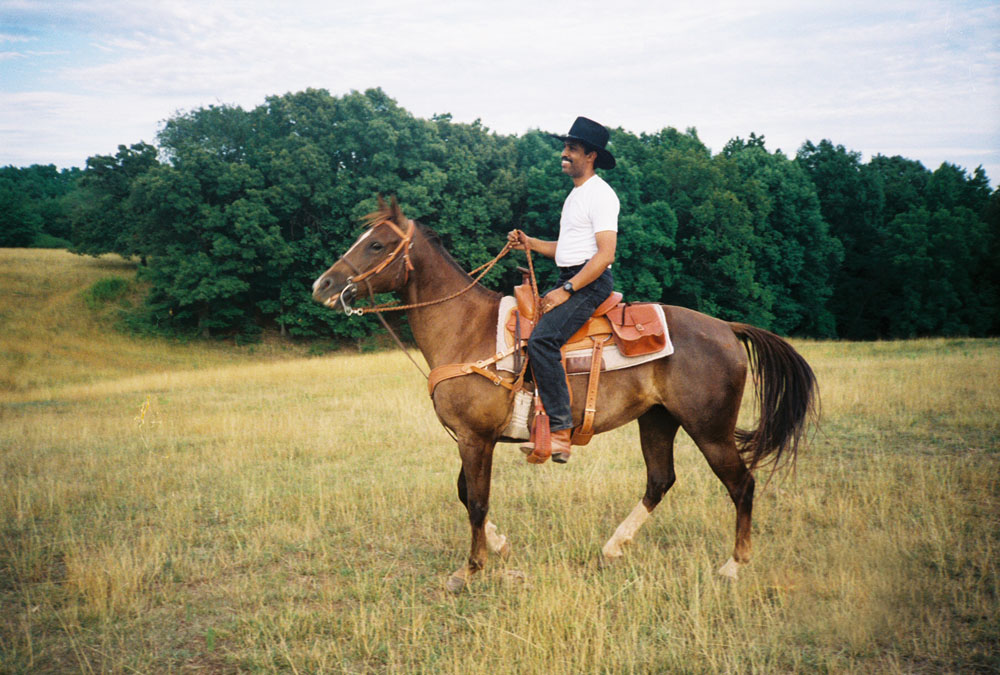
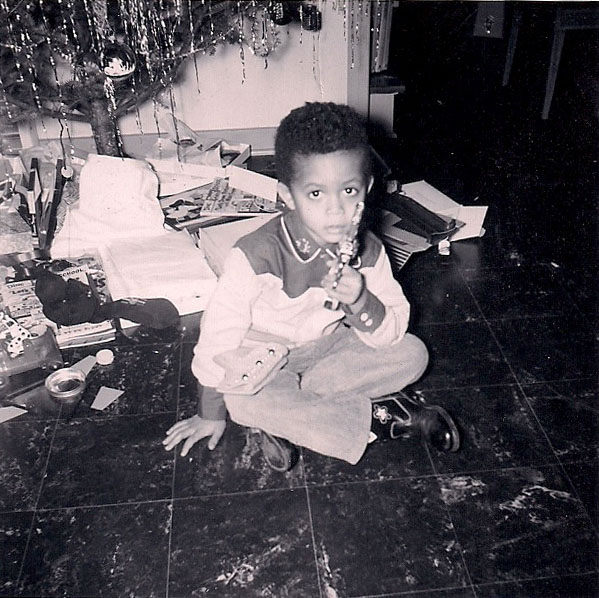
Detroit Cowboys, Then and Now

ernie_on_horse
Cousin Ernest riding his rocking horse, holding his revolver and pointing at the Rhododendrons in my grandmother Cleage’s backyard on Atkinson.

Riding the range as an adult.
Cousin Ernest riding the range as an adult.

Another post about Cousin Ernest – What Is Ernest Doing Now?

warren_cowboy
Cousin Warren back again this week in his cowboy attire. Could be the same Christmas as last weeks. He isn’t wearing his hat, but he had one.

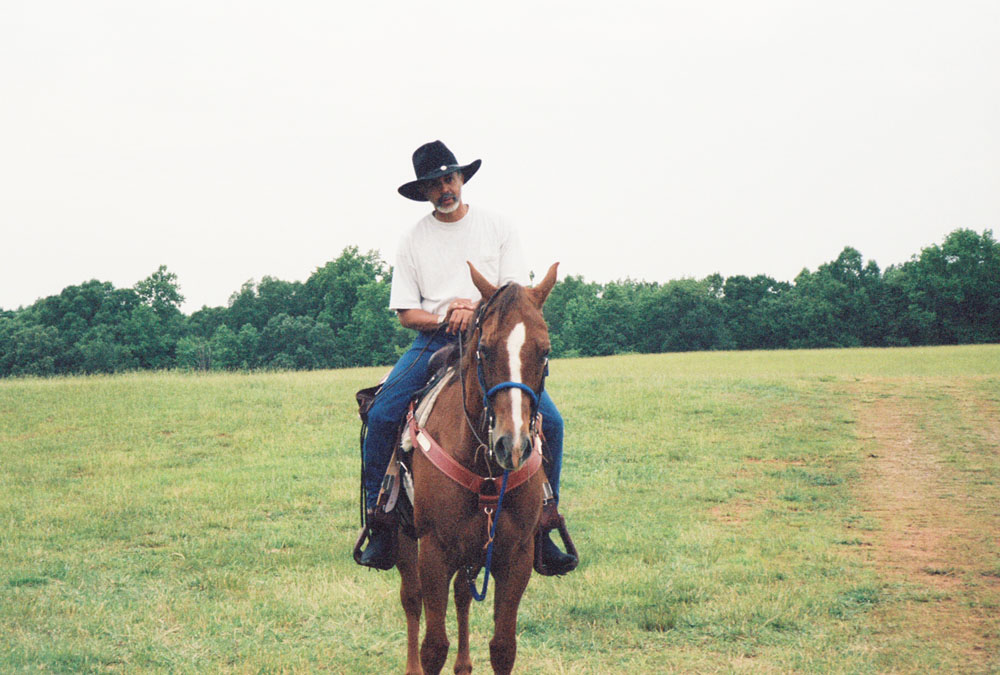
Warren riding in recent times.
Cousin Warren and his horse in recent times.

Other posts about Cousin Warren – Warren’s Christmas Birthday Party,   Warren Evens, Then and Now, A Silhouette of Cousin Warren


To see more Sepia Saturday offerings, CLICK!

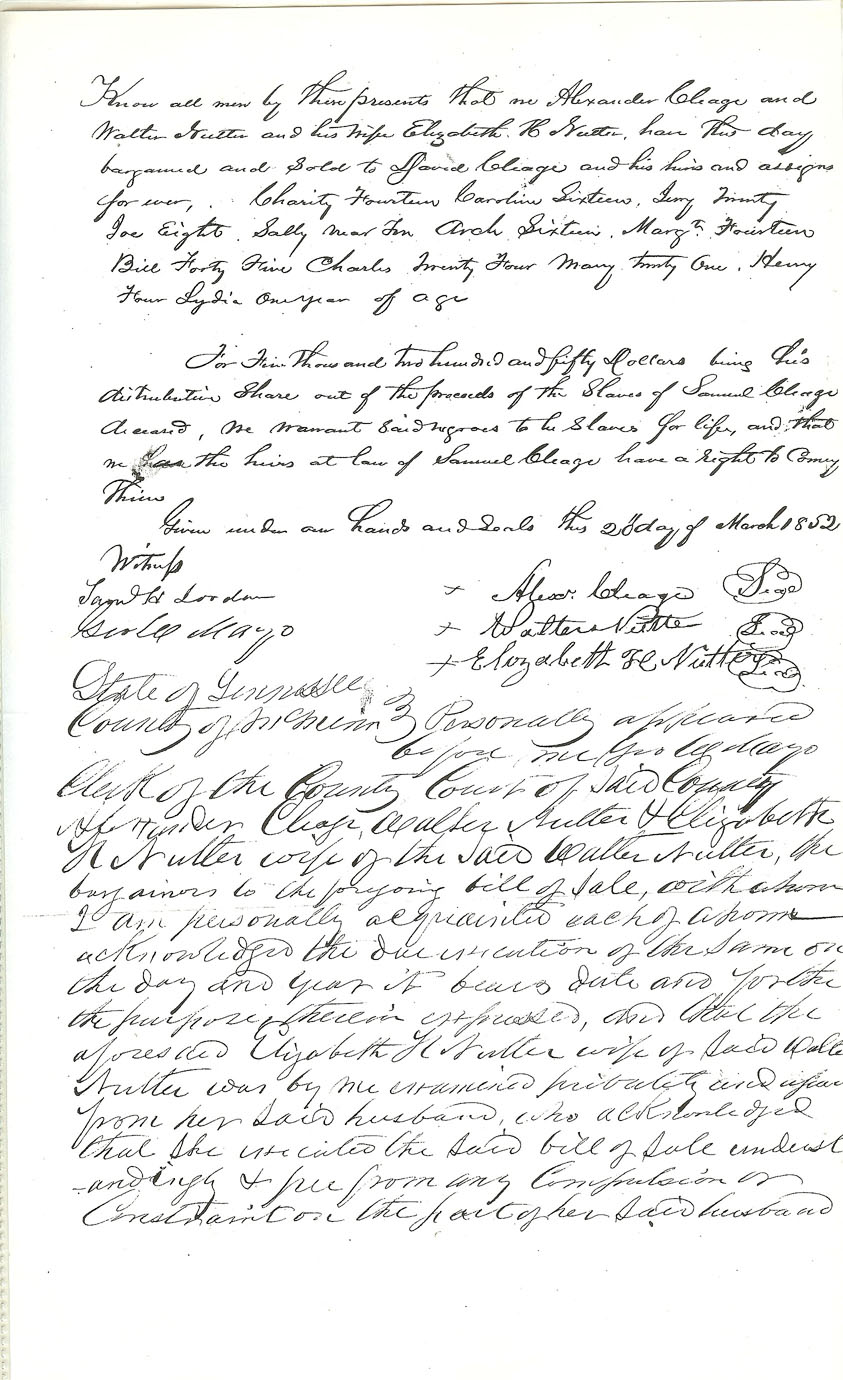
Bill of Sale for Charity, Caroline, Jim, Joe, Sally, Arch, Margth, Bill, Charles, Mary, Henry and Lydia Cleage

This is a copy of a companion Bill of Sale to the one that conveyed my 2 X great grandfather Frank Cleage from David Cleage, Walter Nutter and Elizabeth H. Nutter to Alexander Cleage.  After the death of Samuel Cleage, father of David, Elizabeth and Alexander, died there was some shuffling around of enslaved people, livestock and household property between the sibling.  In each document 12 slaves and the same amount of money are exchanged.  This is one of three Bills of Sale that I have of those transactions.  It is transcribed below. As always, click on them to enlarge.  There was no punctuation in the document and I added none.bill of sale david cleage 5Bill of sale - David Cleage

Know all men by these presents that we Alexander Cleage and Walter Nutter and his wife Elizabeth H Nutter have this day bargained and sold to David Cleage and his heirs and assigns forever Charity fourteen,  Caroline sixteen  Jim thirty  Joe eight  Sally near ten  Arch sixteen  Margth fourteen  Bill forty five  Charles twenty four  Mary thirty one  Henry four  Lydia one year of age

For five thousand two hundred and fifty dollars being his distribution share out of the proceeds of the slaves of Samuel Cleage deceased  We warrant said negroes (sic) to be slaves for life and that we as the heirs at law of Samuel Cleage have a right to convey them

Given under our hands and seals this 20th day of March 1852

Witness

Sam H Jordon                                            Alex Cleage

Geo W Mayo                                      Walter Nutter

Elizabeth H Nutter

State of Tennessee

County of McMinn

Personally appeared before me Geo W Mayo clerk of the county court of said county Alexander Cleage  Walter Nutter and Elizabeth H Nutter wife of said Nutter the bargainers to the above bill of sale with whom I am personally acquainted each of whom acknowledge the due execution of the same on the day and year it bears date and for the purpose therein expressed and that the said Elizabeth Nutter wife of the aforementioned Walter Nutter was by me examined privately and apart from her said husband Walter Nutter who declared that she executed same knowingly & free from any compulsion or restraint on the part of her said husband Walter Nutter

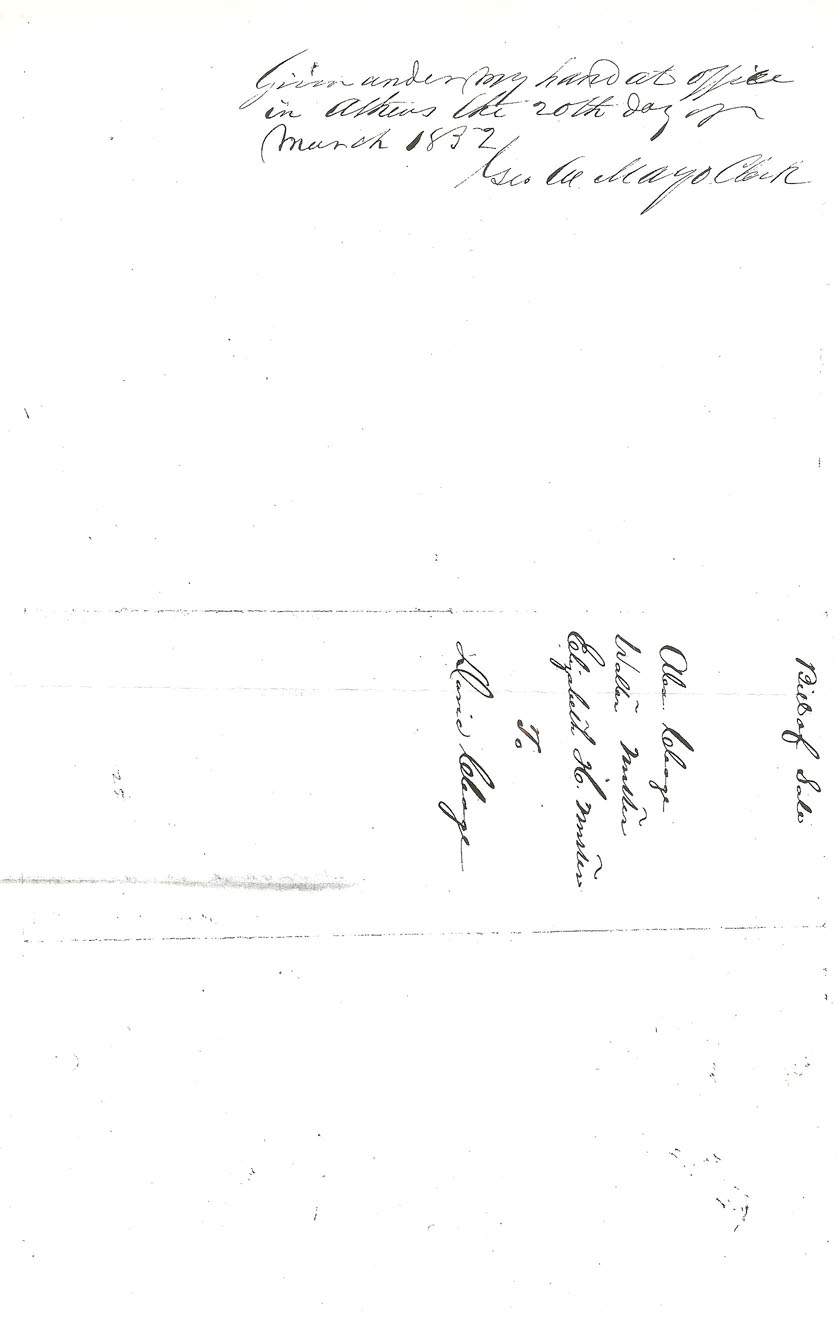
Given under my hand at office in Athens the 20th day of March 1852

Geo W Mayo clerk

Bill of Sale

Alex Cleage

Walter Nutter

Elizabeth H Nutter

to

David Cleage

Bill of Sale for Joe, Jane, Lynd, Frank, Phillip, Lewis, Sam, Jeff, Martha, Lea, Julian and Patsy Cleage

This is a copy of the Bill of Sale that conveyed my 2 X great grandfather Frank Cleage from David Cleage, Walter Nutter and Elizabeth H. Nutter to Alexander Cleage.  After the death of Samuel Cleage, father of David, Elizabeth and Alexander, died there was some shuffling around of enslaved people, livestock and household property between the siblings.  This is one of three Bills of Sale that I have of those transactions.  The documents are transcribed below. As always, click on them to enlarge.  There was no punctuation in the document and I added none.

slave docs cleage to alex
to alex cover

Know all men by these presents that we David Cleage and Walter Nutter and his wife Elizabeth H Nutter have this day bargained and sold to Alexander Cleage and his heirs and assigns forever Joe forty four years of age  Jane eighteen  Lynd eleven  Frank thirty nine  Phillip forty  Lewis twenty six  Sam ten  Jeff five  Martha twenty one  Lea thirty four  Julian forty three  Patsy five

For five thousand two hundred and fifty dollars being his distribution share out of the proceeds of the slaves of Samuel Cleage deceased  We warrant said negroes (sic) to be slaves for life and that we as the heirs at law of Samuel Cleage have a right to convey them

Given under our hands and seals this 20th day of March 1852

Witness

Sam H Jordon                                            David Cleage

Geo W Mayo                                               Walter Nutter

                                                                       Elizabeth H Nutter

State of Tennessee

County of McMinn

Personally appeared before me Geo W Mayo clerk of the county court of said county David Cleage  Walter Nutter and Elizabeth H Nutter wife of said Nutter the bargainers to the above bill of sale with whom I am personally acquainted each of whom acknowledge the due execution of the same on the day and year it bears date and for the purpose therein expressed and that the said Elizabeth Nutter wife of the aforementioned Walter Nutter was by me examined privately and apart from her said husband Walter Nutter who declared that she executed same knowingly & free from any compulsion or restraint on the part of her said husband Walter Nutter

Given under my hand at office in Athens the 20th day of March 1852

Geo W Mayo clerk

Bill of Sale

David Cleage

Walter Nutter

Elizabeth H Nutter

to

Alex Cleage

Louis Cleage & Family – 1880

Loudon County farm land today.

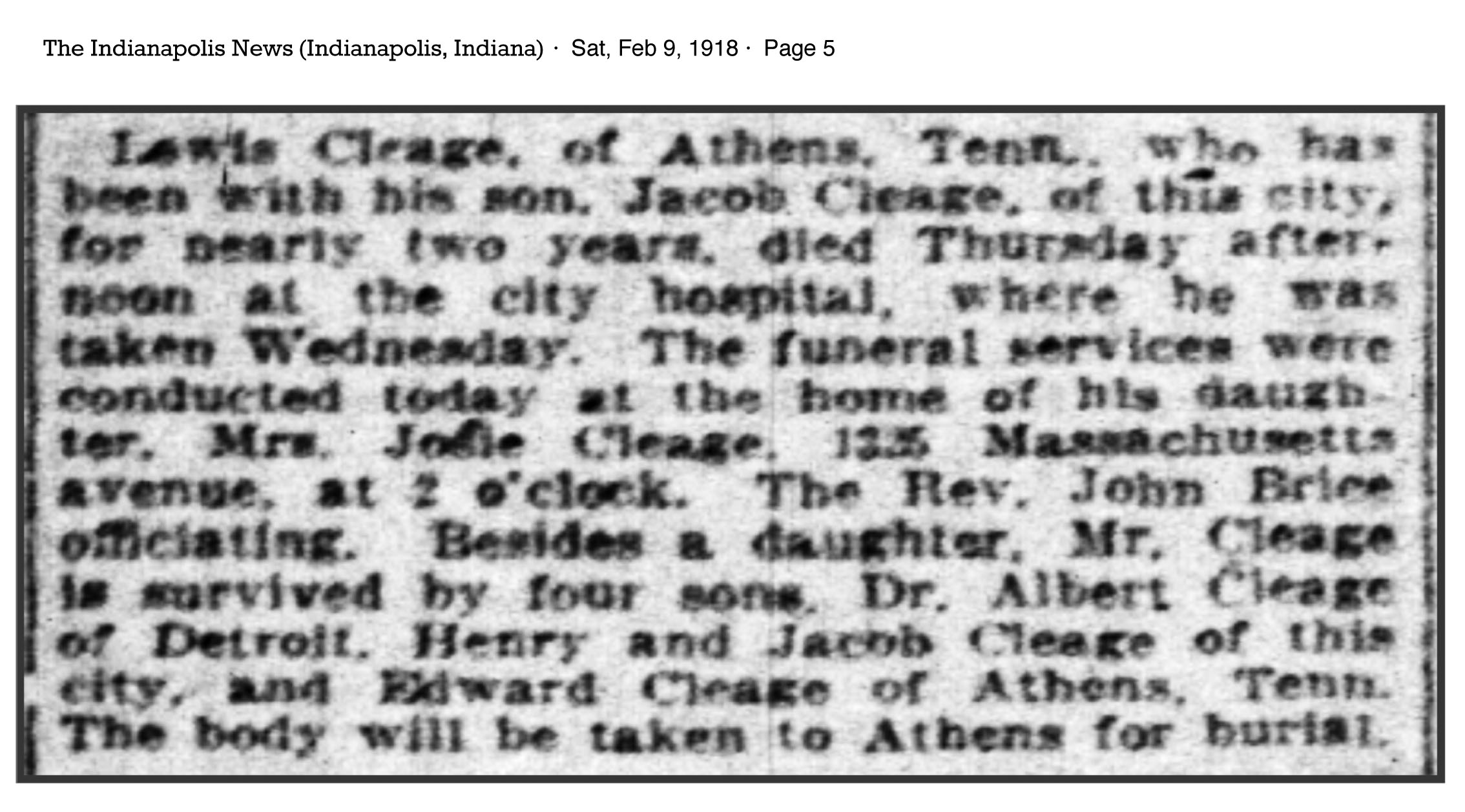
In 1880 my great grandfather Louis Cleage was 28.  His wife Celia (Rice) Cleage was 24. They were farming in Loudon County Tennessee. They had been married for 8 years and were the parents of four children – 7 year old Josie, 5 year old Jacob, 3 year old Henry and 1 year old Edward.  Louis’ 20 year old sister, Tennessee lived with them along with 5 year old Louseny.  Their 5th child, my grandfather Albert,  would not be born until 1882.  None of the adults could read or write.  The children were too young to attend school.

32686_236972-00701n
The census as it appeared on Ancestry.com.

The 1880 Agricultural Census Schedule that includes Louis Cleage are in poor condition.  Parts of it are unreadable because they are blackened. Other parts are pale and blurry making them difficult to read.  This is the information I could make out.  He rented his land for shares of his crops.  He had 15 tillable acres and 5 acres in woodland and forest. The farm, buildings, land and fences were worth $150. Farm implements and machinery were worth $125. The livestock was worth $125. He had 1 milch cow and produced 25 lbs of butter in 1879. I was unable to read if he had any swine, chickens, mules or horses, I hope he did. He had no working oxen.   He planted 25 acres of Indian corn, yielding 100 bushels. He planted 5 acres of oats, yielding 25 bushels and 5 acres of wheat that yielded 25 bushels.

As I was going over the 1880 Agricultural Census for Louis Cleage, I noticed some differences with my 2X great grandfather on my mother’s side, Joe Turner in Lowndes County, AL.  When I compared population censuses, farmers who owned enough land to be included in the agricultural census were further apart in Lowndes County.  There were many farm laborers enumerated in between. The farmers in Loundon County TN were right next to each other in the  population schedule.  Farm holdings were also smaller in Loudon County than in Lowndes County, AL.  I may go into this more in a future post.

By 1991, The Cleages were back in Athens, McMinn County.  This post Louis Cleage – Work Day Wednesday follows Louis through the following decades as he worked in the mines of Birmingham, AL and as a railroad hand.