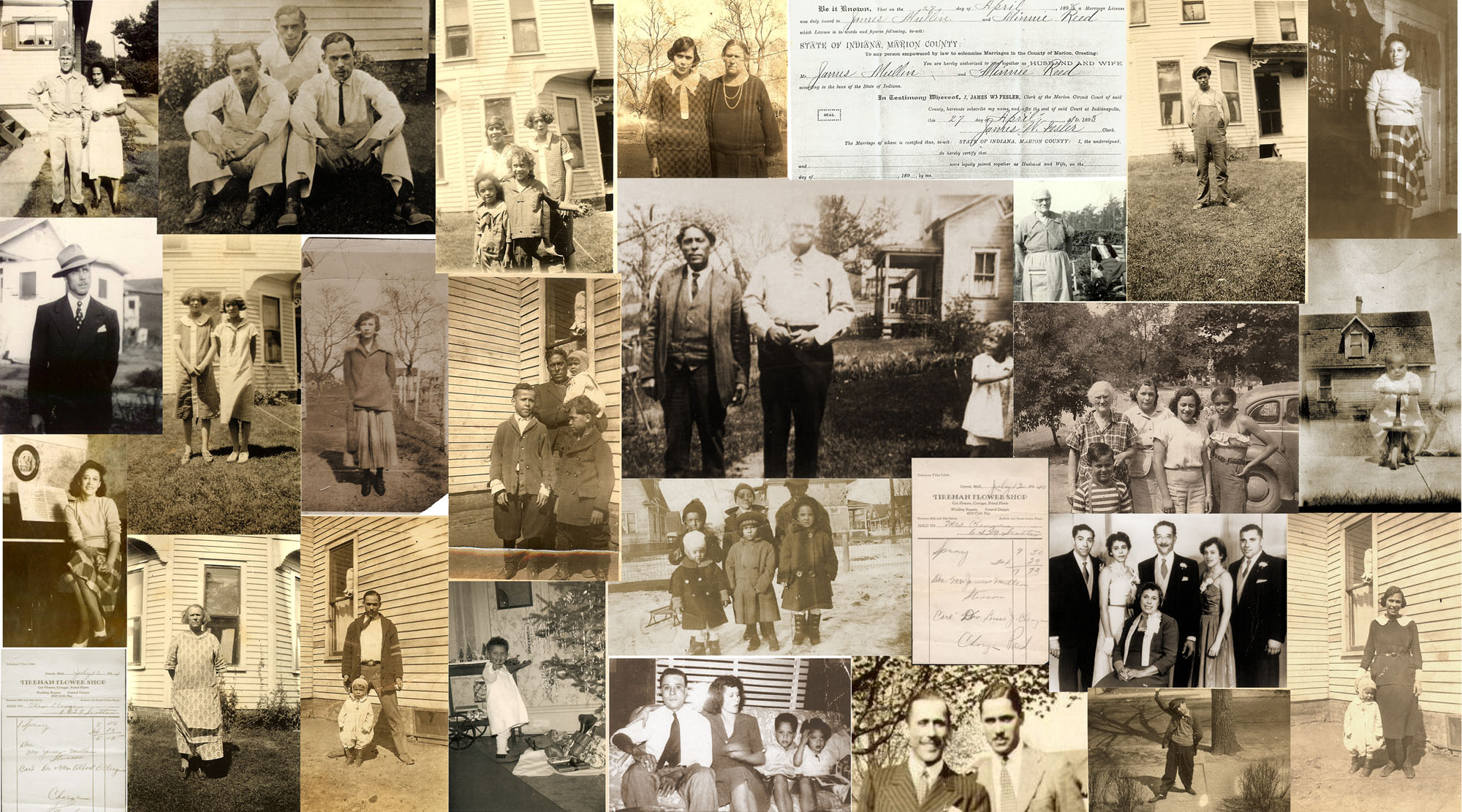
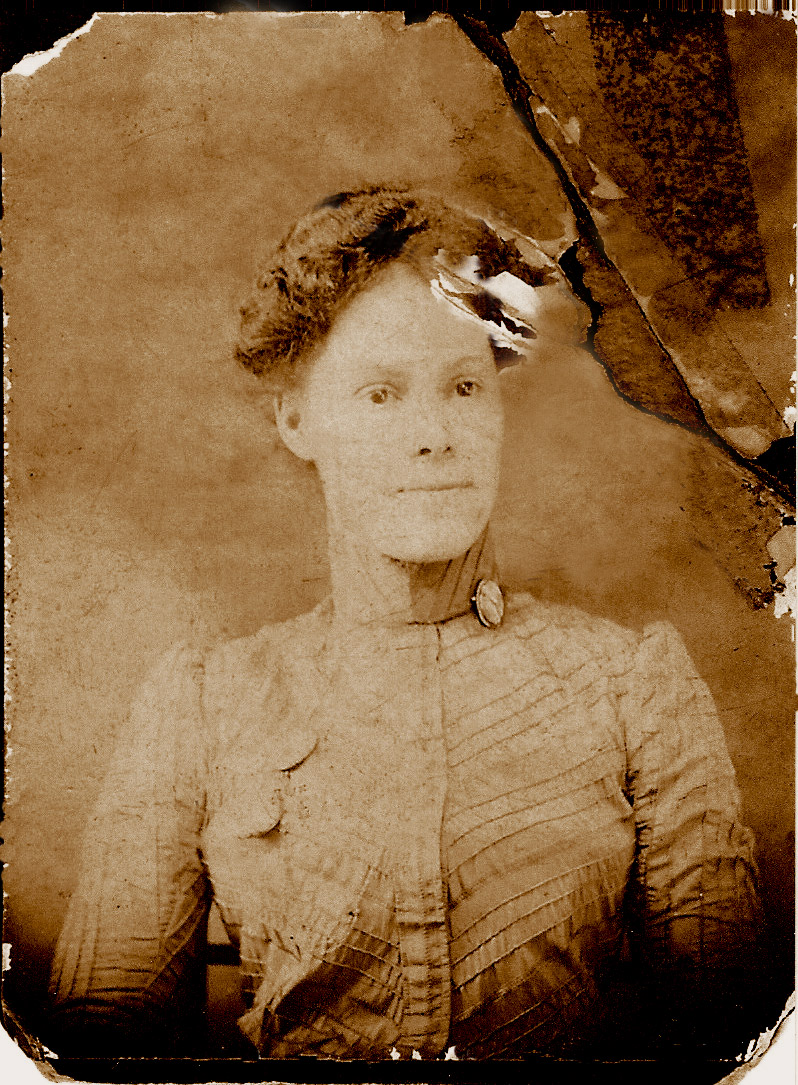
Today I will write about Minnie Averitte Reed Mullins who was my grandmother Pearl’s older sister.
Click to enlarge.
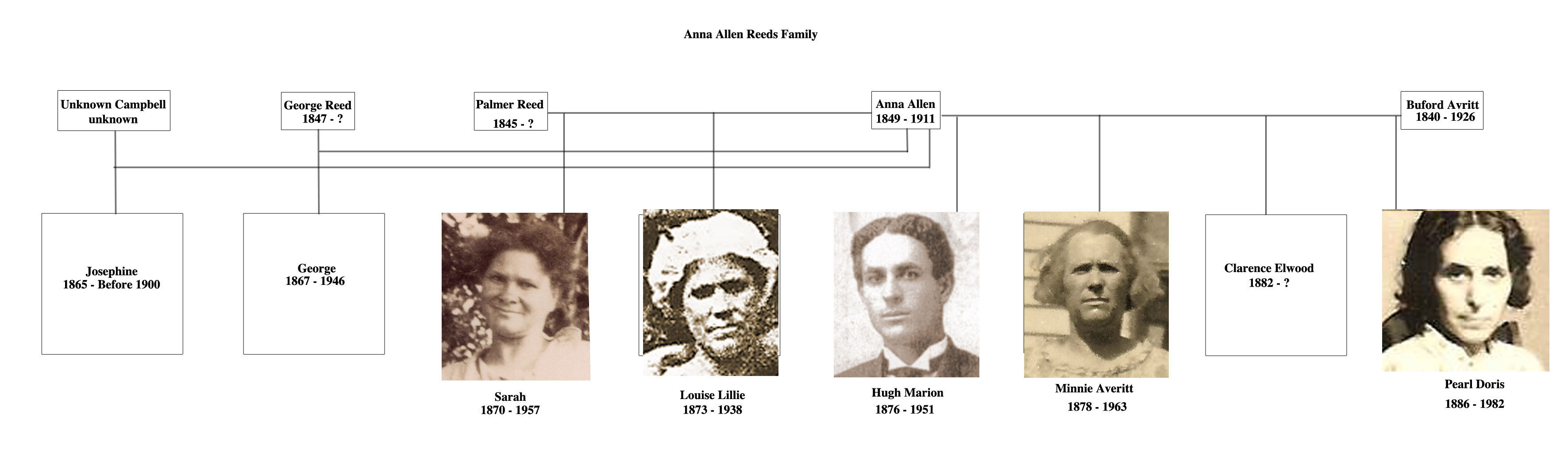
Minnie Averitte Reed was born in Lebanon, Kentucky in 1878. She was the second child of the white Dr Buford Avritt and Anna Allen Reed and Anna’s 6th child. The only story I have of him is that once the family was having a tough time and the boys went and asked for his help and his response was “I know nothing about you people.” The connection has been established by oral history and DNA.
Two year old Minnie first appears in the 1880 census living with her mother and five older siblings in Lebanon Kentucky. Her mother’s parents lived next door.
By 1893 Anna Reed was in Indianapolis, Indiana. Minnie was 15. Her two older sisters had already married and moved to Berrien County, Michigan. In 1898, when Minnie was twenty years old, she married James Mullins. By 1900 they had one daughter, Helen who was a year old. Everyone in the household was identified as “B” for black. James was working as a fireman. At that time the Indianapolis Fire Department had one station with all black fireman. They operated out of the firehouse at 441 Indiana Avenue.
Minnie’s family lived next door to Minnie’s mother.
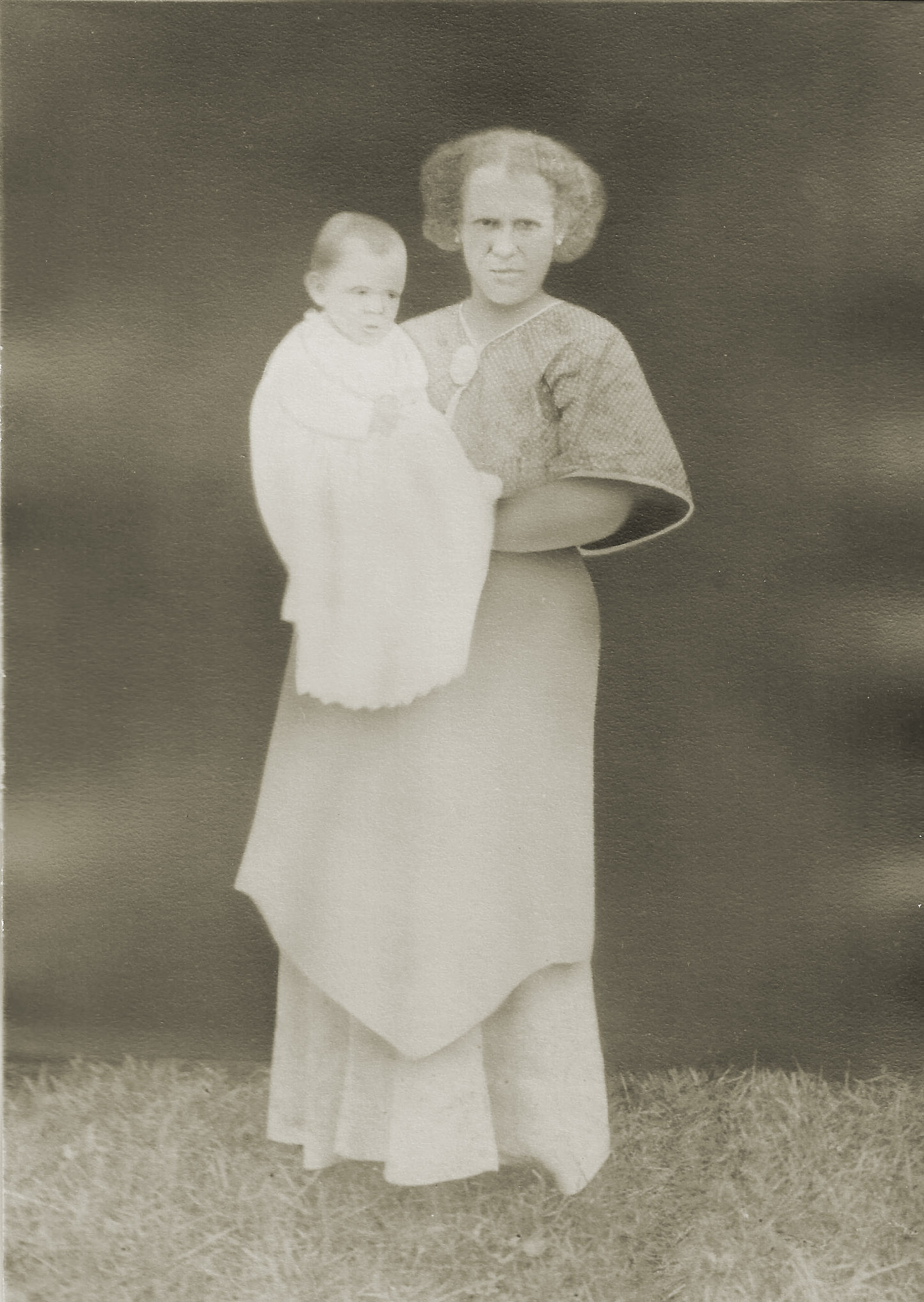
Minnie and baby Bill. About 1912. From the collection of the family of Bill Mullins
By 1910, there were 6 more children. James was born in 1900. Ben was born in 1901. Arthur was born in 1904. Pearl was born in 1906. The twins, Anna and Marie, were born in 1908 and little Minnie was born in 1910. The family was still living in Indianapolis and James Mullins had continued working as a fireman. Everybody was identified as “Mulatto”.
By 1920 the family had moved to Detroit, Michigan. My grandmother Pearl Reed Cleage, Minnie’s younger sister, and her family lived in Detroit. Three more children had been added to the family. William was born in 1913, Harold was born in 1914 and Barbara Louise was born in 1916. James was working as a carpenter at an auto plant. Arthur was working at the Packer Auto Plant. The two oldest boys were around 20 and no longer living in the home.
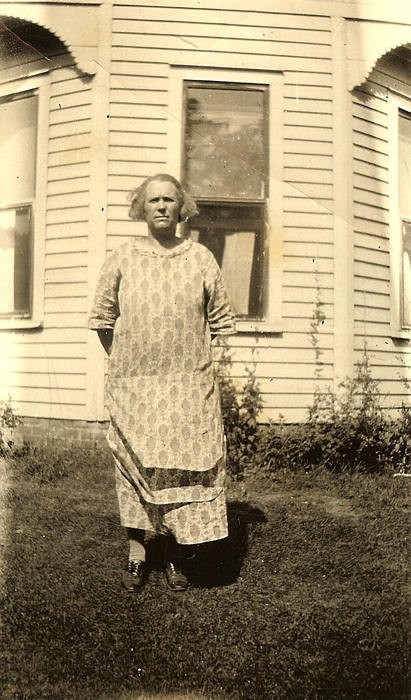
Minnie Reed Mullins about 1926 in front of the family home in Benton Harbor, Michigan
In 1930 Minnie and her family had moved to Benton Harbor, Michigan where her two older sisters and their families lived. Minnie was identified as ‘white’ while the rest of the family was identified as “Indian”, specifically “Cherokee”. James was working as common laborer. Son Arthur, who works at a foundry and is “Cherokee” and his wife were living down the street as was sister Louise Reed Shoemaker. Youngest son, John was 9 years old.
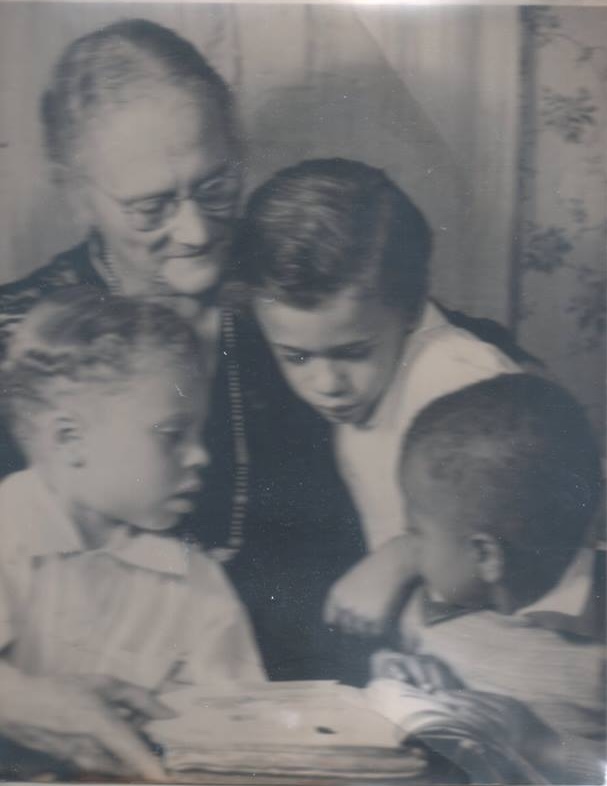
Minnie reading to three of her grandsons
You can read about the Mullins family in 1940 here 1940, Minnie and James Mullins. They were back in Detroit and only three of the sons were still at home. Minnie died in Minneapolis, Minnesota of pneumonia in 1963. She was 84 years old.
MRS. SHOEMAKER, BERRIEN RESIDENT FOR 44 YEARS, DIES
Mrs. Lillian Louise Shoemaker, 63, died at 4:30 a. m. today at her home, 693 Maiden Lane. She was born in Lebanon, Kentucky, October 27, 1874.
She was married to Solonus Shoemaker on June 26, 1891, in Berrien county where she had been resident for 44 years. Mrs. Shoemaker leaves a son and daughter, F. E. Shoemaker and Mrs. Wright, both of Benton Harbor; three sisters, Mrs. Sarah Busby of Benton Harbor, Mrs. Minnie Mullen and Mrs. A. B. Cleage of Detroit; three brothers, H. M. Reed, Clarence A Reed of Chicago, George Reed of Indianapolis, Ind. Friends may view the body at the Reiser mortuary. Funeral arrangements are incomplete.
An obituary leaves out so much of a person’s life. So it is with Lillian Louise Shoemaker’s obituary.
My grandmother’s older sister Lillian Louise Reed was born about 1873 in Lebanon, Kentucky. She was the fourth child of Anna Allen Reed. Her father was Palmer Reed. I don’t know if she was able to attend school, but she was able to read and write later in life.
In the 1880 Census “Lulu” was seven years old. Her family lived on Railroad Street. She lived with her mother, Annie (31) who did washing.
0ldest child, 17 year old Josephine “Josie” had no employment given, but probably helped her mother with the washing, the children, the cooking etc. Brother George was 13 and employed as a servant. Sarah “Sallie” was ten, Hugh was four and Minnie was two. Clarence and my grandmother Pearl had yet to be born, Annie’s mother Clara and her husband James Green, a carpenter, lived next door.
1880 was 16 years after the end of slavery. The people over 16 would have been born into slavery. There were fifty people in nine households on this page. Two households were headed by women. Everybody was identified as mulatto or black. All had been born in Kentucky, as were the majority of their parents. Twenty six were under 17. Five of the children attended school. No one in Lulu’s household did. Two adults could read but not write.
There was one person on the page with consumption (TB of the lungs) and two with scrofula, (a tuberculosis infection of the neck’s lymph nodes). Antibiotics would have cured it in less than a year, but there were no antibiotics.
People worked a variety of occupations. Three worked on farms, four were servants, two drove wagons, three were laborers. There was one each; working at a grocery, working a meat stand, working in a brickyard and as a carpenter. There were four women keeping house.
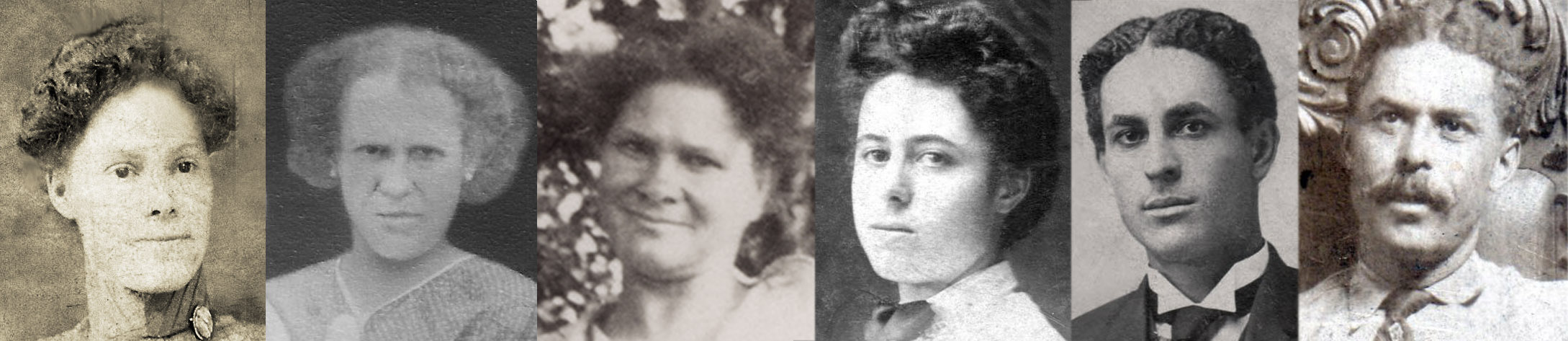
Siblings-Lillian Louise, Minnie, Sarah, Pearl, Hugh, Clarence. Josie and George have no photo.
In 1887 sixteen-year old Sarah Jane moved north to Indianapolis. In 1889, Sarah married James Busby and moved further north to his hometown in Benton Harbor, Michigan. Lillian must have gone to visit her sister in Benton Harbor because on June 10, 1891, seventeen year old Louise married twenty-six year old Michigan native Solomus Shoemaker, in Berrien County, Michigan. Both the Busby and the Shoemaker families had originally been enslaved in Virginia escaped to freedom in the North several generations earlier.
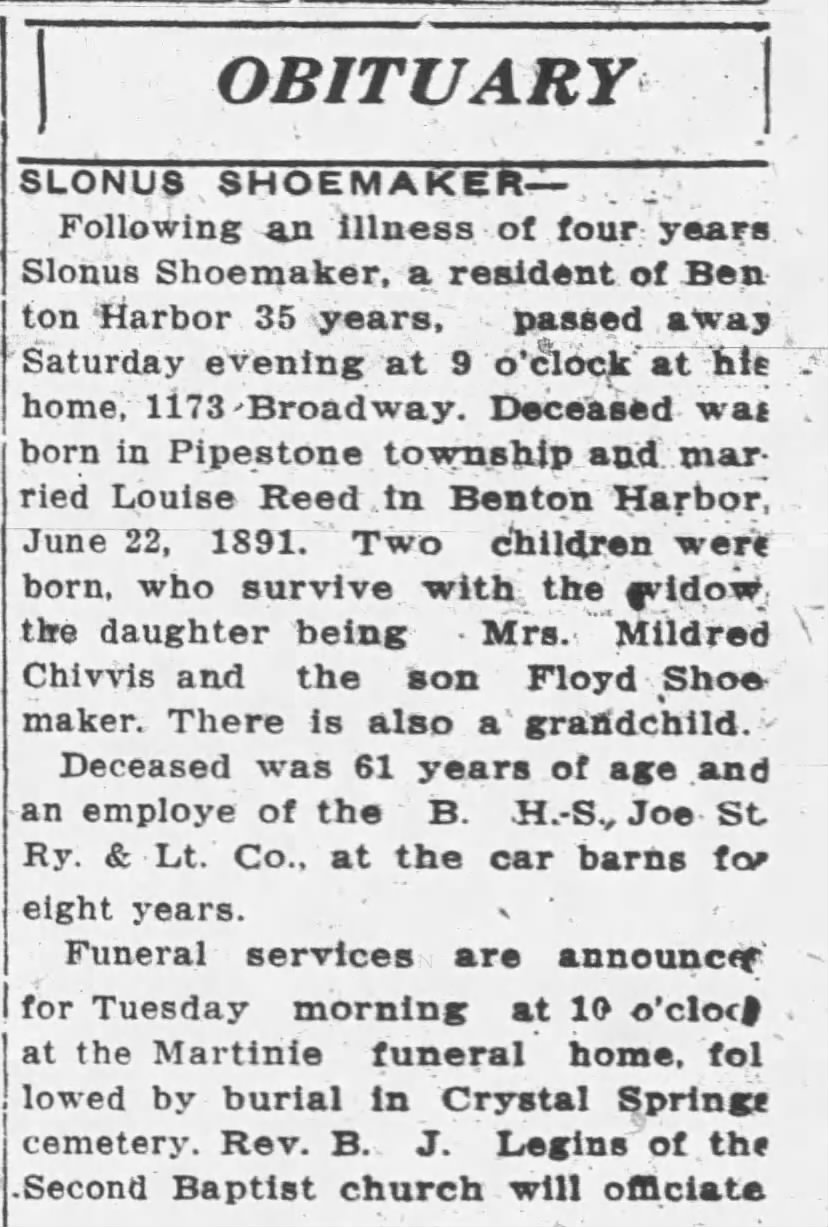
Lillian’s and Solomus’ marriage was not a smooth one. During the trial after the tragic shooting (see below), it came out that they had sometimes lived apart. In the 1900 census they were living apart. Lillian and one year old Mildred were living with a family and she did washing. In 1916 Lillian filed for divorce. The case was dropped and they remained married until his death in 1925.
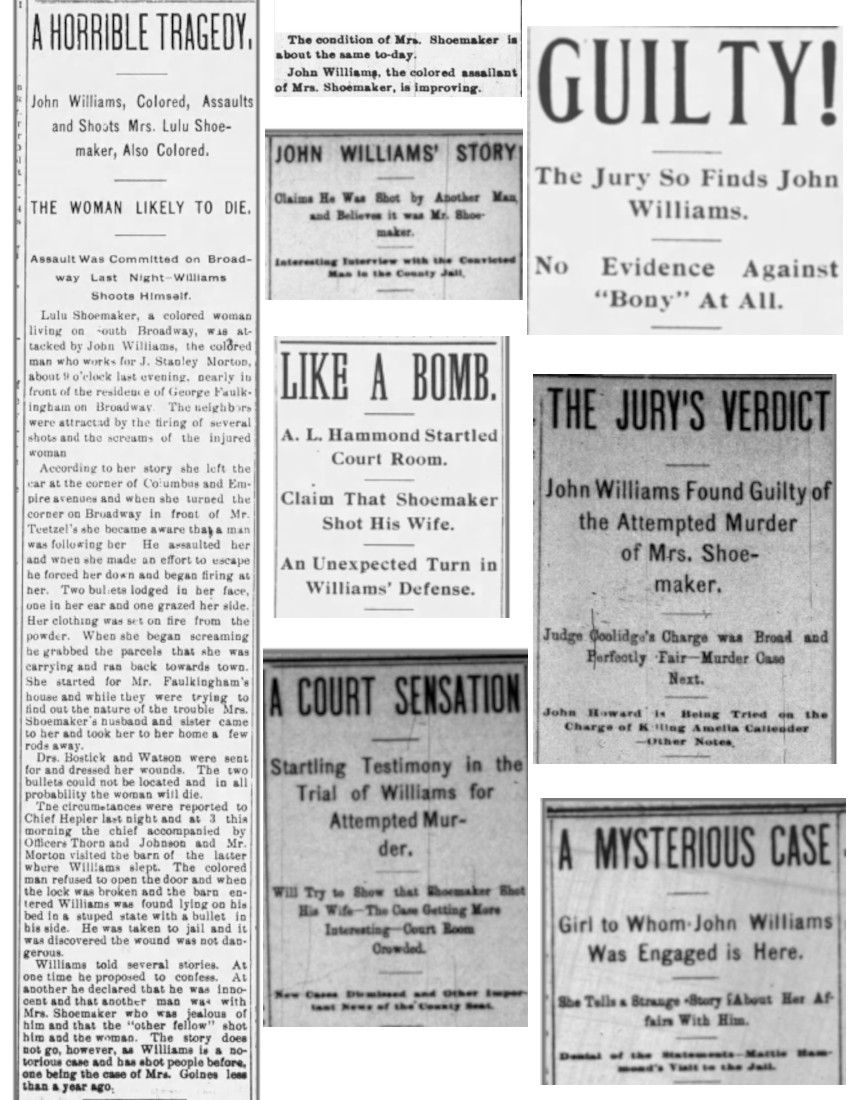
Headlines from the trial. She lived and he was found guilty. Mr. Shoemaker was called “Boney”. The paper was carried articles from the original shooting through the trial and afterwards when a former fiance of Williams appeared.
A HORRIBLE TRAGEDY
John Williams, Colored, Assaults and Shoots Mrs. Lulu Shoemaker, Also Colored.
THE WOMAN LIKELY TO DIE.
Assault Was Committed on Broadway Last Night-Williams Shoots Himself.
Lulu Shoemaker, a colored woman living on South Broadway, was atacked by John Williams, the colored man who works for J. Stanley Morton, about 9 o’clock last evening, nearly in front of the residence of George Faulkingbam on Broadway. The neighbors were attracted by the firing of several shots and the screams of the injured woman.
According to her story she left the car at the corner of Columbus and Empire avenues and when she turned the corner on Broadway in front of Mr. Teetzel’s she became aware that a man was following her He assaulted her and when she made an effort to escape he forced her down and began firing at her. Two bullets lodged in her face, one in her ear and one grazed her side. Her clothing was set on fire from the powder. When she began screaming, he grabbed the parcels that she was carrying and ran back towards town. She started for Mr. Faulkingham’s house and while they were trying to find out the nature of the trouble Mrs. Shoemaker’s husband and sister came to her and took her to her home a few rods away. Dr.s Bostick and Watson were sent for and dressed her wounds. The bullets could not be located and in all probability the woman will die.
The circumstances were reported to Chief Hepler last night and at 3 this morning the chief accompanied by Officers Thorn and Johnson and Mr. Morton visited the barn of the latter where Williams slept. The colored man refused to open the door and when the lock was broken and the barn entered Williams was found lying on his bed a stuped (sic) state with a bullet in his side. He was taken to jail and it was discovered the wound was not dangerous.
Williams told several stories. At one time he proposed to confess. At another he declared that he was innocent and that another man was with Mrs. Shoemaker who was jealous of him and that the “other fellow” shot him and the woman. The story does not go, however, as Williams is a notorious case and has shot people before, one being the case of Mrs. Goines less than a year ago.
The Weekly Palladium, Benton Harbor, Michigan • Fri, May 12, 1899 Page 10
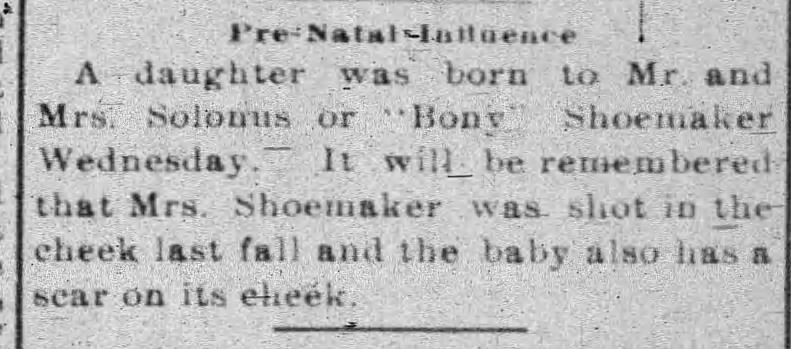
In 1899, a year after the shooting and the trial, daughter Mildred was born. She had a little scar on her cheek, where her mother had a scar from being shot. Four years later in 1903, their son Floyd was born.
The Herald-Palladium Benton Harbor, Michigan • Mon, Aug 10, 1925 Page 8
Lulu Shoemaker died of cardiac asthma caused by congestive heart failure. Solomus died of apoplexy, a stroke. Husband and wife are buried in Chrystal Springs Cemetery in Benton Township, Berrien County.
________
Several years ago, a granddaughter of Lillian Louise’s son Floyd, found me through Ancestry.com. Her father and his siblings grew up thinking they were of Italian descent. My cousin was trying to find out what ship they came over on when she discovered they weren’t Italian, they were African American and my cousins. We exchanged information and photographs and met once. This is one of the photographs she sent.
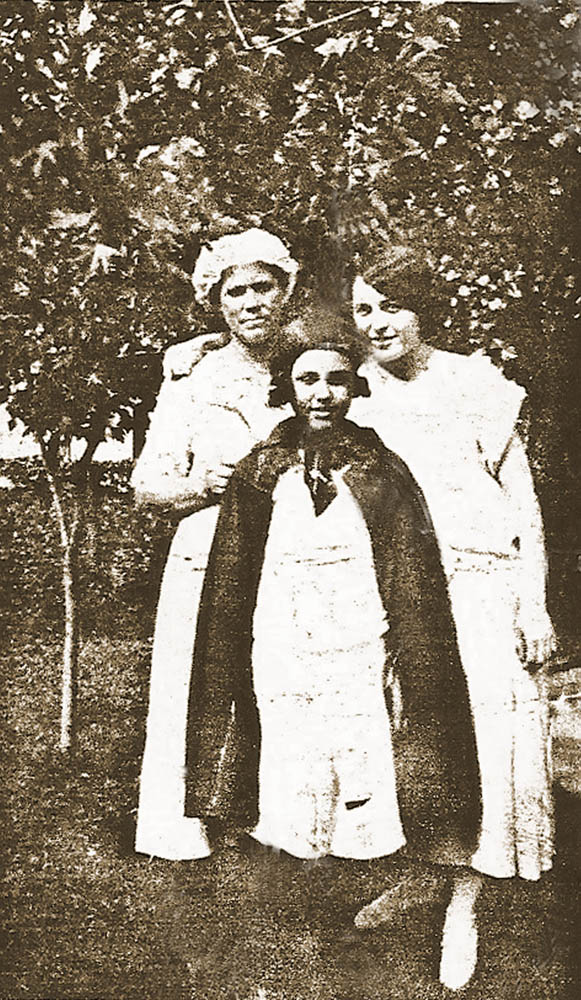
Lillian Louise Shoemaker with her brother Hugh’s daughters, Teresa and Anna. Taken in Benton Harbor, Michigan. This is a copy of the original which is in the collection of the Shoemaker descendants.
Kate Elizabeth Primus was born April 12, 1855 on Foster and Marietta Ray’s plantation. She was the granddaughter of Basil and Diana Primus and the daughter of Agnes Primus. She was baptized February 28, 1857 by Rev. John B. Hutchins at St. Augustine Catholic Church.
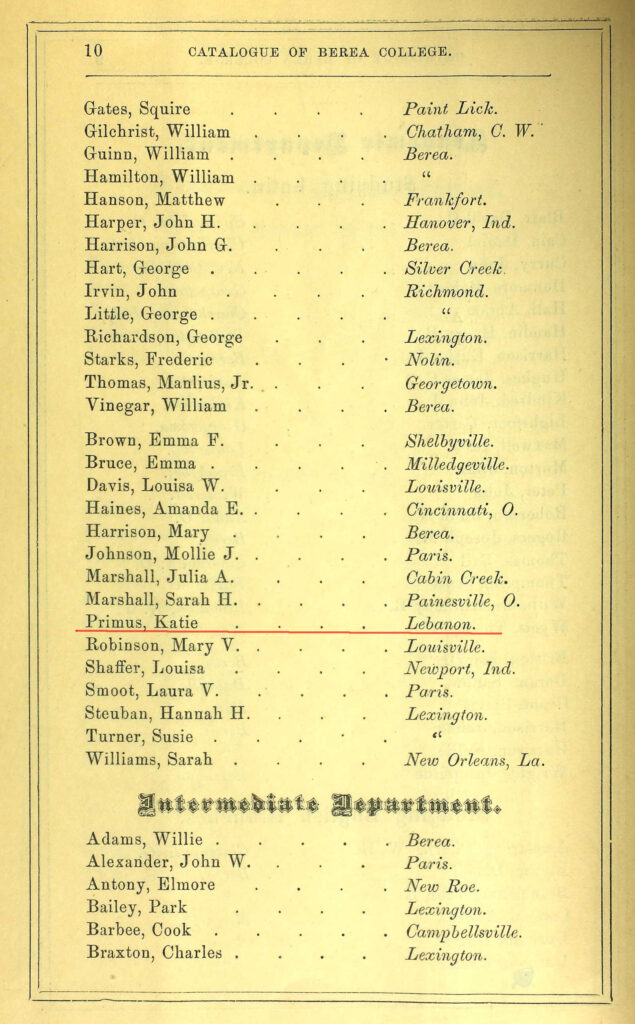
Kate was ten in 1865 when slavery was outlawed in Kentucky. She was 17 when she worked as a servant along with her mother and brother, for Marietta Ray Foster. Kate and her brother, John, were both literate. In the 1870-1871 Berea college catalog Kate is listed as a student.
Berea College was founded in Madison County, Kentucky in 1855 by Kentucky abolitionists and educators. The school was integrated and the ministers associated with Berea preached and talked against slavery. After John Brown’s raid in 1859, sentiment ran high against the school. There were numerous mob actions until the staff left Kentucky en masses for points north with plans to return as soon as they could. After the Civil War, they were able to and established the school. Berea was not a college as we think of them today – subjects went from the very basics through the college curriculum.
Marietta Foster wrote her will on November 20, 1871. Among other bequests, she left $1,000 to buy Agnes Primus a house. Marietta Foster died on January 9, 1872. I do not know when or if Agnes actually received a house in Lebanon, Kentucky.
Her brother John died in 1881, his daughter known as Scottie was born. Kate was there to be her godmother in 1882. Shortly afterwards Kate and her mother moved to Chicago.
Henry C. Allen was also from Kentucky. He had been in Chicago for several years working as a waiter and living with his older brother. Henry and Kate married in 1886. He continued worked as a waiter for most of his working life. He also did some catering later.
By 1900, they had three sons Primus, Guy and Stanley.
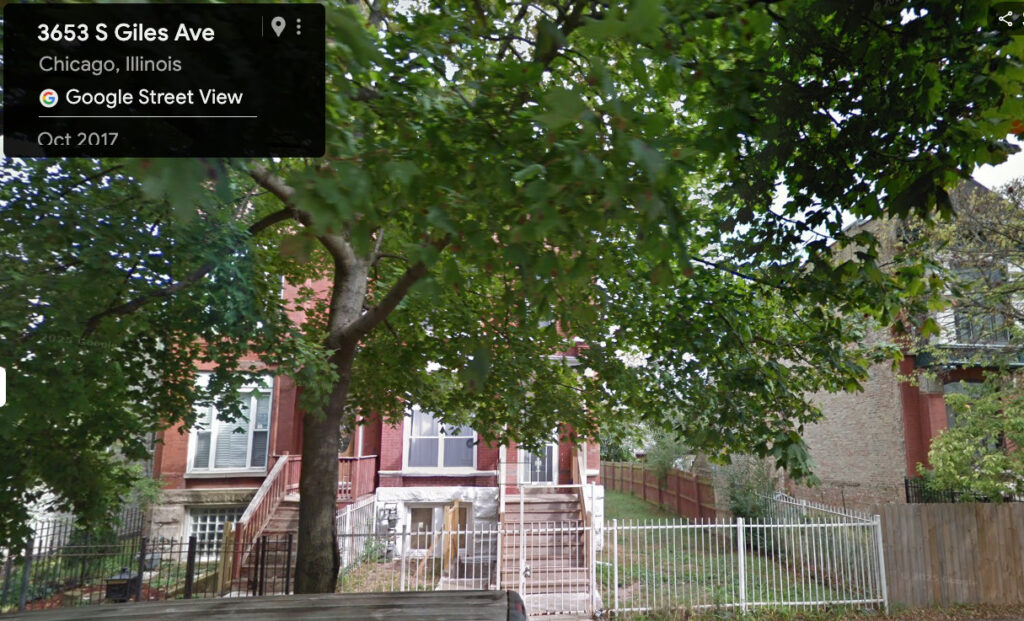
A photo of the house as it is today. Unfortunately that tree is covering most of it. The whole block used to be houses, but some are missing now, as the one next to 3653 is.
In 1910 the growing family owned their home at 3653 Foster (later Giles) Avenue. It was a brick row house with 5 bedrooms. Living there were Kate and Henry and their three sons and Kate’s mother Agnes Primus. They lived in this house until their deaths.
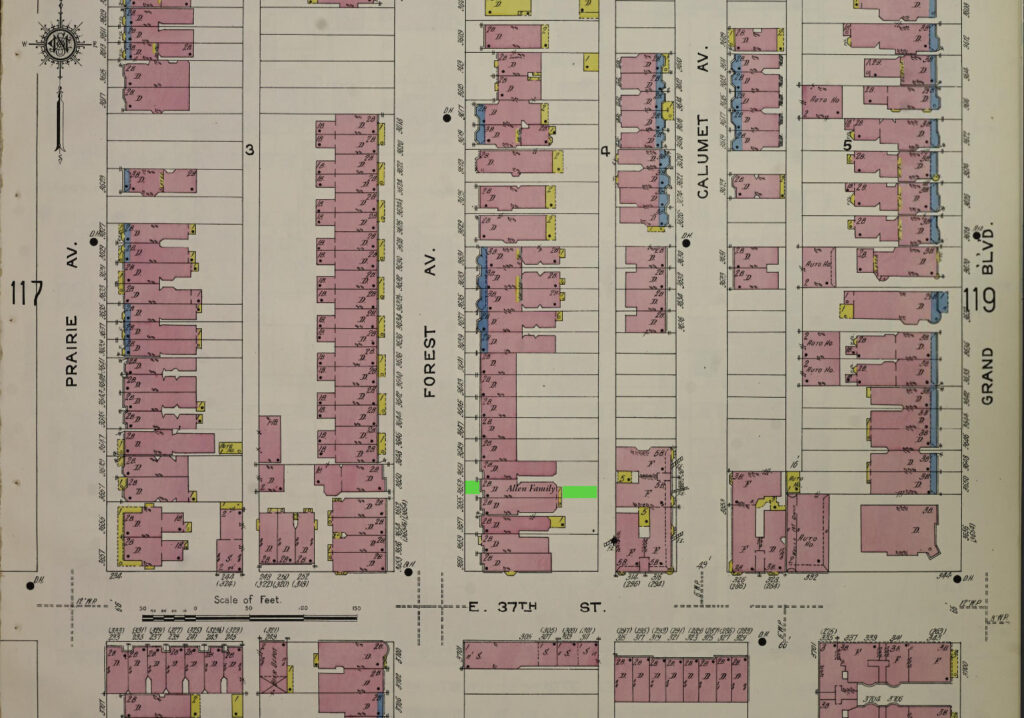
The house is the one with the green lawn. You can enlarge by clicking.
Agnes lived with Katie and her husband in Chicago until her death in 1919. She is buried in Mt Olivet Catholic Cemetery.
In the early years, Katie did hairdressing. Later she did not work outside of the home. Through the years the house was full of family – sons, and grandchildren. Henry died in 1930. Katie followed him five years later in 1935. They are buried next to each other in Holy Sepulchre Catholic Cemetery.
The oldest son, Primus A. Allen was born in 1887. He completed the 6th grade. He was tall, slim with blue eyes. He married and had one son. Although he started his work life as a plasterer, he later became a red cap with railroads and continued with that. He lived with his brother Guy when he died in 1954.
Guy Eugene Allen was born in 1890. He completed four years of high school. He was tall, slender with brown eyes and brown hair. He and his wife had two sons. For awhile he worked as a postman. Later, Guy had his own business building and repairing houses. He owned his own home, right down the street from his brother Stanley. He died in 1986.
Stanley Henry Allen was born in 1892. He completed the 8th grade. He was medium height, medium weight with dark brown eyes, black hair and light brown complexion. He was a porter at the railroad station. He married but had no children. He owned his home when he died in 1970.
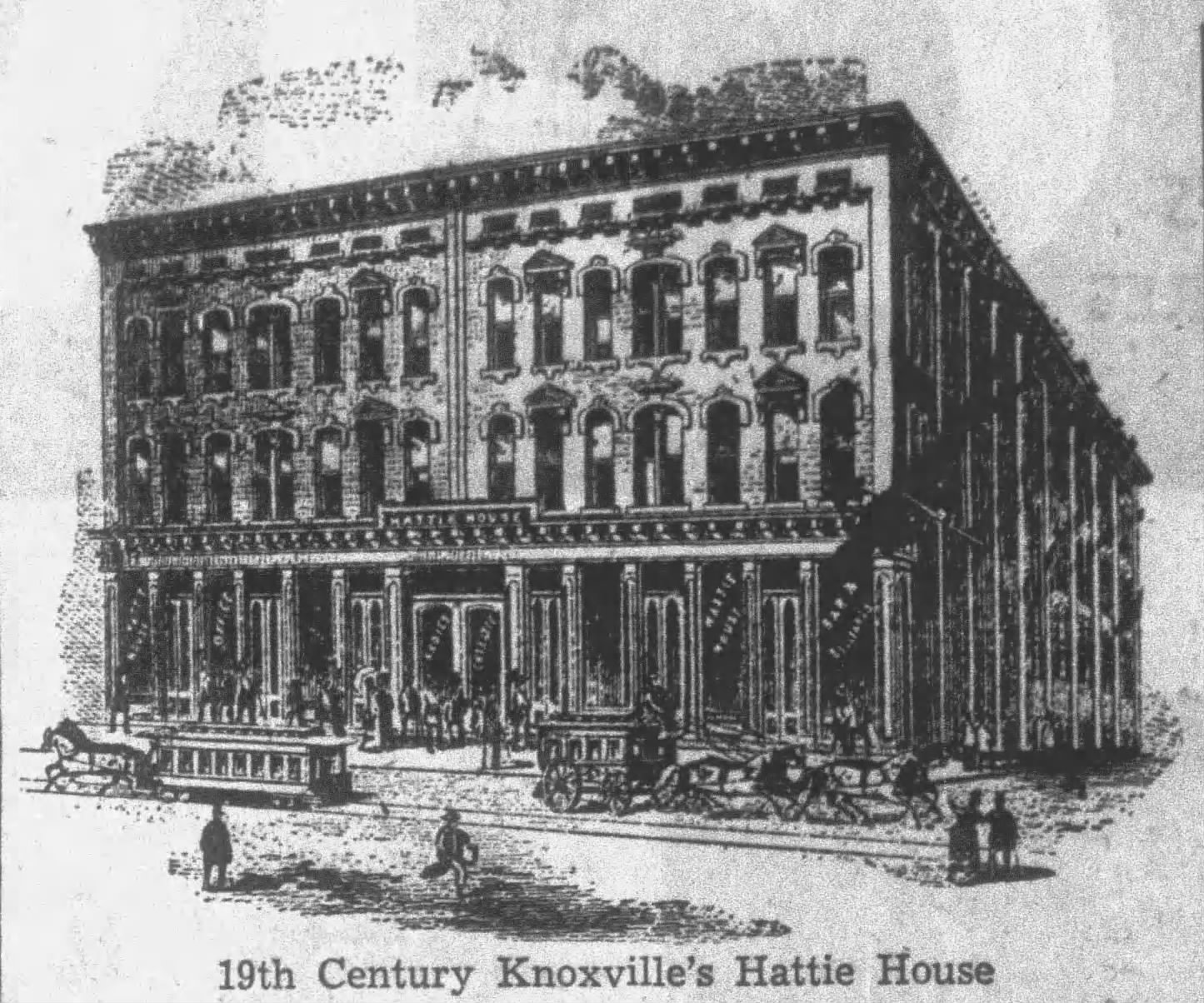
Hattie House – where Jacob Cleage was head waiter for many years.
Jacob Cleage was one year old in 1851 when he was sold, along with his mother and five sisters, to David Cleage, slave holder in Athens, Tennessee. When freedom came in 1866 he was 15 years old. He next appears in Knoxville, 58 miles from Athens, when he married Miss Fannie Wilson at the residence of Dr. George W. LeVere. They left on the 9 O’Clock train for Athens on a bridal tour. Unfortunately, Athens did not have a black newspaper to cover his return home with his new bride but we are going to assume that they were greeted with dinner and gifts and news.
They had three children, who all died young. Fannie worked as a cook for white families and cooked for suppers at their church, Shiloe Presbyterian Church and other community events, such as those given by the Masons, of which her husband was an important part.
Article from Dec 14, 1892 The Journal and Tribune (Knoxville, Tennessee) Stories and events
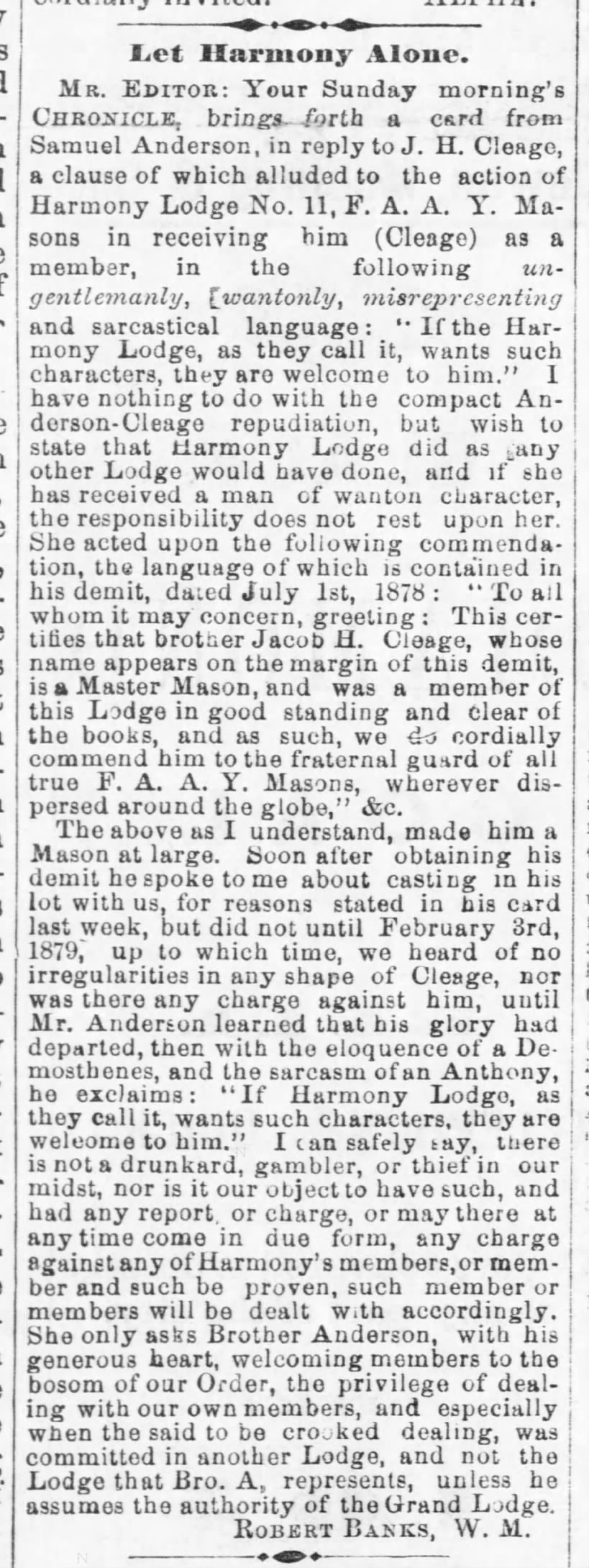
Jacob was an active and important member of the Harmony Lodge black Masons group. There was a bit of controversy when he joined with a Samuel Anderson declaring Jacob Cleage had been accused of deception and fraud and expelled from one group of Masons and shouldn’t be accepted by the Harmony Lodge. The Lodge responded that it was sour grapes on the part of Anderson. Jacob continued to be active with Harmony, rising to the highest rank. He was also active in politics. Attending and speaking at Republican party meetings.
After a query by my daughter Ayanna, I decided to include the discussion of the Harmony – Jacob Cleage – Anderson dispute.
Jacob died from consumption shortly after Christmas, 1893. His obituary as it appeared in the local press appears below.
JACOB CLEGG (Cleage) Generalissimo of the Colored Masons of Tennessee Died of Consumption in Knoxville Yesterday. He Will be Buried at 2 o’clock This Afternoon With Imposing Ceremonies, in Which all Colored Masons Will Take Part From. Thursday’s Daily
Jacob Clegg, the biggest negro (sic) Mason in Tennessee, is dead. He died yesterday afternoon shortly after 2 O’Clock.
Clegg held the exalted position of generalissimo of the state Masonic fraternity, and as such was honored by the members of his race throughout Tennessee. The deceased will be buried this afternoon with imposing ceremonies, in which all the colored Masonic orders of the city will participate, The funeral services will be held at Shiloh Presbyterian church, on Clinch street, at 2 O’Clock this afternoon. Clegg was for a long time head waiter at the Hattie house, but for the past year or more he has suffered with consumption, being confined to his home in East Knoxville for a greater part of the present year. Clegg’s wife has for years past been a valued servant in the family of Mr. C.J. McClung, on Main street, and a few days ago Clegg went there to be with his wife. His condition grew worse immediately after going there and he died in the servants’ quarters at the McClung place, at 2 O’Clock yesterday afternoon.
The Semi-Weekly Knoxville Sentinel Knoxville, Tennessee • Sat, Dec 30, 1893 Page 1
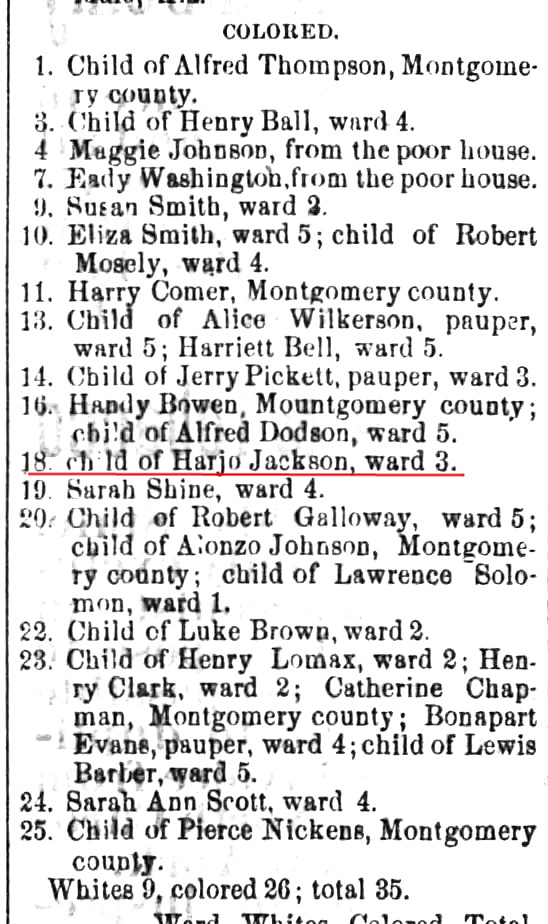
After writing about the deaths of Harjo Jackson’s children, I decided to look through the newspaper reports to see if there was any more on Harjo. I didn’t find anything, but I did start to notice the other causes of death as I went through the weekly reports in the Montgomery Advertiser. Today I am sharing some of those.
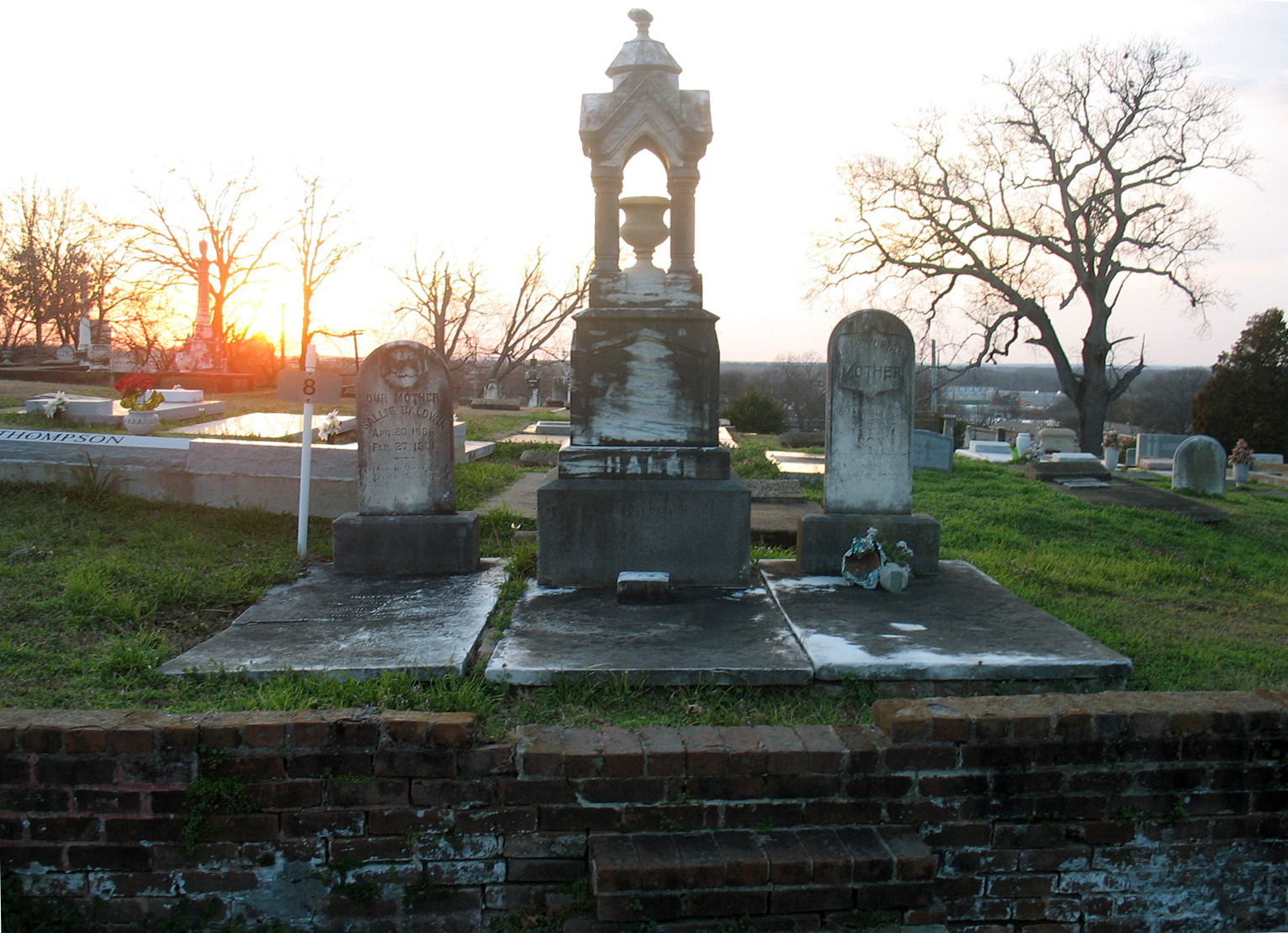
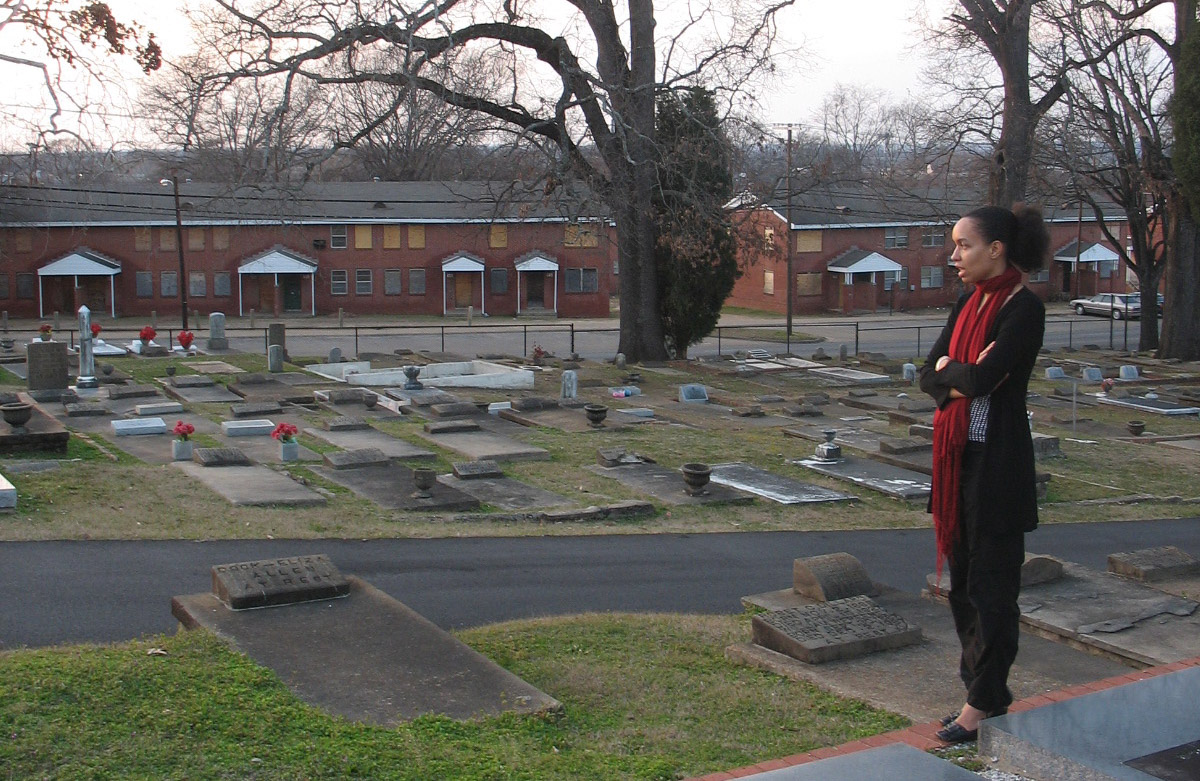
The notifications were for interment in the Montgomery Alabama City Cemetery, which is now Oakwood Cemetery. This is the cemetery where my 2Xs great grandparents Eliza and Dock Allen are buried. I named this blog for Eliza. Other family members are buried there.
My daughter Ife standing to the right of Dock and Eliza’s grave stone.
Oakwood Cemetery started with donations of land by Andrew Dexter and General John Scott in 1817 and 1818. The earliest part of the cemetery was known as Scott’s Free Burying Ground. Over 200,000 are buried in Oakwood Cemetery. Both black and white are buried there, although in different sections.
__________________
Below is a random sample of some of the interment reports for 1883. The numbers in front of the names are the dates on which those deaths occurred. I have added explanations for various obscure causes of death.
The Montgomery Advertiser. February 27, 1883 Page 2
The interments in the city cemetery the past week, ending last night the 24th, were as follows:
WHITES.
18. *Child of Norah Reed, bronchitis. •
COLORED.
18. Randal Brooks, menengitis.
19. Ruth Ann Lewis, consumption (tuberculosis).
20. Child of Walter Freeman, premature birth: *Laura Meriwether, a child, inanition; *child of Mary Miles, infantile remittent fever. (Malaria is a common cause of intermittent fever)
21. *Alice Jones, syphilis, (tartary.) (Tertiary syphilis final stage of an untreated infection, occurring 10–40 years after initial exposure. It causes widespread, severe damage to organs, including the heart, blood vessels, brain, and nervous system
23. Betsy Hailes, pneumonia.
24. Dave Driver, consumption; child of George Robinson, unknown, no physician.(Cause of death was unknown because no doctor was on the case).
The interments in the city cemetery the past week have been as follows:
WHITES.
4. Child of John R. Pugh, Bronchial Phthisis (Bronchiectasis is a condition where damage causes the tubes in your lungs to widen or develop pouches. It makes it hard to clear mucus out of your lungs and can cause frequent infections. Coughing a lot with pus and mucus is the main symptom.); E. Cleveland, Insanity and Inanition. (Inanition – physical or mental exhaustion due to lack of nutrition.)
6. C. L. Lowery, Congestion.
COLORED.
*2. Child of James Green, unknown no physician.
4. Louisa Sturdivant, a child, after effects of measles.
*5. Louisia Lewis, Consumption; child of Caroline Ligon, Convulsions.
*6. Child of Matty Smith, Trismus Noscretium (lockjaw).
7. Child of Ida Fair, still-born.
Whites 3: colored 6. Total 9. *Died outside of city limits.
__________________
The Montgomery Advertiser. September 11, 1883 Page 3
The interments in the City Cemetery the past week were as follows:
WHITES.
Mrs. Carrie Cater, puerperal eclampsia. Thomas J. Dillard, opium poisoning suicide.
5. Child of Emmet Fowler, meningitis. MA Bellie L. Schley, typhoid fever.
COLORED.
3. Child of Henry Ball, cause of death unknown; no physician.
4. *Maggie Johnson, cories of vertebra. (I found nothing for “cories”)
7. *Eddy Washington, old age and cancer of liver.
whites 4; colored 3; total 7.
*Died outside the city limits.
_______________
The Montgomery Advertiser. April 1, 1883 Page 4
The interments in the city cemetery for the week end March 31st, were as follows:
WHITES.
26. *Child of Charles W. Joseph, cause of death unknown; Woodie Carter, smallpox.
30. *Mrs. Harriet I Singletary, heart disease.
31. *J.N. Waddell, Bright’s Disease. (a historical classification of kidney disease)
COLORED.
26. Child of Jane Sturdivant, inanition.
27; *Edward Jefferson, child, unknown.
29. Child of Richard Scott, pneumonia; Eliza E. Jackson, a child, scrofula.(An infection in the lymph nodes of your neck. It causes a swollen, sometimes discolored mass that’s usually painless.)
30. Rosa Syers, a child, unknown, No physician.
Whites 4; colored 5. Total 9. *Died outside of city limits.
______________
The Montgomery Advertiser. Mar, 25, 1883 Page 5
The interments in the city cemetery for the past week, ending Saturday, March 24th, have been as follows:
WHITES.
22. Child of M. M. Turbyfill, still-born
COLORED.
19. *Margaret McKenzie, dropsy. (edema is a medical term for swelling caused by excess fluid trapped in the body’s tissues symptom of heart failure. modern medicine identifies the underlying cause, such as congestive heart failure, kidney disease, or liver issues)
22. Gracy Thomas, worms (Children, particularly in areas with poor sanitation, can die from severe intestinal worm infections (helminthiasis)—such as roundworms, hookworms, and whipworms—which lead to acute malnutrition, anemia, and intestinal obstructions.)
24.*Charles Seaborn, old age.
Whites, 1; Colored, 3. Total, 4. *Died outside of city limits.
_____________________
The Montgomery Advertiser. Oct 21, 1883 Page 4
The interments in the City Cemetery for past week have been as follows:
WHITES.
14. Miss Mary Josephine Howell, congestive fever. (malaria or severe malarial chills)
18. E. A. Curtis, typhoid fever.
19. *Child of Charles Newman, from Greenville, inflammation of bowels (Symptoms of both ulcerative colitis and Crohn’s disease usually include belly pain, diarrhea, rectal bleeding, extreme tiredness and weight loss.); Tommie Stewart, lock jaw.
COLORED
14. *Fenton Harris.
17. *Charlotte Oliver, hypertrophy of heart (abnormal thickening or enlargement of the heart muscle). child of Matthew Stodemeyer, ulceration of bowels (Ulcerative colitis is an inflammatory bowel disease that causes chronic inflammation and ulcers in the superficial lining of the large intestine).
19. Reuben Dean, unknown, no physician; child of John Young, teething. (historically used as a catch-all diagnosis for infant deaths caused by infections, diarrhea, or malnutrition in the 19th century)
20. Henry Drayton, tuberculosis; *Cheney Fraser, cancer of liver.
Whites 4, colored 7; total 11. *Died outside of city limits.
Harjo Jackson first appeared in the probate record of Crawford Motley Jackson. Crawford M. Jackson was Harjo’s slave master and probable father. He died in 1860 of pneumonia leaving his 135 enslaved people to be divided up between his siblings or auctioned off. Harjo was nine years old and was auctioned off along with his mother and five siblings. He was valued at $500. Follow the links for more information.
Prissy 35 $1000 Harjo 9 $900 Griffin 8 $900 Frank Prince 6 $650 Delia 2 $200 Iba 12 $1004 Mary 4 $450 (Poppy’s mother)
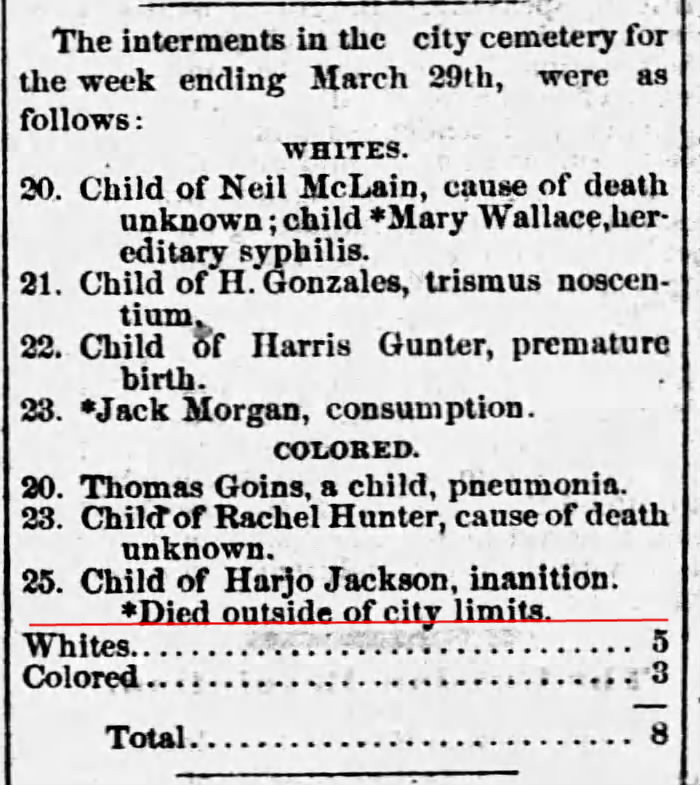
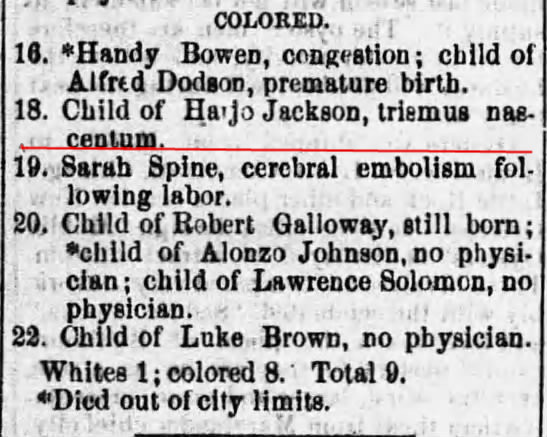
I could not find Harjo in any more records for years. He didn’t appear in the 1870 census with his mother and siblings. Recently I found three items in the Montgomery Advertiser, all were for deaths of infants of Harjo Jackson.
On March 25, an infant of Harjo Jackson died of inanition which according to Wikipedia isthe exhausted condition that results from lack of food and water.
The Weekly Advertiser Montgomery, Alabama • Tue, Mar 29, 1881 Page 2
On September 18, 1883, a child of Harjo Jackson died of Neonatal tetanus (trismus nascentium), a form of generalised tetanus that occurs in newborns. Infants who have not acquired passive immunity from an immunized mother are at risk. It usually occurs through infection of the unhealed umbilical stump, particularly when the stump is cut with a non-sterile instrument. (from Wikipedia)
On August 13, 1886 Another child of Harjo died. There was no cause given this time.
The Montgomery Advertiser Montgomery, Alabama • Fri, Oct 5, 1883 Page 3
Well, I was horrified to find that my maternal grandfather, Poppy’s uncle had lost so many children in such terrible ways. And I wondered why I hadn’t found more about him, since he was alive. Today I decided that he might have changed his name as other family members had, to a more common name, like Joe.
I searched for Joe Jackson and have found several promising leads that even involve shared DNA. I’m going to keep digging and if I find anything new before the end of the A to Z, I will work it in.
“…my former servants … Tresey Maxwell and Betsey Doneghy (also of color) the sum of one hundred and fifty dollars each.” From the Will of Marietta Foster Ray, 1871.
$150 in 1870 is equivalent in purchasing power to about $3,741.81 today, an increase of $3,591.81 over 156 years. CPI Inflation Calculator
Teresa Primus Maxwell was one of the seven children that Foster Ray was allowed to bring into Kentucky for his personal use. She received $150 from Marietta Ray Foster in 1871. I don’t know how she used the money.
Teresa married Henry Maxwell, a Civil War veteran with the United States Colored Troops. They had ten children, all but one lived to adulthood. Emma and James Basil, the youngest, graduated from the 8th grade in one of the “colored schools” in Lebanon, Kentucky.
The public school system wasn’t developed in Kentucky until after 1865, when the Civil War ended. Schools were segregated in Kentucky until after the 1954 Supreme Court ruling desegregating public schools. The process was slow with some schools taking until the 1960s.
In 1906 the Kentucky Legislators opened two Normal schools to prepare white teachers. Eventually one was also opened for black teachers. It wasn’t until about 1920 that a Normal School degree was required to teach. The salary for male teachers in 1895 was $50.72 a month and $32.61 for women.
Because so many teachers lacked qualifications, sessions were held during the summer that offered more training through lecturers, papers presented and discussions. A reading circle was started to expose them to a wide variety of relevant literature.
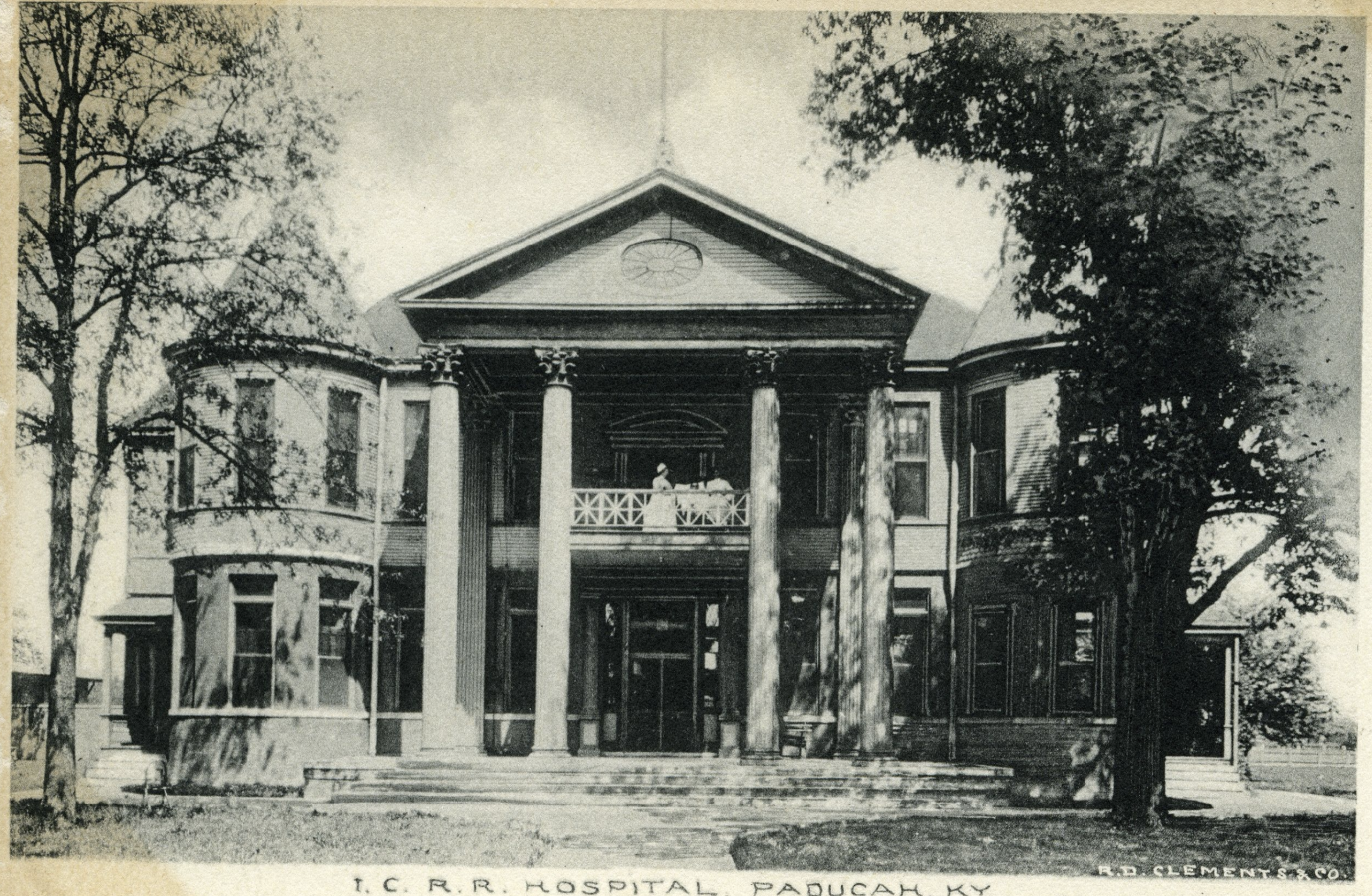
Emma Maxwell married Frank Rice, an undertaker. They had one child who died in infancy and Emma continued to teach until 1918 when the family relocated to Paducah Kentucky where she began working as a nurse at the Illinois Central Hospital, for men injured while working on the railroad.
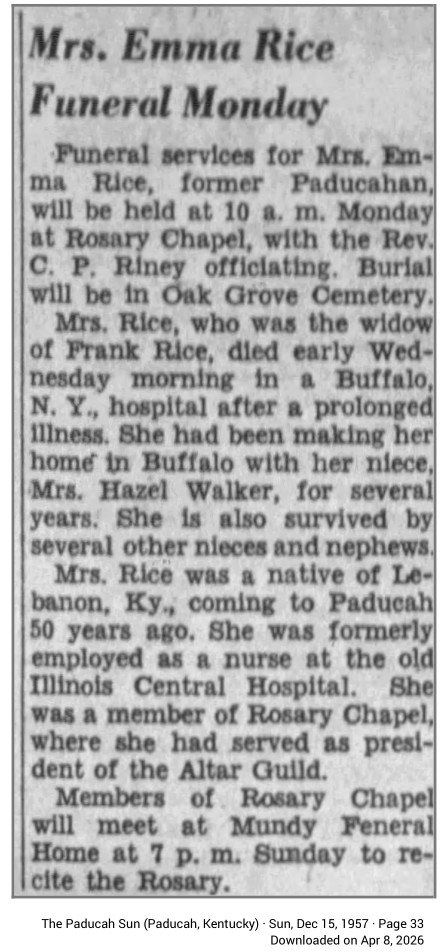
Mrs. Emma Rice Funeral Monday
Funeral services for Mrs. Emma Rice, former Paducahan, will be held at 10 a. m. Monday at Rosary Chapel, with the Rev. C. P. Riney officiating. Burial will be in Oak Grove Cemetery, Mrs. Rice, who was the widow of Frank Rice, died early Wednesday morning in a Buffalo, N.Y., hospital after a prolonged illness. She had been making her home in Buffalo with her niece, Mrs. Hazel Walker, for several years. She is also survived by several other nieces and nephews. Mrs. Rice was a native of Lebanon, Ky., coming to Paducah 50 years ago. She was formerly employed as a nurse at the old Illinois Central Hospital. She was a member of Rosary Chapel, where she had served as president of the Altar Guild. Members of Rosary Chapel will meet at Mundy Funeral Home at 7 p. m. Sunday to recite the Rosary.
T.C. R. R. Hospital, Paducah, Ky Image photographed by R.D. Clements. This was called the Trans Continental Railroad Hospital. Also called the Illinois Central Hospital.
James Basil Maxwell married Annie Carter and they had eight children. They all at least completed high school. He taught until the family moved to Santa Monica, California in 1918 where he worked as a plaster and eventually as a mechanic and finally a janitor until he died in 1987.
After publishing B – Betsy I got the following question from my daughter Ayanna:
“I wonder what the house with 12 people in it was like. Did the home have indoor plumbing? Where did they sleep? Where did they eat? Food storage? What was a regular weekday meal? Were they near a park or other outdoor space that they could access? I have so many questions!”
The immediate neighborhood
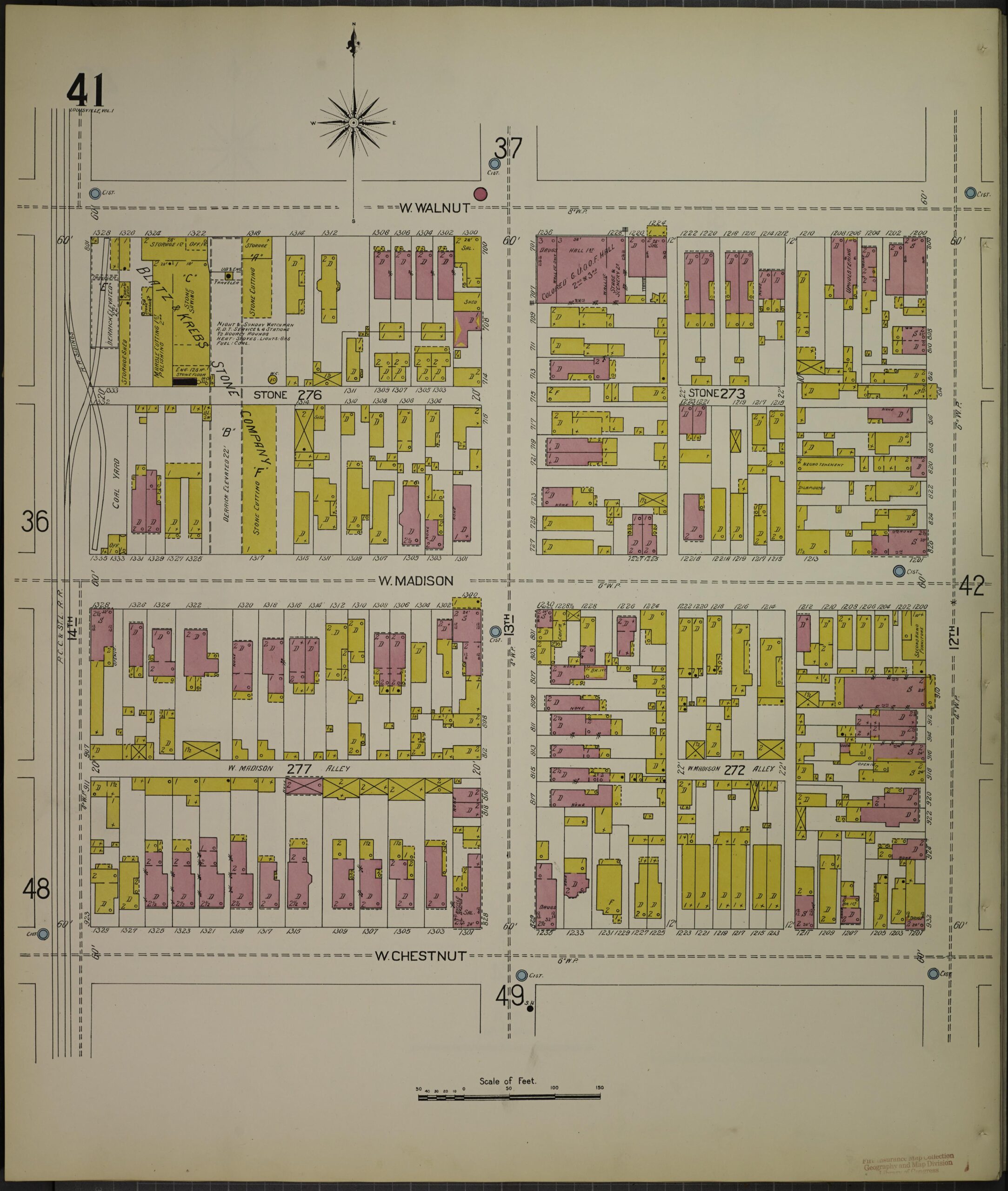
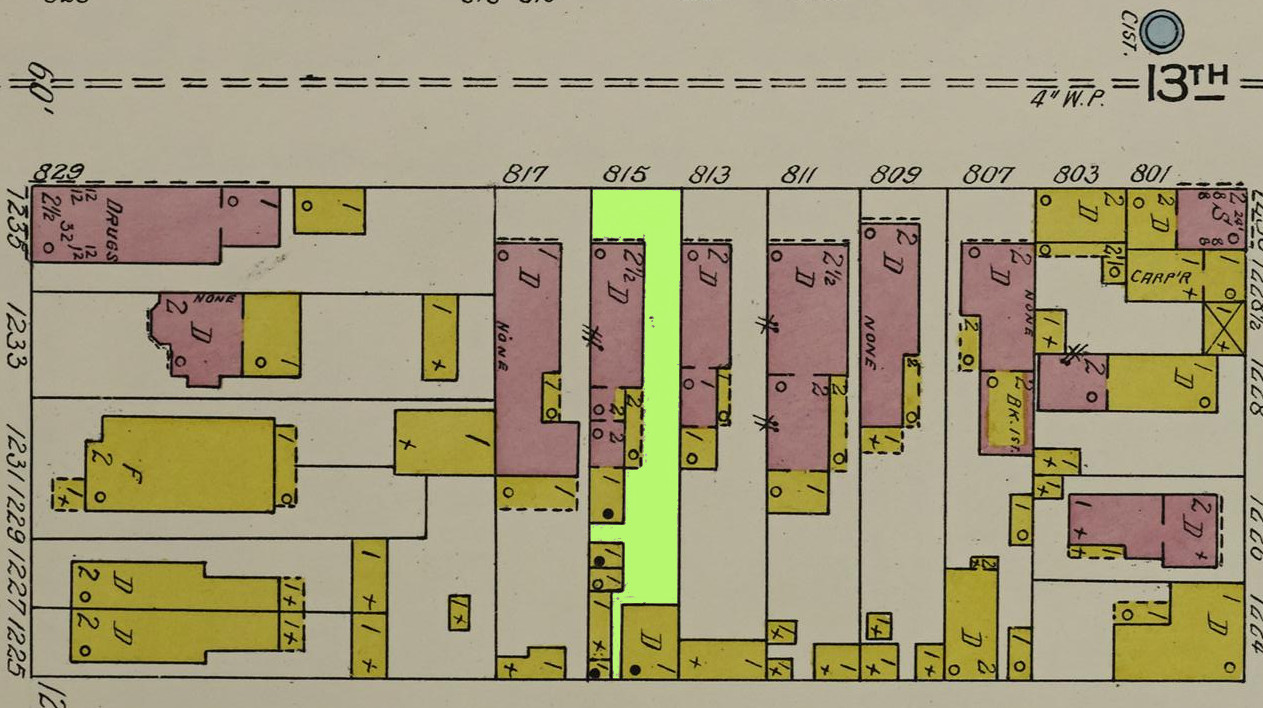
In 1900, sixty year old widow, Elizabeth “Bettie” Doneghy lived at 815 13th Street in Louisville, Kentucky with her large family. Included were her daughter Katie (washerwoman) and her husband William (coachman) and their son one year old Charlie; Her daughters Marcie and Laura were both laundresses; Her son Sam (cook at the Lou Hotel) and his wife Emma and two little sons; and sons Wesley(waiter) and Tingsley (cook at the Union depot). All the adults were literate except Elizabeth and Tingsley.
The house shared by the twelve people in the Doneghy family is highlighted in green. Click to enlarge.
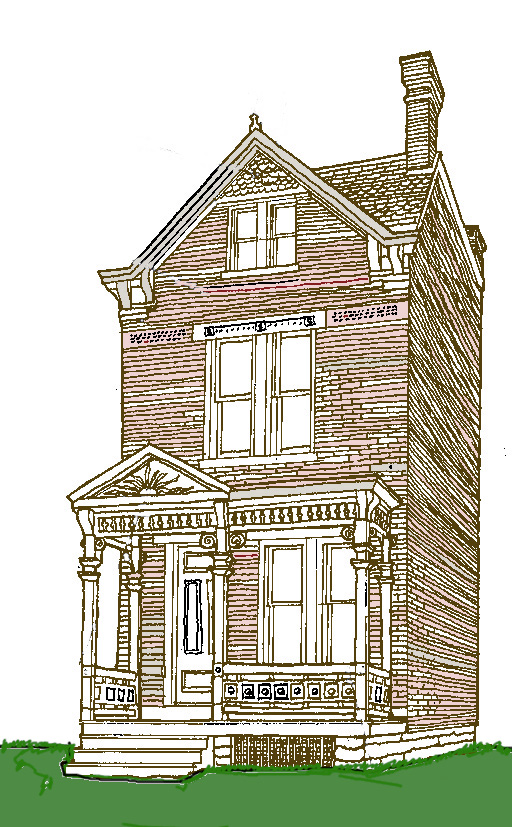
This house is the same type as the one they lived in, but not an exact replica.
The family stayed in the west Louisville African American community, but moved around often. They rented the brick house on 13th for about three years. The main portion of the house was two and a half stories high, that is two full stories and a third story that was not as large as those below because of the sloping roof but it added more room.
A hand pump
Indoor plumbing was a rare luxury. In the early 1900s only 1% of homes in the United States had indoor plumbing. There would have been a pump in the backyard. Bathing was done through sponge baths with pitchers and washstands, or by heating water on a stove for a tub bath. Most families bathed once a week. An out house in the backyard would suffice for a toilet.
The family ate the basic southern diet, cornbread, beans, sweet potatoes, greens. Maybe fish if they went down to the Ohio River and fished. Maybe they had a small garden, perhaps a few chickens. The yard looks big enough for that. They most likely cooked with wood and heated water the same way. Although there were ads for ice boxes for $3 or less, googling tells me that poor people didn’t have ice boxes. I doubt there were leftovers needing refrigeration. Maybe they bought milk for the children.
There were public parks in Louisville, but at that time they were for whites only. Later there was one for African Americans. In 1905, the Western Branch Library for black people opened.
The family was Catholic in Lebanon, I’m assuming they continued to be. St. Augustine Catholic Church was the black Catholic church and it was in their area.
Lot to unpack here… my mind snagged on 75 people in 8 “cabins” Opps, I miscounted the first time, there were 48 people in eight cabins with four young girls, ages 12, 13 and 19 being rented out so that they weren’t living in the cabins.
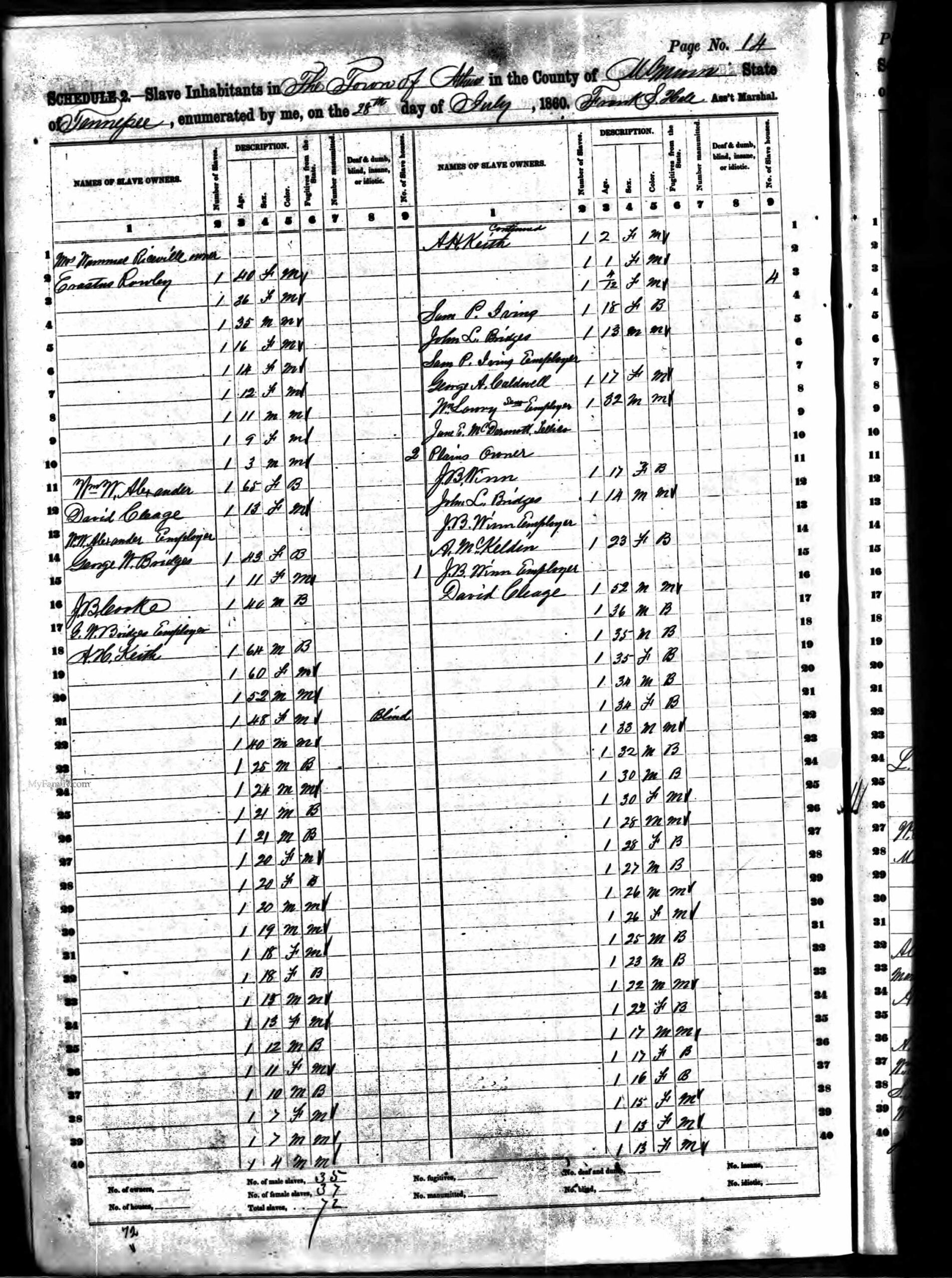
By 1860 David Cleage had real estate worth $20,000 and a personal worth of $90,000. He now owned 48 people who lived in eight cabins.
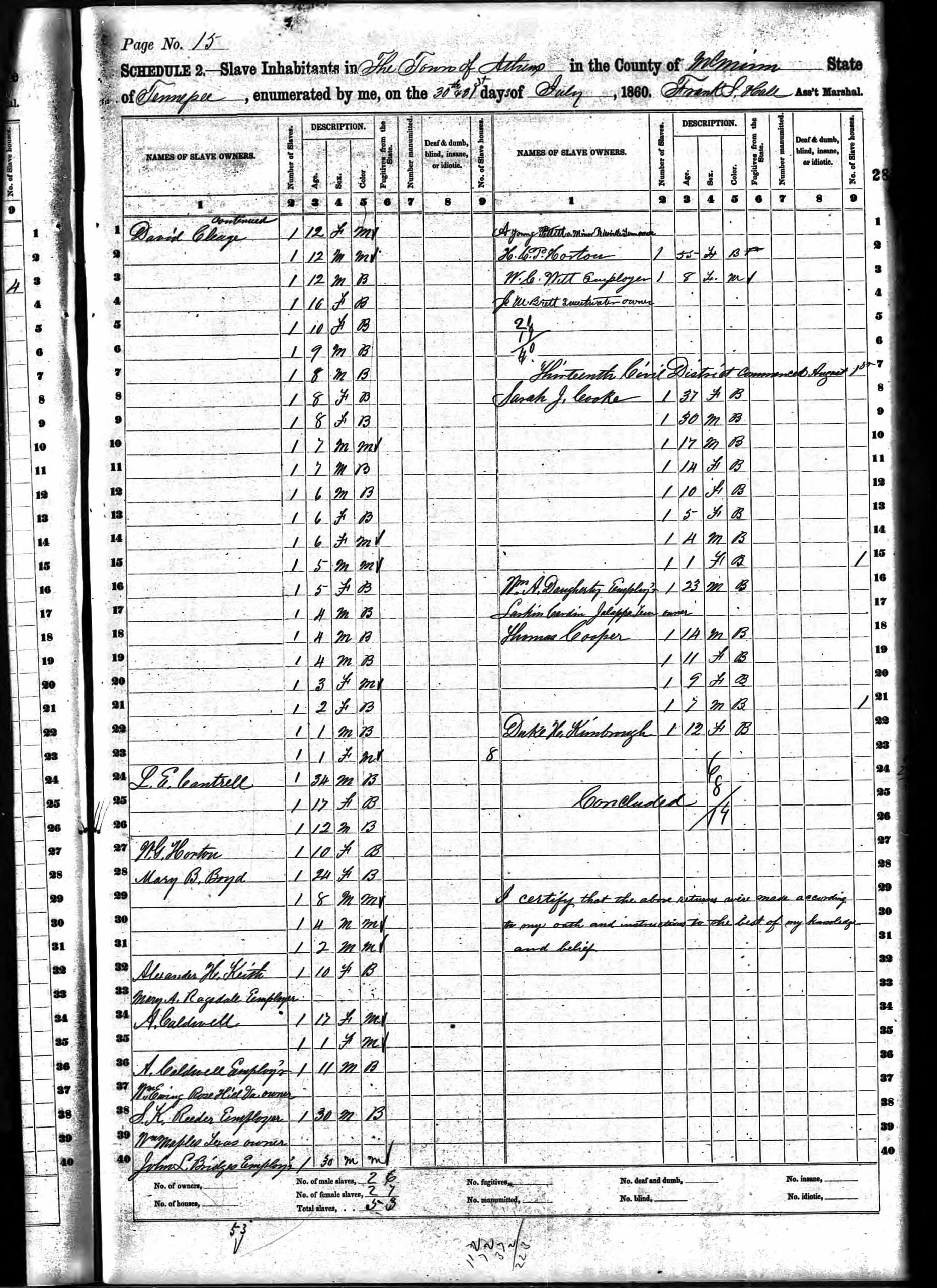
Below is the 1860 slave census with those on David Cleage’s plantation being listed by age, sex and color Mu(lato) or B(lack). Unfortunately they are not arranged in family groups. Sometimes a family shared a cabin. Sometimes a group of unmarried young men shared a cabin.
The 1860 Slave Census for David Cleage
Names and approximate ages of some of the enslaved people that lived in the quarters in 1860 on David Cleage’s plantation. They are in family groups.
Charles A. 32 Martha 25 Julie 11 Hillard 9 Frank 3 Philip 1
Charles 20 Mary 4 Richard 2 James 1
Jerry33 Charlotte 25 Harriett 10 America Emaline 8 Joseph 3 Mary 2
Henry 36 Jane 29
Joseph 45 Amy 35 Henry 3 Jeff 2
Isaac 32 Fanny 35 William 13 Mariah 12 Neppie 10 Steve 9 Isaac 6 Malinda 3
Fanny 38 Martha Jane 20 Mary 18 Lydia 16 Ellen 14 Sydney 12 Jacob 9
From The New York Public Library. Click photo to go to page.
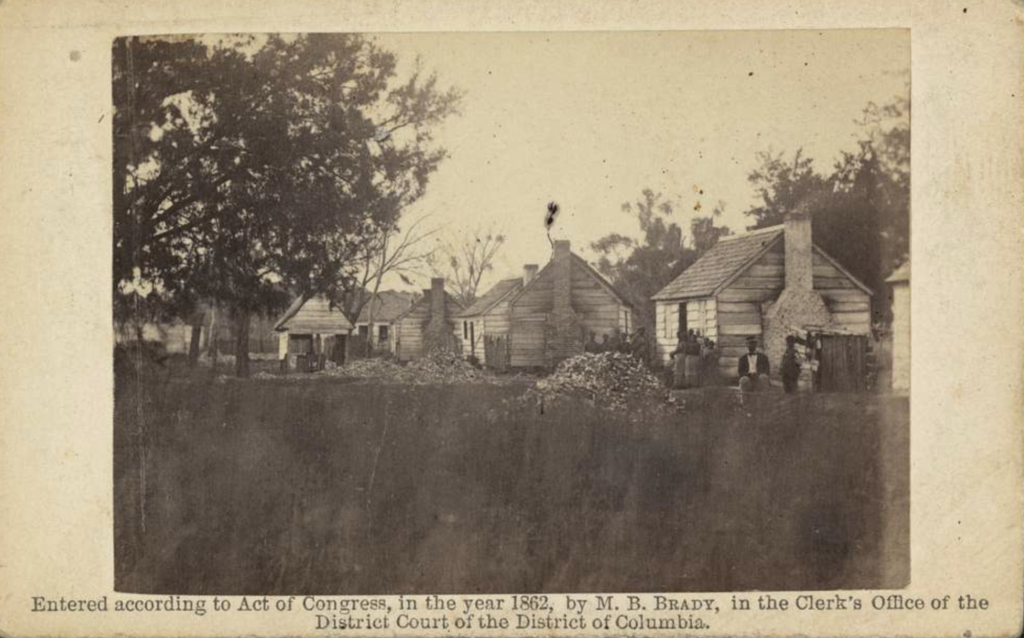
The pictures of these cabins are not from those on the Cleage plantation. None of those remain. They were probably similar. The cabins were grouped together near the house which allowed for community interaction. The cabins, at least some of them, had a loft that was used for sleeping, along with the downstairs. After all, quite a few people lived in most of the cabins.
A Cabin Story “The rectangular one-story, two-room, weatherboard-clad building is constructed of southern yellow pine. It includes an overhanging porch roof, a brick masonry fireplace, and a back door. The original design featured a single front doorway, an open floor plan, and a loft. As many as 10 to 12 enslaved people were held in bondage in the cabin, where they slept in the open space and the loft. ” After freedom came, formerly enslaved Black people served as sharecroppers and lived in their former slave cabins, which they retrofitted in an effort to make them homes. They added newspaper for insulation. They added a wall dividing the large common area into two rooms. They also manifested their freedom by adding a back door, enabling them to come and go as they pleased, no longer under surveillance from the single entryway.”
In Fanny Cleage Turks application for a pension due her because her husband, Isaac Turk served in the United States Colored Troops, Charles A. Cleage gave the following testimony. Both families were enslaved on David Cleage’s plantation.
“…Charles A. Cleage, who, I hereby certify, is a respectable and credible person, and who, being duly sworn, declares in relation to the aforesaid claim as follows: that he and the said soldier Isaac Turk were slaves and belonged to the same master during the year 1849 and on up to the war of the rebellion they lived as the custom was, within a few nods of each other, both being married and having children; he further states he is enabled to fix the date of birth of Mariah Witt, daughter of said soldier Isaac Turk, by the birth of his own daughter Juley Ann Watts, which as his family Bible Record shows, occurred July 29th 1849, said Mariah Witt being born just one month later which would make the birth of said child Mariah August 29th 1849.”
Sallie Marsh said in a testimony in the Katie Cleage pension case: “When his mother died she gave Phillip to me to take care of. Phillip slept in my house upstairs, until he went in the army. He slept with my oldest boy. My boys name was GEORGE Cleage, I don’t know whether he is living or not. The last I heard of him he was at Corinth, Mississippi.“
In 1850 slave holder David Cleage, his wife Martha and their two little sons lived with his father Samuel Clegg in Athens, Tennessee. The spelling of “Clegg” was changed to “Cleage” after the Civil War. Samuel’s occupation was farmer and he had real estate worth $20,500 and enslaved 31 people.
David was a bank cashier with $1,000 worth of real estate and owned 32 men, women and children. Later that year, his father was killed by his overseer and David, and his three older siblings, Alexander, Elizabeth and Sarah, divided their father’s property and enslaved people.
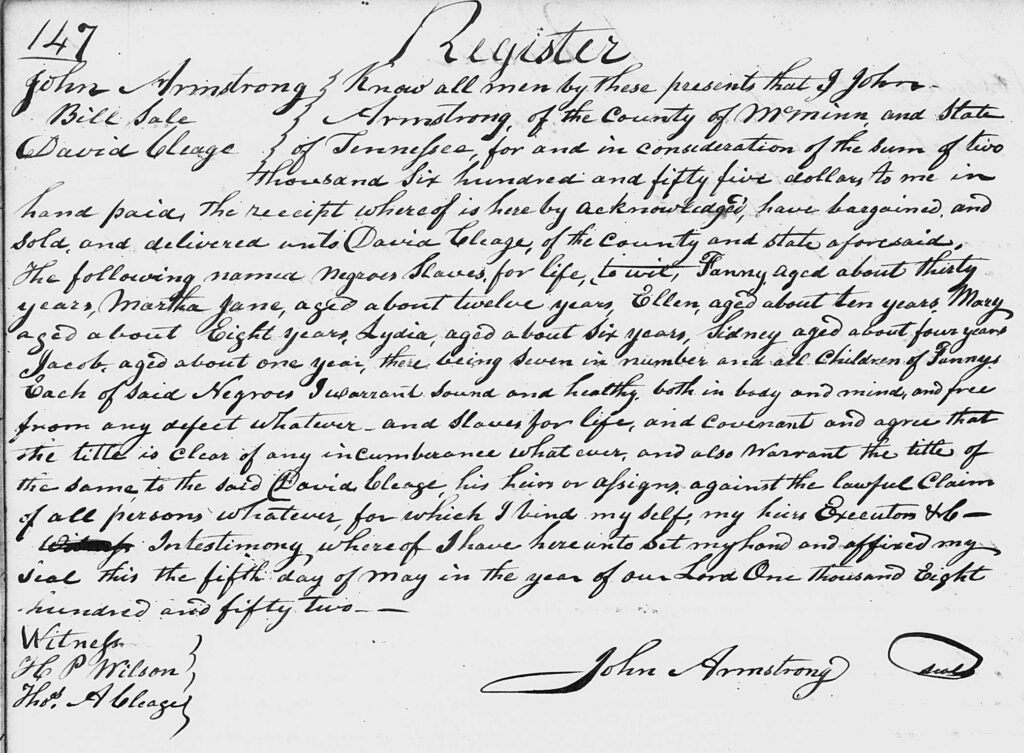
By 1860 David Cleage had real estate worth $20,000 and a personal worth of $90,000. He now owned 52 people who lived in eight cabins. Among them was the family of eight he had purchased from John Armstrong in 1852.
film 7842274, frame 00093
Register 147 John Armstrong } Bill of Sale } David Cleage } Know all men by these presents that I John Armstrong, of the County of McMinn, and State of Tennessee, for and in consideration of the sum of two thousand six hundred and fifty-five dollars to me in hand paid, the receipt whereof is hereby acknowledged, have bargained, and sold, and delivered unto David Cleage, of the County and State aforesaid, the following named negro slaves, for life, to wit, Fanny aged about thirty years, Martha Jane, aged about twelve years, Ellen, aged about ten years, Mary aged about eight years, Lydia, aged about six years, Sidney, aged about four years, Jacob, aged about one year, there being seven in number and all Children of Fannys. Each of said Negroes I warrant Sound and healthy. both in body and mind, and free from any defect whatever – and slaves for life, and covenant and agree that the title is clear of any incumberance whatever, and also Warrant the title of the same to the said David Cleage, his heirs or assigns, against the lawful claims of all persons whatever, for which I bind myself, my heirs Executors & C – Will in testimony whereof I have here unto set my hand and affixed my seal this the fifth day of May in the year of our Lord one thousand eight hundred and fifty two – – Witness } H P Wilson } Thos A Cleage } John Armstrong Seal
This is the third slave holder who bought a family with seven children in these first four posts. We will find out more about this family in a later post.