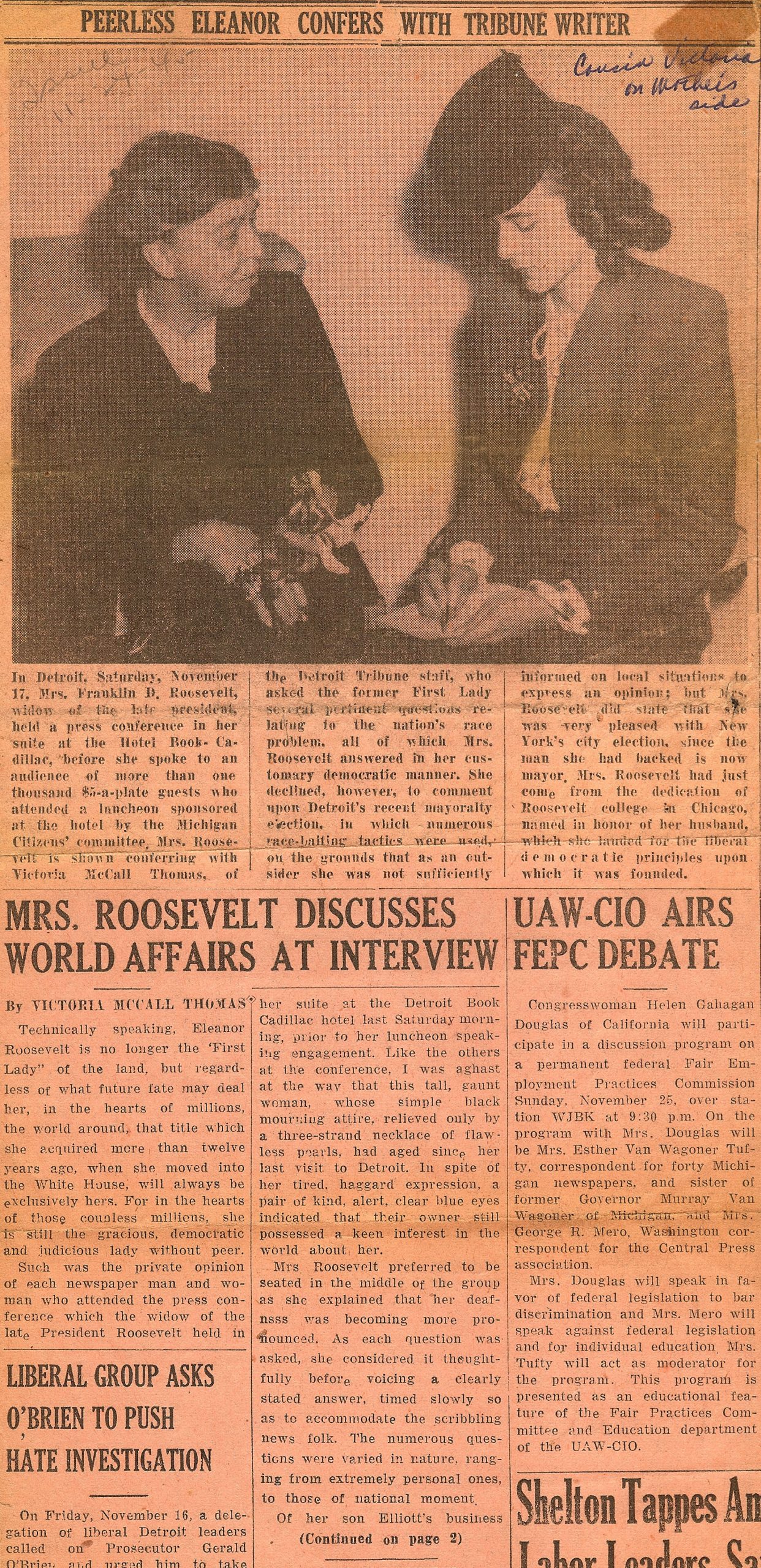
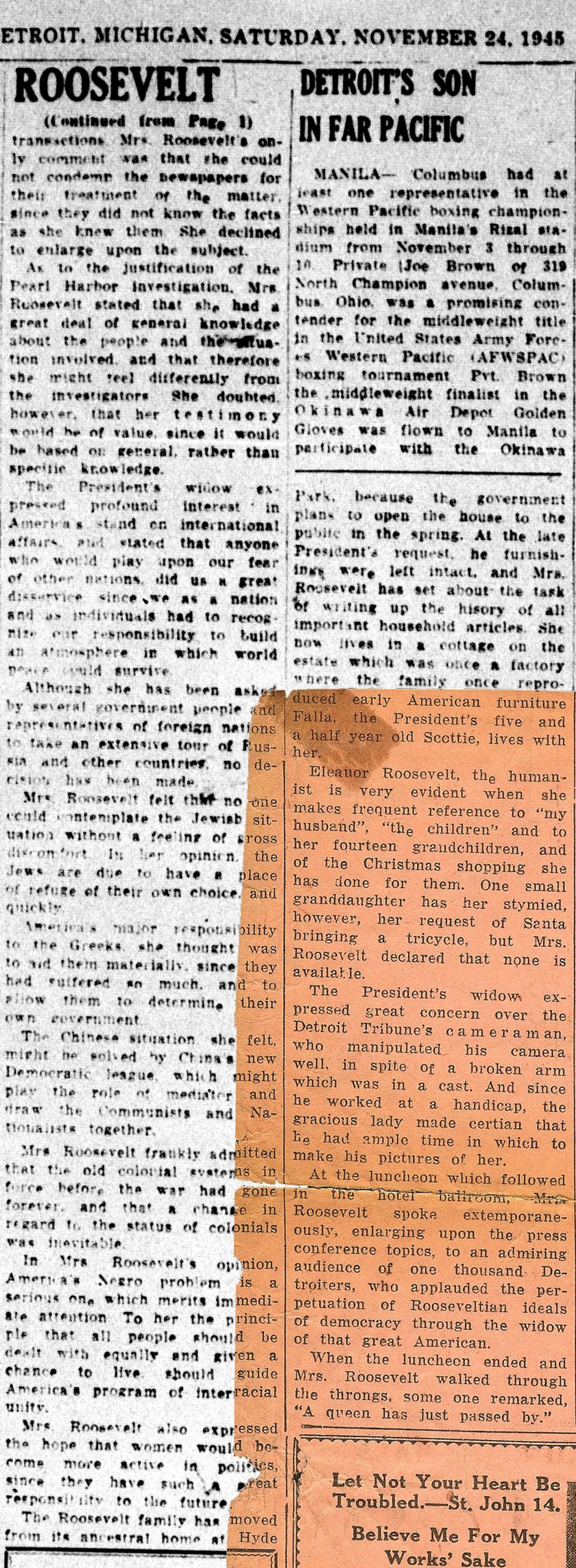
This article is from my Grandmother, Fannie Turner Graham’s scrap book. It was printed in the Detroit Tribune on November 24, 1945. Victoria’s parents, James and Margaret McCall, were the owners and operators of the Tribune. My grandmother wrote the date and my mother wrote the identifying information.
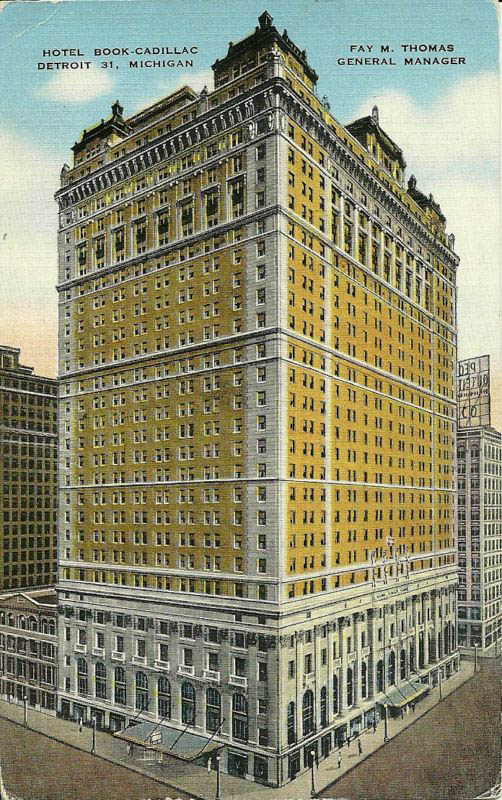
The postcard on the left shows the Book-Cadillac Hotel, where the interview took place, in the 1940.
Part of the article is missing. I think my grandmother trimmed one side and part 2 was on the other side. I combined her pink article with a scan from online.
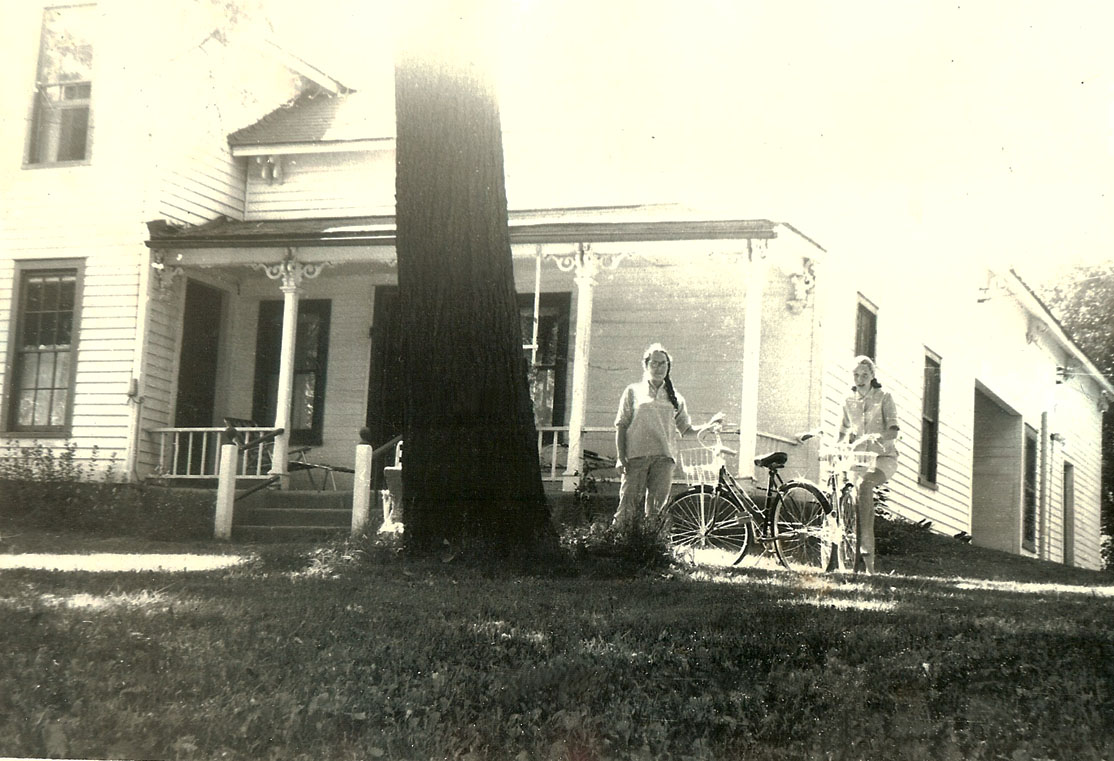
I was 16 and my mother was 39 in this photograph. We were getting ready to go bike down Old Plank Road. I was bare footed. We used to bike past the neighbors on the hill and down to a pond that was small and weedy. Sometimes we skated there in the winter. The neighbors had two big dogs that were often outside and we would peddle fast to get past before the dogs got to the road. We’d take enough time riding to the pond and looking at the water for them to go back up and then we’d repeat the ride back to the house. The dogs never got to us.
Barefoot biking.
I got my first bike on my 8th birthday. It was a basic, blue bike. I didn’t know how to ride and it took me so long to learn that my mother finally threatened to give the bike to my cousin Barbara if I didn’t learn how to ride. I don’t remember anybody holding the bike and running with me. I do remember practicing in the driveway of the house on Chicago until I learned to ride. At that point I only rode around the block.
When I was older, I remember going bike riding all around the neighborhood with my cousins, Dee Dee and Barbara. We rode in the street, which I wasn’t supposed to do. My sister and I used to go bike riding too but we usually had a destination – the library or my grandmother’s house. I lost that bike when I left it unchained outside of a store on W. Grand Blvd. We were on the way home from the Main Library. Later it was replaced by a three speed bike. I had that one up at Old Plank until we sold the place and then I had it in the Detroit. It too was stolen when my husband left it unchained on a porch one night.
When we lived in Idlewild, from 1986 to 2007, I used to ride my Uncle Hugh’s old bike. It had a bigger than average seat which made it more comfortable for me to ride, however it was old and had been through a lot and the tires were sort of crooked. I enjoyed riding it the 4 miles around the lake and for one memorable 5 mile ride into town with my daughter, Ife. She was going to work so she had 6 hours between her rides. I had to turn around and ride 5 miles back. If the streets around my house here were flat and I didn’t see rottweilers trotting down the street alone, I would get a bike and ride now. I know I am not going to take a bike to a park to ride.
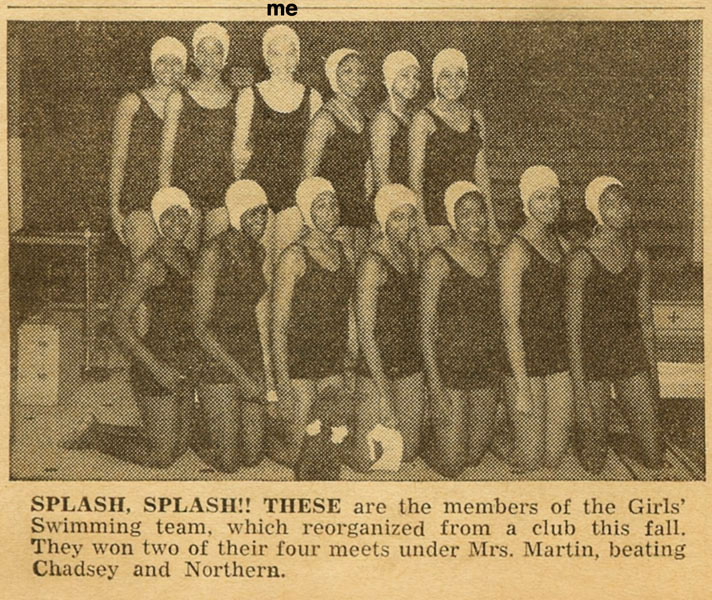
Photo from the Northwestern Colt, the school newspaper.
Both the Olympic swimming events and the insane hoopla about Champion Gabby Douglas’ hair took me back to my own swimming experience. I first joined the Swim Club as a freshman so that I could spend more time swimming. I took a regular swim class every semester and we swam everyday, except Friday, when we went across the street to the Lucky Strike Bowling Alley and bowled so that the regular gym class could use the pool. We also stayed after school for an hour doing more focused swimming. I didn’t enjoy competing, but I did like swimming so I stayed after the club became a team. I usually swam only in the relay but sometimes all the best swimmers would be ineligible due to bad grades and I would have to swim in a race. One time I came in second place. There were only two in that race. There was one girl in my class who made negative comments about my hair during the three and a half years I swam. I wish that I had known more ways to wear my natural hair instead of just pulled back in a little bun, which she kept telling me, looked like a shredded wheat biscuit. During my senior year our regular coach left to have a baby and the new coach turned the team into a synchronized swimming club. I didn’t much like her and I did not like synchronized swimming at all, so for that last semester of high school, I did no swimming.
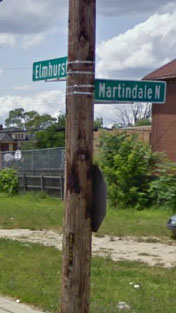
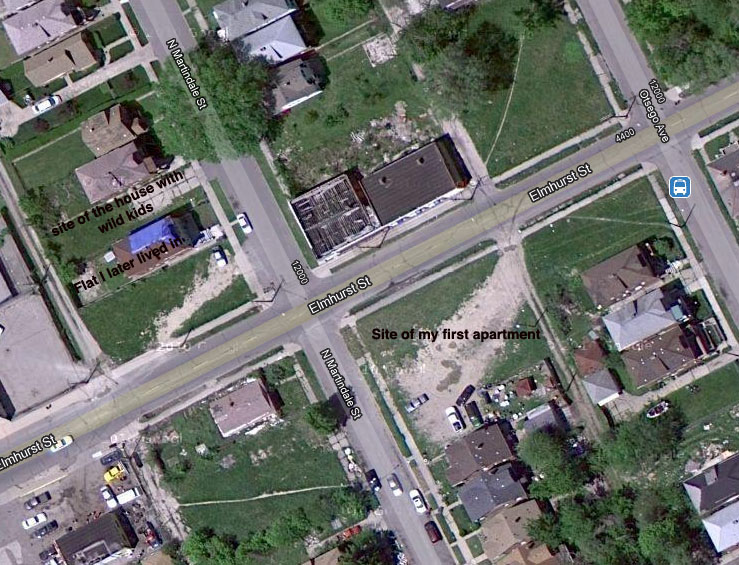
This post continues a series using the Alphabet to go through streets that were significant in my life as part of the Family History Through the Alphabet Challenge. It takes us back to North Martindale, kitty corner from my first apartment.
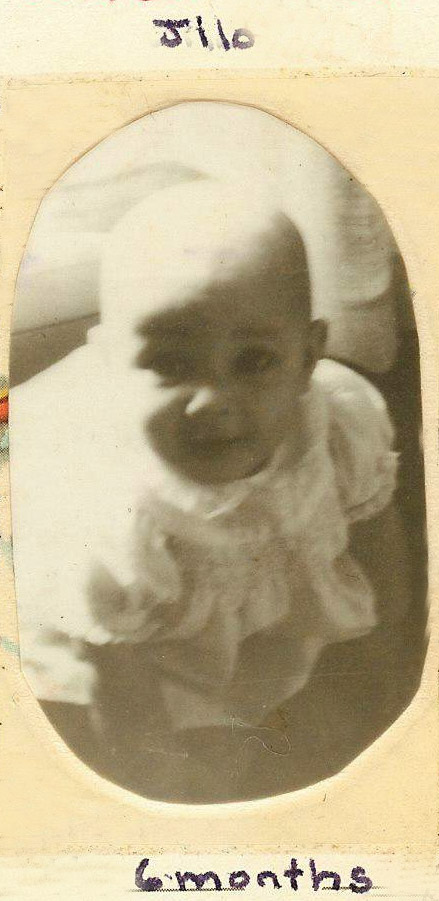
As soon as I reach a letter for which I have no street, I am going to post a chart of where I lived and for how long. From the time I left home until Jilo was a bit over 1 year old I must have been getting ready for this series by moving every 3 to 8 months.
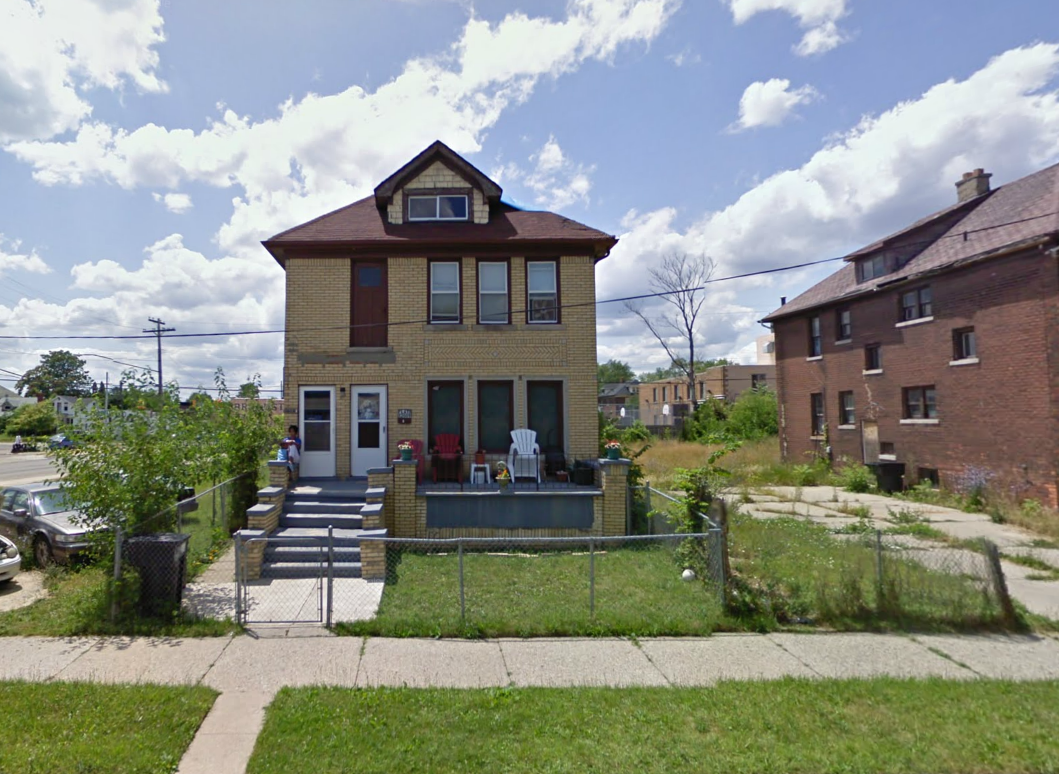
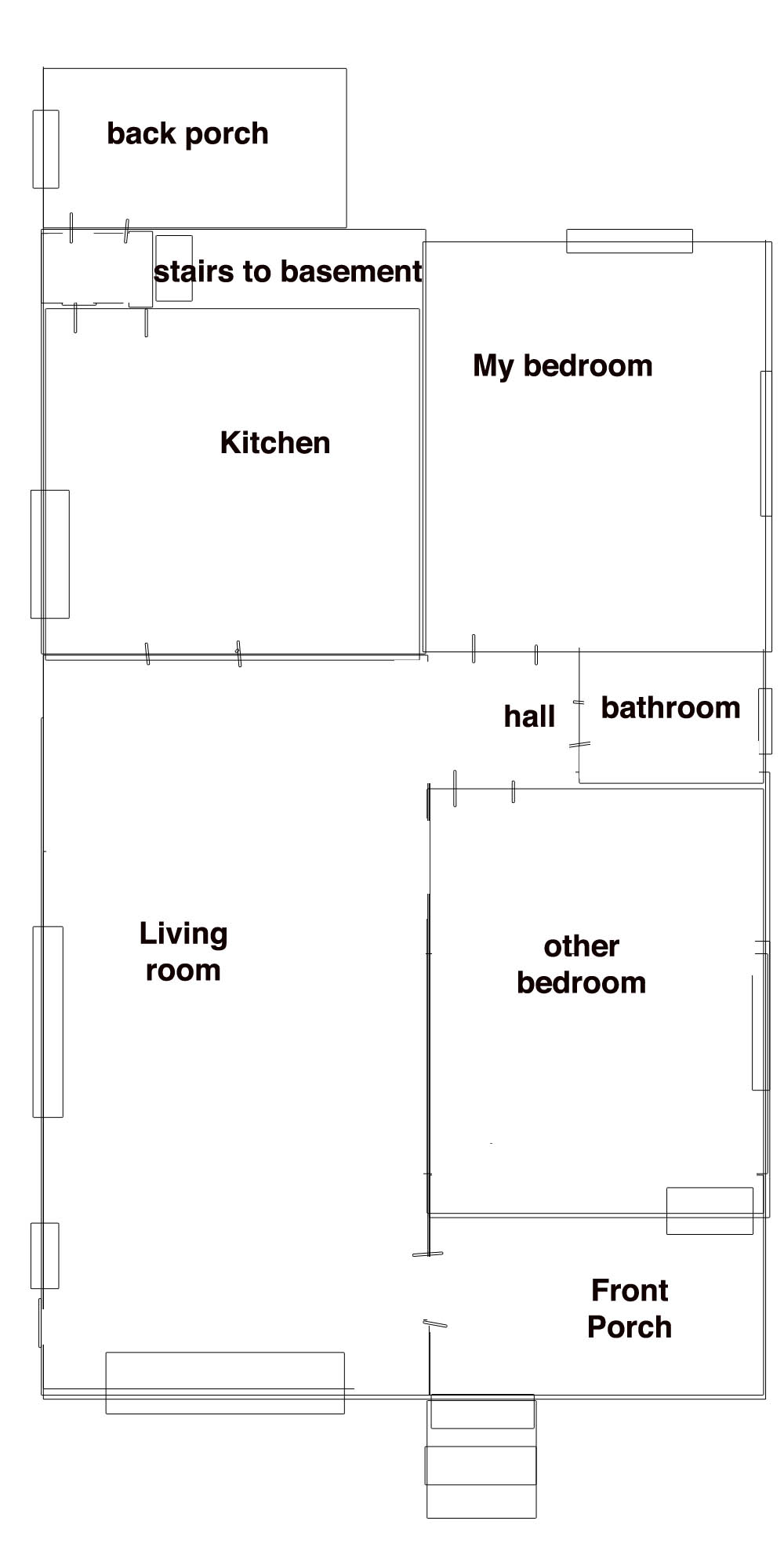
Today I will write about living at Brother John’s. Brother John and my husband, Jim, were both members of the Republic of New Africa and they all called each other “brother” and “sister”. We were there from October 1970 to March 1971, about 6 months. Bro. John lived in the downstairs flat, we lived in the upstairs flat. We didn’t have the whole flat though. He had his office in what would have been the front room. The dining area was empty, sort of a buffer zone. We had the kitchen, bathroom and three bedrooms. I made one of the bedrooms into a living room. The other two were bedrooms. At one point Jim, and I cleaned out the basement in hopes that Bro. John would move his office down there. He didn’t. Even cleaned out the basement was not very inviting.
Back in 1970 the upstairs flat had a porch where that door walks out into air. Next door where the vacant lot is now there was a small, single family house where 5 very wild children and their parents lived.
Some of the things that I remember… the wild kids next door who shot a BB gun into the house. Because we were living a charmed life, nobody was in the room. I remember the pear tree outside of the back porch and that I never picked any pears.
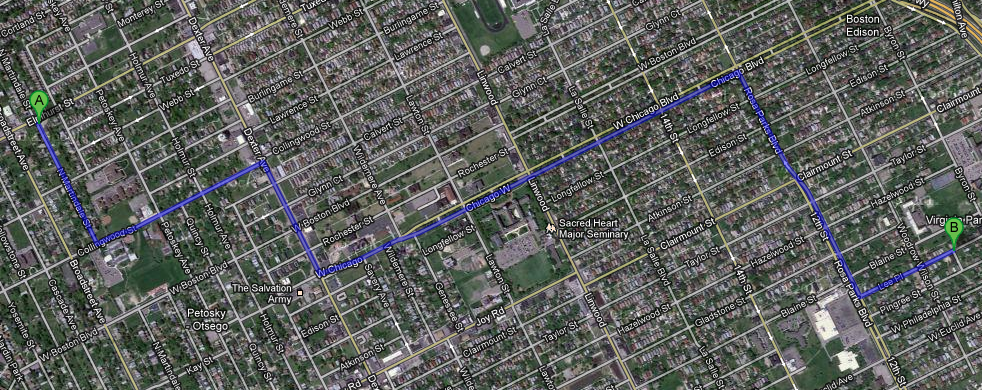
I remember once when Jim was out of town somebody, a community organizer, was shot to death when he answered his door. This disturbed me so much that I put Jilo in her stroller and walked from my house to Miriam’s house on Lee Place. I just didn’t want to be home alone. It was 2.8 miles. It was night and the only part of the walk I remember is that I didn’t walk down 12th but went down the next street over because there were so many people out on 12th.
Approximate route I took from N. Martindale to Lee Place on foot – 2.8 miles.
I remember when three friends and I started a food and baby co-op. We went to Eastern Market, a farmer’s market, early Saturday morning, babies on our backs. We bought cases of greens and sweet potatoes and eggs. We divided them up. We also took turns watching each others babies for a few hours a week so we could get a bit of free time. I can’t remember what I did with my free hours. The co-op eventually fell apart but Martha started a co-op with a La Leche League chapter and I started one at my father’s church.
Eastern Market today.
Some random memories. going away one day and leaving the little washing machine I had earned by babysitting, running. It over flowed and dripped down to Bro. John’s kitchen below. Having the flu while Jim was out of town. Getting Jilo to sleep through the night only to have that go for naught when we visited my sister in Atlanta and she started waking up through the night to nurse again. And last, Bro John finding the dynamite in the attic and being incredulous that anybody would be so dumb as to store dynamite in a house that was being watched by the police and the FBI because it belonged to a member of the Republic of New Africa. I could not fault his logic. At that point we moved to the horrible house on Monterey . Luckily Jilo had no idea what was going on during these times. She probably still doesn’t, unless she is reading these posts.
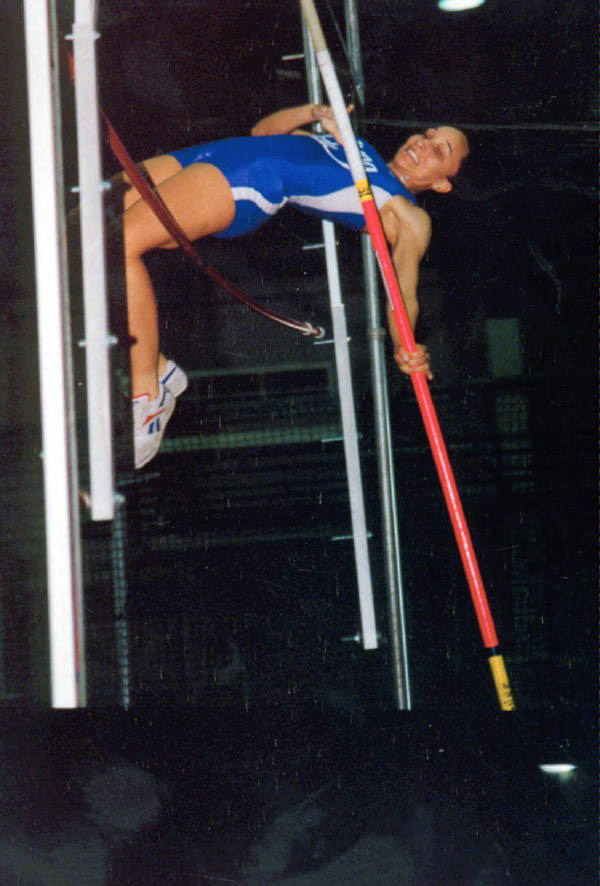
Tulani pole vaulting for Indiana State University.
My daughter Tulani pole valuting. She was one of the first to take it up when the event was added to college women’s track in 1996 as an exhibition event. In 1997 NCAA recognized and scored women’s pole vault as a regular meet event. She competed as a part of Central Michigan University’s Track team where she held the school record and was ranked in the top three Divsion I women vaulters in the state of Michigan. Tulani also pole valuted as a member of the Indiana State track team where this picture was taken.
This post continues a series using the Alphabet to go through streets that were significant in my life as part of the Family History Through the Alphabet Challenge. I can’t believe we are half way through the alphabet already and that I have found a street for every letter so far.
______________
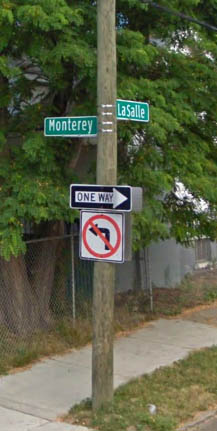
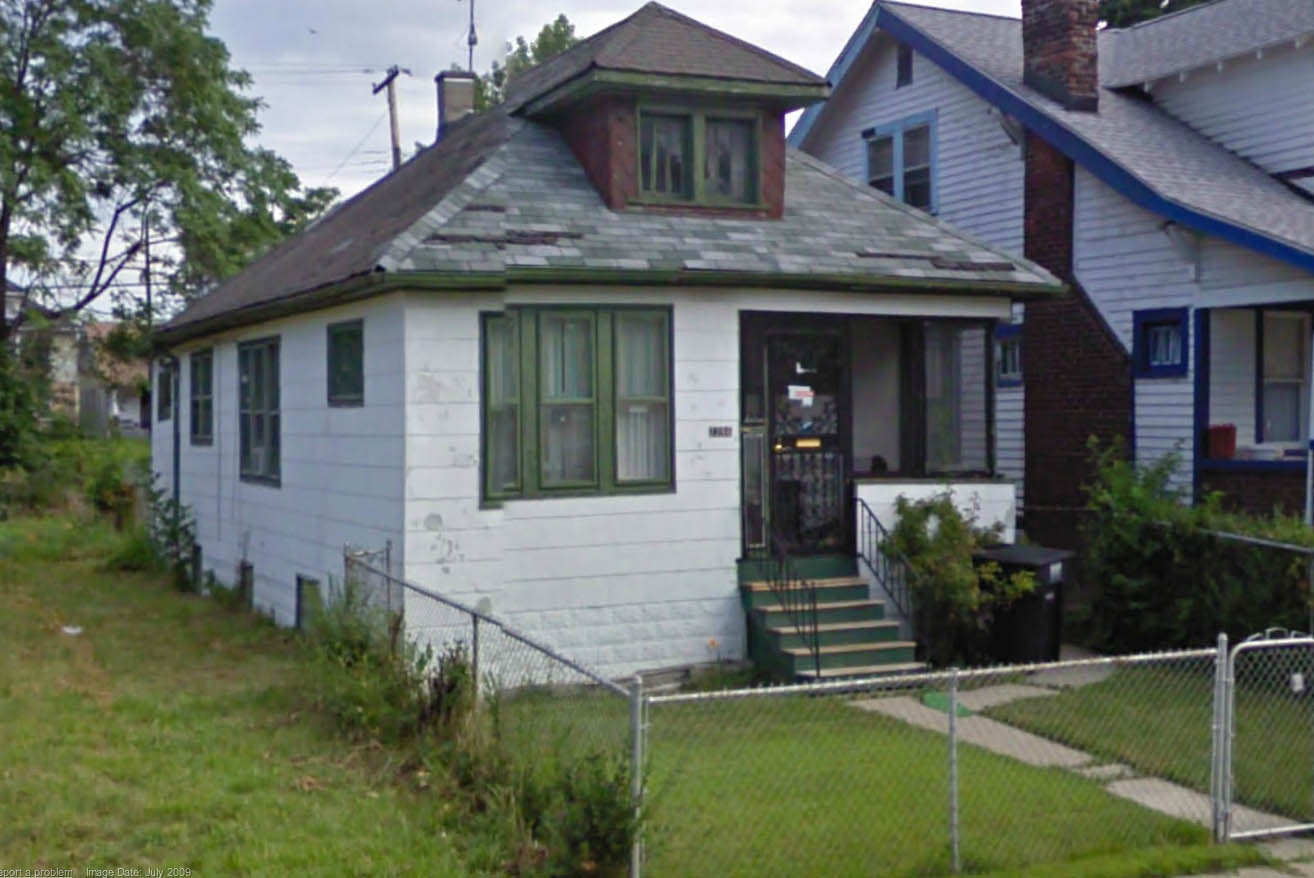
Today I’m going to write about living on Monterey Street on the west side of Detroit. The house was between LaSalle Blvd and 14th street and in the same area as the Black Conscience Library’s Linwood location. Unfortunately by the time I lived here the library had moved to Grand River which was a bus ride away. Living here is one of those situations where I am thankful we made it out of there unscathed. It included living with supposedly reformed junkies who turned out not to be, a wandering wife, explosives in the basement and finally a beating of the wife. That was the day I left that house never to return.
The house as it looks today on Google maps. It wasn’t in quite that bad shape in 1971.
Daughter Jilo on the front porch.
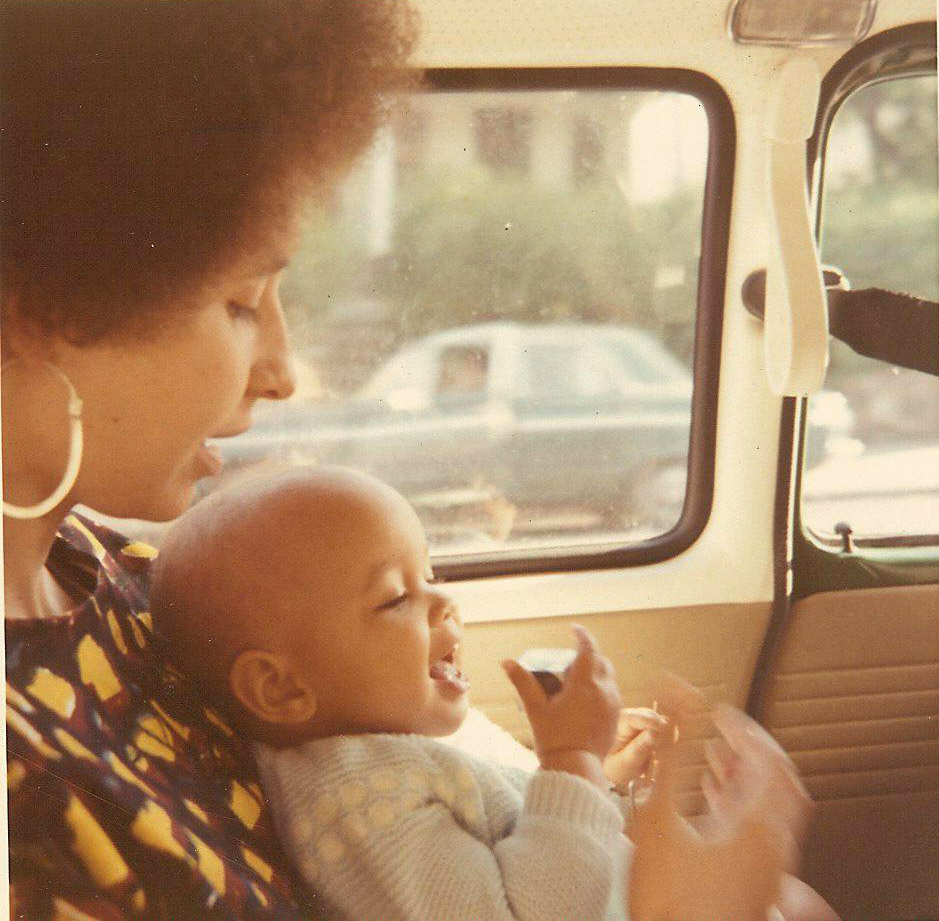
I’m holding Jilo on the way to my sister’s graduation from Spellman College during the time we lived on Monterey.
This song always reminds me of that couple and the spring of 1971.
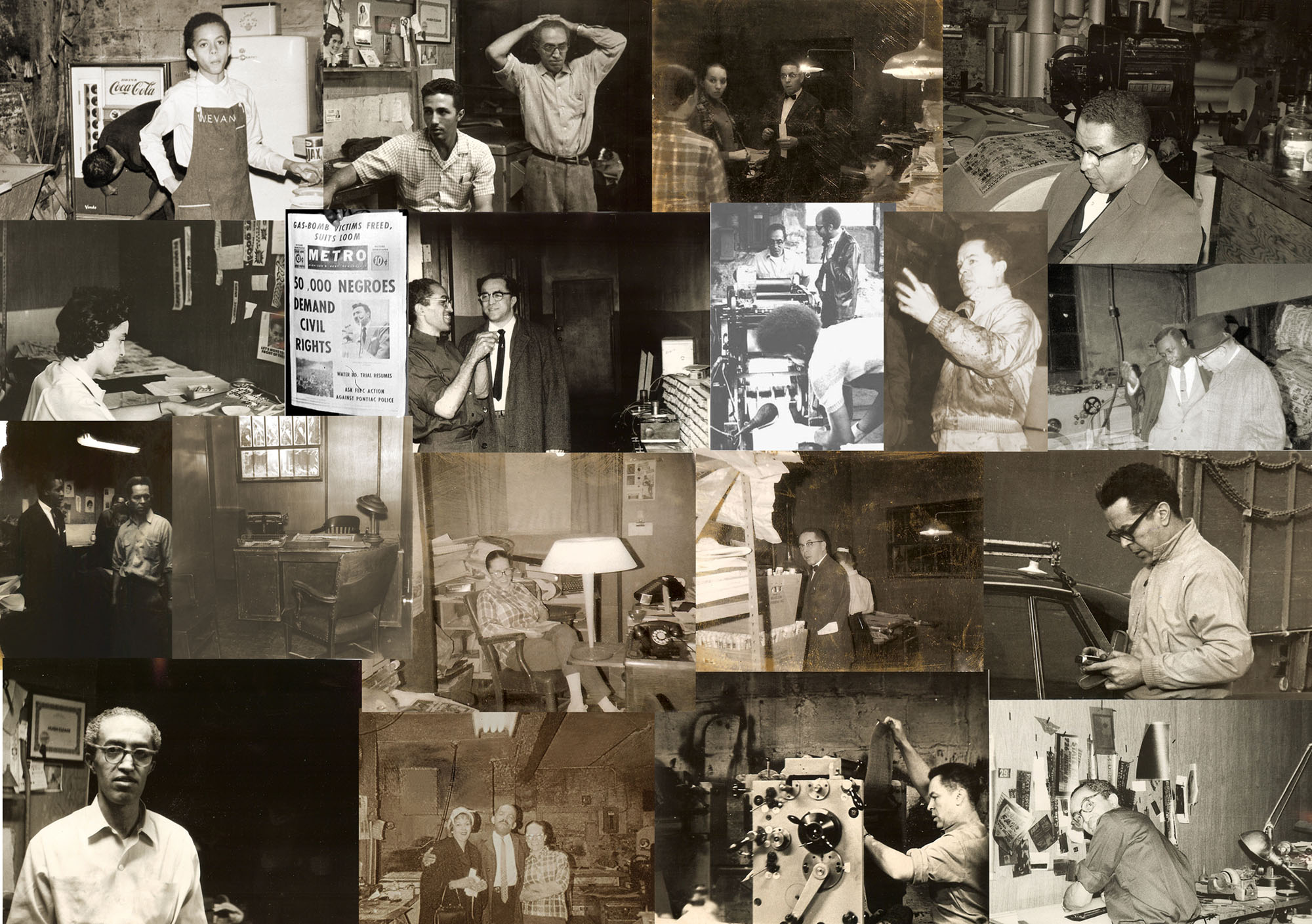
Click on this and other photos to enlarge. Scenes from Cleage Printers – 1960s. Most of these photographs were developed in the plant dark room. I wish I’d learned more about photography while there was that great dark room available and all those wonderful cameras.
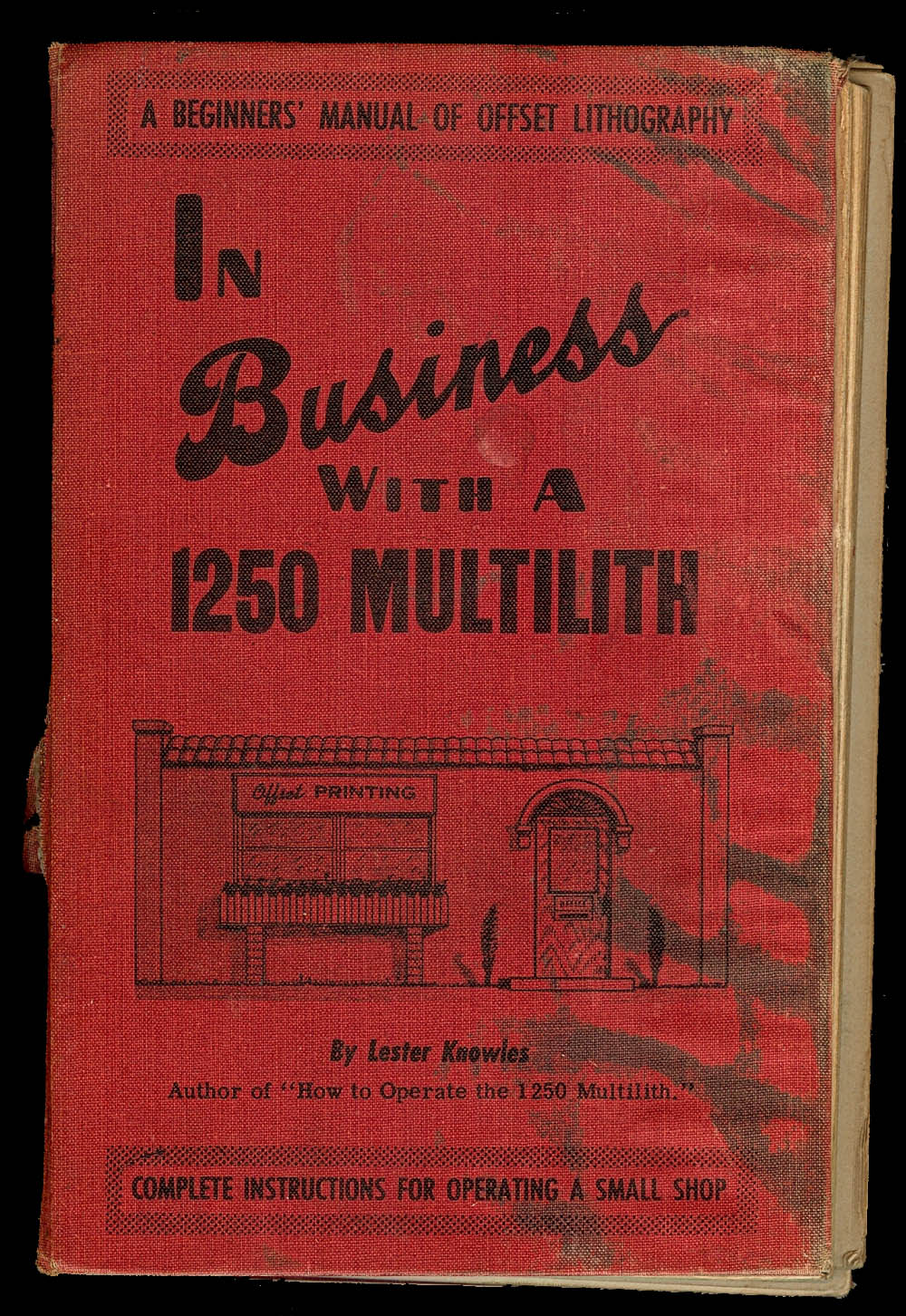
My uncles, Henry and Hugh Cleage owned and operated Cleage Printers for about a decade, from the late 1950s until the late 1960s. It’s difficult to pinpoint the time they started printing. They published a newspaper called The Metro in 1956. I’m not sure if they printed that themselves or put it together and had it printed elsewhere. On the March, 1960 marriage license for Henry and my mother, he listed his occupation as Printer/Lawyer. The plant, as we called it, was located behind Cleage Clinic at 5385 Lovett, near McGraw on Detroit’s Old West Side. Henry was an attorney and Hugh worked at the Post Office before they started printing. I don’t know if either of them had any experience printing before that. I asked my husband, who was also a printer for a number of year without much prior experience. He said it’s not that hard to learn while doing. Maybe armed with “In business with a 1250 Multilith” they were able to set up shop and learn on the job. I still have the book. Uncle Louis, the doctor, put in the start up money for the press. Later when they had to upgrade Henry said that family friend, Atty. Milton Henry, contributed that money.
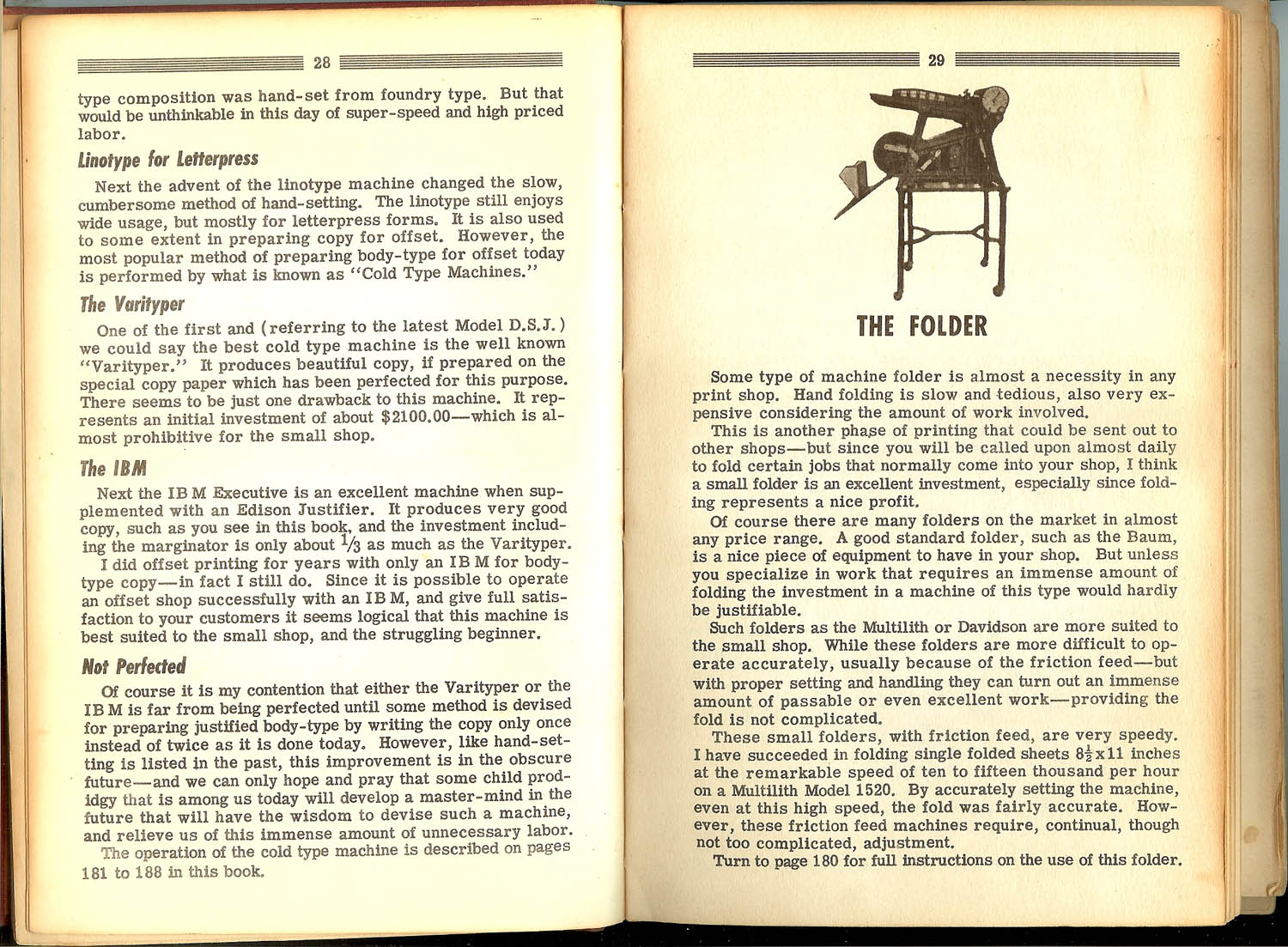
According to the memories of family friend, Billy Smith and my aunt Anna, they went into business for themselves because they wanted the independence of being their own boss and Henry had always been interested in printing. They had several long term employees and a number of young people who worked there for a short period of time. My aunt Barbara worked there for awhile. My sister and I worked there the summer I was 16. I learned to run the small press and use the Varityper described below. I remember Ronald Latham keeping up a running story about being a Venusian now living on Earth. Henry kept our first weeks wages of $10 to make it like a real job. He was supposed to give it to us at the end of the summer, when we stopped work but we never saw that $10 and we didn’t bring it up. If we had, I’m pretty sure we would have been paid.
They made their money by printing handbills for neighborhood markets. In addition to that they printed up flyers, newsletters, magazines for various radical black groups, materials for the Socialist Workers Party and the Detroit Artist’s Workshop. The printing plant was a place where people came to find discussion of the issues of the day and in the 1960s there were plenty of issues to discuss. My Uncle Henry loved to hold forth on a variety of topics and his arguments were always well thought out and convincing. Hugh didn’t talk a lot but he would have something to put in, maybe just a quiet shake of his head over what Henry was saying. If Louis came back he would join in with his sarcastic comments and distinctive laugh.
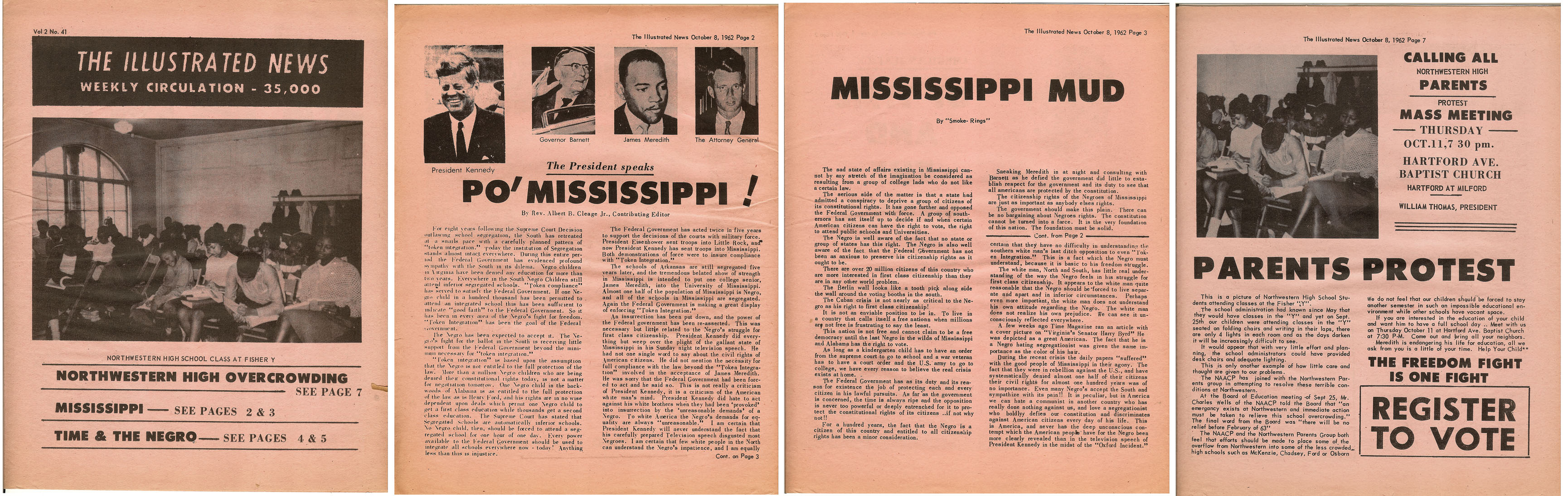
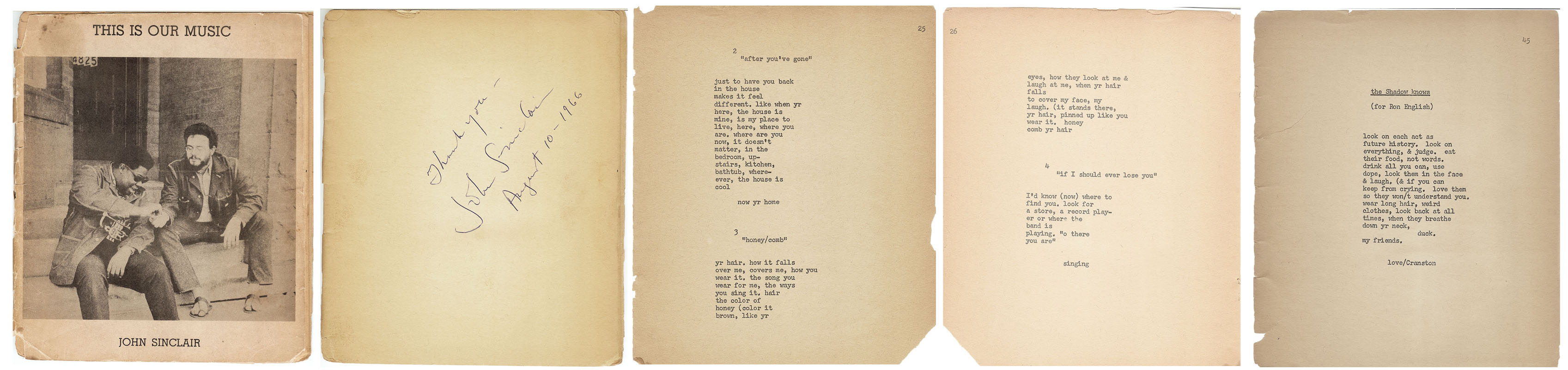
Various flyers printed at Cleage PrintersFour pages from the October 6, 1962 issue of The Illustrated News. They printed it on pink newsprint left over from the market handbills so it was often called the “pink sheet”. My uncles published it from 1961 to 1964. It started off as a weekly and eventually went to bi-weekly and consisted of 8 pages of commentary about local and national events of concern to the black community. My father wrote many of the article. My uncle Louis had a biting, humor column called “Smoke Rings” on the back page.In addition to grocery store circulars and race literature, Cleage Printers printed a variety of other alternative materials, such as a series of poetry books for the Artist’s Workshop in Detroit, headed by John and Leni Sinclair.
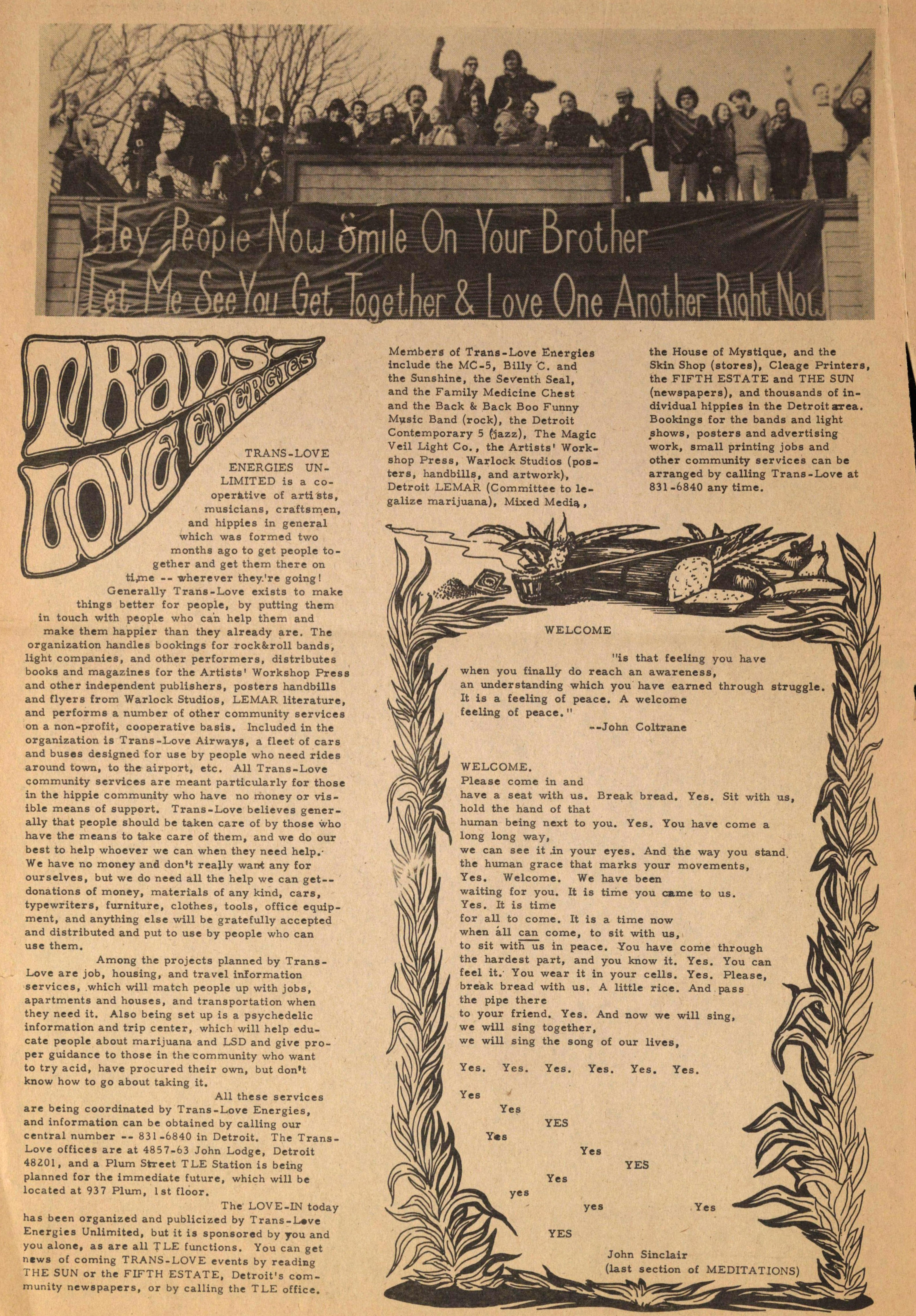
I found this at The Ann Arbor Library. You can see that Cleage Printers is mentioned as a part of the Trans-Love Engeries Unlimited co-operative in the 2nd line of the 3rd column, of this April 1967 copy of “The Sun”. I wonder that I never heard about that.
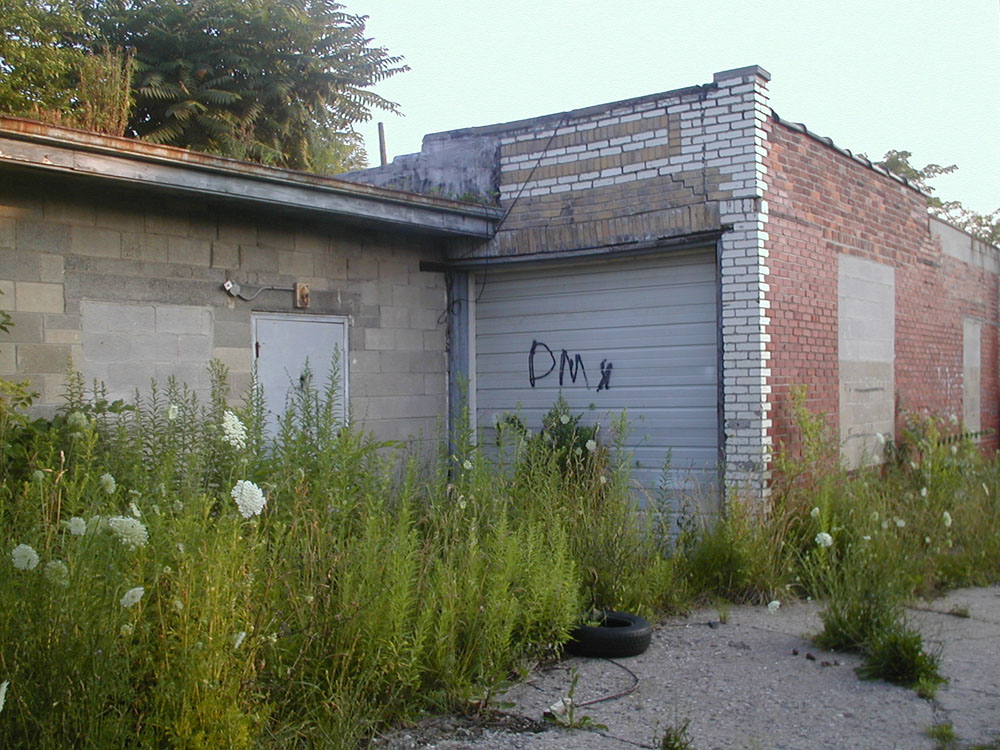
Sometimes there would be things that had to be collated in the evening and all of us cousins and our mother’s would be down there at night putting whatever it was together. After the 1967 Detroit riot so many stores went out of business that they couldn’t make enough to keep going. Henry went back to law and worked with Neighborhood Legal Services. Hugh held on for another few years, printing for the church and teaching young people how to run the small press. Finally, he too left. I wish in all those photographs that were taken, one or two had been of Cleage Printers in it’s prime. All I have is a photograph I took in 2004 of the way it looks now, deserted and overgrown. I wish I had interviewed and taped Henry and Hugh talking about their experiences.
The building that housed Cleage Printers as it looked around 2007.
This was written as part of the 120 Carnival of Genealogy hosted by Jasia at CREATIVEGENE.
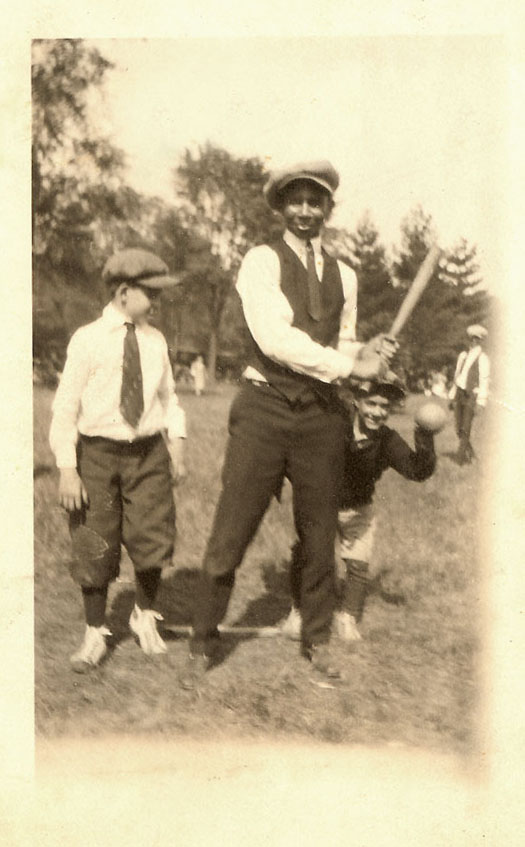
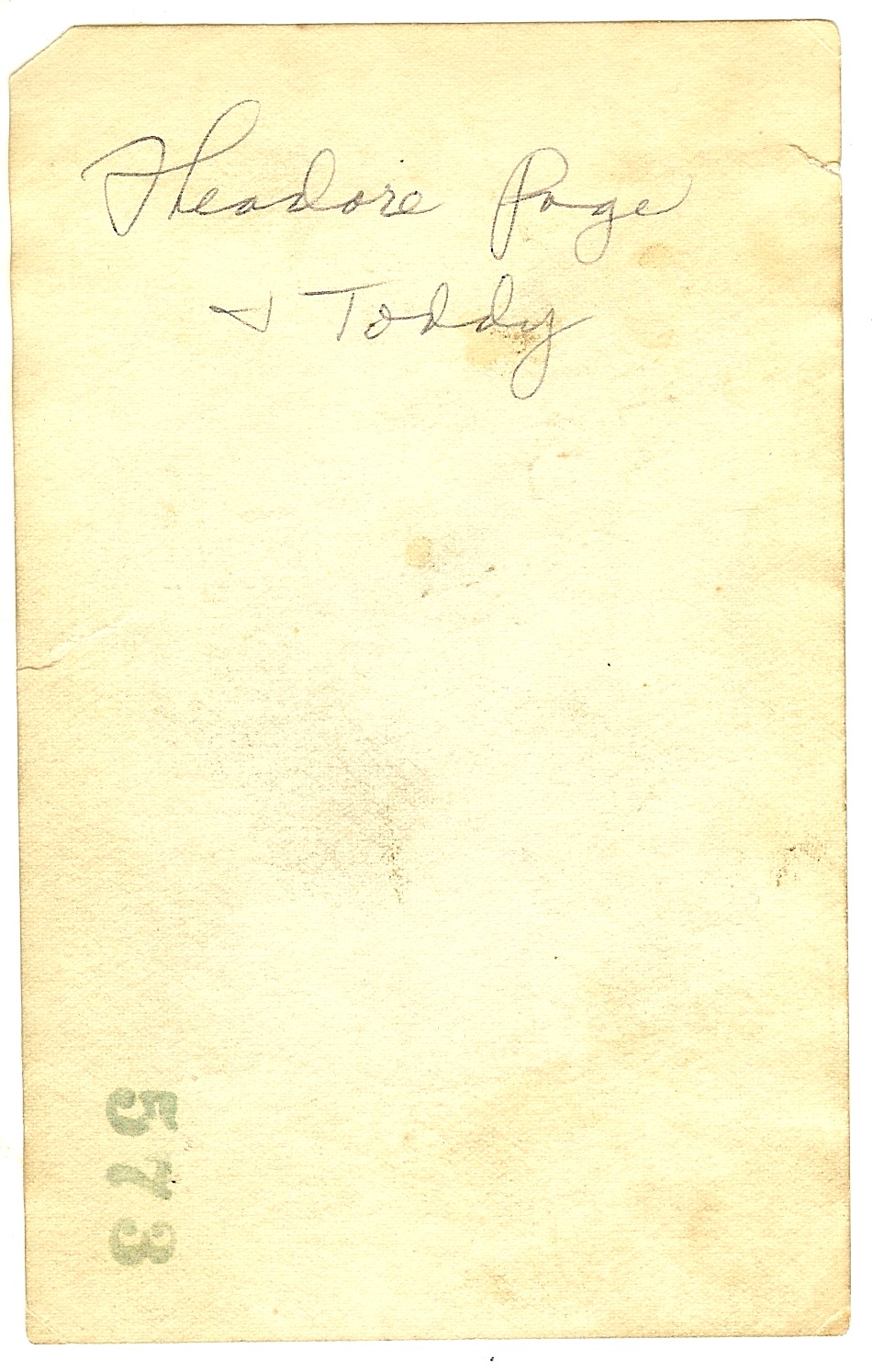
I have posted this photograph before as part of my discovery of the numbers on photographs as a means of sorting and dating them. My father’s cousin, Theodore Page, is ready at the bat while my father, “Toddy” seems oblivious to the fact that he could have his head knocked off when Theodore goes to hit the ball. The photograph was taken in the summer of 1922, probably at Belle Isle, an island park in Detroit. The day was an outing for the extended Cleage family.
My uncle Henry loved baseball and often described the game in terms that made it seem like a work of art or a piece of music. My mother’s mother used to listen to games on the radio. I never liked playing the game – I could not hit the ball. I didn’t like watching it, compared to basketball, baseball games seem so long and slow moving.
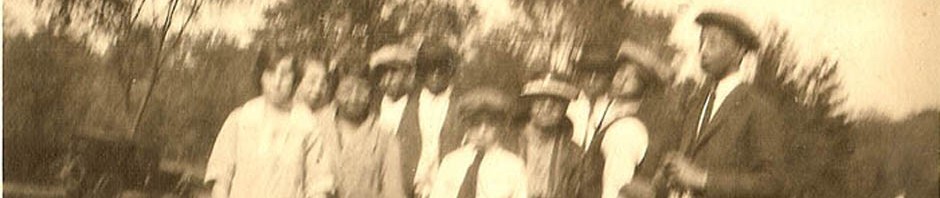
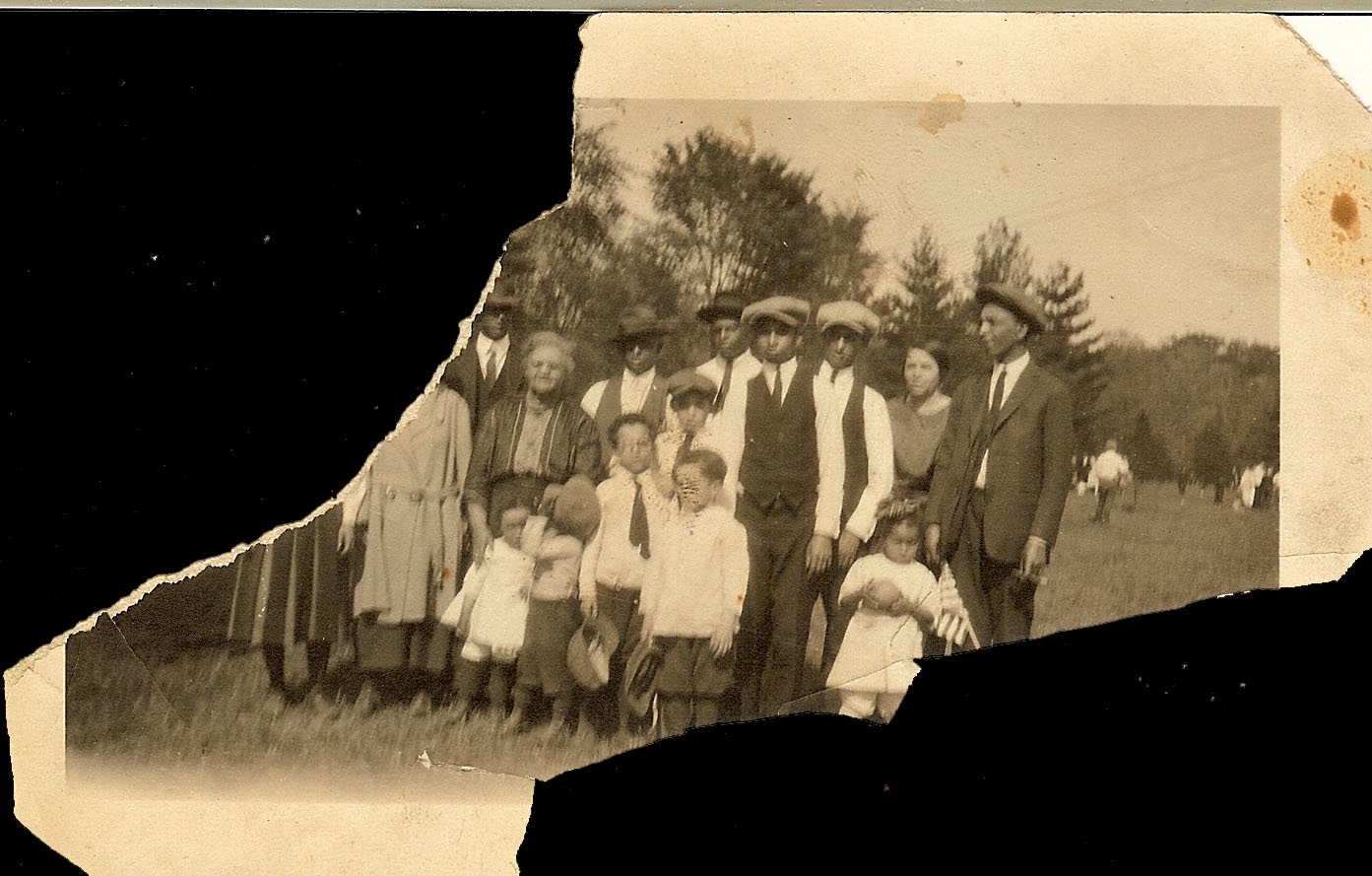
Another photograph from the same outing. Starting from the left, are two headless women and I don’t know who they are. The little girl is my Aunt Barbara, next to her is my Uncle Hugh, Uncle Louis, Uncle Henry, Theodore Page (who looks like he has a double), my uncle Henry’s daughter, Ruth, who is holding the same ball the catcher is holding in the action shot. Behind them are, an unknown man, my great grandmother Celia Rice Cleage Sherman, her son Jacob, my father Albert “Toddy”, three people I don’t know then my grandfather Albert B. Cleage Sr. In the background are some other people. I don’t know who they are.
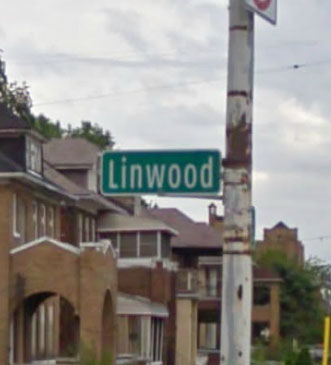
Linwood was woven through my life from the time we moved on Calvert, between Linwood and Lawton, 1954 until I moved from Detroit in 1972. If I have done blog posts on the spot already, I will provide a link to the earlier post.
To view Linwood, Detroit in a larger map, click on the blue link.
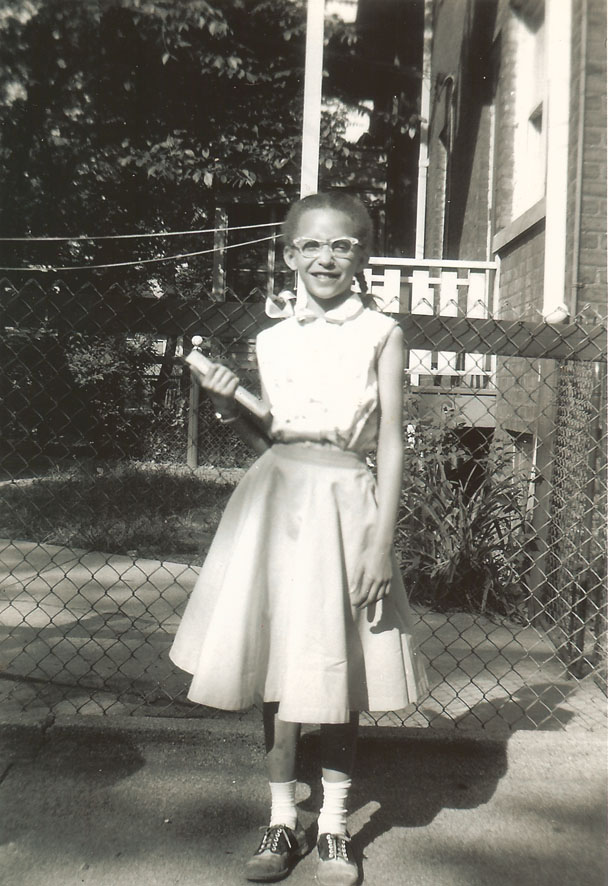
Me
13211 Linwood – Toni’s School of Dance Arts I was about 9 when we started taking Saturday ballet classes at Toni’s School of Dance Arts. They went on for several years. We wore blue tutus, black ballet slippers shoes and white ankle socks. There was a bar and a wall of mirrors. I learned the five ballet positions and to point my toe. Each year culminated in a big recital at the Detroit Institute of Arts. On the Saturday before the recital all the students spent the day at Toni’s so that the entire program could be gone through. Those not performing would wait outside in the walled in yard of the studio. It was crowded and hot. For the performance one year we wore white calf length dresses, net over satin fabric. The next year we wore net tutus. I had bright blue. My sister’s was bright green. My mother thought the costumes were getting too expensive. I don’t remember minding when we stopped going about the time we moved off of Calvert. Unfortunately, I don’t have a picture of myself wearing a dance outfit but I picture the me in this photograph wearing a black leotard and blue tutu, white anklets and black ballet slippers.
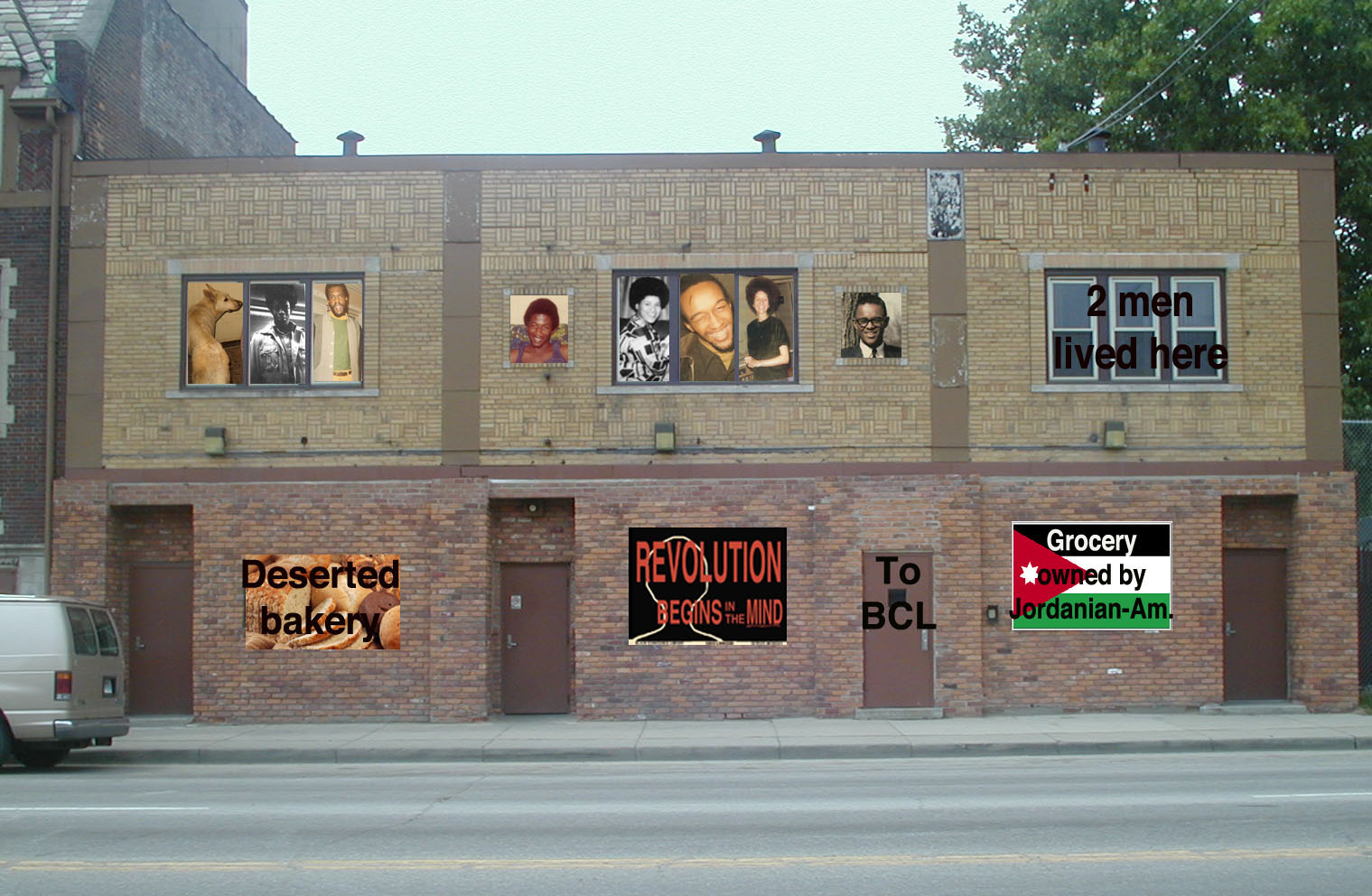
The Black Conscience Library building with photos. From L to R. My dog Big, Phil, Dewy (later Chimba Omari), Malik, Miriam, Jim, Me, Longworth. Downstairs was the deserted bakery that took up two spaces. I put our sign over one and a very small, poorly stocked grocery store owned and run by a Jordanian. He was robbed numerous times while we were there.
12019 Linwood – Black Conscience Library The Black Conscience Library was located here from the winter of 1969 to the spring 1970. In addtion to a small collection of books there were classes and movies related to black history, culture and freedom struggles in various parts of the world. For more read – Once I Worked In A Sewing Factory.
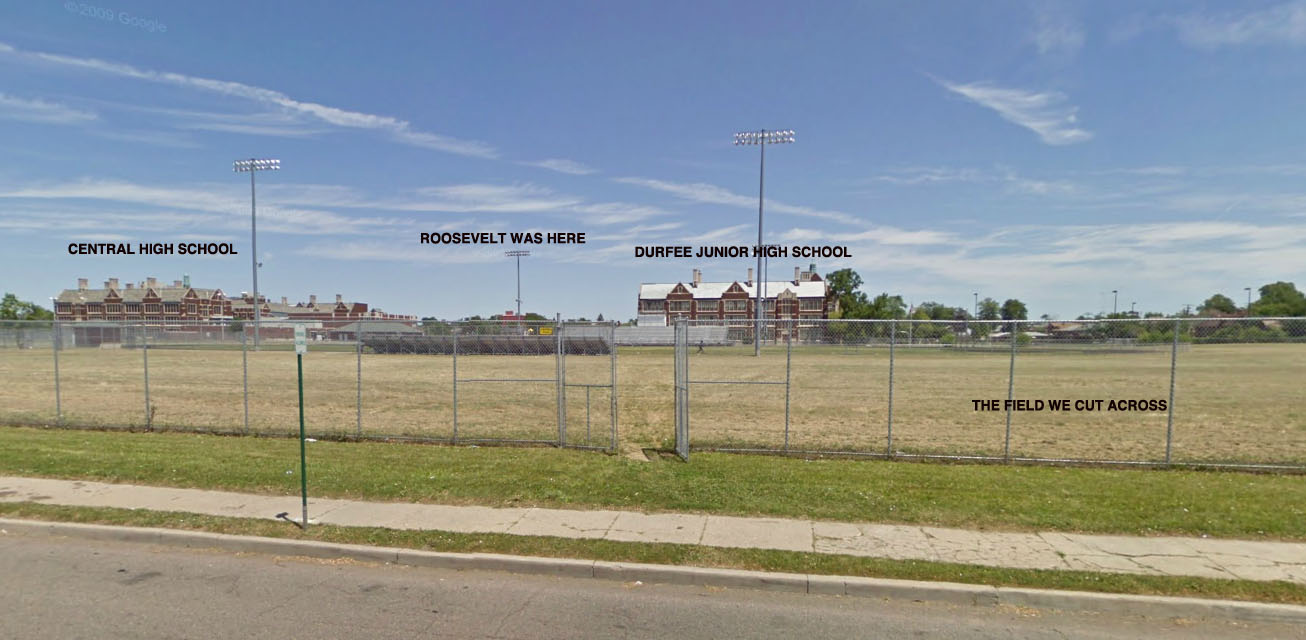
Roosevelt Elementary School I attended 2nd through 6th grade here. My mother taught Social Studies there from 1954 through 1965. We also cut across the athletic field from Linwood to get to and from Roosevelt. The building is no longer there.
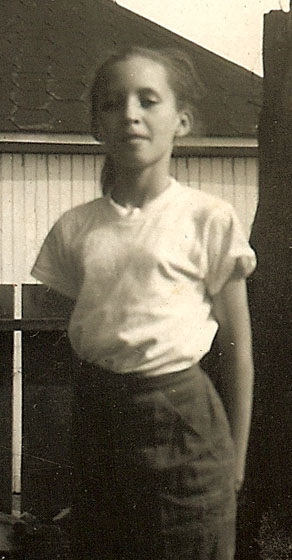
Me
Durfee Junior High School I attended half of the 7th grade at Durfee. I learned to swim in the pool. The school address is not on Linwood but, the back of the school is.
Athletic Field We walked across here to get to school when we lived on Calvert between Linwood and Lawton. I remember a neighbor lost her boot in the snow cutting across this field in 2 feet of snow. Once my sister and I went with our mother to fly kites here.
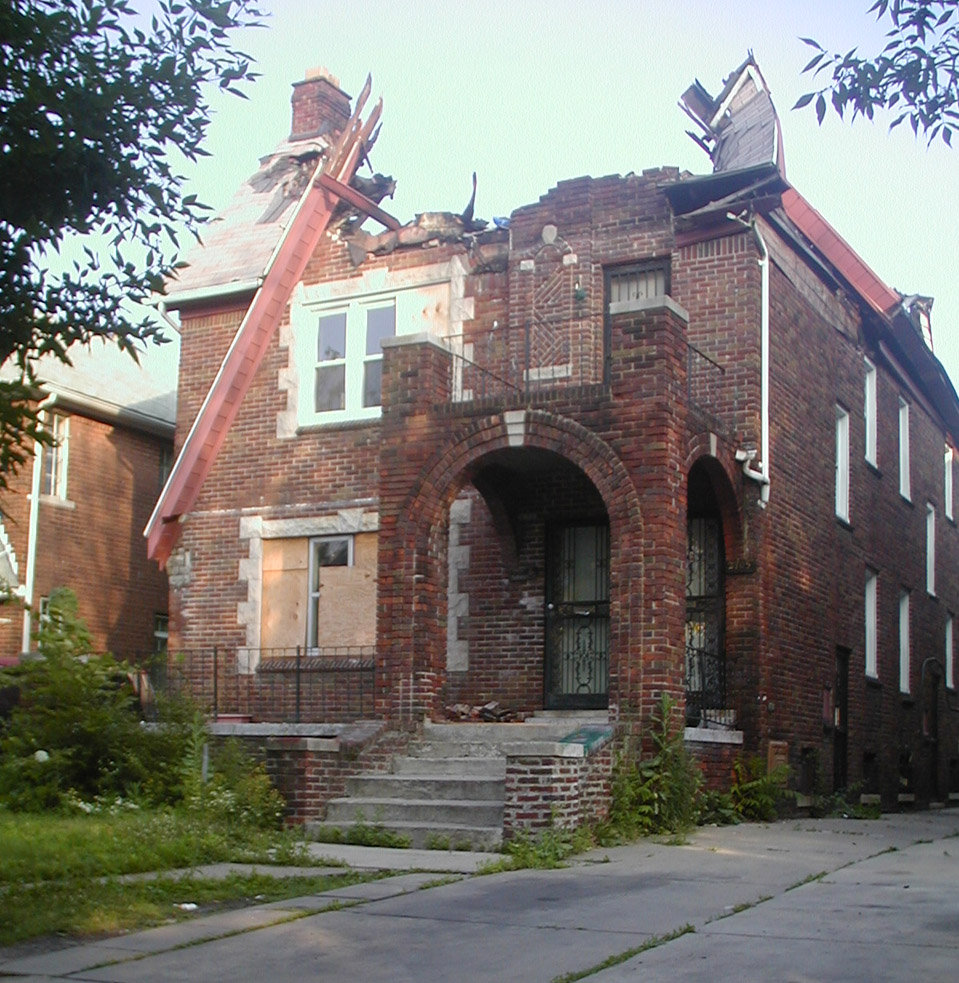
We lived in the upstairs flat. This is how the house looked in 2004.
2705 Calvert between Linwood and Lawton. I lived here, from 1954 to 1959. We bought penny candy and fudgesicles (ice cream on a stick), from a store on the corner of Linwood and Calvert, walked to school down linwood and at times walked blocks and blocks to activities at church. Read more here – “C” Is For Calvert.
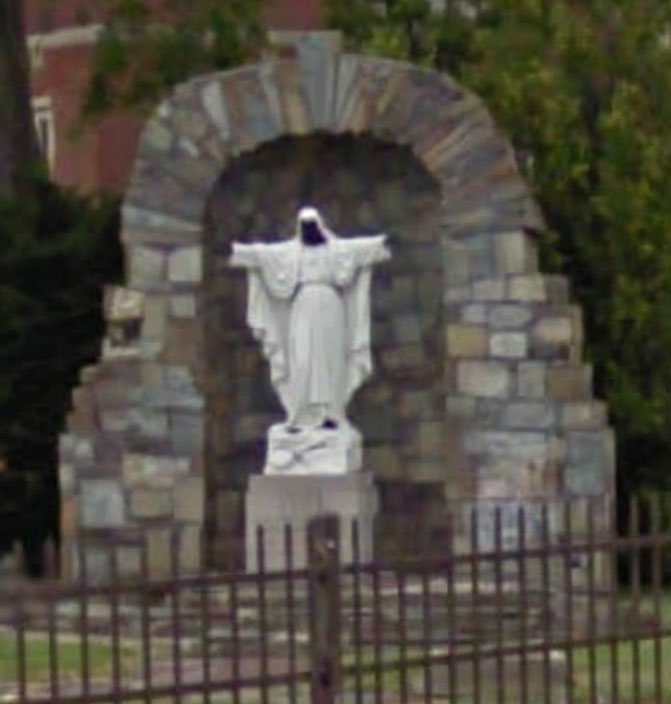
Black Christ at Sacred Heart Seminary
Linwood and Chicago Blvd. – Detroit Rebellion Journal – 1967. During the 1967 riot, this statue belonging to Sacred Heart Seminary was painted black. It was repainted white and then repainted black. It has stayed black right through to the present. You can also find more photographs of the statue here.
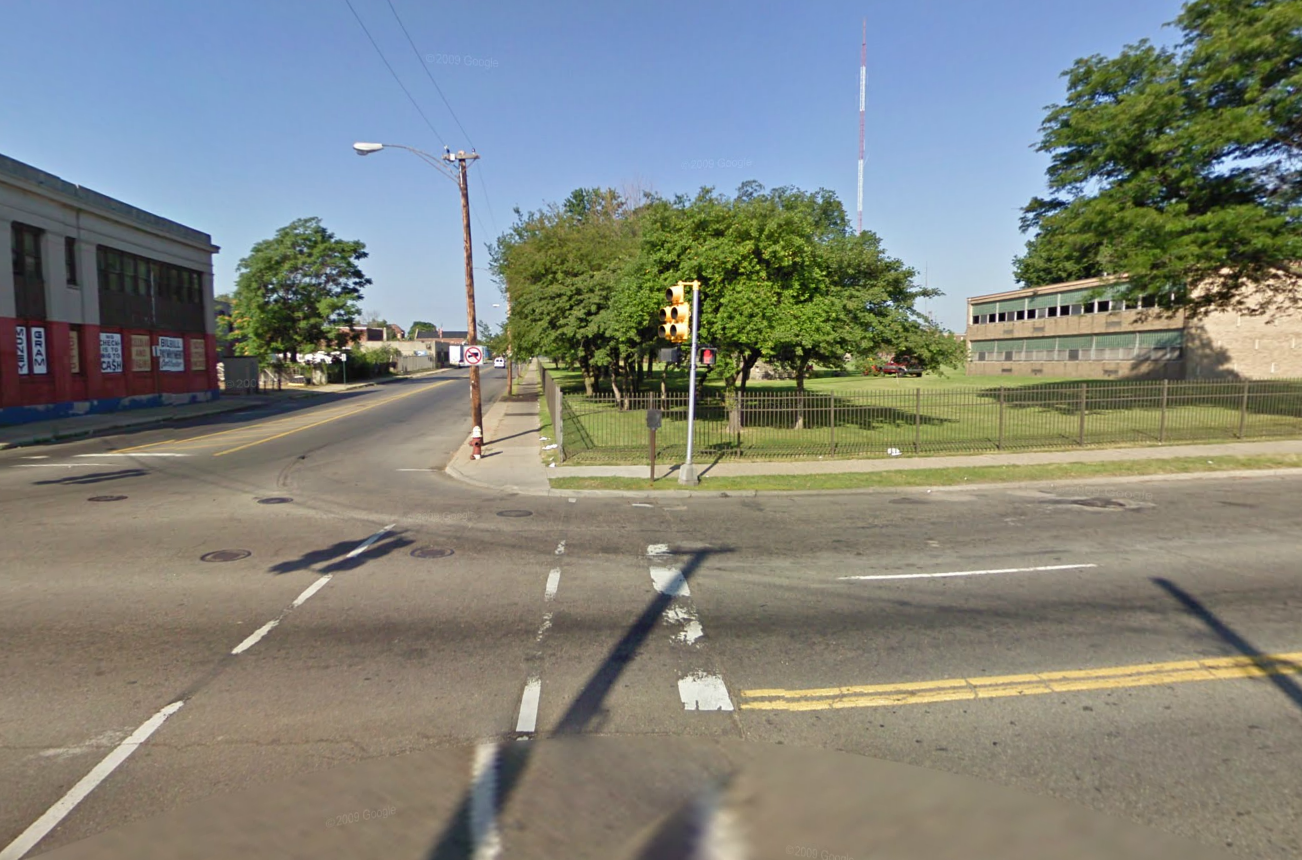
Street Crossing
Street crossing I crossed the street here at Linwood and Joy Road when I attended Brady Elementary School for kindergarten and part of 1st grade. There was also a block with the bank my mother used and the dime store we spent our pennies, one block down. The photo is looking across Linwood to Joy Road. Read more here “A” Is For Atkinson.
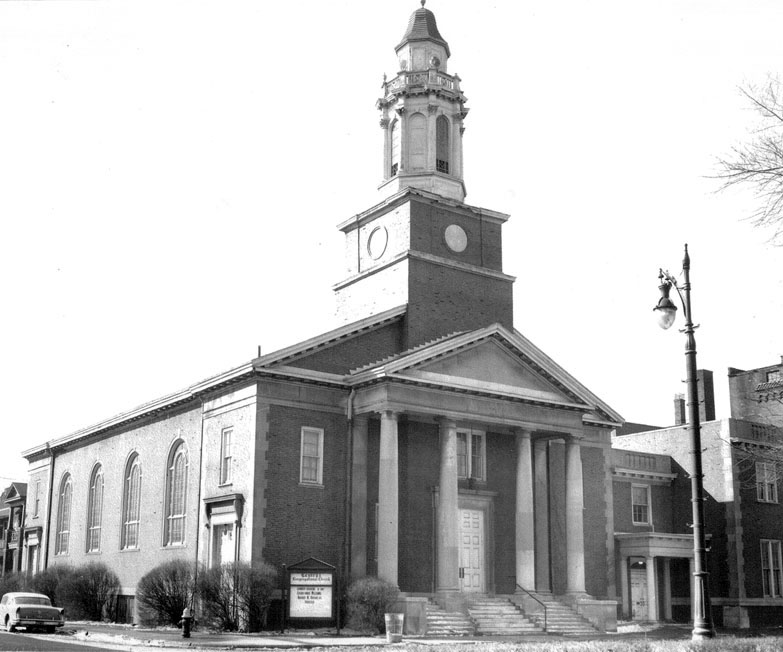
Central United Church of Christ
Shrine of the Black Madonna. Formerly Central Congregational Church. The church I grew up in, pastored by my father Rev. Albert B. Cleage,Jr/Jaramogi Abebe Agyeman Read more here – “H” is for Linwood and Hogarth.
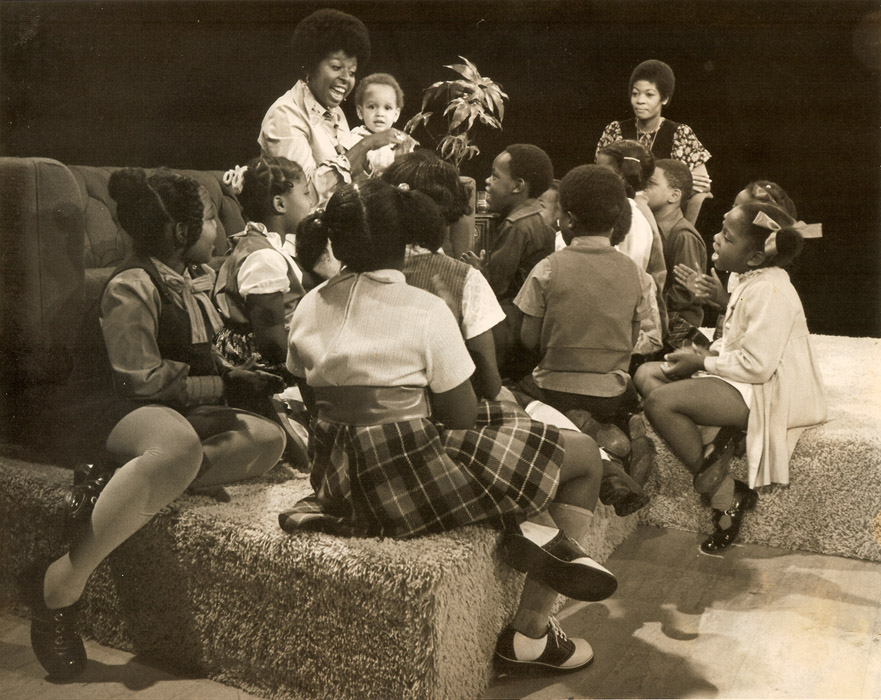
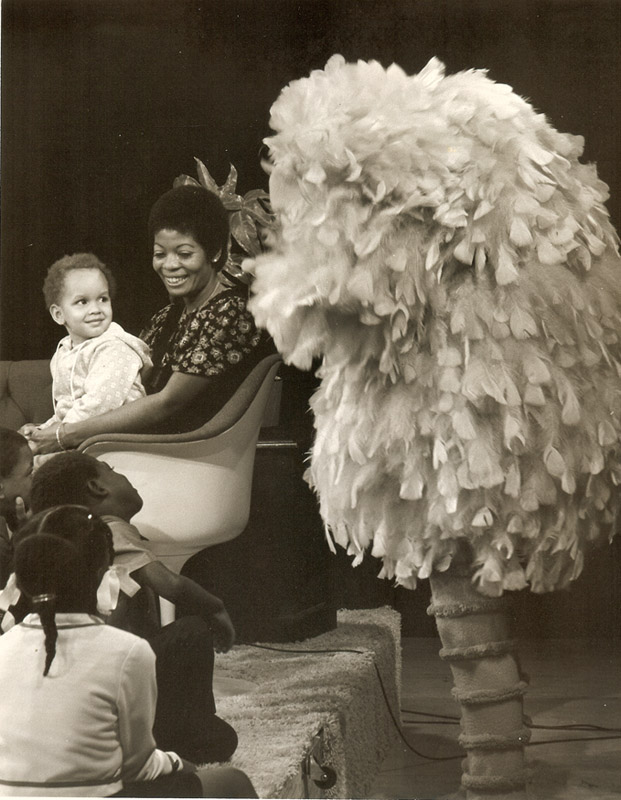
In 1973 my sister, Pearl, worked with the television program “Good Morning Atlanta”. One day Susan and Big Bird, from Sesame Street, appeared on the show. There was an audience drawn from a local elementary school. My oldest daughter, Jilo, was 2.5 years old. Pearl invited her to come on the show too. She seems to enjoy sitting on Susan’s lap but be a bit skeptical of Big Bird.
Jilo sitting on Susan’s lap.
Jilo looking at Big Bird. His head seems to be tucked down.
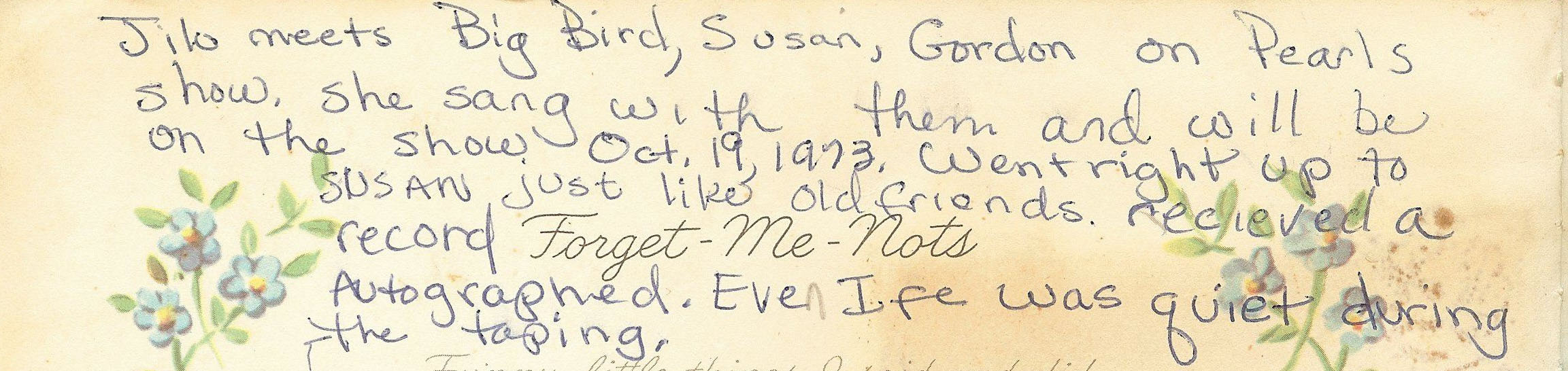
Entry from Jilo’s Baby Book.
“Jilo meets Big Bird, Susan, Gordon on Pearl’s show. She sang with them and will be on the show October 19, 1973. Went right up to Susan just like old friends. Received a record, autographed. Even Ife was quiet during the taping.”
Ife was about 7 months old. So, Jilo did get a momento. After I read this I remembered how we played that record over and over and over, for a long time.
For more Sepia Saturday offerings, CLICK! The theme for this week was “Two Views of the Health Fairy”.