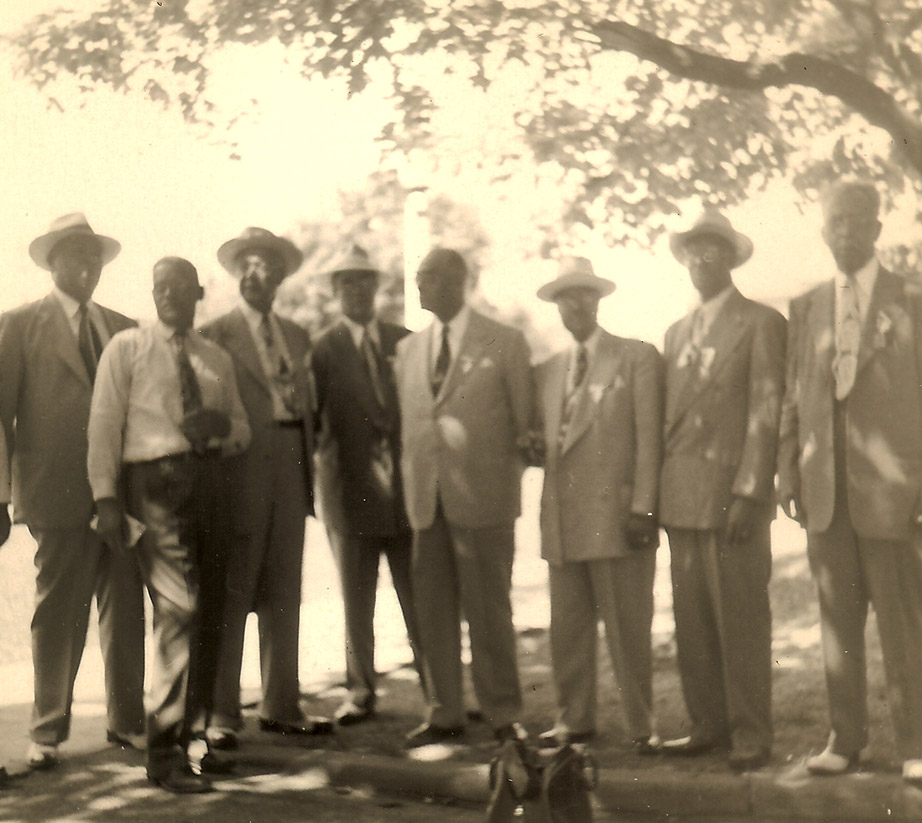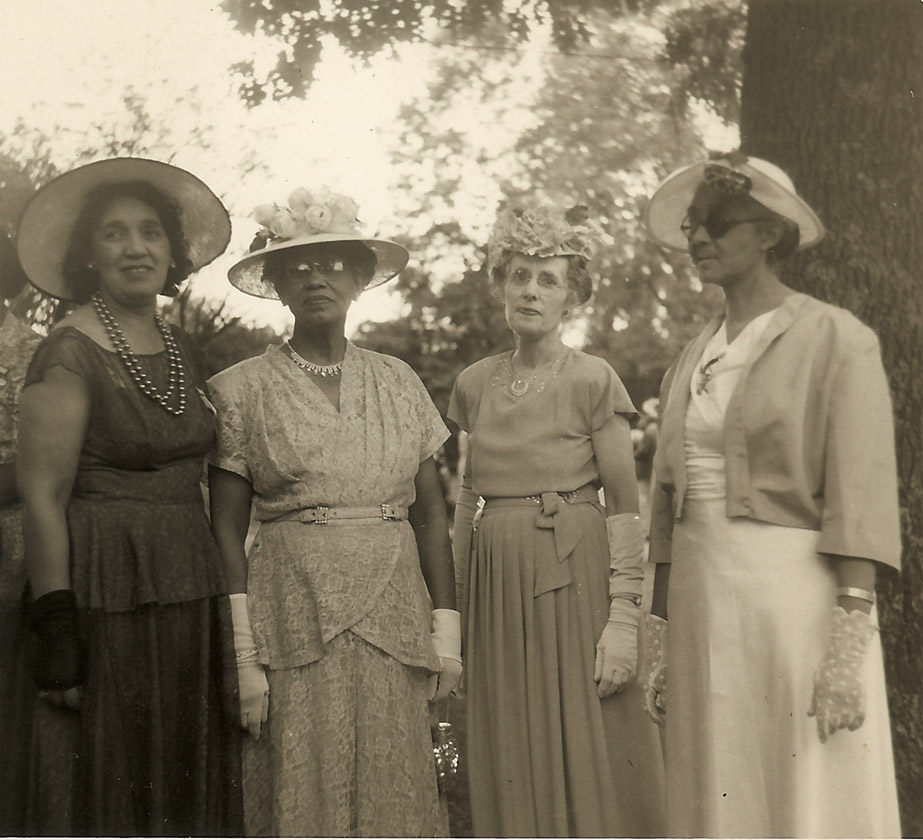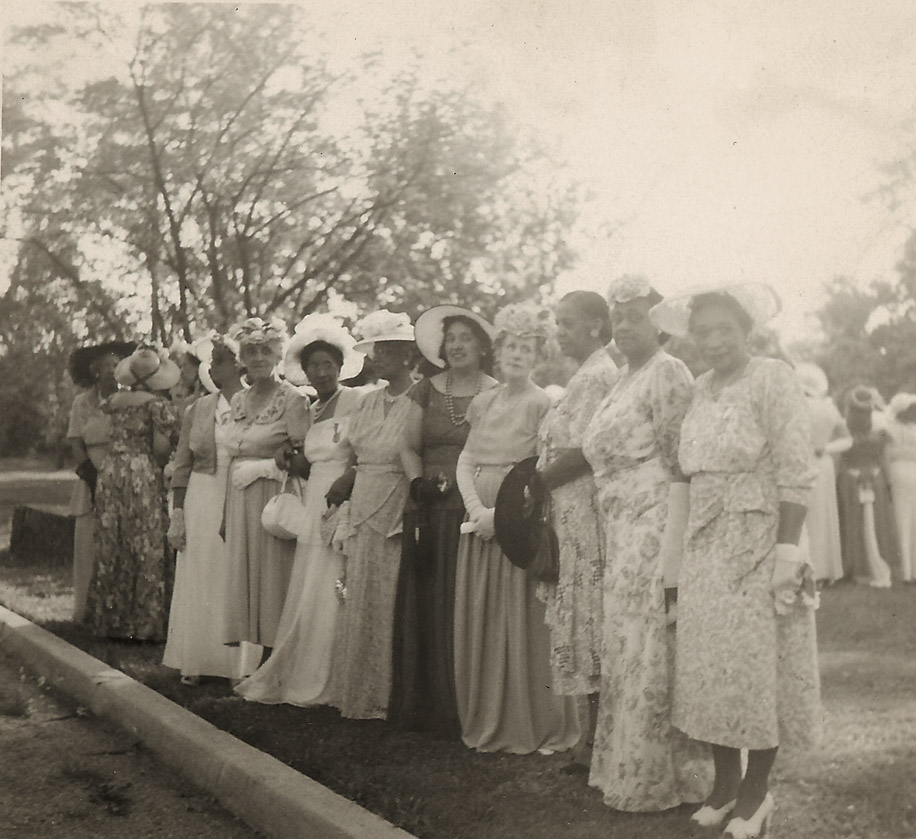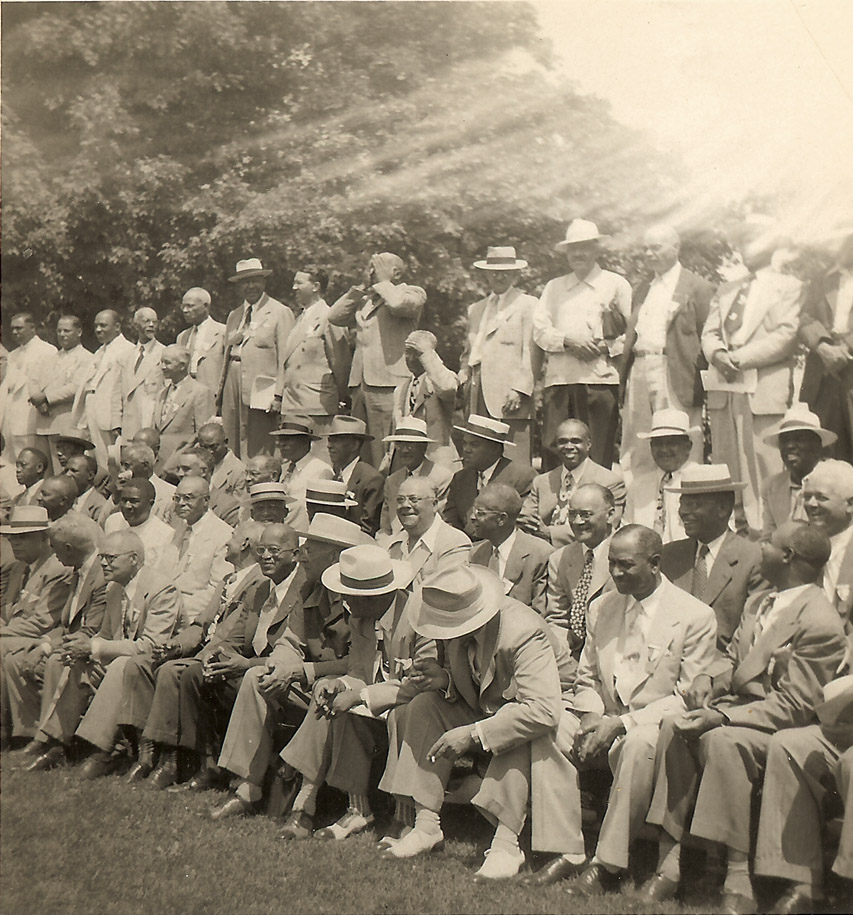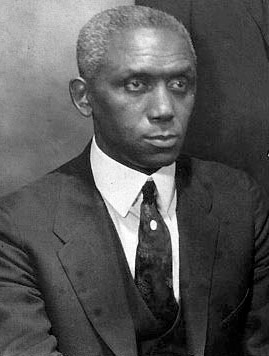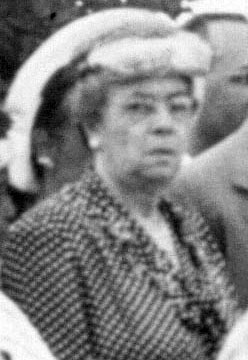
Today’s SepiaSaturday prompt showed a wedding party in their posh clothes. My photos are not of a wedding party but everybody is dressed up and most are wearing hats. They are from my Cleage family collection and are labeled only “Boulé“. They were taken during the 1950’s in Detroit, I believe. I had heard of the Boulé all my life as an organization my grandparents belonged to. I had no idea it was secret fraternal organization until I started working on this post. I have labeled my grandparents. I do not know who any of the other people are.
My grandfather, Dr. Albert B. Cleage Sr on the right hand end of the line. Where is his hat?My grandmother, Pearl Reed Cleage, is second on the right.My grandmother, Pearl Reed Cleage, 4th from the right. Why is she giving her neighbor that look? Because she isn’t wearing her hat?
“Sigma Pi Phi Fraternity, also known as the Boule, is the first Greek-letter fraternity to be founded by African American men. Significantly, unlike the other African American Greek -letter organizations, its members already have received college and professional degrees at the time of their induction. The fraternity’s insignia is the Sphinx.
From the beginning, Sigma Pi Phi Fraternity was a learned society, a social fraternity and an advancement organization, albeit a quiet one. As well, the fraternity believed absolutely in the equality of standing of its members and insisted that anyone who was eligible for membership was eligible and qualified for leadership. The founders were so certain of this fact that the fraternity selected its officers by lot, a custom that continued for the most senior officer until 1970.” Taken from the official Boule page. Click to read the more about the Boulé.
Several days ago Cassmob’s of Family history across the seas blog had an interactive map of places she’s been writing about in Papua, New Guinea. I immediately went to Google Maps to figure out how to do it myself. Below is a map of places my family lived during the 1940 Census in Detroit. If you click on the blue markers it will tell you who lived there and how they are related to my grandparents.
Detroit is divided by Woodward Avenue into Westside and Eastside. My Cleages are all clustered close on the Westside, which is also where I grew up. The Grahams are more spread out on the Eastside. Plymouth had a vibrant youth group program in the 1930 and that is where my parents met. The old Plymouth Congregational Church was urban renewed in the late 1970s and moved location but in 1940 it was located at Garfield and Beaubien, right in the middle of what is now the Detroit Medical Center.
There is a way to insert pop up photographs too which I am going to figure out next.
I don’t know who the young woman on the left is, next is my mother, Doris Graham, my uncle Hugh Cleage and my aunt Mary V. Graham. Taken in 1940 in Detroit, Michigan. Photographer not known.
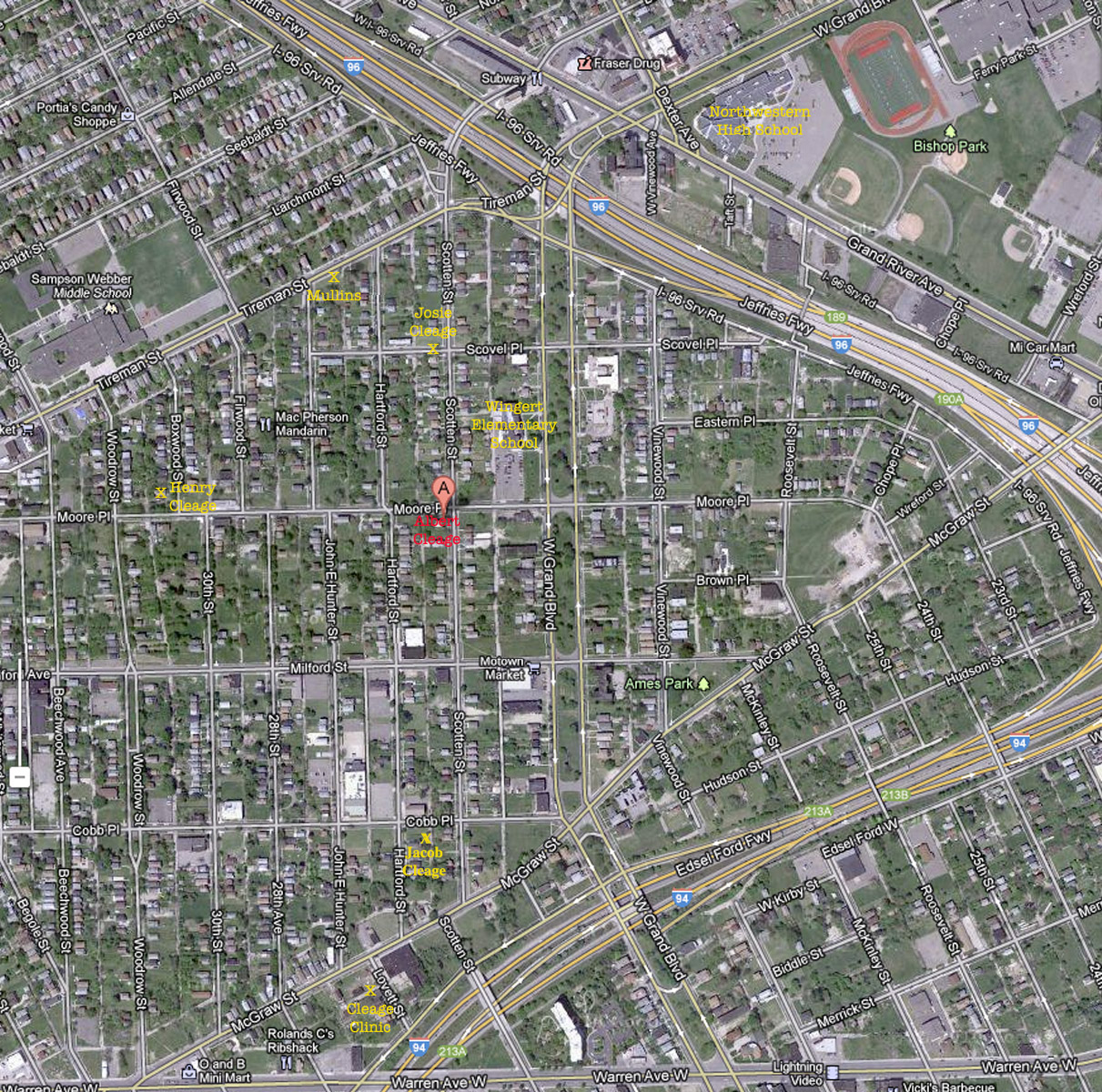
The Old West Side Detroit neighborhood where my father's family and aunts and uncles and cousins lived in 1940. Uncle Jake's house was the second one up from the bottom of the map.
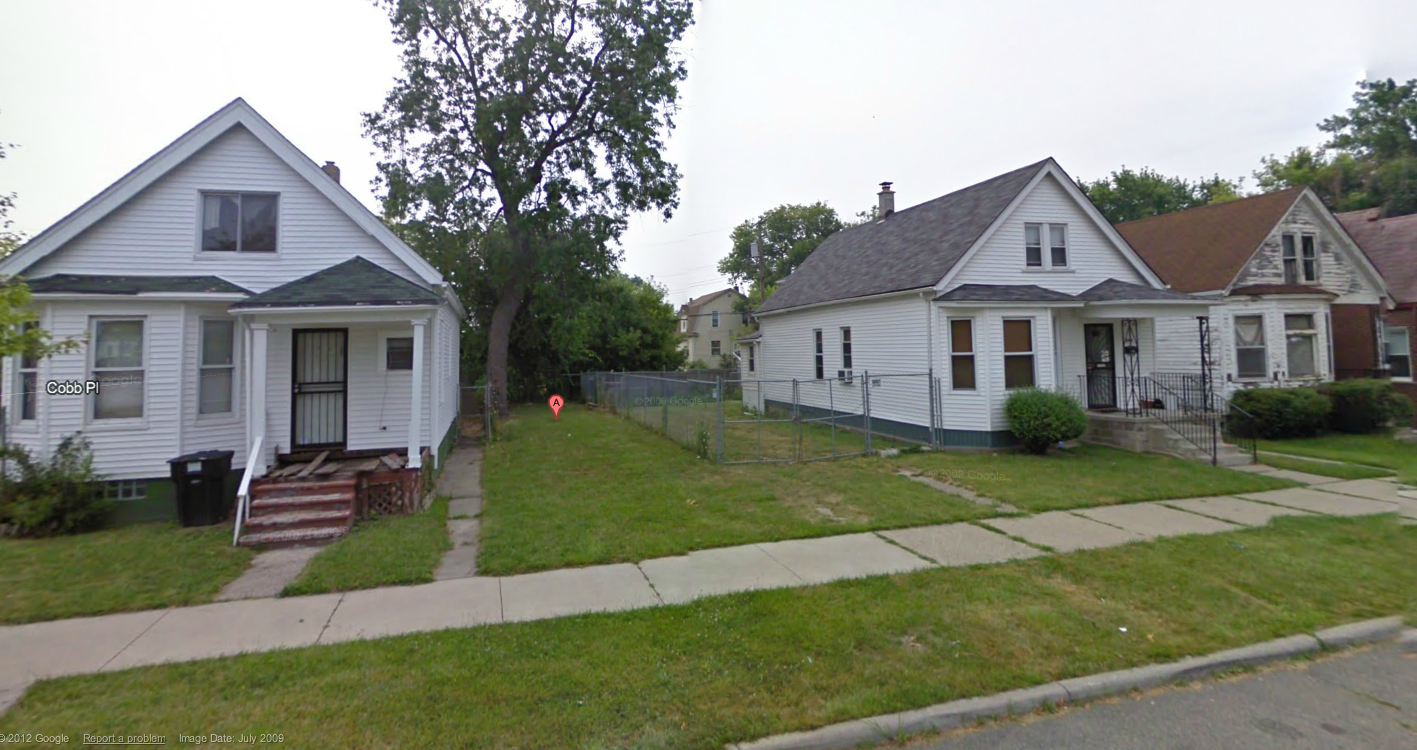
Jacob Cleage was my grandfather Albert Cleage’s oldest brother. He and his wife, Gertrude, lived at 5670 Hartford Avenue, very close to my grandfather’s Cleage Clinic. The house is no longer there, but there are 3 houses on either side of the spot where it stood and it appears that all were built from the same plan.
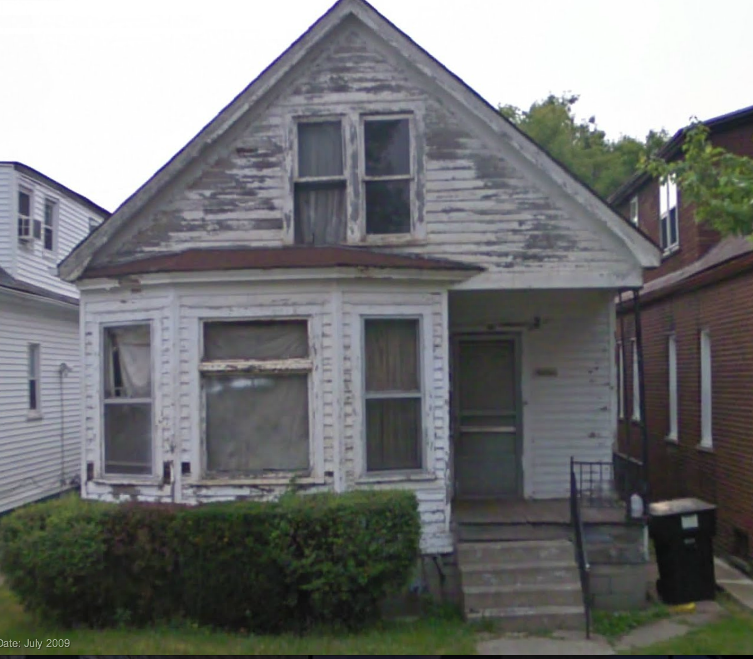
Empty spot marked by "A" where Jacob and Gertrude Cleage's house once stood.House near 5670 Hartford Ave. The least modernized house of the 3 and perhaps the closest to what their house looked like.
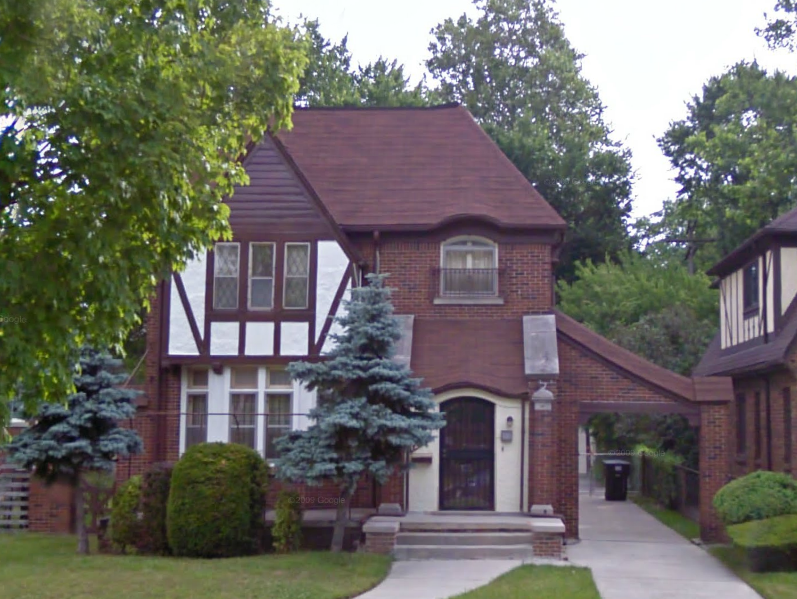
5670 probably looked like this house that hasn’t been renovated or sided. I think their house would have been painted and kept up. They owned the house and it was worth $1,900 according to the 1940 census.
Jacob CleageGertrude Cleage
There were six people in the household. Everybody was identified as Negro and had been living at the same address in 1935.
According to the census Jacob Cleage was the head of the house. He was 62 years old and had been born in Florida. He worked as a sweeper in an auto plant with 2 years of high school. He earned $1,200 in 1935.
Gertrude Cleage, 58, wife, born in West Virginia. She was not working outside the home and had completed 3 years of high school.
John Cleage, 29, son (SON?? first I heard of Jacob having any children), born in West Virginia. He worked in the stock room of an auto factory and earned $1,600 during 1935. He had 4 years of college and was attending college in 1940. He was married and his wife were seperated.
Jacob Cleage, jr, 24 son (ANOTHER SON???) also born in West Virginia. Not working with 3 years of college and attending college in 1940. He was single.
Robert Evans, 22, lodger, born in Alabama. He had attended school that year and had 2 years of high school. He wasn’t working and had earned no money. He was married.
Countess Evans, 22, wife of a lodger born in Alabama. Shw had 4 years of college, was not working and had earned no money. Countess spoke to the enumerator which probably accounts for the incorrect information.
Jacob Cleage was actually born in Tennessee and Gertrude was born in North Carolina. I never heard that they had any children and I’ve followed them down through the years from the 1880 census and other records and through family stories and photographs. My grandparents lived with them when my father was born in 1911. I can’t find Jacob Jr. or John Cleage any place else, not living apart with a different mother and not in any directories. If all of these young people were living there in 1935, the lodgers would have been 17. Jacob Jr. would have been 19 and John would have been 24. That would have been a house full of students for one working man to support. Jacob Cleage died in 1942, just two years later.
I wish Jacob or Gertrude had been the informant because I’ve got to take much of this with a grain of salt until more information comes my way.
Source: 1940 U.S. census, Wayne Co., Michigan, pop. Sch., Detroit, Ward 14 E.D. 84-785 Sheet No. 11 B HH 191 Jacob Cleage. Informant – lodger. Click to view census sheet.
Albert, Pearl, Albert Jr, Louis, Henry, Hugh, Barbara, Gladys, Anna.
6429 Scotten, Detroit, Michigan
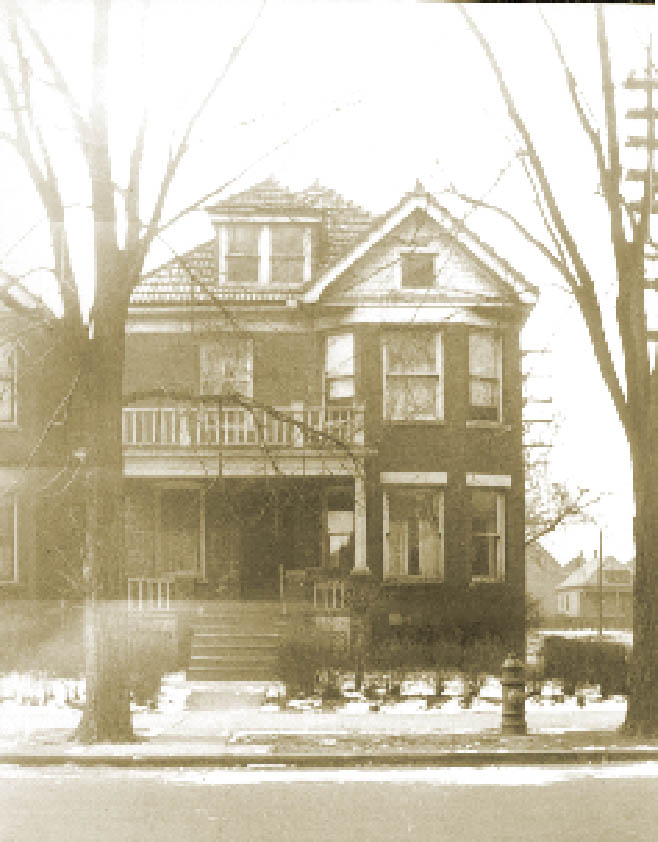
In 1940 my grandparents and family were living at 6429 Scotten at the corner of Moore Place. They owned the house and it was worth $5,000. They had lived in the same place in 1935 and in fact had been there for over 20 years as all the girls in the family were born in that house. My grandfather was a medical doctor in private practice at the Cleage Clinic. The amount of money he made in 1939 was a crossed out number, replaced with “0”. He was the informant, that is he is the one that talked to the census taker and gave them the information on the form.
My grandfather was 56 years old, born in Tennessee with plus 5 years of college. My grandmother was 50, born in Kentucky with 4 years of high school. My father was 28, born in Indiana, had plus 5 years of college and was absent from the home. All the other children were born in Michigan. Louis was 26, had plus 5 years of college and absent from the home. Henry was 24 and had 5 years of college. Hugh was 21 and had 2 years of college. Barbara was 19 and had completed 1 year of college. Gladys was 17 and had completed 4 years of high school. Anna was 15 and had completed 2 years of high school.
All of the children were in school. Anna was still attending Northwestern High school. Gladys had graduated in 1939 and was a freshman at Wayne State University. Henry, Hugh and Barbara must have been at Wayne. Louis graduated from Wayne State medical school in 1940 and was doing a residency at Homer Philips in St. Louis. My father graduated from Wayne in 1938 and was in the seminary at Oberlin College.
Source: 1940 U.S. Census. State: Michigan. County: Wayne. City: Detroit. Ward 14. Enumeration Districe: 84-787. Sheet number: 11-A. Head of household and informant: Dr. Albert B. Cleage. To see the census sheet for the Albert Cleage family click HERE.
I hadn’t realized that one of my grandmother sisters and all of my grandfather’s living siblings lived within walking distance of their house. I have labeled their houses, Northwestern High School, Wingert Elementary School and the Cleage Clinic. I sort of knew this, but I didn’t realize it until I mapped it out after finding everybody in the same neighborhood. In future posts I will share what I learned about each household in 1940.
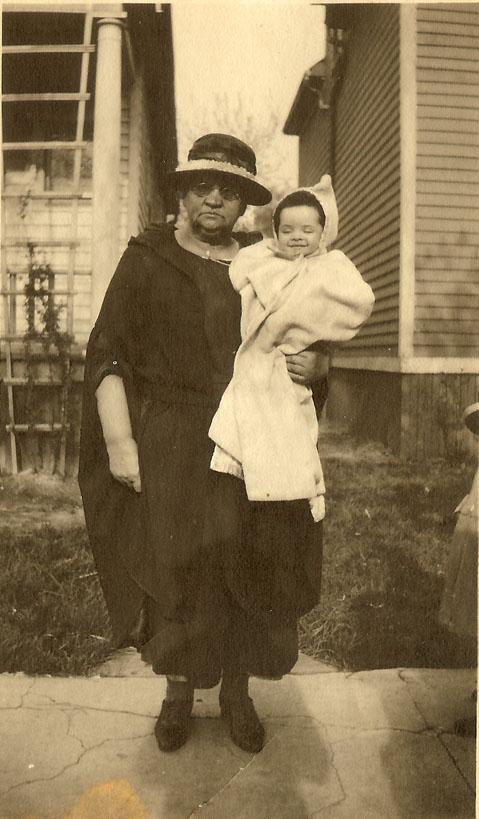
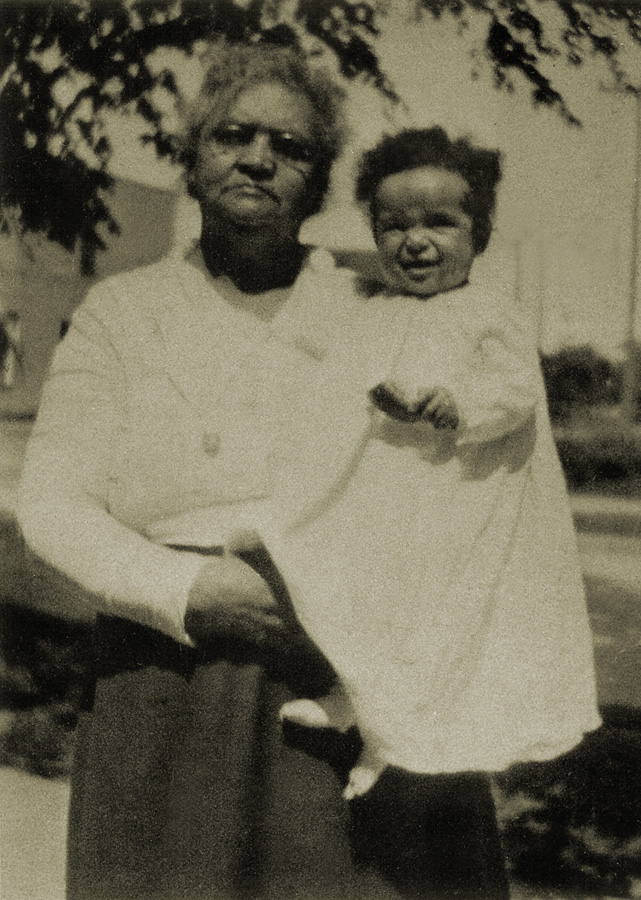
My Great grandmother Celia holding my aunt Gladys. 1923. Detroit.
This post is a combination of information I found through records and memories of my aunts and uncles about their grandmother Celia. She died before I was born so I never had the chance to meet her.
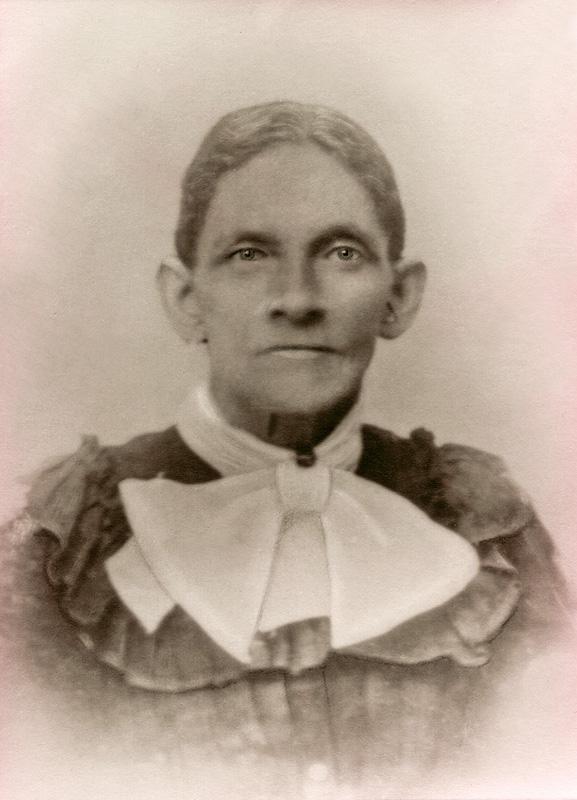
Celia Rice was born in Virginia about 1855. Her father was a member of the Rice family and her mother was enslaved on the Rice plantation. She was brought to Tennessee when she was small. By the time I asked, nobody remembered her mother’s name. She was about ten when freedom came.
My aunt Gladys said that when Celia was a child, she had to walk around in the sun. The masters wife did not want her to be confused with the white children of the family, who she resembled.
On April 23, 1872 Celia Rice and Louis Cleage were married in Athens, McMinn County Tennessee. They moved to Louden County, TN where their five children were born over the next 11 years. Josephine “Josie” was born in 1873. Jacob was born in 1875. Henry was born in 1877. Charles Edward was born in 1879. My grandfather, Albert, was born in 1883. Louis did farm work and Celia did house work. She was unable to read or write.
My uncle Louis said that Lewis C. worked all day for 50 cents. Celia worked all week for 50 cents. He often spent his on good times before he got home. Many nights he spent in jail – drunk – playing the guitar and singing!
The marriage doesn’t seem to have been a happy one and by 1899 they had split up and Celia married Roger William Sherman, a carpenter, in Athens, Tennessee. She was 45 years old. By 1900 oldest daughter, Josie, was married to James Cleage (Different Cleage family, not related but off of the same plantation.), a teacher and they had several children. Jacob was not at home in the 1900 census. Edward, Henry and Albert were at home and all students. Celia could read. She had birthed five children and all five were living and doing well.
After her husband died, Celia lived with her son Edward and his family in Athens, TN for some years and then she moved to Detroit where her other three sons lived.
My uncle Henry said she used to give him an apple every once in awhile and slip him a nickel. He was her favorite. My aunt Gladys says they used to stop by her room sometimes and she would try to show them how to tat and crochet and it was kind of interesting, sitting on her bed, watching.
My Aunt Anna says, Grandma Celia was in Detroit for a while…making the rounds between uncle Henry, uncle Jake and ours….She would get tired of one house and occupants…complain and move to another... there was a Rev. Rice… he was a big shot in the Presbyterian Church… he came to town in a blaze of notoriety….to speak at some church… Granma [Celia] wanted to go…but Daddy wouldn’t hear of it! His name and picture were in the paper…Anna said she saw the paper and that he looked just like Granma.
My uncle Henry remembers one time his Grandma Celia wanted to go back to Athens. “….and Daddy said he could not send her to Athens. And they went on for about ten years and then, pretty soon she said, well, I’m going to Athens if I have to go up and down the street and beg. He was fussing and hollering and she said ‘I am going to go to Athens. I am going to go home.’ And finally he had to give her the money to go. I guess it just gets in you sometimes. You know, living with us was no picnic. She had to go and he didn’t have the money.”
I have been unable to find a death record, certificate or burial information for my great grandmother. She was living with my Grandfather Albert Cleage in the 1930 census. Going by the Memories of my Aunt Anna, she must have died soon after.
My Aunt Anna remembers being about 5 and in the kitchen when Granma Celia had a stroke. She was sick for quite awhile before she died. She remembers when Celia died they laid her out in the living room…Henry was a broken man! She places Henry at about 13 years old.
What education did your mother receive? Your grandmothers? Great-grandmothers? Note any advanced degrees or special achievements.
On My Maternal Side
My 3X great grandmother, Annie Williams, was born about 1820 in Virginia into slavery. According to the 1880 Census, when she was about 60, she spoke English and could not read or write.
Eliza - my 2x great grandmother
Her daughter, my 2X great grandmother, Eliza Williams Allen, was born in Alabama about 1839 into slavery. She was freed by 1860. According to the 1910 census, she was about 67, spoke English and could not read or write
Jennie - my greatgrandmother
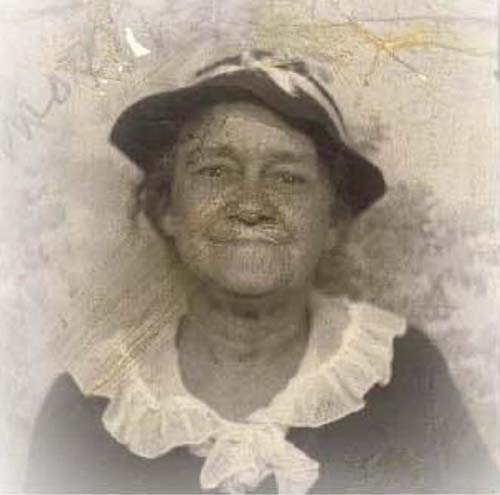
Her daughter, my great grandmother, Jennie Allen Turner was born free in Montgomery, Alabama in 1866. According to the 1880 Census, she was 13 years old, had attended school in the past year, spoke English and was literate. I found one of my favorite books at her house “Lydia of the Pines.”
Fannie - my maternal grandmother
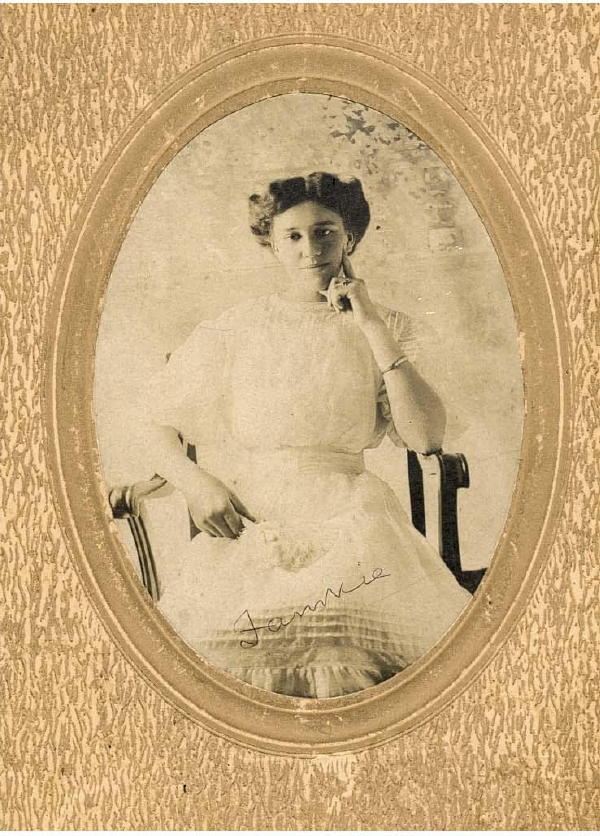
Her daughter, my Grandmother Fannie Mae Turner Graham, was born in 1888 in Lowndes County, Alabama. She grew up in Montgomery. According to the 1900 census, she was 11 years old, at school, spoke English and was literate. My mother told me that when Fannie graduated from high school – State Normal, was offered a scholarship to Fisk but refused it and took a job in her uncles store, which she managed until she married in 1918. Also according to my mother, Fannie could quickly add long columns of numbers in her head.
Doris - my mother
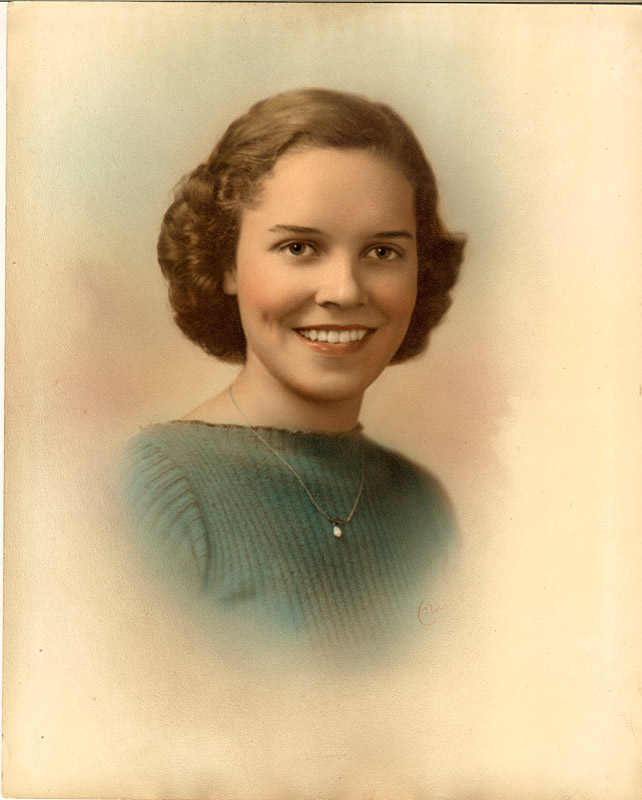
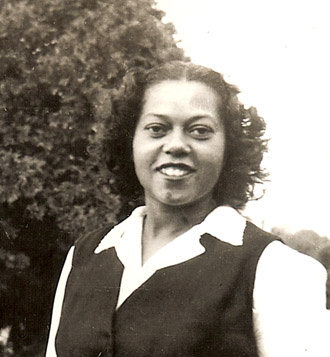
My mother , Doris Graham Cleage, was born in Detroit in 1923. She graduated from Eastern High School in Detroit and received a full scholarship to Wayne State where she earned a BA with distinction as a Sociology major in June/1944. She returned to school in 1951 and earned teaching certification. In 1958 she became a masters candidate in education, completing her Master’s of Education Degree in the fall of 1958. She took postmasters classes in education during a sabbatical in 1963. She also took evening classes in 1968, when I was a senior at Wayne State.
My great grandmother, Emma Jones Turner (My grandmother Fannie’s paternal grandmother) was born about 1840 in South Carolina into slavery. According to the 1880, 1900 and 1910 census she spoke English and was literate. I wish I knew more about her. I never heard a story about her. After my grandmother’s father was killed when she was 4 years old, her mother broke all ties with her husband’s family.
On My Paternal Side
Celia - my great grandmother
My great grandmother Celia Rice Cleage Sherman was my grandfather’s mother. She was born about 1855 into slavery in Virginia and brought to Tennessee as a child. She was about 10 when freedom came. In the 1880 census she could neither read nor write. By the 1930 census she spoke English and could read but could not write. I wonder if my grandfather or his siblings taught her to read when they went to school.
My 2X great grandmother, Clara Green was born into slavery about 1829 in Kentucky. She was my grandmother Pearl Reed Cleage’s grandmother. In the 1880 census she was listed as about 55, spoke English and could not read or write.
Her daughter, my great grandmother Anna Allen Reed was born about 1849 in Kentucky into slavery. According to the 1910 Census she spoke English but could not read or write. Anna’s four older children were illiterate while the four youngest were literate.
Pearl - my paternal grandmother
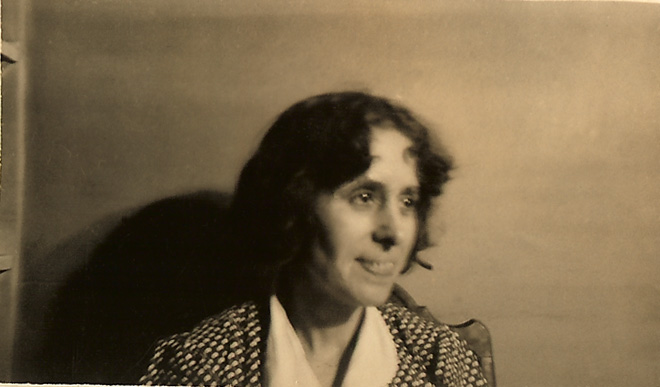
Her youngest daughter, my grandmother Pearl Reed Cleage was born in Lebanon, Kentucky in 1886. In the 1900 census she was 16 and where it says if you were or were not in school it says “Book 1” I don’t know what that means. At any rate she was literate and spoke English. My Aunt Barbara told me she finished high school. I remember my grandparent’s house being full of books.
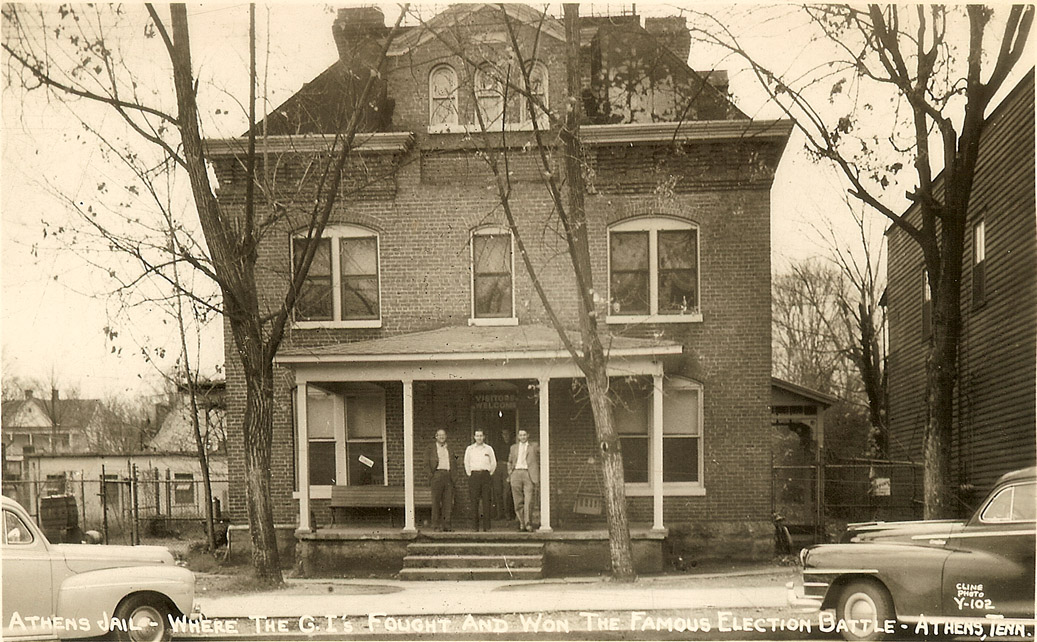
In 1946 there was a pitched battle between the corrupt local government and WW2 veterans in Athens, Tennessee. My paternal grandfather was from Athens and I had cousins living there. My cousin, Beatrice Cleage Johnson, wrote a description of that night. It is pretty much the same story as told in the video except that the man shot in the back in the video is white and in the memoir he is black. The video is embedded after Beatrice’s memory of the event.
______________________
I will never forget the day this occurred. The G.I.s had returned to McMinn County and were faced with the same political machine they had left and were determined to do something about it to rid McMinn County of machine politics.
Paul Cantrell was sheriff at this time and he loved two things: money and power. He ruled McMinn County with an iron hand. He was tied to the “Crump Machine,” which was the political boss of the State of Tennessee during the 30’s and 40’s.
Cantrell used deputies who had served prison terms for gambling and bootlegging.
Election day (August 1, 1946) in Athens was a war of “ballots and bullets.” We lived only a few blocks from the jail, where the votes were counted. There were around nine thousand residents in Athens. Of these, seven hundred Negroes played a small part in the election, but they formed a balance of power. Most of the Negroes were Republican and received threats and repeated arrests from the Democrats. The election of the sheriff was very important in McMinn County. The Republicans tried to unseat the Democrats. The pressure of a world war and the return of veterans from World War II had great influence on the politics of the county.
Election day in Athens was like an armed camp. When voters came to the polls, the Cantrell Machine was staging demonstrations, strutting around with pistols and black jacks. Deputy Sheriff Pat Mansfield, used thugs from other states as deputies. The voting was heavy at the polls. The GI’s were “poll watchers.”
Trouble started at the polls when Tom Gillespie, an elderly Negro, tried to vote and was slugged by the deputies. He was shot in the back by another and was taken to the hospital. G.I. poll watchers were held prisoners at the polls. No one in Athens slept that night.
The Athens Jail where the action took place.
The votes were being counted at the McMinn County Jail. The G.I.’s stood at the door of the jail and demanded the ballot boxes and the release of the G.I. prisoners.
The battle had begun. The G.I.’s blasted the jail with dynamite and bullets. The deputies were safe behind the walls of the solid brick jail. Cars were dynamited, turned over and filled with bullets. Picks and axes were also used to destroy cars.
The deputies finally surrendered at 3:30 in the morning with their hands up. Both Paul Cantrell and Pat Mansfield were able to escape from the jail, leaving their deputies behind to face an angry mob.
McMinn County was without law and order from the night of the election until the afternoon of the next day. I remember seeing men walking the streets with shotguns and rifles. I will never forget the morning after when everybody went to town to see the ruins. After this battle, the county soon settled down to ordinary life. Freedom of speech and the right to vote their way was given back to the people, but August 1, 1946, will never be forgotten.
McMinn County became a Republican county; however, Democrats also held offices in both the county and city and still do.
My mother and my grandmother turned out to be more sociable in their youth than they were by the time I knew them. Here are a couple of photographs I found of them being social butterflies.
Progressive Twelve Club – Montgomery, Alabama – 1911
Some of the young women in the Progressive Twelve Club were relatives. My grandmother, Fannie Mae Turner wrote the song. Daisy Turner was her sister. Naomi Tulane and Jennette McCall were first cousins. Some of them are also in the photo below. The information on the back of the photo was stuck to the album page so I’m not sure who is who. The purpose of the Progressive Twelve Club seemed to be sewing. I wish I could have heard them sing this song.
Fannie and friends at Holly Springs, MS
Progressive Twelve Club Song Composed by F.M.T. 1911
(1)
It was a bright September day In dear old 1911; our club of 12 was organized An hour to needlework given We hear the name “Progressive 12”, As you’ve already seen; the Kilarney rose adorns us Our colors are pink and green.
(2)
Chorus We’re loyal to our motto with it we like to delve; See…hear..speak no evil as do the Progressive Twelve! We’re loyal to our motto. With it we like to delve see no–hear no–speak no evil, Oh you! Progressive Twelve!
(2)
On Thursdays to our meetings In sunshine or in rain: We go to greet our hostess, and new inspiration gain. We’ve carried a record high and fair on which we look with pride Not only in art but in music, we’re noted far and wide.
Chorus
(3)
Mesdames Campbell and Dungee sing, Washington and Miller too, McCall and Tulane join in, (while) Laurence and Wilson sew. Mayberry makes the music Jones and the Turners two just work and think of our motto, with hopeful hearts and true.
Chorus-
_____________________________________________
The Social Sixteen – 1937 – Detroit, Michigan
My mother, Doris Graham is in the back row center with the flowered dress on. Her sister, Mary V. is seated in the very front. First man in the back right is Frank “Buddy” Elkins who Mary V. would later marry. My father’s sister, Barbara Cleage is seated on the far right, front. I don’t know what exactly the Social Sixteen did but my Aunt Barbara told me that the only reason they had her in the club was because of her 4 older brothers. The young woman at the other end of the couch was my mother’s best friend, Connie Stowers. We used to go visit her once a year. Which I still don’t understand because she lived across town, not in another city.
After church on a Sunday afternoon in 1953. My mother, Pearl and me on steps. Henry with hand on hip.
In the fall of 2011, my friend, Ben, went down to old 12th Street in Detroit and took some photographs so that I could combine them with old photographs from 1953. I finally got around to doing it.
Close-up of Sunday morning 1953 - my mother in the dark suit.