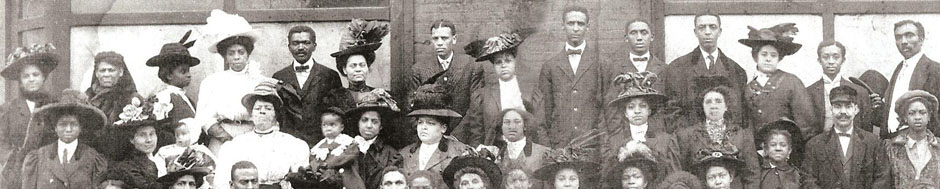
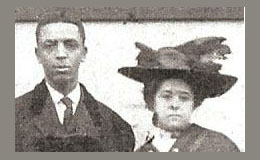
My grandparents – Albert B. Cleage & Pearl D. Reed in 1909.
For this year’s April A-Z Challenge I am blogging everyday using items taken from the letters written by my grandfather to my grandmother from 1907 to 1912, starting with “A” and moving right through the alphabet to “Z” during April.
12/8/’08
Am sure this will not reach you in time for you to answer. Anyway – I’ll take a chance and come out tomorrow night. Look for me!!
My grandparents – Albert B. Cleage & Pearl D. Reed in 1909.
For this year’s April A-Z Challenge I am blogging everyday using items taken from the letters written by my grandfather to my grandmother from 1907 to 1912, starting with “A” and moving right through the alphabet to “Z” during April.
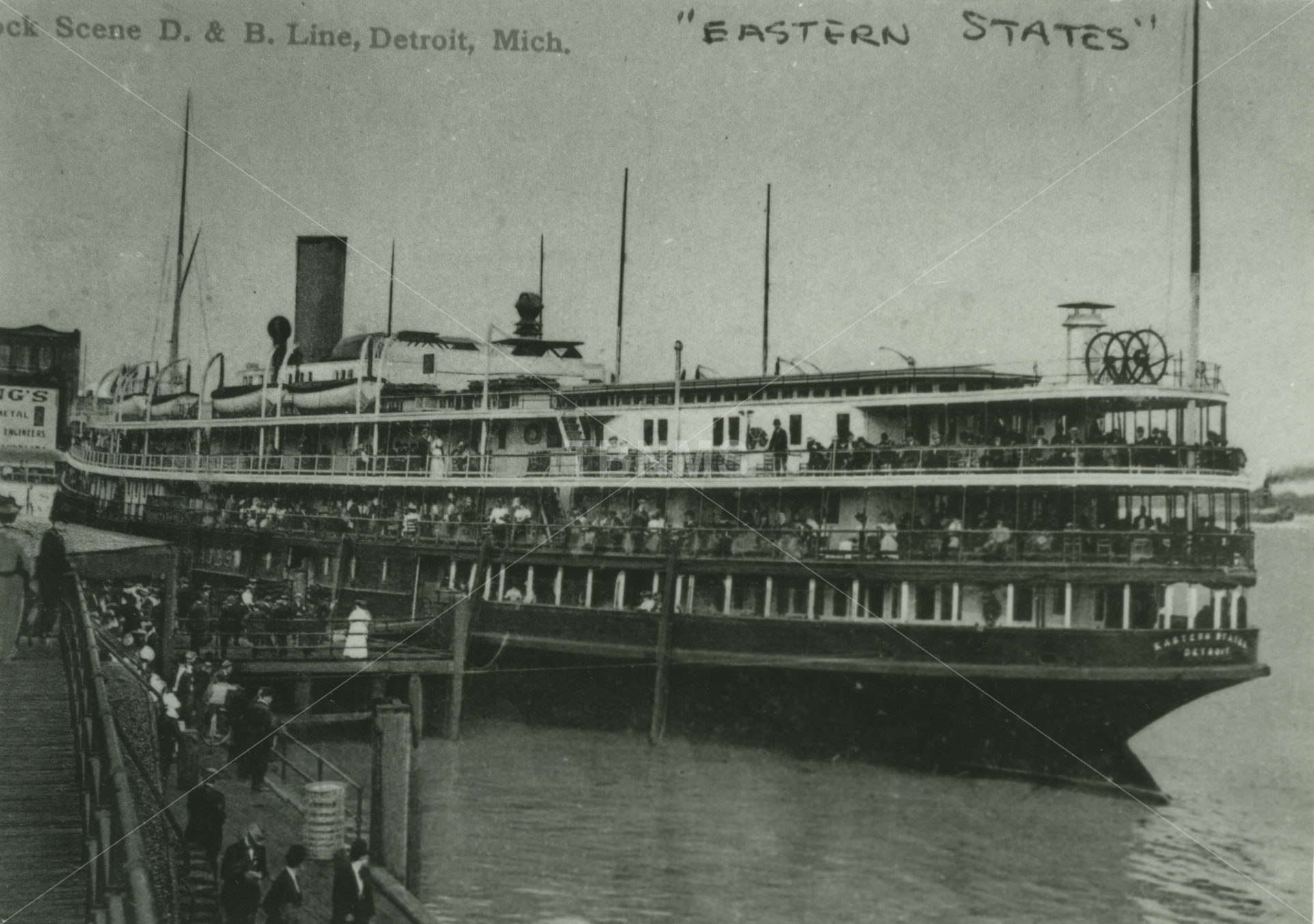
Steamer Eastern States Aug 9 – ’09 …”I am sorry that your mother is not well and I trust that ere this she is in health and spirit what you would have her be. Have seen several people from Indianapolis whom I know among them were Drs Hummons & Atkins who were in Detroit the other day enroute to Niagra Falls and Toronto.To see them come and go makes one homesick. Sweetheart is real late and I m tired and sleepy will write you a long sweet letter next time.
In this letter Albert wrote to Pearl in Benton Harbor, MI, where she has gone for a summer visit. Two of her older sisters, Sarah Reed Busby and Louise Reed Shoemaker lived there with their families.
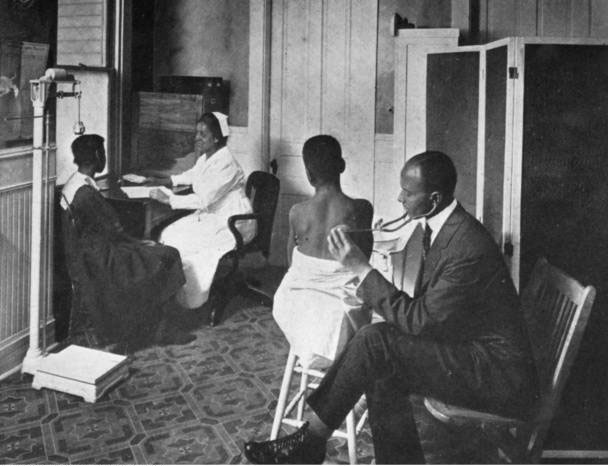
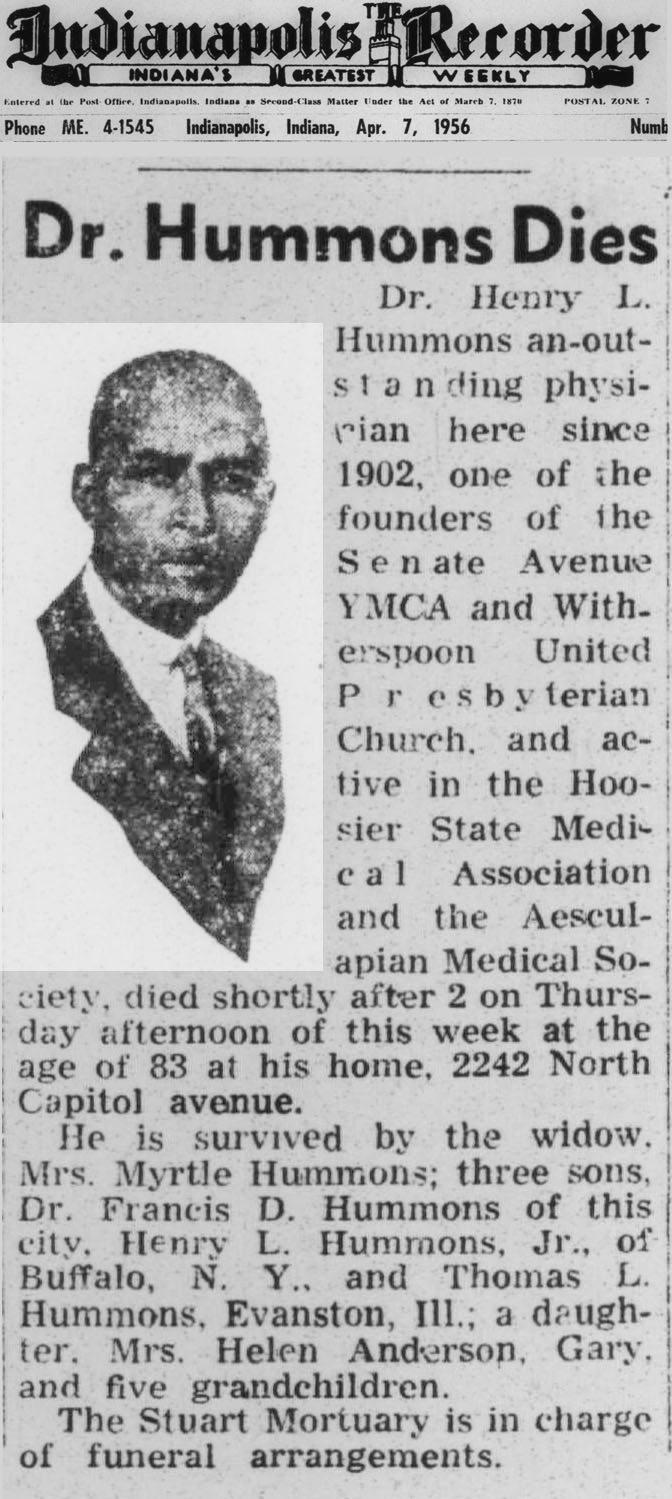
Dr. Henry L. Hummons was about 10 years older than my grandfather and a leader in Indianapolis’ black community. He had attended Knoxville College, as did my grandfather and also graduated from Indiana Medical College, which my grandfather was attending. Dr. Hummons had set up his practice in Indianapolis. He took a leading role in starting Witherspoon Presbyterian Church, of which my grandparents and my grandfather’s brothers were founding members. He and my great uncle, Henry Cleage, were leaders in the campaign to get a black YMCA in Indianapolis as the white ones were not integrated. His name appears in several of my grandfather’s later letters. You can read more about him in the obituaries below.
“Dr. Henry Lytle Hummons (M.D., Med. Coll. Ind. ’02) of Indianapolis, Indiana, died on April 5, 1956 after a prolonged illness. He was 83. Dr. Hummons was born in Lexington, Kentucky on February 25, 1873, the son of Thomas and Mary Ellen Hummons. He received his early education in the local public schools and graduated from Knoxvillle College in 1896. In that year he came to Indianapolis, and later entered the old Medical College of Indiana from which he received the M.D. in 1902. He served an internship in Shelbyville Hospital in 1903 and entered practice in Indianapolis in that year.
He was long active in medical, civic and church activities. In 1919 he established the city’s first free tuberculosis clinic at Flanner House. he was one of the co-founders of the Senate Avenue branch of the Y.M.C.A. With the aid of Mr. Henry Cleage, he organized the Witherspoon United Presbyterian Church 49 years ago. The Omega Psi Phi fraternity, of which he was a member, named him their “Man of the Year,” in 1953. Also in 1953 he received a pin from the Indiana Medical Association in recognition of his 50 years service as a physician.”
My grandparents – Albert B. Cleage & Pearl D. Reed in 1909.
For this year’s April A-Z Challenge I am blogging everyday using items taken from the letters written by my grandfather to my grandmother from 1907 to 1912, starting with “A” and moving right through the alphabet to “Z” during April.
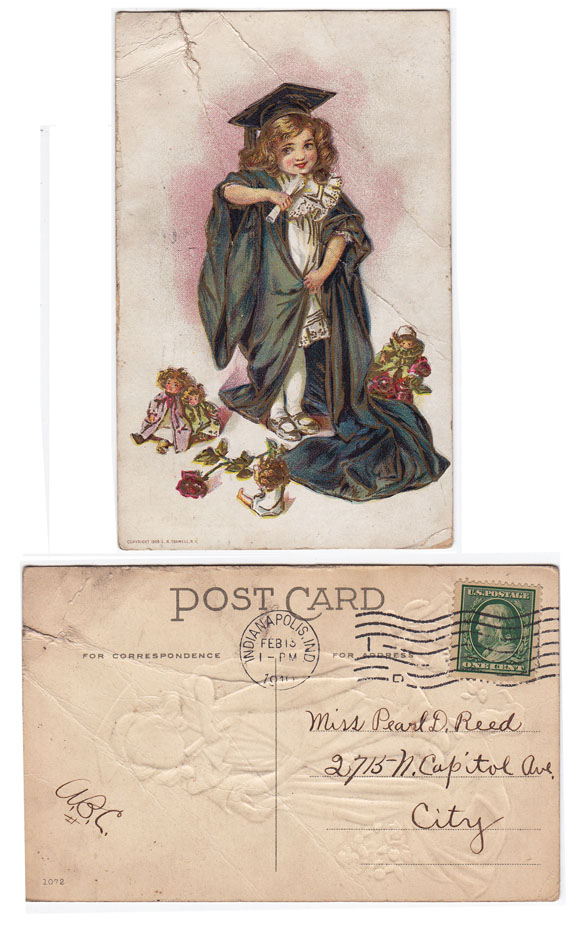
I’m not sure why my grandfather Albert sent this card with the child graduate and no message. His own graduation from Medical school was still 8 months away. He is using a different address, so perhaps this was a test card to make sure it arrived safely, away from the hostile eyes of Pearl’s mother. Her mother was opposed to their relationship.
My grandparents – Albert B. Cleage & Pearl D. Reed in 1909.
For this year’s April A-Z Challenge I will be blogging everyday using items taken from the letters written by my grandfather to my grandmother from 1907 to 1912, starting with “A” and moving right through the alphabet to “Z” during April.
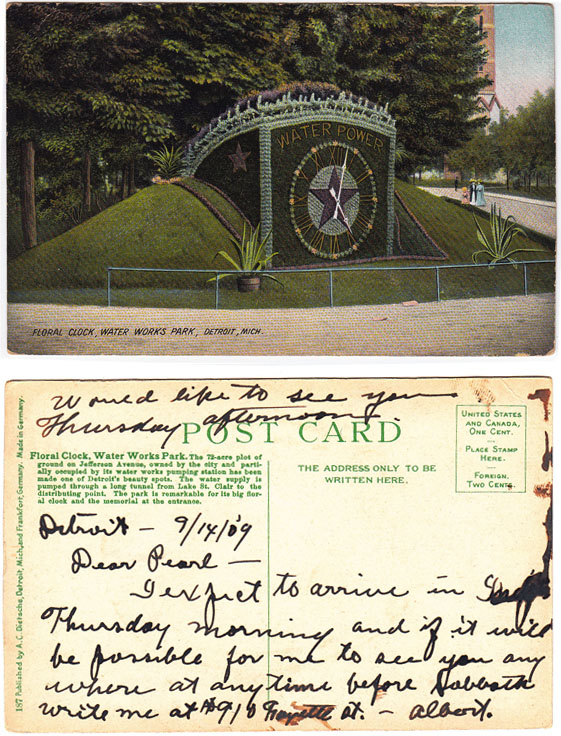
Would like to see you Thursday afternoon.
Detroit 9/14/09
Dear Pearl,
I expect to arrive in Indianapolis Thursday morning and if it will be possible for me to see you any where at anytime before Sabbath write me at #910 Fayett St. – Albert
Title: Floral Clock at Gladwin Park, Detroit, Mich. Caption on back: This Floral Clock is located at Gladwin Park, which contains 75 acres. Here also is the water pumping station were seventy-three million gallons of water are pumped daily for Detroit’s supply. The Clock is run by water power.
“This park — which still exists today but is no longer open to the public — would eventually encompass 110 acres with swimming and picnic areas, play equipment like swings and teeter-totters, baseball diamonds, even a library. It also was a popular place for fishermen. At the turn of the 20th Century, the park also had two islands, three bridges, a small wading lagoon and a winding canal where rowboats could enter the park,” “The First 300 Years” says. “Visitors strolled along pathways lined with chestnut trees, intricately landscaped shrubbery and floral displays,” it continues. Another beloved attraction was a clock near the entrance that was made of flowers and run off water pressure.” Water Works Park Tower – Historic Detroit
My grandparents – Albert B. Cleage & Pearl D. Reed in 1909.
For this year’s April A-Z Challenge I will be blogging everyday using items taken from the letters written by my grandfather to my grandmother from 1907 to 1912, starting with “A” and moving right through the alphabet to “Z” during April.
“June 27, 1909 (On board the Steamer “Eastern States” – Lake Erie) This is Sabbath night about 10:00 o’clock and we are about six hours ride out of Detroit and about twelve miles from land in the shortest direction.
Surroundings are such as to impress one with his insignificance and emphasize the fact that he is indeed kept by Jehovah’s care. I shall first endeavor to acquaint you with the boat on which I am working. It’s name is “The Eastern States” and runs from Detroit to Buffalo. We leave Detroit one day at 5 PM and arrive in Buffalo the next morning at 8 o’clock, staying in Buffalo all day we leave again for Detroit in the Evening at 5 pm. You see we spend one day in Detroit and one in Buffalo. Today we were in Detroit and would it interest you to know how I spent it? Well, if it will interest you; after breakfast was over about 9 am, I went down to our “quarters” (I suppose you have only a faint conception of what that word means – I describe it later.) and slept until 11:30 – served lunch, after which Aldridge and I walked up town for about 2 hours – smoked some cigars, came back to the boat and took a couple of hours more of sleep. So you see I am putting in plenty of time sleeping. This stuff I’m sure does not interest you and I will not bore you longer but as I promised to say something about our “quarters”
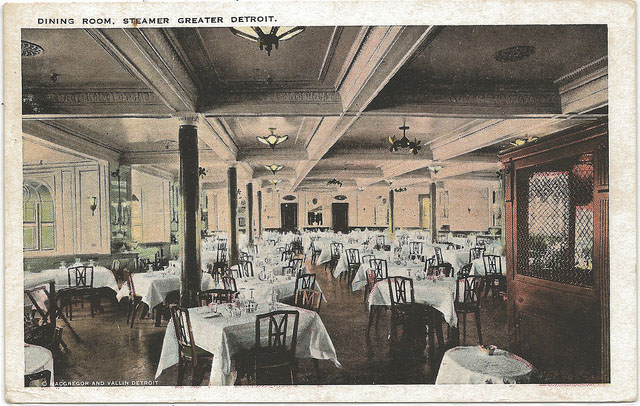
This isn’t the dining room of the Eastern States but the City of Detroit was a sister ship so it was probably similar.
It is one large room about 35 x 40 ft. in which are 32 beds – just think of it!! Those beds or better bunks are arranged in tiers of three and I at the present time am sitting on my bed (the top one) and there are two other fellows below me. What ventilation we get comes through six small port holes the diameters of which are about 6 in.
The fellows are a cosmopolitan aggregation, men from everywhere and at any time you can hear arguments and discussions on all subjects – Sensible and nonsensible. There are several students on board – boys from Howard University, Wilberforce University, Oberlin University, Michigan, and Indiana and out of them there are some very fine fellows to know… I could talk all night about the desirable and the non-desirable features of my Steamboat experience…”
My grandparents – Albert B. Cleage & Pearl D. Reed in 1909.
For this year’s April A-Z Challenge I will be blogging everyday using items taken from the letters written by my grandfather to my grandmother from 1907 to 1912, starting with “A” and moving right through the alphabet to “Z” during April.
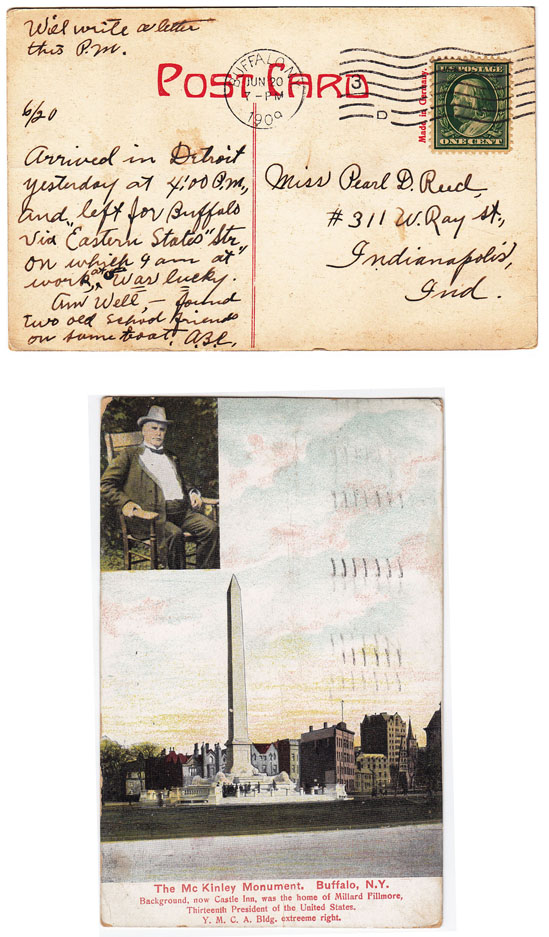
Will write a letter this P.M. 6/20/09 Arrived in Detroit yesterday at 4:00PM, and left for Buffalo via “Eastern States” Steamer on which I am at work at 5. Was lucky. Am well – found two old school friends on same boat.
A.B.C.
My grandfather had gone from Indianapolis to Detroit to get a summer job as a waiter on one of the steamers that went between Detroit and Indianapolis. He was successful and had even found several friends who were medical students at other schools who would also be working on the steamer with him. It was a good way to earn money for school. Some worked as porters or waiters on passenger trains.
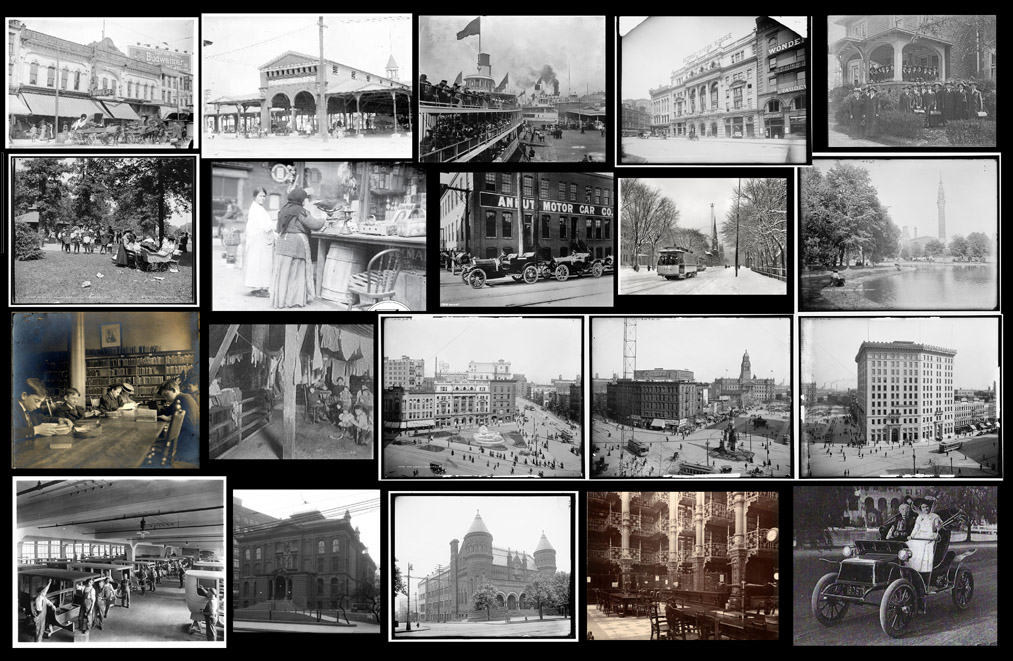
In 1910, just a year later, Detroit’s population reached 465,766. 5,741 (1.2%) were African American. Cass Technical High School graduated it’s first class of 6 students. Other high schools were Central (located in what is now Old Main on the campus of Wayne State University), Eastern and Western.
This would have been the Detroit my grandfather saw as he spent his free time walking around Detroit. Click to enlarge.
Detroit History “During the early 1900s Detroit was referred to as the Paris of the West for its beautiful gilded age architecture, and Washington Boulevard, which was electrified by Thomas Edison. Detroit emerged as a transportation hub and a growing manufacturing city which prompted Henry ford to build his first automobile in a rented workshop on Mack Avenue. Ford Motor Company was soon to follow in 1904. Other auto manufacturers such as William C. Durant, the Dodge brother, Packard, and Walter Chrysler further reinforced Detroit as the world’s automotive capital and giving it the nickname the Motor City.”
My grandparents – Albert B. Cleage & Pearl D. Reed in 1909.
For this year’s April A-Z Challenge I will be blogging everyday using items taken from the letters written by my grandfather to my grandmother from 1907 to 1912, starting with “A” and moving right through the alphabet to “Z” during April.
May 27, 1910
My dear Sweetheart:
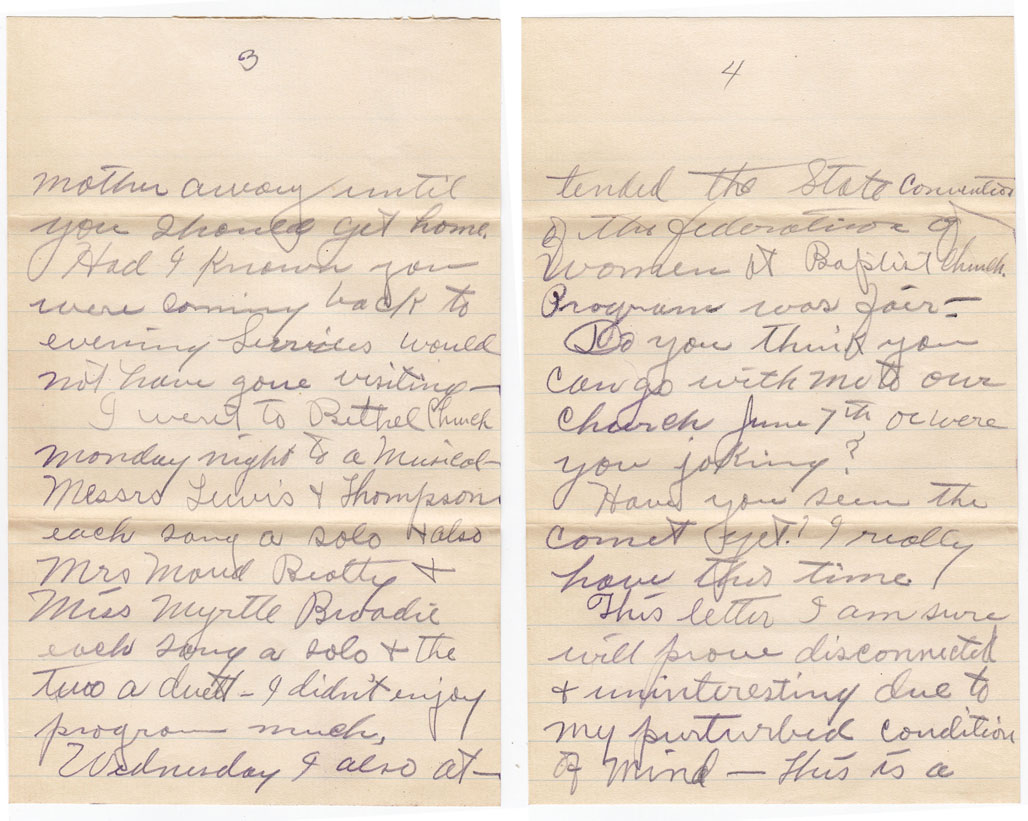
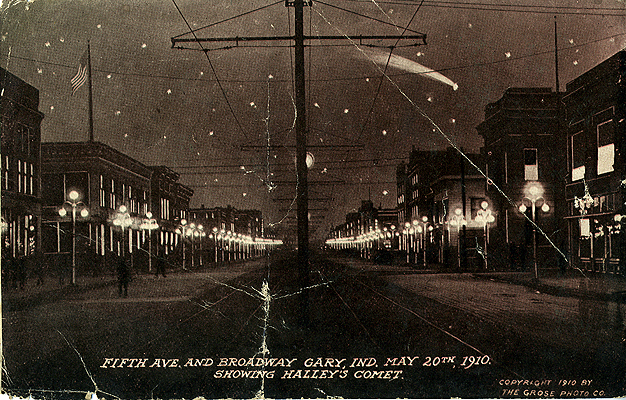
…Had I known you were coming back to evening services would not have gone visiting – I went to Bethel Church Monday night to a musical- Messrs. Lewis and Thompson each sang a solo and also Mrs. Maud Beatty and Miss Myrtle Broadie each sang a solo and the two a duet – I didn’t enjoy program much, Wednesday I also attended the state convention of the federation of women at Baptist church. Program was fair – do you think you can go with me to our church June 7th or were you joking? Have you seen the comet yet? I really have this time…
The Return of Halley’s Comet. “What’s more, this particular pass of the comet (in 1910) was an especially close one. The comet came within 14 million miles (21 million km) of Earth at one point during its May approach, and Earth briefly passed through the tail of the comet. This, of course, was amazing for scientists, allowing them to study many details of the comet ‘up close’ as it were. The close pass was reportedly spectacular in the sky, the comet easily visible.
The downside of this close pass and the new observations made was that a panic briefly overtook much of the world’s population. Scientists had noticed a poisonous gas known as cyanogen that was present in the composition of the tail, and while they assured the public that the gas would be much too diffuse to have any effect during Earth’s pass through the tail, many people still panicked and assumed the worst. In addition, the comet was connected to several events that it could not possibly have caused, such as the death of King Edward VII in England and the death of Mark Twain. This brief hysteria faded when the Earth passed through the comet’s tail without problems, but many people were coerced into buying expensive comet protections or otherwise suffered from the panic.”
For this year’s April A-Z Challenge I will be blogging everyday using items taken from the letters written by my grandfather to my grandmother from 1907 to 1912, starting with “A” and moving right through the alphabet to “Z” during April.
My grandparents – Albert B. Cleage & Pearl D. Reed in 1909.
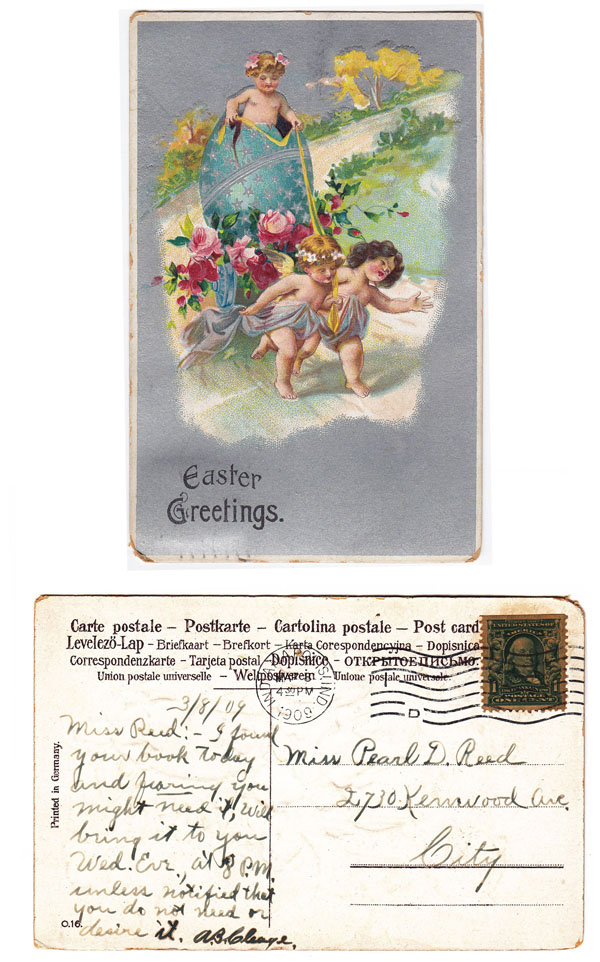
3/8/09
Miss Reed: – I found your book today and fearing you might need it, will bring it to you Wed Eve at 8 p.m. unless notified that you do not need or desire it.
A.B. Cleage
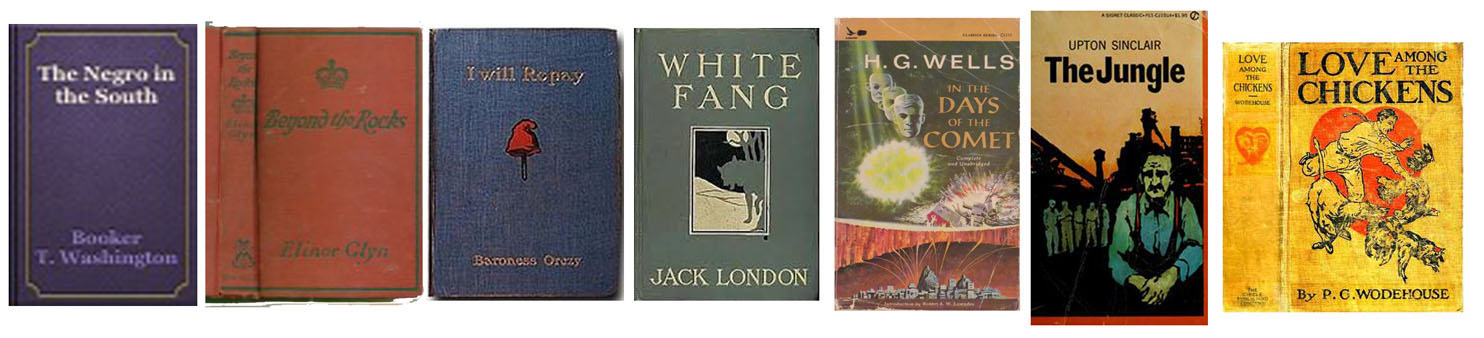
What was the book that my grandfather wanted to return? When I knew my grandmother she read or had read many books, including Kristin Lavransdatter by Sigrid Undsett, who I was named after. But that wasn’t published for decades. It doesn’t sound like a novel because why would she “need” a novel? Of course, it may have been a ruse to get to see her and he knew she didn’t need it. Here are some books that were popular in 1906 and 1907.
Click to enlarge.
There were many articles in African American newspapers at that time about Booker T. Washington and W.E. B. DuBois so maybe it was The Negro in the South by Booker T. Washington and W.E. Burghardt DuBois. Or maybe it was one of the novels of the time:The Jungle by Sinclair Lewis about the horrors of the meat packing industry in Chicago. Perhaps it was a hymnal or other book of songs because Pearl D. Reed sang in the church choir and at other community events. Beyond the Rocks is a 1906 novel by Elinor Glyn, which was later adapted into a 1922 silent film in which Gloria Swanson and Rudolph Valentino. In the Days of the Comet (1906) is a science fiction novel by H. G. Wells in which humanity is “exalted” when a comet causes “the nitrogen of the air, the old azote,” to “change out of itself” and become “a respirable gas, differing indeed from oxygen, but helping and sustaining its action, a bath of strength and healing for nerve and brain.” The result: “The great Change has come for evermore, happiness and beauty are our atmosphere, there is peace on earth and good will to all men.”
My grandparents – Albert B. Cleage & Pearl D. Reed Taken from a 1909 group photograph at Witherspoon United Presbyterian Church.
Today begins the 2014 April A-Z Challenge. I will be blogging everyday using items taken from the letters written by my grandfather to my grandmother from 1907 to 1912, starting with “A” and moving right through the alphabet to “Z” during April.
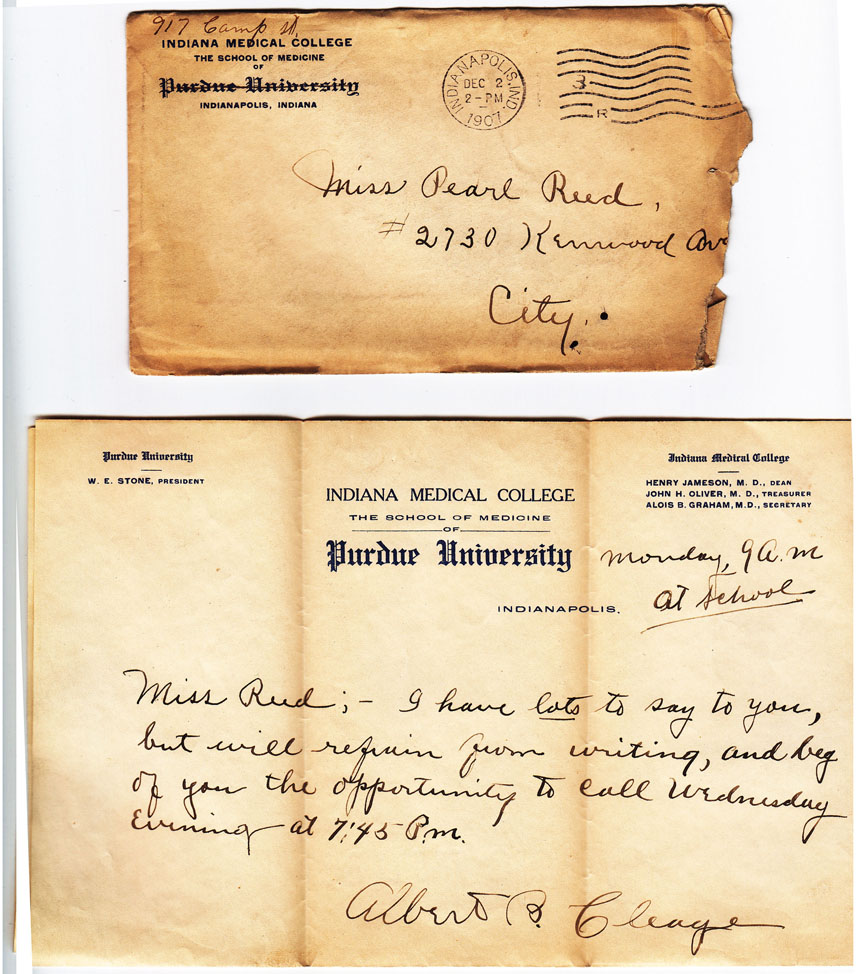
Albert B. Cleage’s letters begin in 1907, shortly after he met Pearl D. Reed. The letters end in 1912 as they prepare for a move from Indianapolis, IN to Kalamazoo, MI. This is the first letter in the collection.
Monday, 9 a.m. at school
Miss Reed; – I have lots to say to you, but will refrain from writing, and beg of you the opportunity to call Wednesday evening at 7:45 P.M.
Albert B. Cleage
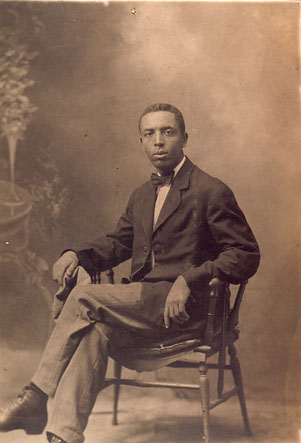
Albert B. Cleage. This photograph was enclosed in a later letter.
My grandfather was born Albert Cleage in Loudon County, Tennessee on May 15, 1883. He was the 5th and youngest child of Louis and Celia (Rice) Cleage. His parents were born into slavery and were free after the Civil War. They married in Athens, TN in 1872. By 1880 the family was living on a farm in Louden County, TN. Louis sharecropped 15 acres.
By 1891, the family was back in Athens. Albert was 8 years old. His parents were divorced and in 1897 his mother was married to widower Roger William Sherman, a successful carpenter. His father worked at laboring jobs in various places, from the railroad to the mines of Birmingham, AL.
In 1902 my grandfather graduated from Henderson Normal and Industrial College in Henderson, NC where his brother-in-law was teaching. He attended Knoxville College 4 years where he played football and wrote for the school paper in addition to studying. On the way to one of these schools my grandfather decided that he needed a middle name and chose the name of “Buford” from a sign he passed on the train going to school.
In 1906, after graduating from Knoxville College, he followed 2 of his older brothers to Indianapolis, IN and attended the Indiana University Medical School. In 1907 Albert, his brothers and my future grandmother all signed a petition asking for the formation of Witherspoon United Presbyterian Church. During the summer of 1909 he worked as a waiter on the steamer, Eastern States which ran from Detroit to Buffalo NY. The money he earned funded his college education. He graduated with his MD on September 1, 1910. He received appointment as an intern at the City Dispensary. On September 21 he and Pearl Doris Reed were married at her home.
In 1911 Pearl’s mother died and the first of their 7 children was born – Albert B. Cleage Jr, my father. In 1912 the family moved to Kalamazoo, Michigan where my grandfather set up in private practice. And that takes us to the end of the time covered in these letters.
This is my second year doing the A-Z Challenge. Last year I used the broad theme of my blog – family history.
This year my focus will be the letters and postcards written by my future grandfather, Albert B. Cleage to my future grandmother, Pearl D. Reed. from 1907 – 1911. I will be using people, places, addresses and events mentioned in his correspondence, to learn more about my family and the times.
I have more of a head start this year. Although I have not yet written any posts, I am researching and narrowing down the scope of posts. As I go along, I may change the word for the day if something else draws me in. Now to see what others have planned.
Click to find more blogs participating in the reveal!