For this years Blog Caroling event hosted by footnote Maven, I decided to post my Carol from last year once again – We Three Kings on hang drum.

For this years Blog Caroling event hosted by footnote Maven, I decided to post my Carol from last year once again – We Three Kings on hang drum.
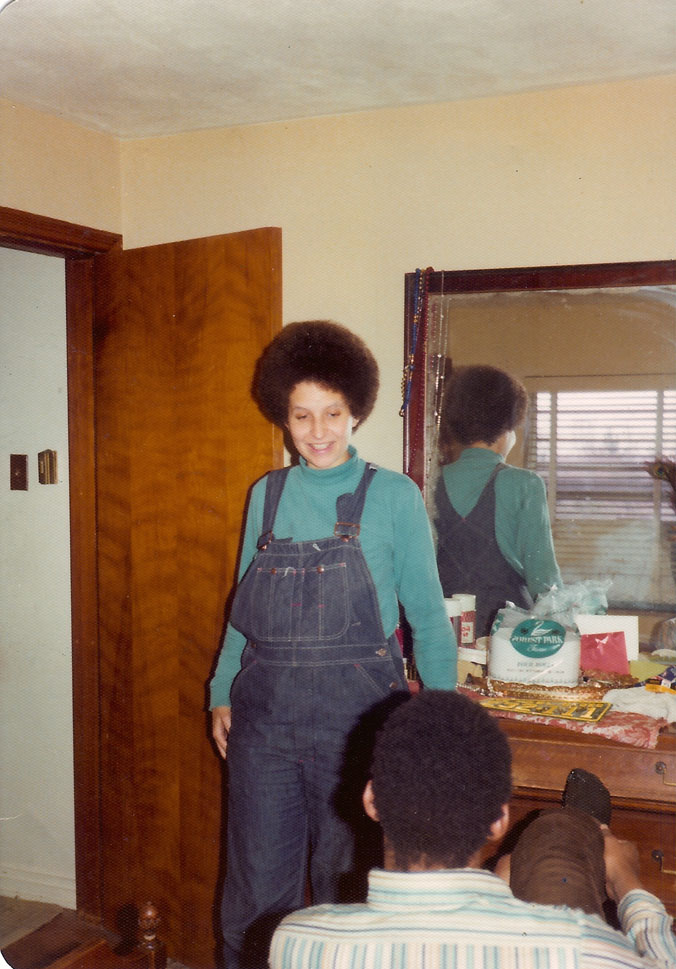
We moved to Simpson County, Mississippi in November of 1975. Jim was in charge of the Emergency Land Fund’s Model farm. Our daughter Jilo was 5 and Ife was 2.5. I was 29 and Jim was just about to turn 31. This was before we had goats, chickens or rabbits. The greenhouses weren’t in production. I remember several of the farmers Jim worked with gave him gifts of money for Christmas. It didn’t amount to more than $30 total but it paid for all the gas we used.
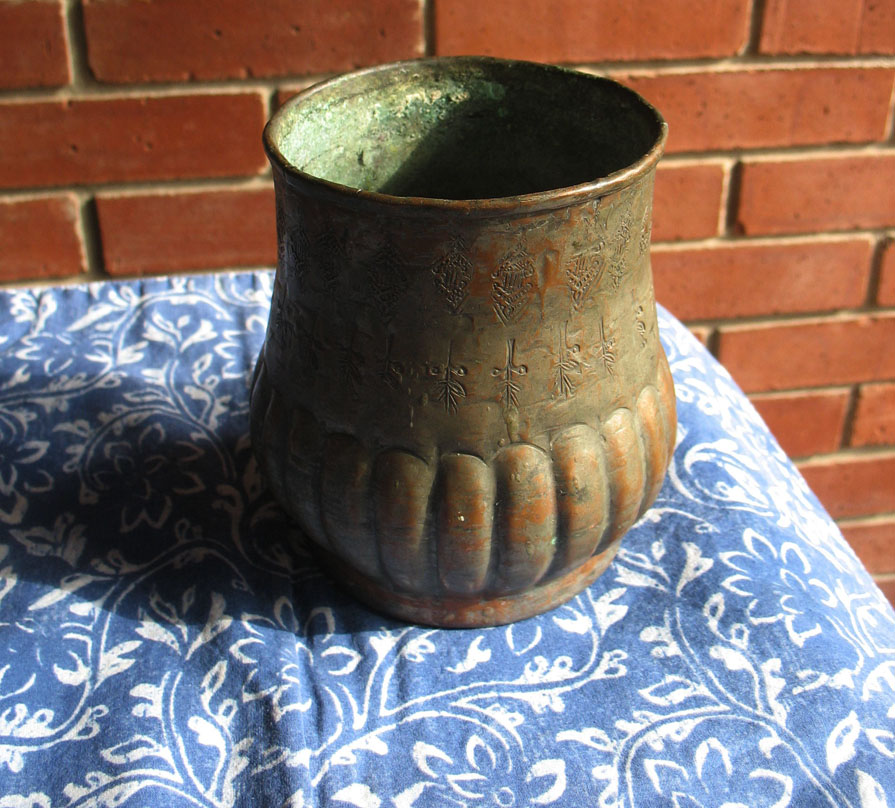
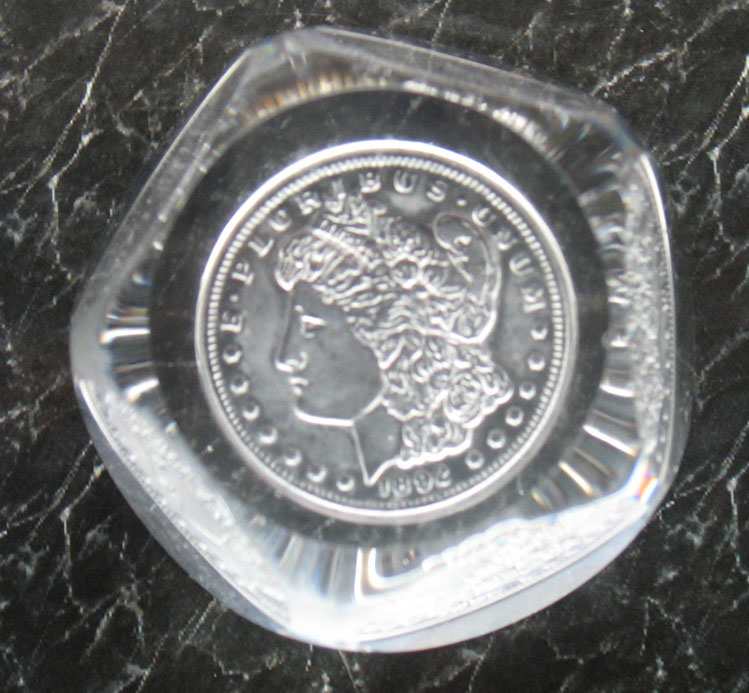
We decided to drive up to share the holidays with Jim’s family in Rock Hill, MO. They lived at #1 Inglewood Court, right outside of St. Louis. Seventeen year old Micheal, fifteen year old Monette and twelve year old Debbie were living at home. We made the eight hour trip in the little gray Volkswagon that came with the job. We took food to eat on the way, left early and drove straight through. I don’t remember anything specific about driving up. As I recall we got to St. Louis before dark. Jim’s parents gave us their bedroom. They were always so nice about that. Jim and the kids and I shared the pushed together twin beds. There weren’t presents for us but Jim’s mother looked around and came up with some. I don’t remember what she gave Jilo and Ife but she gave me two copper vases and Jim two glass paperweights. I don’t remember what we took as gifts.
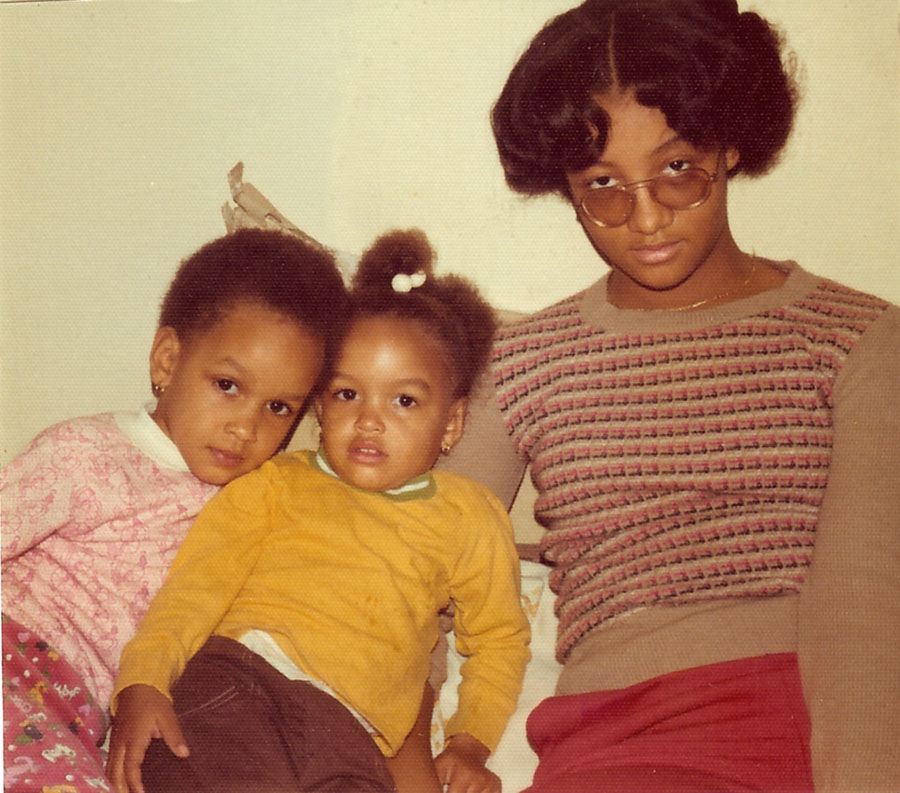
I remember going to see Jim’s brother, Harold, at one of his jobs. He had several, just like his father always did. We also stopped by his studio where he made plaster knick knacks. Or was it cement bird baths? Or both? There was a Salvation Army or Goodwill store nearby and we stopped and I got some shirts for the kids and a dress that Ife wanted. Mostly we stayed around the house and visited.
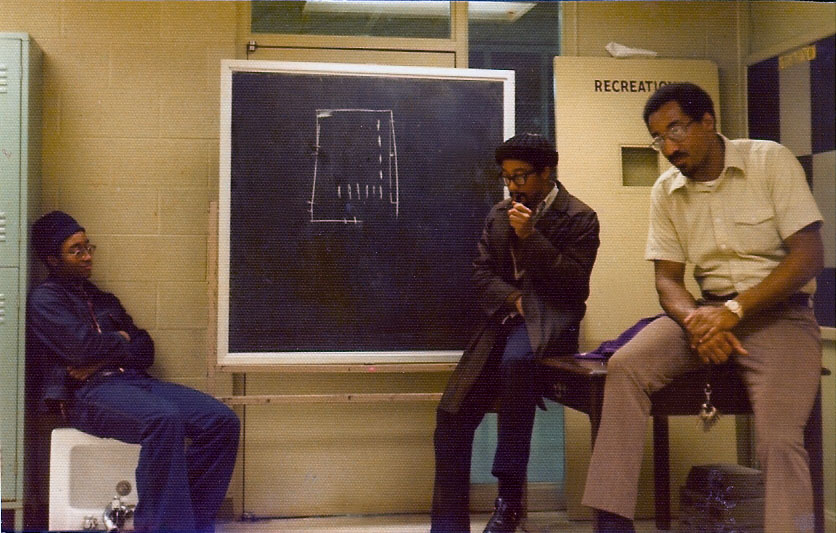
We stayed until New Years Eve and left in the evening. There is never enough food or time to prepare it for the return trip. We stopped at Howard Johnson’s somewhere on the way home and I remember getting fried oysters. It was cold and dark and clear. There were stars. And there are always trucks. We listened to the radio and talked and maybe sang some. The kids eventually fell asleep in the backseat and we welcomed the New Year driving through the night.

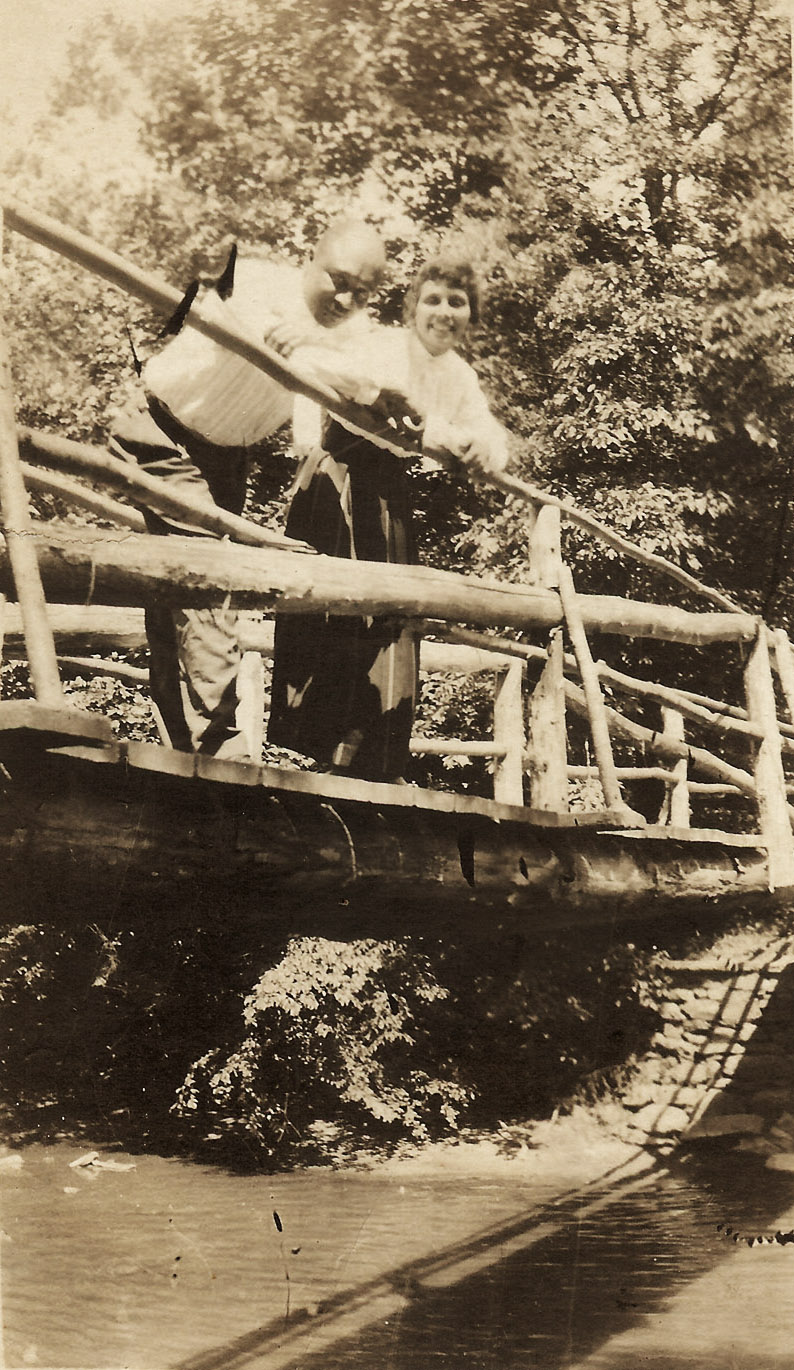
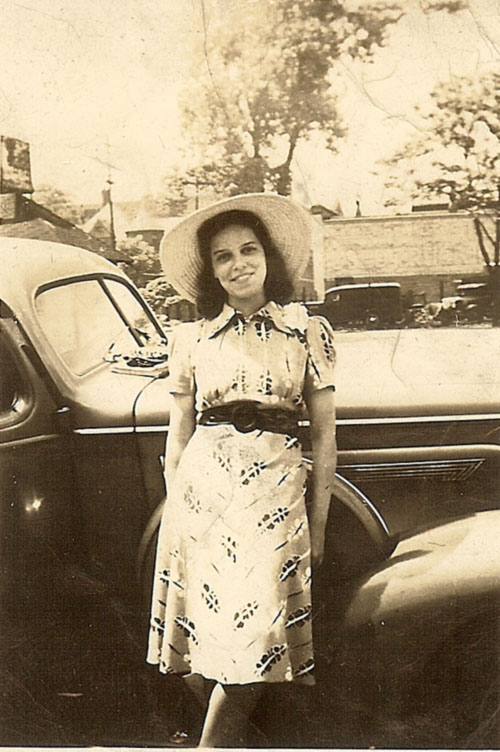
I was inspired to post this photo by a post on Between the Gate Posts “The Lady Wears The Hat“. It’s a beautiful photograph of her aunt.
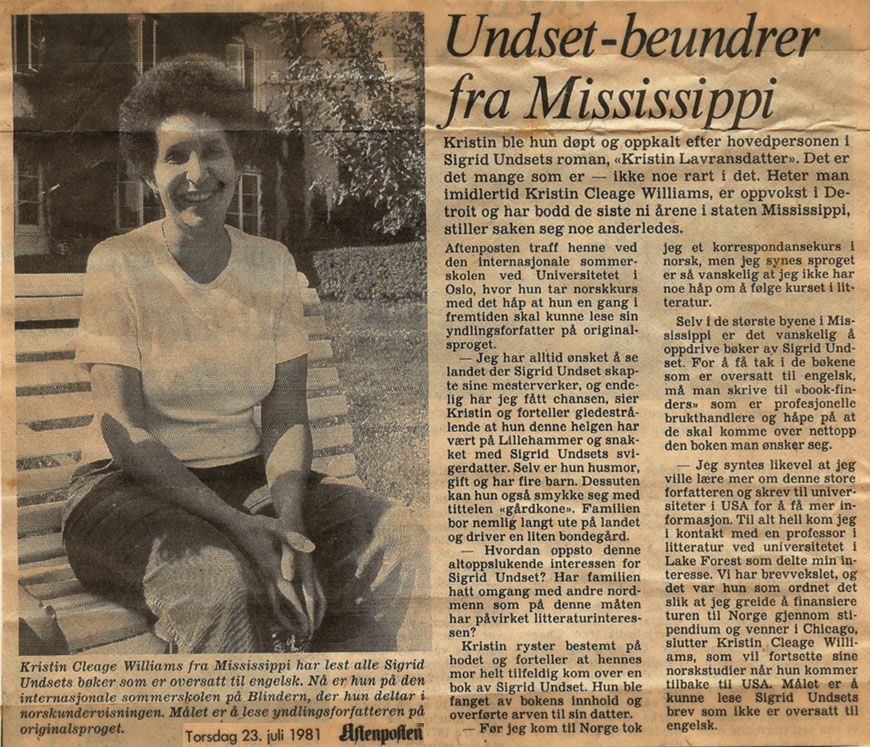
 I was named Kristin at my Uncle Henry’s suggestion, after the heroine of Norwegian author, Sigrid Undset’s trilogy, “Kristin Lavransdatter“. My mother had considered naming me after her mother, Fannie, but my grandmother said that was an awful name to inflict on a child, so she didn’t. My other grandmother, Pearl Reed Cleage, thought everybody should have a family name. In the case of my name she made an exception because it came from, she said, the best book in the world.
The name Kristin reached it’s height of popularity in the 1940s, however my health care professionals seem to be continual startled to find such an old woman with the name of Kristin. They think that only younger people have received that name.
I’ve always liked my name, even though people like to spell it with an “e” instead of an “i”. During the late 1970s, Penguin Books came out with a new edition of the trilogy. I was stunned to read that Sigrid Undset wrote the series while raising 6 children. I was raising 4 and hardly had time to read, much less write Nobel Prize winning literature. I started trying to find out more about her life. I wrote letters to Undset experts at various universities and made connections that resulted in a 7 week trip to Norway in the summer of 1981. I found out how she did it and I will write more about that experience in another post.
I got the idea for this post from Randy Sever’s Saturday Night Genealogy Fun, although I didn’t do it exactly the way he described.
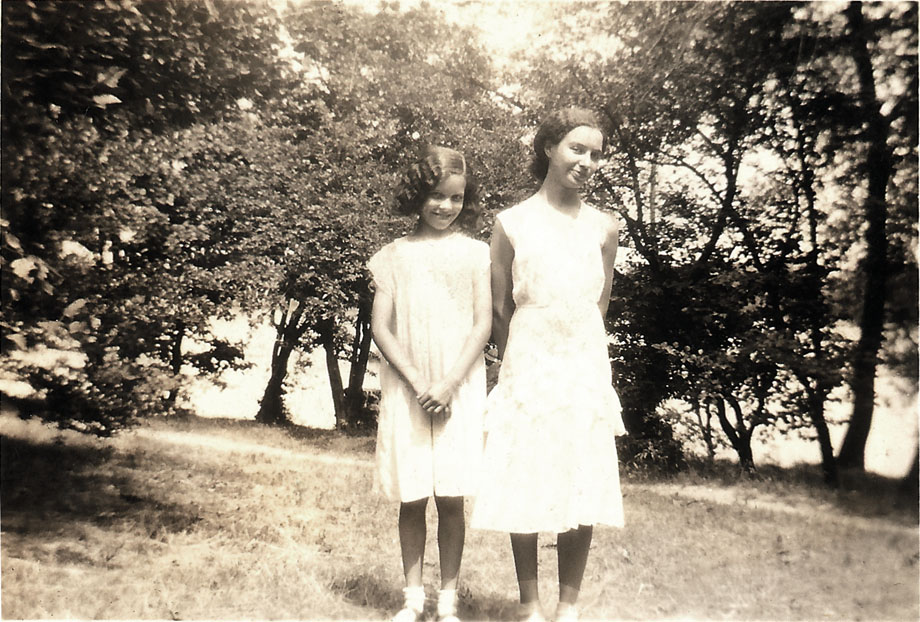
This photo of my mother, Doris and her sister, Mary V. Graham was taken in 1933. My mother was 10 years old and her sister was 13 years old. The photograph was taken on Belle Isle, an island park in the Detroit River between Detroit and Canada. You can see the river in the background.
They lived with their parents, Fannie and Mershell on Theodore Street. My grandfather worked at Ford Motor Co. at the River Rouge Plant. They had a dog named Bonzo. Their little brother, Howard, had died the year before from complications of diabetes and scarlet fever.

The generations gathered around my Graham grandparents dining room table in 1963 for Thanksgiving dinner. There was turkey with cornbread dressing cooked by my grandfather. There was white rice, cranberry jelly, green beans, corn pudding and sweet potatoes. There was my grandmother’s finely chopped green salad and her homemade biscuits with butter and with a relish plate holding olives, sweet pickles and carrot sticks.
One thing there wasn’t, was talk about the old days. My grandparents were born in 1888. My grandmother was born Fannie Turner in Lowndes County, Alabama. My grandfather was born Mershell Graham in Elmore County, Alabama. They met and married in Montgomery. My great great Aunt Abbie was born in 1877 in Montgomery, Alabama and was the second to youngest child of Dock and Eliza Allen. My mother told us stories she had heard from her mother, mainly about Dock and Eliza and their children. I remember once my older cousin was trimming Aunt Abbie’s toenails when Aunt Abbie mentioned that she used to trim her grandmother’s toenails when she was a girl. And that her grandmother also had arthritis. I have always remembered that, but I didn’t ask any follow up questions about her grandmother, Annie Williams who was born a slave and was full grown and the mother of a fully grown woman when she was freed. And Aunt Abbie didn’t say anything else about it.
My grandfather, who we called Poppy, was a mystery. My mother only had little parts of stories she had gotten from her mother, things that just made the mystery deeper in most cases. What were his siblings names and what happened to them? Are the ones I’ve found that I think are his siblings, really his siblings? In 1900, I found these possible siblings living with a man who is listed as their father but has a name not listed on any of their death certificates, was he their father with a different name? And where was he, my grandfather, in 1900? Why wasn’t he there, or anywhere else I can find? Where was their mother? What was the name of the little white girl he was servant of when he was a boy? The one he slept on the floor outside of her bedroom door? The one who changed his name from Michele to Mershell because Michele sounded too “foreign”? How did he learn to read? Did he go to school? Did he know his grandparents and what plantation did his parents come off of? There was a photograph of his sister and her children in the album. I would like to ask him what their names were. Are they the ones I’ve found in the census?
I would like to ask my grandmother some of the same questions about her father’s family. Howard Turner died when she was 4 and her mother moved away from that community and went back to her family in Montgomery. I was able to find her father’s family because I knew his name, his age and the community he came from but I have no stories about his parents and siblings or what plantation they came off of. I only know that his father, Joseph Turner of Hayneville, Lowndes County was a farmer and owned his own land and had given his son some land which he didn’t want him to sell and the two of them argued about it.
When we went by my other grandparent’s house for desert I would ask where my grandfather’s mother, Celia Rice Cleage Sherman is buried. And why my grandmother Pearl thought her grandmother was Cherokee.
Unfortunately, I can’t go back to 1963 and sit around the table and steer the conversation around to who was where and when and how and why. I can only use the information I do have to keep looking and hope that one day some cousins from those mysterious lines will turn up and perhaps have some of the answers to my questions.
_______________

This was written for the Blog Carnival “The Ancestors Told; the Elders Listened; We Pass It On”.
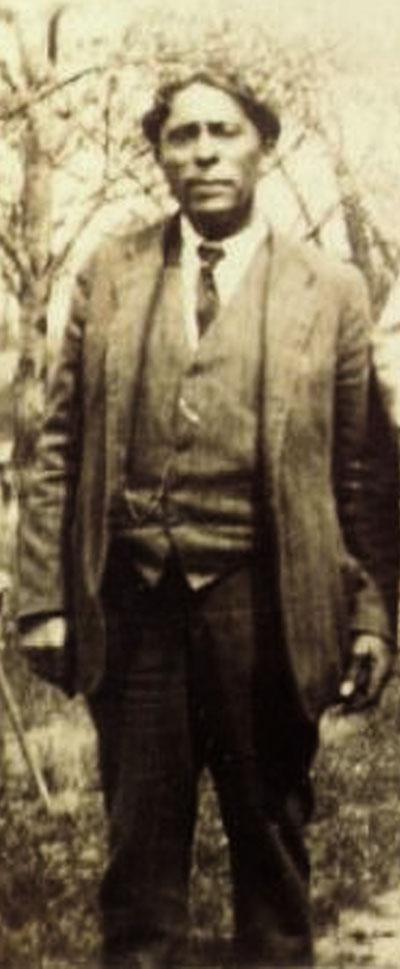 Today was Mr. Mullins birthday and I thought I would share some information about him.
James Mullins was born about 1863 in Shilo, Harris County, Georgia. He was the third child of the 14 children of Isaac and Sallie (Jarrett) Mullins. He worked on the family farm until some time after 1880. On 27 April, 1898 he married my grandmother Pearl’s sister, Minnie Averitte Reed, in Indianapolis, Indiana. In the 1900 Census he was listed as a fireman and the first of their 12 children, Helen, was a year old. The family lived next door to Minnie’s mother and siblings on Willard. In 1910 they were still in Indianapolis and he was still a fireman. There were 8 children.
The family moved to Benton Harbor, Berrien County, Michigan about 1916. In the 1920 Census they were living in Detroit and Mr. Mullins is listed as a carpenter at an auto factory. In 1930 the family was in Benton Harbor, living on Broadway with various family members living up and down the same street. Mr. Mullins was listed as a common laborer in this census.
By 1940 the family was back in Detroit and you can read about them in this post – 1940, Minnie and James Mullins. Throughout the years the family members were variously identified as mulatto, black, Negro, white and Indian in the Census. Mr. Mullins died in Detroit on July 10, 1944. He was 80 years old and unemployed. The cause of death is listed as “terminal uremia”. His wife, Minnie was the informant. He is buried in Detroit Memorial Cemetery.
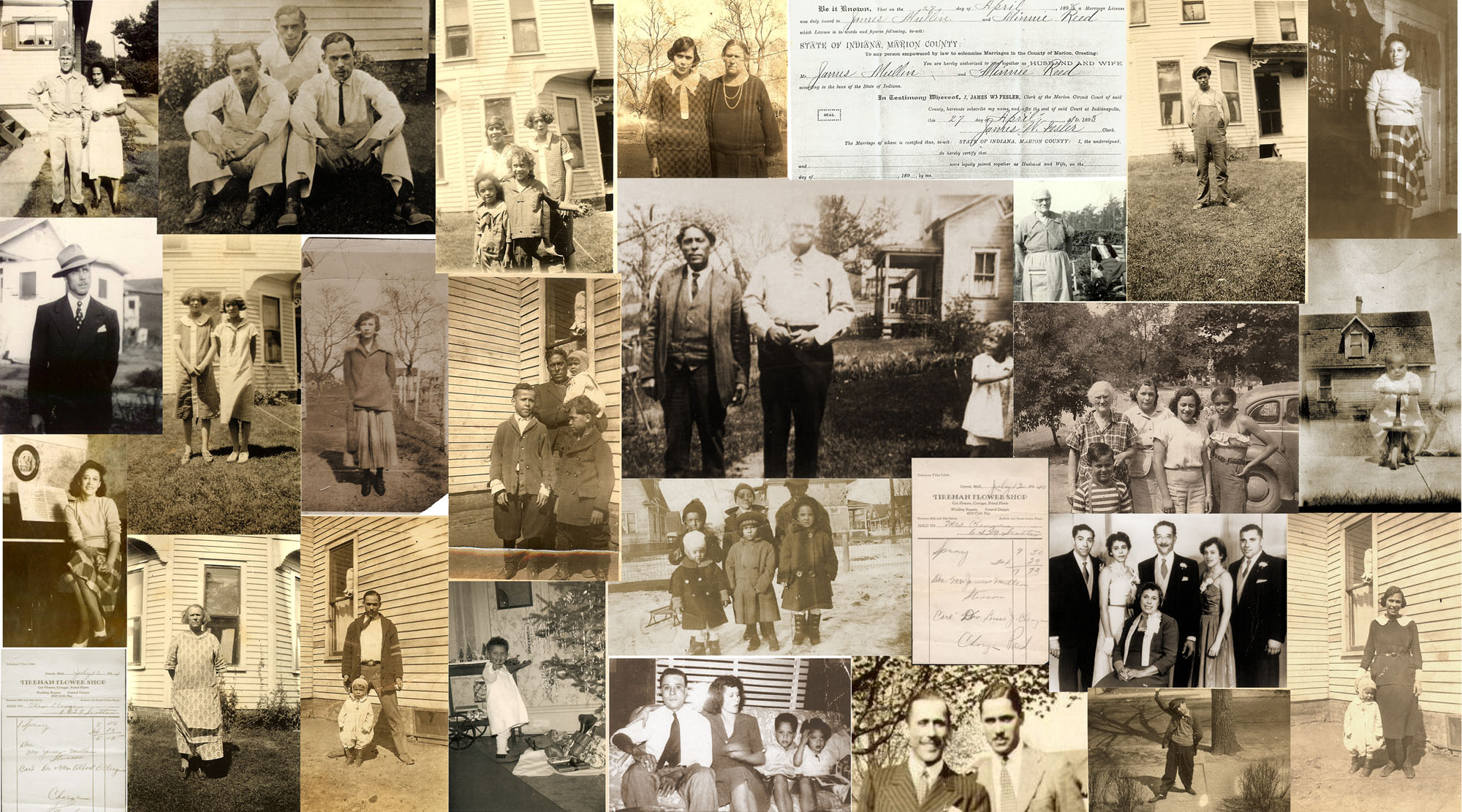
My uncle Henry shared some of his memoried of Mr. Mullins in the 1990s. “Mullins was always referred to that way. He was a very stern, hardy type. Admired the Irish. Had the long Irish upper lip himself. A very ‘Indian’ looking fellow. They lived in Benton Harbor and later moved to Detroit. ‘Sir Walter Lipton’, that’s the only kind of tea he’d drink. Rather, whatever kind he drank was that. He’d be talking about only drinking ‘Sir Walter Lipton’, and when he finished, Minnie would tell him, “Oh, Mullin, hush up! You know that’s Salada Tea.” When he moved to Detroit with his family the last time they figured he was 90 something years old. He died one day walking from Tireman all the way downtown. I think he just fell out. Like the old one horse shay, he just give out.“
Henry continued, “Aunt Minnie would talk a lot of trash. She said he’d sit down with a bottle of wine and eat all the food, talking a lot of trash about he was a working man, he needed his strength and the rest of them were all starving to death. All that was Aunt Minnie’s talk. We never heard his side of it. They lied on him and he never defended himself. They never made fun of him because he’d a beat everybody’s brains out. He never found it necessary to say anything. I think Aunt Minnie embellished the truth because I know we went there and tore up his lawn, his pride and joy, and he didn’t say anything much. He had a grape arbor. We (Me, Hugh, Bill and Harold), had a tent out there. We’d get to wrestling and tear up the tent and the grapes and he didn’t say anything. Probably crippled Bill and Harold after we left because they should have known better, we were just kids.”

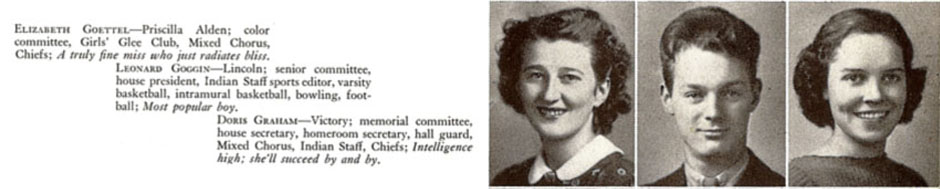
In 1940 my mother, Doris Graham, was a senior at Eastern High School in Detroit. At that time it stood on East Grand Blvd and Mack Ave, a mile from her home at 6638 Theodore. Eastern was torn down in the late 1960s. She was copy editor of the school newspaper “The Indian”, a member of the school Honor Society “The Chiefs” and regularly achieved all “A” report cards, “A” being the highest grade. My mother was in a variety of school activities , but the only photo of her in the Year book is the one below. She is on the lower right, writing.
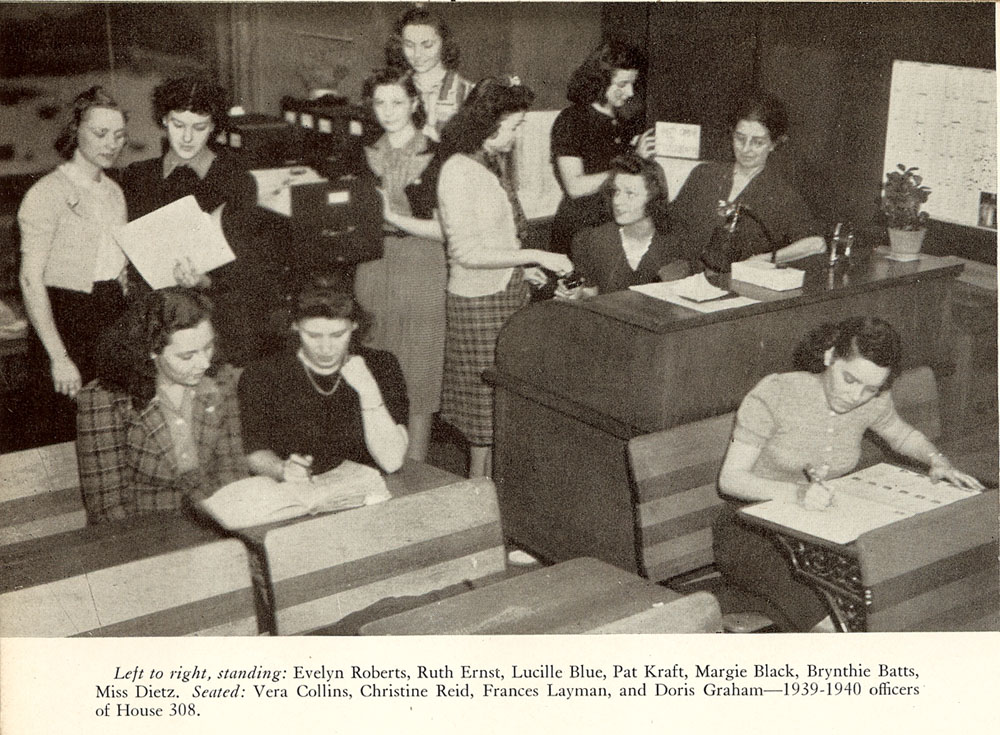
My mother graduated in January of 1940 and entered Wayne University the next month. I wrote about the cost of attending Wayne in 1940 here. You can read an article my mother wrote for the school paper and see a report card here. You will notice I used the above photo in that post. It fit so well with this week’s prompt that I had to feature. You can read about my mother and her family in the 1940 census here.
This week the Sepia Saturday theme is telephones or telephone operators. I would like to write about my cousin Marilyn’s amazing career as a telephone operator for Bell Telephone Company in Detroit. She started working in 1981 and continued until her retirement in 2008.
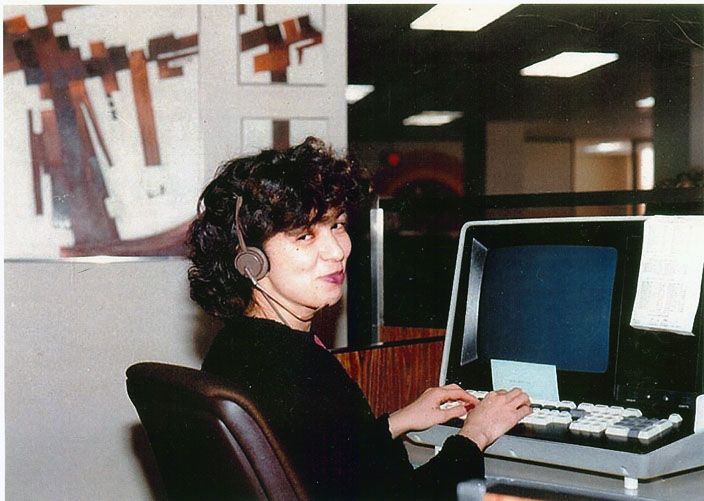
My cousin sent me a photograph of herself at work with the phone company. She wrote a bit about her years at there:
At Michigan Bell Telephone Co, which turned into AT&T Inc. Worked from 1981 to 2008 (about 28 years)
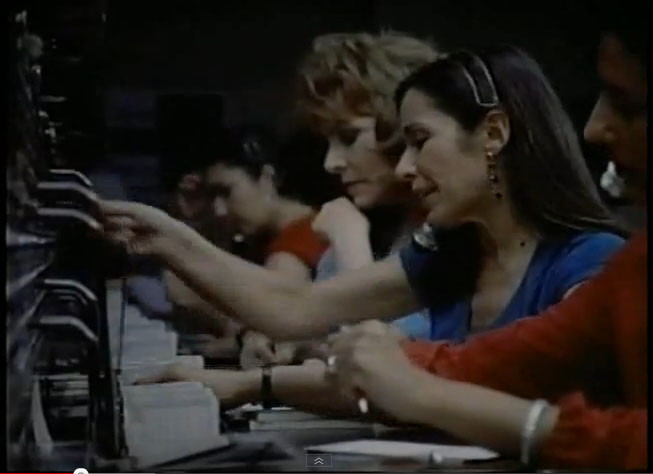
Unfortunately I do not have any photographs of Marilyn at the switchboard so I am inserting a photo grab from one of my favorite movie, Danzón (María Novaro, 1991). The whole movie (Spanish, no subtitles) is available on YouTube in more than 10 parts. I would advise renting the movie. It has everything, dancing, true love, a fine young man on a boat, good hearted prostitutes, female impersonators, friendship, motherhood, aging. I found it on Netflix here and also cheap on Amazon.