All posts by Kristin

Poem for Poppy

Today I am transcribing my Grandfather, Mershell C. Graham’s funeral program.  I’ve been looking for my grandfather’s funeral program for several months.  It wasn’t in the binder, where it should have been, or in the box with the not yet filed funeral programs.  Today, while looking for something else, I found it.  It was in my file cabinet in a folder having nothing to do with anything relevant.  The poem was written by my sister, Pearl Cleage.

Mershell Cunningham Graham standing beside his corn patch.

Poem For My Grandfather

(for M.C. Graham)

The handing down of things
worn smooth between your fingers.
The handing down of parts of you
in hurried kitchen ceremonies.
The smell of biscuits
and the smell of heirlooms.
A story about trains.
A whisper of hard times
and magic in the face you hold so close to mine
and smile.
The handing down of things.
The handing on of you…

By Pearl Cleage

In Memorium

Mershell C. Graham
Thursday, September 6, 1973, 12 Noon
Plymouth United Church of Christ
514 Garfield
Detroit, Michigan
Rev. Nicholas Hood, Pastor

Order of Service
Processional……
Hymn          ……
Invocation   …….
Scripture      …….
Hymn          …….
Eulogy         …….
Benediction  …….

Interment
Detroit Memorial Park

In Charge
Charles T. Cole Funeral Home

Honory Pallbearers 
Friends of Mr. Graham

Active Pallbearers
Members of the Men’s Club

Mershell C. Graham was born December 25, 1887, in Coosada Station, Alabama.  He received his early Christian training in the First Congregational Church of Montgomery, Alabama.  He met his beloved wife, Fannie Mae, in the church.  They celebrated their 54th wedding anniversary in June of this year.  They had four children and shared a long and beautiful life.  

He was one of the founders of Plymouth United Church of Christ and was a devoted member of the church all of his life.  He served as treasurer for many years and was Trustee Emeritus.  He was retired from the Ford Motor Company after over thirty years of service and was a member of the U.A.W. and the N.A.A.C.P.

Mr. Graham passed on September 3, 1973, at his home at 16260 Fairfield.  He leaves to mourn his loss his wife, Fannie, his two daughters, Mary Virginia Graham Elkins and Doris Graham Cleage; five grandchildren Doris Diane Elkins; Kristin Cleage Williams; Barbara Elkins; Pearl Cleage Lomax and Marilyn elkins; and six great-grandchildren; Maricea McNeil; Harry McNeil; Frank Elkins; Lonnie Elkins; Jilo Williams and Ife Williams.

He was preceded in death by his two sons, Mershell C. Graham Jr and Howard A. Graham.

Photos, Photos Everywhere

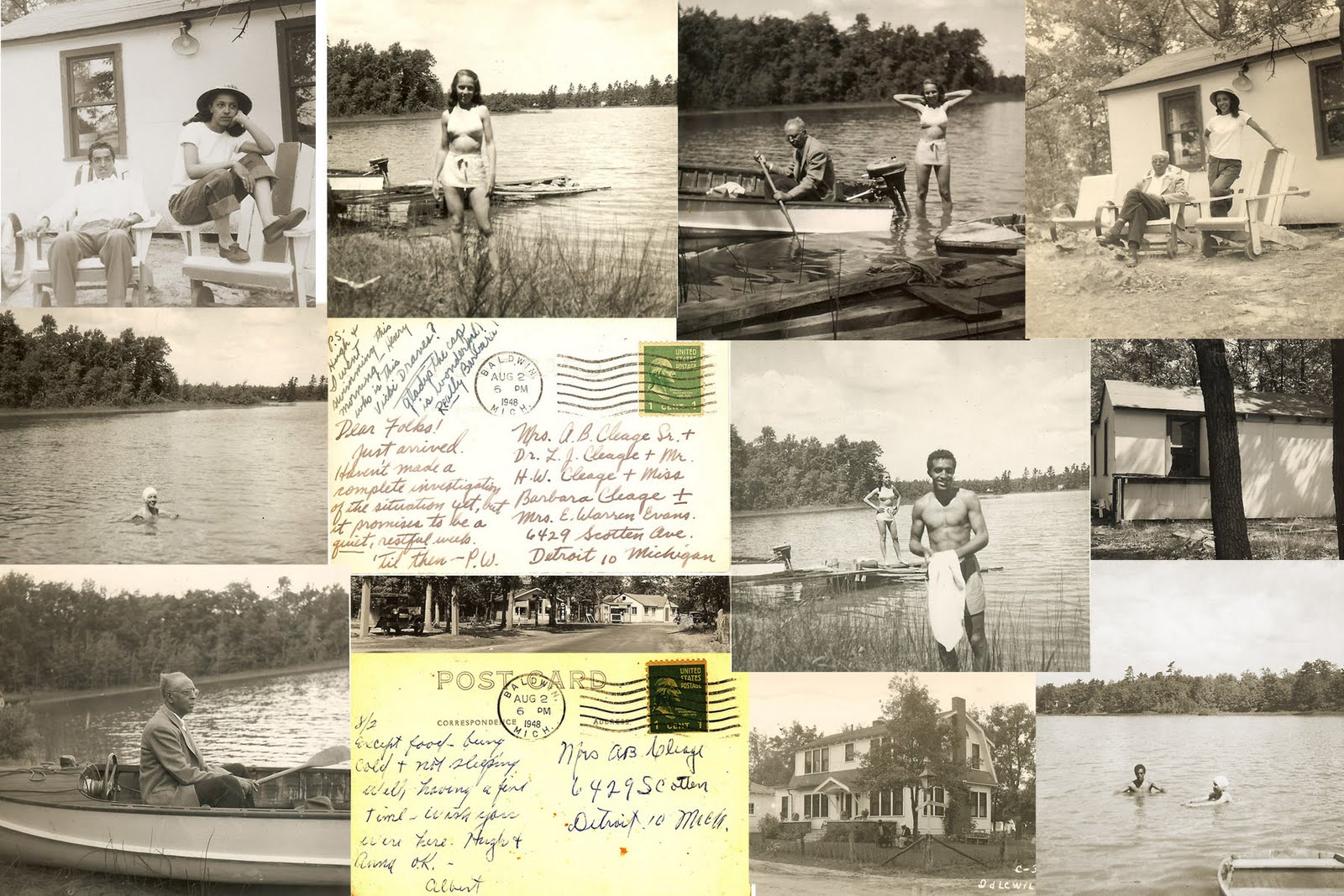
This week I spent hours putting my photographs from the paternal side in order.  First by grouping them into piles according to the numbers on the reverse side.  After dividing them up by number, I then started dating the files.  I was able to determine who some of the babies were in later photos by which siblings were already there and how old they were.  I will show some of these in a later post.  It’s been slow going and I almost missed Sepia Saturday.  However I thought I should make an entry.  Above you see some of the piles.

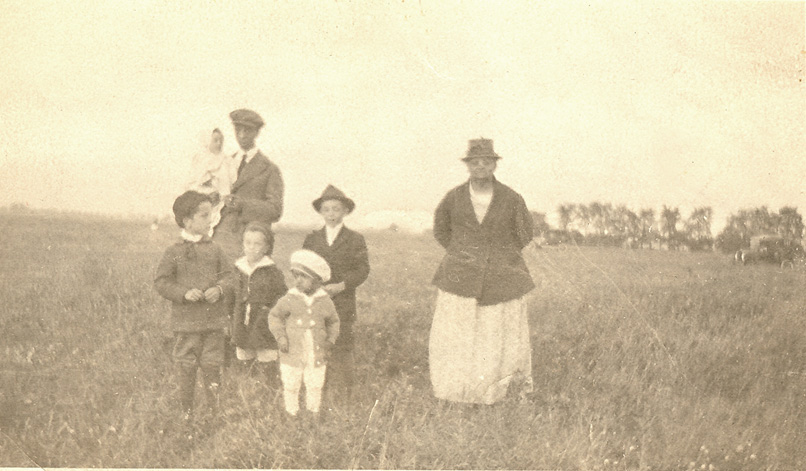
These two photographs have the same number.  I have wondered for years if that boy with the stocking cap on standing next to the car was my father.  When I saw the photo of my Uncle Louis (on the left) and my father, Albert, with the stocking cap, I saw it was him.  There are other photos that have both boys that have different numbers but they appear to be taken at the same time on one of the family’s annual trips to Athens Tennessee, my grandfather’s hometown.  One brother, Edward, remained in Athens.  The rest of the family ended up first in Indianapolis, IN and then in Detroit, MI.

Here are some other posts about the Athens branch of the Cleages.
Uncle Ed’s daughters – 1917.  Memories to Memoirs, and Juanita and Daughters.

To Read more Sepia Saturday post and to participate click HERE.

The 4th Annual i Gene Awards at Finding Eliza (and My Cleages)

This time last year I didn’t know the i Gene Awards existed.  This year I am here to present the Awards for the best posts on my blogs in five categories.  First I would like to thank my ancestors for saving so many photographs, stories, letters, journals and scraps of paper and seeing that they got to me.  It has made my job so much easier. And now on to the awards.


The Best Picture Award goes to  My Mother – 1952  a Sepia Saturday offering that caused much speculation about why she seemed to be avoiding the camera.  Was she shy?  Was she coy?  Did she lose her earring?  Was there a cat under the chair?  We will never know but I would like to thank my mother, Doris Graham Cleage, for being so photographically mysterious.

The Best Screen Play Award goes to Eliza and the People in Her Life – a Chart  This would be a multi-generational saga that begins in slavery and ends in freedom.  We have slavery, lust, an escape to freedom while being chased by hounds, true love, vengeance, the surrender of Montgomery, reconstruction, family bonds, death in childbirth, hard work and much, much more. The chart is the cast of this drama.   I would like to thank my sister Pearl Cleage for being my casting director. Her picks are below:

  1. Young Eliza — Jurnee Smollett/played the debating girl in “The Great Debators” and was the young girl featured in “Selma, Lord, Selma!” and “Eve’s Bayou.” good actress.
  2. Old Eliza — Barbara O/Yella Mary from “Daughters of the Dust.” amazing actress and looks like she could be what Jurnee would look like old. (let’s say old Eliza is the one who starts telling the story in flashbacks so she’d start and then Jurnee would fade in as Eliza in her twenties when she meets Dock.
  3. Dock — Jeffrey Wright/played Muddy Waters in “Cadillac Records.” he’s a little old, but he looks like he could be Dock and he’s an amazing actor.
  4. Annie Williams — Viola Davis/in her 40’s, so she could be in a flashback/she was nominated for an academy award for her role as the mother in “Doubt.” last year, she won a Tony for playing Rose in “Fences” on b’way.
  5. Milton Saffold — here come the movie stars… maybe Jake Gyllenhaal he was in “Brokeback Mountain” and lots of movies. he’s a good actor. the right age, in his 30’s.
  6. Georgia Whitting —  Reese Witherspoon, usually comedic, but was really good playing June Carter Cash in the movie about Johnny Cash.  She’s from Tennessee so she could call on her roots.
  7. Edmund and Jane Harrison — oh, let’s throw in a couple of really BIG time movie stars for fun. how about Angelina Jolie and Brad Pitt?
  8. Martha Harrison —  how about Dakota Fanning? she’s young, blond, not a bad actress.
  9. Clara Bolden – Tariji P. Henson. got nominated for an Ocsar for a weird movie two years ago. was also a star of the awful movie, “Hustle and Flow”, but that wasn’t her fault. she’s pretty good and can play sad and angry, two emotions required of colored mistresses.

The Award for Best Documentary goes to In Which I Hit the Google Photo Jackpot, another Sepia Saturday offering.  In this one I wrote about the information I found trying to explain why the Tulanes might have been sitting so far apart on the porch, get side tracked into researching Victor Tulane’s family and then talk about all the photographs I found for this family, using google, while just trying to illustrate the original information.

The Award for Best Biography goes to the two part series about my Grandmother Fannie Mae Turner Graham 1888 – 1974 – part 1 and Fannie Mae Turner Graham 1888 – 1974 – Conclusion I would like to thank my mother, Doris Graham Cleage, for writing this series in 1976.

Last but not least, The Award for Best Comedy goes to a post for which I have to give credit to my Uncle Henry Cleage (Does it seem to you, right about now, that I wrote only half of these posts, at most??) for the short story Just Tell The Men – A short story by Henry W. Cleage.

A big thank you to Carnival of Genealogy hostess, Jasia, at Creative Gene for creating these Carnivals!
.

A letter to my grandmother Fannie

I am sharing a letter from Victor Tulane to my grandmother Fannie after her family moved up from Montgomery to Detroit.  Soon after she and my grandfather bought a house her mother and her two sisters joined them.  They had two children under 5 and my mother was on the way.  Read more about Victor Tulane here and about my grandmother here.

"Letter to Fannie Graham from Victor Tulane."
Letter to Fannie Graham from Victor Tulane

Rents Collected                                                                                     Homes Bought       Loans Negotiated                                                                                         And Sold 
Estates Managed

V.H. TULANE
REAL ESTATE AND INSURANCE
SCOTT BUILDING 123 MONROE ST.
Telephone 388
                 555                                                                                        
                                                                                                      Montgomery, ALA.,        Nov. 23, 1922

Dear Fannie,
I am enclosing check from this M.R. & Ins. Co; for ten dollars which the sec’y should have mailed you some time ago.

We are winding up the affairs of this company and will send you another payment on stock acct. pretty soon.  I think that the company will be able to pay off it’s stock holders dollar for dollar.

I trust this will find all well and getting along nicely.

Your mother’s things were shipped yesterday.  Trust they will arrive on time and in first class condition.  Remember me to all the folks.  Tell the kids hello!
Let us have a line from you when convenient.

Your Uncle,
Victor


The Whole Bunch – 1922

Today I spread all my Cleage photos out on the table and began putting them into order by number or date.  While I was doing this, I found another photograph in the sequence that I posted about twice this week.  Click here to see the photo of my grandparents, where I speculate that it was taken soon after their marriage.  Several people wondered what he was holding over his shoulder.  Click here to read about my discovery of the numbers on the back of most of the photographs.

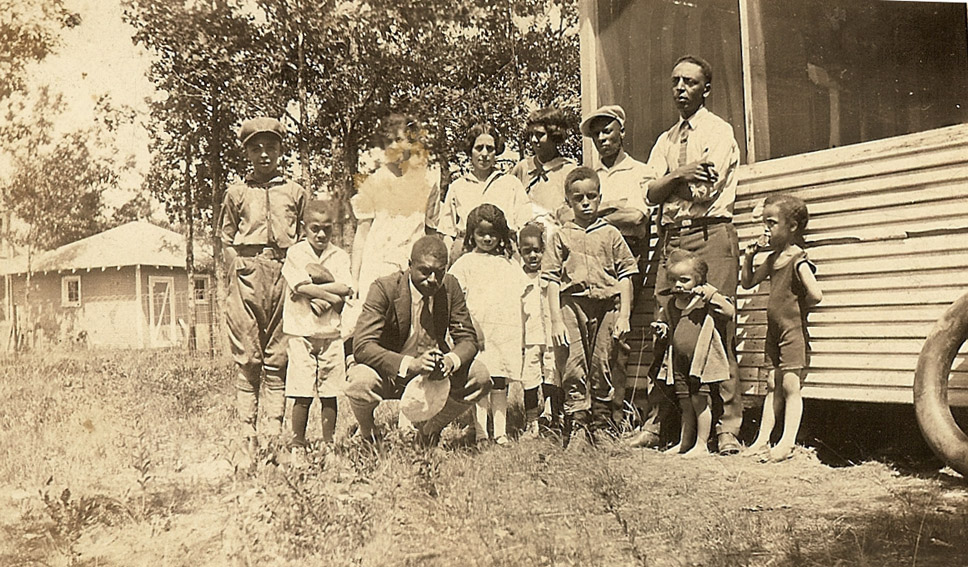
I can see the people more clearly in this group photograph but, it is in bad shape.  Starting from the left, are two headless women and I don’t know who they are. The little girl is my Aunt Barbara, next to her is my Uncle Hugh, Uncle Louis, Uncle Henry, Theodore Page (who looks like he has a double), a mystery girl, and the FLAG that my grandfather held over his shoulder.  Behind them are, an unknown man, my great grandmother Celia Rice Cleage Sherman, her son Jacob, my father Albert “Toddy”,  three people I don’t know then my grandfather Albert B. Cleage Sr.  In the background are some other people.  I don’t know who they are or where they are.

Click here to read other Sepia Saturday stories and to join in with a Sepia Saturday post of your own.

More Information About Yesterday’s Photo and a Discovery

Last night I posted an undated photograph of my grandparents.  I assumed it was taken soon after they were married in 1910.  Then one of my daughter’s asked me when it was taken and where it was taken.  I went back to my box of Cleage photos to see if I could find some others taken on the same day.  After going through quite a few pictures, I noticed that there were numbers on the back of the photographs.

Here is the back of the photo in question.  That is my handwriting.  I started looking for other photos with the number 573.  Voila!  I found two.  One says ‘Toddy and Theodore Page”, not in my handwriting.  Toddy is my father and Theodore Page was the nephew of  Gertrude, my great uncle Jacob’s wife.  He was living with them in Detroit, according to the 1930 census.

Taking a side trip, I began to look for information about  Theodore (Roosevelt) Page.  I found him at age 6 living with his parents, Jacob and Anna Eliza Page, and siblings William and Ophelia living on a farm in Mississippi in 1910.  By 1920 he was 16 years old.  He and his mother were living with sister his Ophelia and her husband, Henry Red, in Arkansas.  He worked on the family farm and had attended school in the last year. I’ve been trying to find Uncle Jacob’s wife’s maiden name for years.  Maybe finding her sister will help.

The other photo with the number 573 on it is a very blurry group photo.  I see my grandmother Pearl on the far left with little Barbara in front of her.  Hugh is next to Barbara,  My father is in the front row center, next to him is my great grandmother, Celia Rice Cleage Sherman, a little kid, probably my uncle Henry is next.  Behind Henry we see Theodore Page.  My grandfather is on the end.  Is he still holding the mystery object from the other photo?   

Now I’ll make another attempt to date the photo.  My father was born in 1911.  He could be 10 or 11.  Barbara was born in 1920.  She could be 2. Gladys was born the end of September in 1922.  Does my grandmother look pregnant?   My estimate is summer of 1922.

With this new information I will begin sorting, and scanning the box of photos in the near future.

Interview With Mignon Walker Brown & 3 Hats

This photograph is dated September 1, 1919. The people from left to right are – my Grandfather Mershell C. Graham (aka Poppy), Mrs. Hicks from Chicago and Moses L. Walker. They seem to be having a picnic. I don’t know who Mrs. Hicks is. She only appears in the photos from this day. Uncle Moses wasn’t actually our uncle. He was the uncle of our cousins and an old friend of my grandparents from Montgomery, Alabama. My grandparents roomed with the Walkers when they first moved up to Detroit in 1918 and they were my Aunt Mary V.’s Godparents.

I have transcribed below an interview my cousin Margret did with Uncle Moses daughter, Mignon.

Interview With Mignon Walker Brown

Margaret McCall Thomas Ward

Today is May 15, 1986. I am going to interview Mignon Walker Brown, my cousin, about her mother and her mother’s interest in cosmetics.

Margaret: You know, Victoria and I were over here one day about a month ago and in the conversation you described a recipe your mother used to make a face cream. Can you remember what it was she used to put in the face cream?

Mignon: Yes it was really not her recipe, it was her sister’s recipe who was a beautician in Chicago. She used lanolin, which was lamb fat. You bought the big pieces of lamb fat and you rendered them in the oven under a very slow fire (can’t understand several words) get too brown. You keep turning the fire off so it wouldn’t cook. And then when you had enough…there was a preparation called Palmer’s Skin Success. Now my aunt had a… the reason she used this in it, was she had a big beauty parlor down in the loop in Chicago…

Margaret: What was her name?

Mignon: and she had a rich Jewish cliental and they wanted their skin kind of bleached. Palmer’s Skin Success was a bleach. It was a green preparation came in a small jar that we bought, that my mother bought and you beat the lanolin with a rotary beater until it got very, very light and then you added this Palmer’s Skin Success, enough for whatever, you know, I don’t remember the proportion of that but enough to bleach as much as you wanted to. And then you added perfume to that. And that was the cream. And my mother used it and my aunt told her she was way ahead of her time because she used to go to Sweden every year to study and she used to make up her face to go to bed at night like you make it up in the daytime and this was before they had night creams and things. And she said that your face got as dirty at night, even though you were sleeping, as it did in the day, so that you should make it up to go to bed and then make it up again in the morning, which is the same principle as using night preparations. And that’s been… I was a little bitta girl then.

Margaret: And that would have been about 1920?

Mignon: Well, I was five or six and I was born in 1909. Couldn’t have been more then seven, so that would have been 1916.

Margaret: What was your mother’s maiden name?

Mignon: Owen. Jeannette Armor Owen.

(pause) It was in Chicago but I don’t remember the name of the shop.

Margaret: Did you ever visit your aunt in Chicago?

Mignon: Yes, they lived in Hyde Park. They lived as white all their lives. My mother didn’t like being white so she went back to live with her grandmother in Memphis, but Aunt Susie, there was a brother, Joe who was my mother’s half brother too, but they were siblings, full siblings, Aunt Susie and Uncle Joe lived with my grandmother in Hyde Park and Aunt Susie really made a lot of money. They never…

Margaret: What was her maiden… what was her name?

Mignon: Mausby M-a-u-s-b-y. And I didn’t know much about her father except that he ran what they called… I’m trying to think of what they … like Ferris wheels and that kind of thing. You know. What do they call those?

Margaret: Circus sideshows?

Mignon: They used to have them in neighborhoods even when we were children.

Margaret: um hum.

Mignon: And he ran those through the South. Evidently was very well off and my grandmother had divorced him and so my mother finished high school in Chicago before she went back, you know, to Memphis. The story behind that really was that my Grandmother was born about a year before Lincoln freed the slaves and she was the daughter of the plantation owner. My great-grandparents were slaves in Virginia.

Margaret: Where in Virginia?

Mignon: I don’t know where in Virginia. When the Civil War… when Lincoln freed the slaves, the man who owned the plantation called my great grandmother and her husband, her black husband, to the house and said, my great grandmother’s name was Sally, “Sally, you and Armor are free. You may do whatever you want. You may stay here and work on the plantation or you may leave but you are not taking Vicki with you because she is my child and I intend to keep her. So they left Virginia under the cover of night and took my grandmother and took her to Memphis.

She was well educated. They sent her to Oberlin to school and she taught school in Memphis and she married my mother’s father, whose name was Owen. And that’s all I know about him because he was dead when I was born.

Margaret: Who? Mr. Owen?

Mignon: Mr. Owen.

Margaret: You don’t know his first name?

Mignon: I don’t remember his first name.

Margaret: But he lived in Memphis?

Mignon: He lived in Memphis. She finally left. She, my grandmother taught school in Memphis. She finally married Mr. Mausby and moved to Chicago.

Margaret: And then by Mr. Mausby she had two children?

Mignon: She had more then two. The others died. Because I was named for one of those.

Margaret: I was going to ask you that. How did you get that beautiful name, Mignon?

Mignon: Well, she… my grandmother named one of her daughters Mignon and my mother named me that for her half sister who died when she was quite young.

Margaret: So now where did your mother and father meet?

Mignon: In Memphis.

Margaret: And how did that come about? Have you any idea?

Mignon: Yes. My father was from Montgomery but he went to Tuskegee to School. And he became a protégé of Dr. George Washington Carver and he wanted to go to business school so Dr. Carver made arrangements for him to get a job at Iowa State University to go to the business school for a year.

Margaret: George Washington Carver?

Mignon: George Washington Carver.

Margaret: Not Booker T. Washington?

Mignon: George Washington Carver.

Margaret: I never knew that.

Mignon: As a matter of fact, my father was very disappointed when I was born that I wasn’t a boy because I was to be named George Washington Carver. (Laughter.)

At any rate, Daddy went to Iowa and stayed the year. He did not graduate because he thought he had made an A in one course and they gave him a B and he would not accept the diploma. But he left there and his older sister lived in what was then Indian Territory before it became the State of Oklahoma.

Margaret: Which sister was that? Susan?

Mignon: His oldest sister Annie.

Margaret: Annie?

Mignon: Not Annie, Susie, his oldest sister Susie who was married and living there. And his occupation was to….he had a mule that he rode and sold Bibles to the Indians. And in his last illness we were sitting… there used to be a program on television (Oh dear my, cut it off I don’t want you to hear that.) He would look at this town and say “My goodness, the people who did these sets certainly knew what they were doing because it looked exactly like that town because he had traveled throughout the West.

He came back and went to Mississippi and worked for a man who had a grocery store. A general store, and he used to go to Memphis to buy for the store and in those days he had just come from the West and he wore his hair like Buffalo Bill, long and cut short and they used to tease my mother about her boyfriend with the curls. But anyway, this is how she met him because he went to Memphis to buy for the store.

Margaret: And what did she do? What was she doing then?

Mignon: My mother?

Margaret: Umm humm.

Mignon: Just living with my grandmother. She didn’t do anything.

Margaret: Where did she go to school?

Mignon: Chicago. She finished high school in Chicago.

Margaret: I see.

Mignon: And she became a milliner. Then she decided to go back to Memphis and she didn’t have to work.

Margaret: Now they married in Memphis?

Mignon: They married in Memphis and went to Washington to live. They married in 1908. At that time my father was working in the Treasury Department in Washington.

©Margaret McCall Thomas Ward May 2, 2003

End.

For more Sepia Saturday offerings, click here

Click for today’s Sepia Posts.