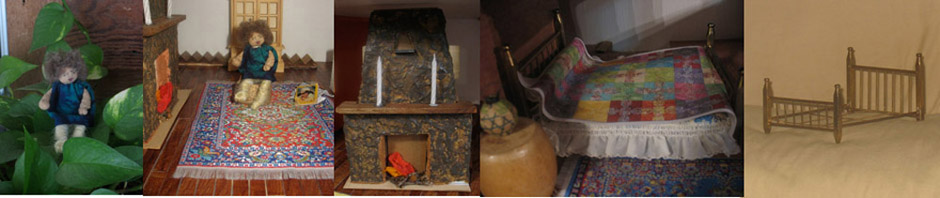
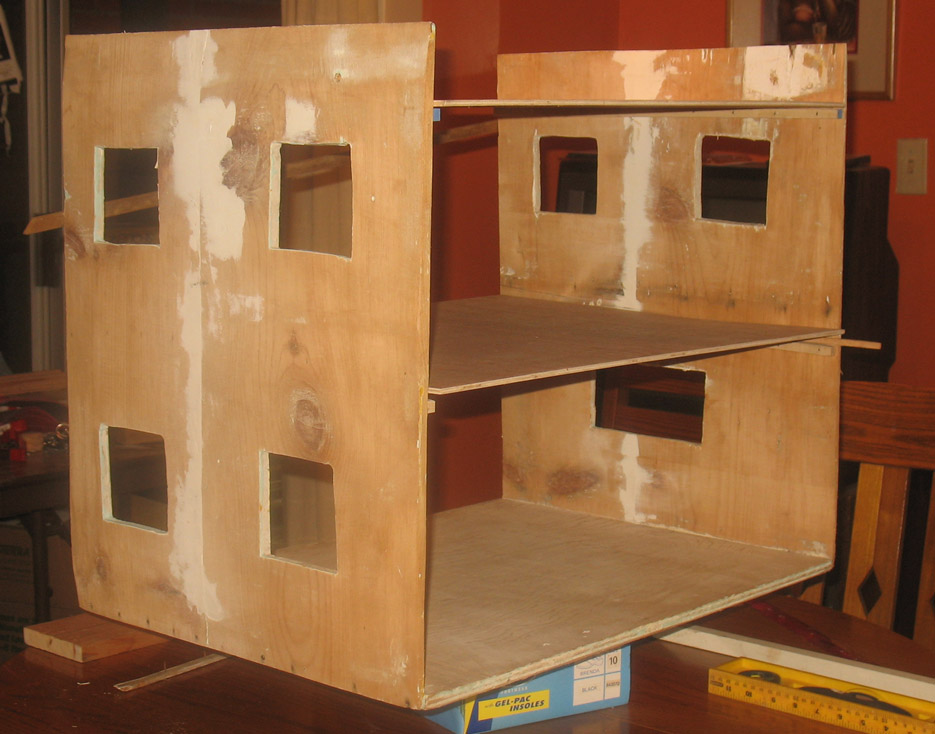
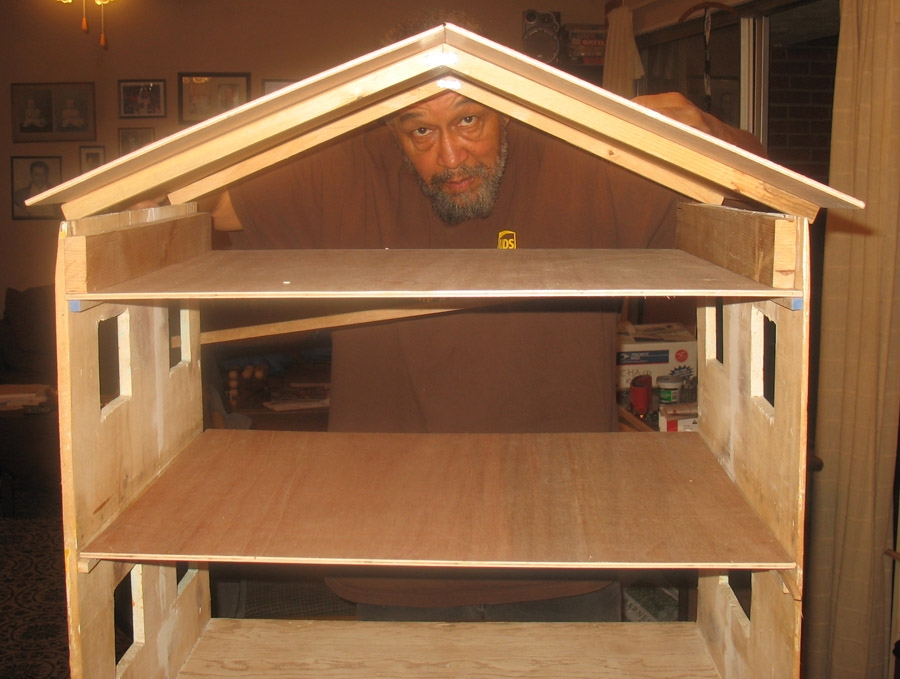
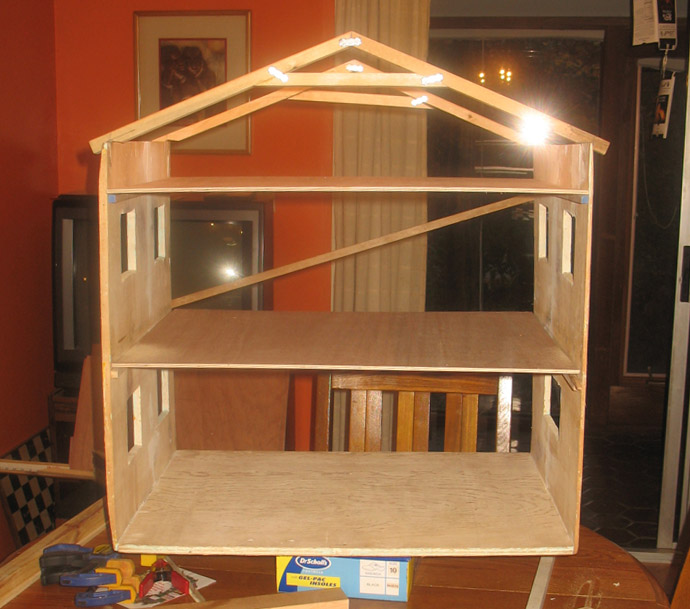
I spent some time today cutting up several 12 X 12 inch self-stick “wood”vinyl tiles in to small strips and sticking them on the dollhouse living room floor. Voila! A hardwood floor. I have a “ceramic” vinyl square for the kitchen. I should cut it up into different sized pieces and lay it our like our floor is, but I might leave it as one piece. I am going to panel one wall in the front room, so tomorrow I’ll cut longer pieces for that.
The roof is going up. The stairs are ready to go in. The plexiglass for the windows has to be cut and the molding that goes around them cut to size and painted. Shutters have to go up. A few interior walls and half walls need to go in. A few walls need to be painted, some touching up and then the furniture and curtains can go in. I still have to make the dolls that will live there, a pleasant older couple with a bunch of children and grandchildren who live in a box and come out for birthdays and the holidays. Maybe someone will live in the attic.
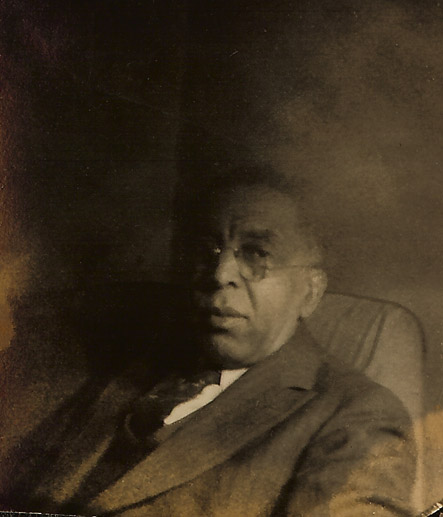
Eliza was also owned by Col. Harrison. Her mother, Annie Williams, was born in Virginia. I am trying to figure out if any information in this article can help me in my research. The Montgomery Advertiser, Wednesday Morning, November 14, 1917
“Old Charles,” Faithful Servant For Almost a Century, Passes Away
Charles Leftwich, born into slavery in “Old Virginny,” at Lynchburg in 1831, in early manhood sold to a new master and carried to bondage to Lowndes County, Ala. died here November 7 at four score years and six. His death was mourned by white and black alike. He heard the “angel voices calling”, and in death as in life, ever obedient, he answered the call. In youth, In young manhood, in middle life, and finally while body was bent and head hung low, as those who knew him say, he was loving, faithful, and true. “Old Charles” is no more, but through the avenue of almost a century he walked among friends he made because of his deeply affectionate nature and entire faithfulness.
Servant of Col. Harrison
As a slave and faithful and devoted servant of Colonel Edmund Harrison, of Lowndes County, when the war broke out Charles was selected by his master as a body guard for the latter’s son-in-law Winston Hunter, when the young man began his service in the Confederate States Army.
Through the blazing heat of Summer, in the sleet, slush, ice, and bitter winds of Winter, for four long and trying years, while the confederacy’s fortunes lay in the troubled balance of the great Civil War, steadfast and true the faithful negro served his warrior master. It was but natural that a peculiarly strong affection bound the two together, a bond of attachment none the less strong because of any difference of color, it is said.
Return To Old Home
After the war and Charles was free, he returned to the plantation of Colonel Harrison as to his natural home, and there remained until the death of the older master. Throughout the trying days of the reconstruction immediately following the war there was no change in the former slave. Day and night he remained true to those who had been good to him, an every ready protector of the women and children in the times that tried men’s souls.
Sorrow stricken after the death of others to whom he was so attached, after the death of “ol morster”, Charles came to Montgomery. Events changed others – but not Charles, for into life, in ease and in plenty, in privation and in misery, this man with a black skin but a spotless character plodded his humble way as nobly within the city’s gates as he had for many years out where the birds twittered and the balm of the Southern sunshine itself ever the silken corn and fields of snowy cotton.
Served in Kessler Family
About ten years before his death “old Charles” began service with Mr. And Mrs. W.D.C. Kessler. He soon became so attached to the Kesslers’ first born, then a baby boy, that he was installed as a nurse. Then this splendid character proved as good a nurse as the gentlest woman. To other boys were born to the Kesslers, and as each came Charles took him in charge, and guarded them as only he could do. all of the children were devoted to him and his pride and affection for them were beautiful evidences of his own great goodness. He wold often say that it was his only desire that he should live long enough for “his boys” to remember him so well that never would they forget him. That this wish is daily gratified there are several who will attest.
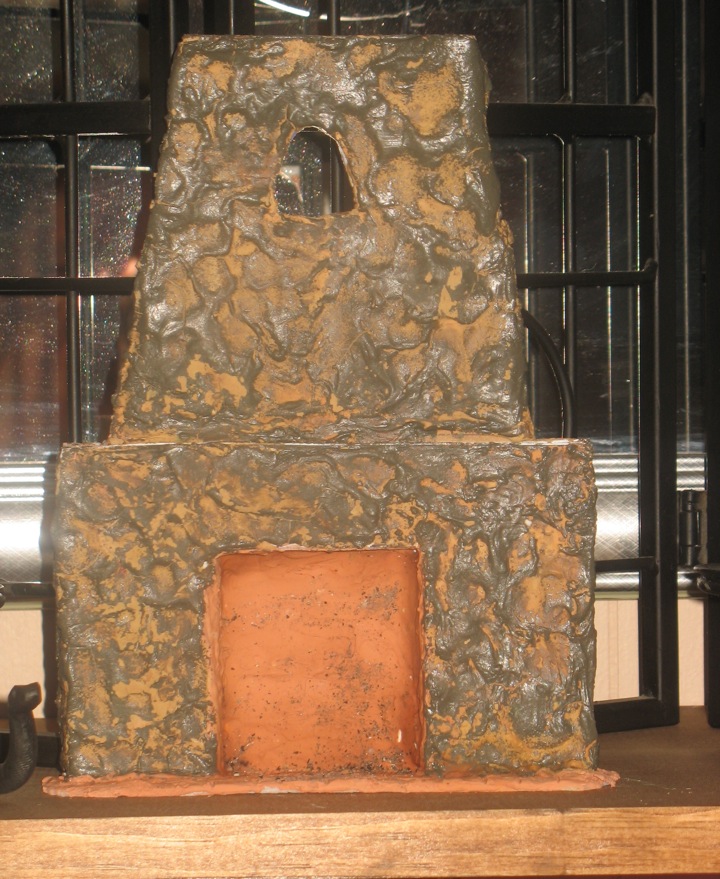
This dollhouse is turning out to have features from several of our real houses. Yesterday I made a fireplace modeled after the fireplace in our Idlewild house. I still need to add the mantel and the picture of the Virgin of Guadalupe and logs, of course.
I used a modeling compound made from toothpaste, white glue, corn starch and water. I got the color with food coloring added to the compound and then rubbed some paint that we used to do the dollhouse roof to make it look more stone like. And threw in a few real ashes for realism.
Jim has been painting and cutting and nailing and there will be more photos soon.
Yesterday I received a very important hint in the comment section from Angella Lister of 37 Paddington. She suggested that I post my photographs larger. I responded that I had tried but they would overlap the other column if I made them x-large. She pointed out that I could make the columns wider by going to design/columns. Voila, bigger columns and bigger photos! I’ve spent today going back to older posts and enlarging the photographs. I love it!
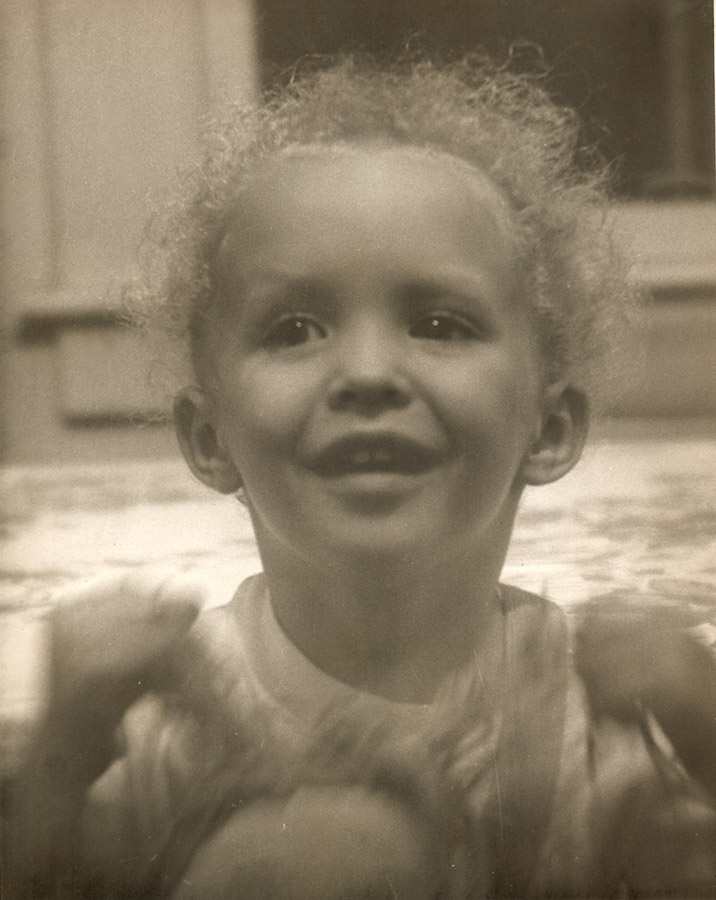
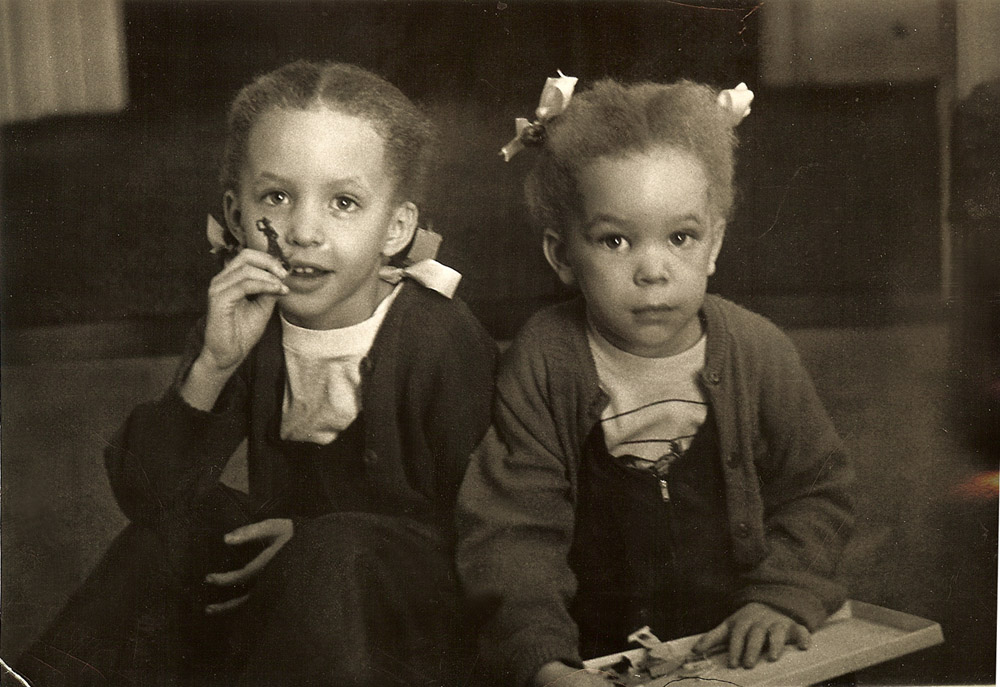
Me at age 3, 1949. Photograph taken by Henry Cleage.
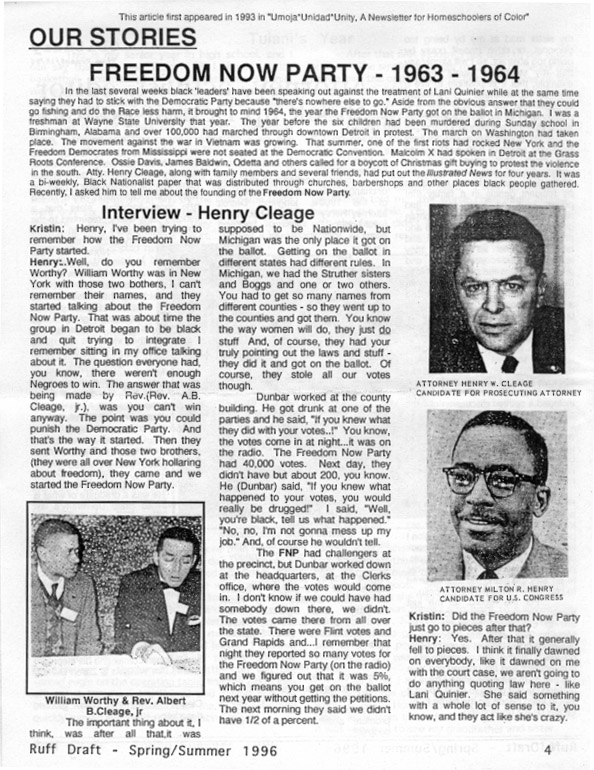
After writing about politics in my childhood yesterday, I remembered this interview I did with Henry in 1993 about the Freedom Now Party and decided to run it today. Scroll down for an easier to read transcription of the article. There are several corrections. Did I not fact check in those days?!
This article first appeared in 1993 in “Umoja * Unidad *Unity, A Newsletter for Homeschoolers of Color”
Our Stories
Freedom Now Party – 1963 – 1964
In the last several weeks black “leaders” have been speaking out against the treatment of Lani Guinier while at the same time saying they had to stick with the Democratic Party because “there’s nowhere else to go.” Aside from the obvious answer that they could go fishing and do the Race less harm, it brought to mind 1964, the year the Freedom Now Party got on the ballot in Michigan. I was a freshman at Wayne State University that year. The year before, the six children (Correction: 4 girls were killed, not 6) had been murdered during Sunday school in Birmingham, Alabama and over 100,000 had marched through downtown Detroit in protest. (Correction: the march took place before the bombing.) The March on Washington had taken place. The movement against the war in Vietnam was growing. That summer, one of the first riots had rocked New York and the Freedom Democrats from Mississippi were not seated at the Democratic Convention. Malcom X had spoken in Detroit at the Grass Roots Conference. Ossie Davis, James Baldwin, Odetta and others called for a boycott of Christmas gift buying to protest the violence in the south. Atty. Henry Cleage, along with family members and several friends had put out the Illustrated News for four years. It was a biweekly Black Nationalist paper that was distributed through churches, baber shops and other places black people gathered. Recently, I asked him to tell me about the founding of the Freedom Now Party.
Interview – Henry Cleage
Kristin: Henry, I’ve been trying to remember how the Freedom Now Party started.
Henry: Well, do you remember Worthy? William Worthy was in New York with those two brothers, I can’t remember their names, and they started talking about the Freedom Now Party. That was about the time the group in Detroit began to be black and quit trying to integrate. I remember sitting in my office talking about it. The question everyone had, you know, there weren’t enough Negroes to win. The answer that was being made by Rev. (Note: Rev. A.B. Cleage Jr.) was you can’t win anyway. The point was you could punish the Democratic Party. And that’s the way it started. Then they sent Worthy and those two brothers, they were all over New York hollering about freedom, they came and we started the Freedom Now Party.
The important thing about it, I think, was after all that, it was supposed to be nationwide, but Michigan was the only place it got on the ballot. Getting on the ballot in different states had different rules. In Michigan we had the Struther sisters and Boggs and one or two others. You had to get so many names from different counties – so they went up to the counties and got them. You know the way women will do, they just do stuff. And, of course, they had yours truly pointing out the laws and stuff – they did it and they got on the ballot. Of course they stole all our votes though.
Dunbar worked at the county building. He got drunk at one of the parties and he said, “If you knew what they did with your votes…!”
You know, the votes come in at night. It was on the radio. The Freedom Now Party had 40,000 votes. Next day, they didn’t have but about 200, you know.
He, Dunbar, said, “If you knew what happened to your votes, you would really be drugged!”
I said, “Well, you’re black, tell us what happened.”
“No, no, I’m not gonna mess up my job.” And, of course, he wouldn’t tell.
The FNP had challengers at the precinct, but Dunbar worked down at headquarters, at the Clerks office, where the votes would come in. I don’t know if we could have had somebody down there we didn’t. The votes came there from all over the state. There were Flint votes and Grand Rapids and…I remember that night they reported so many votes for the Freedom Now Party, on the radio, and we figured out that it was 5%, which means you get on the ballot next year without getting the petitions. The next morning they said we didn’t have 1/2 of a percent.
Kristin: Did the Freedom Now Party just go to pieces after that?
Henry: Yes. After that it generally fell to pieces. I think it finally dawned on everybody, like it dawned on me with the court case, we aren’t going to do anything quoting law here. Like Lani Guiner. She said something with a whole lot of sense to it, you know, and they act like she’s crazy.
Week 46. Politics. What are your childhood memories of politics? Were your parents active in politics? What political events and elections do you remember from your youth?
My sister and I – 1952
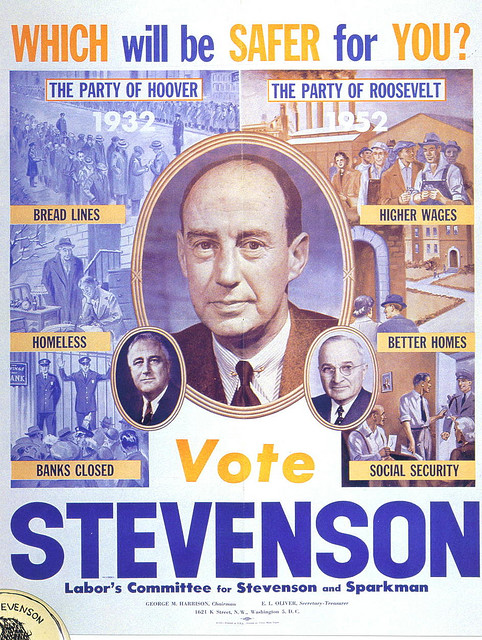
My first memory of politics is the 1952 presidential campaign. My parents supported Adlai Stevenson and I remember waking up the day after the election and asking who won. I was quite disappointed when I found it was not Stevenson.
Hopefully it’ll get a coat or two of paint tomorrow. Maybe Monday the floors will get done. I’ve got to decide where the inside walls and the stairs will go.
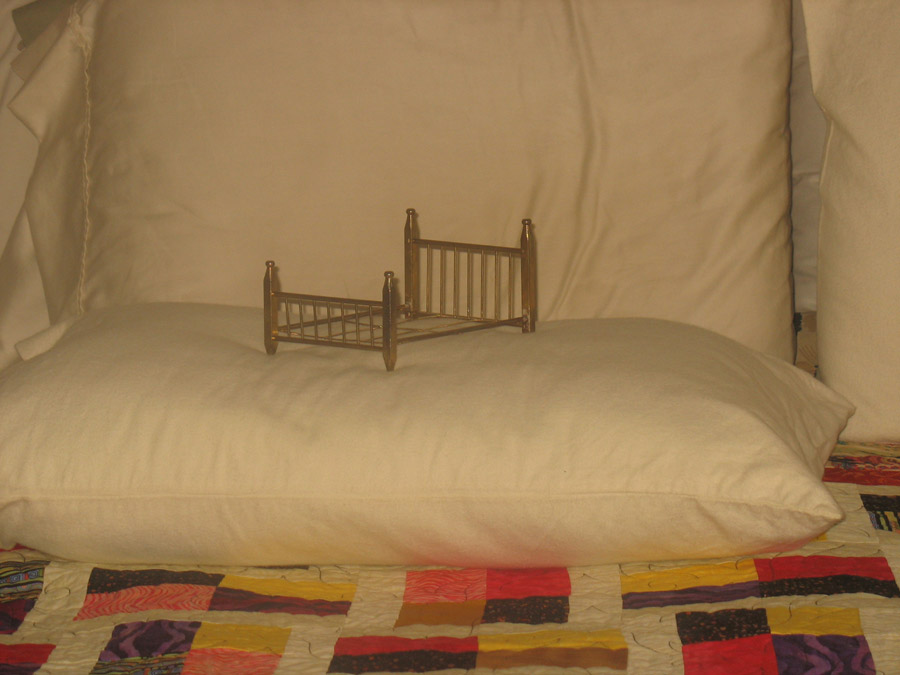
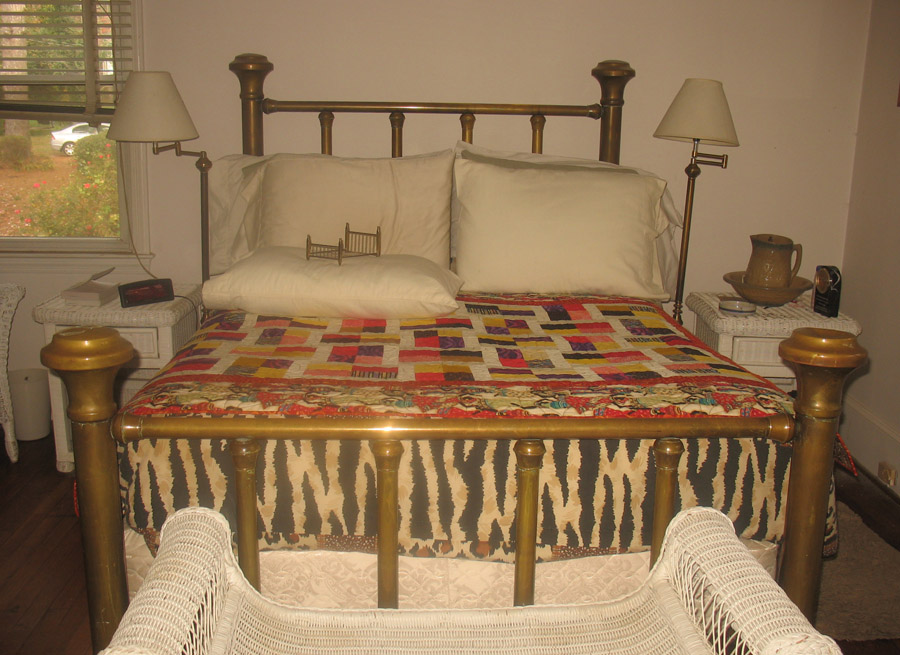
A brass bed that I got this week because…
It looks like the brass bed that Poppy bought soon after he married. He was, the story goes, he was walking down the street when he saw a brothel being evicted and the belongings being set out on the street. This wonderful brass bed was among the items and he bought it on the spot. Growing up we – sister and cousins – spent many happy hours playing in my grandfather’s room. We used to be able to slip between those brass bars at the foot of the bed. My sister Pearl has the big bed now. That’s my mini brass bed on the pillow.
His brother, Harold, always calls my husband, James, on Veterans Day. Harold said that it was a long time ago and the memories almost don’t bother him now. Almost. Harold’s hands still bleed sometimes from the Agent Orange. Both agreed they’d take “Option B” if they had it to do over again.
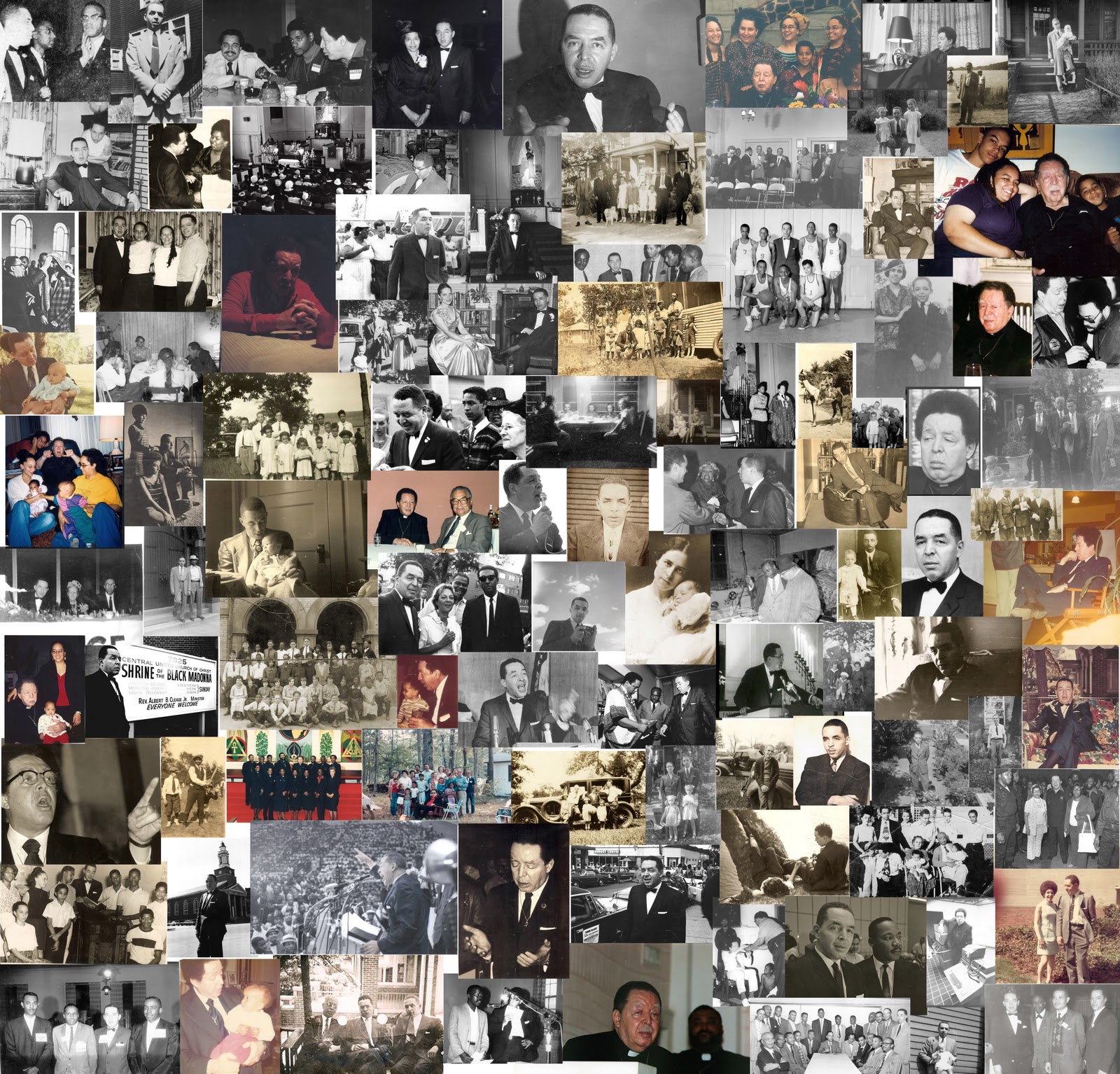
In 2009 Alan Burnett and Kate Mortensen founded Sepia Saturday. This week we celebrate it’s 100th week of existence. I contributed my first post to Sepia Saturday #48 on November 7, 2010. Since then I have usually been a “themer” and enjoy coming up with something from my family photograph collection related to whatever theme Alan comes up with each week. I also enjoy seeing what others come up with. I have chosen to celebrate the occasion by posting 100 photographs of my father, who would have been 100 years old this year.
Obituary from: The New York Times – U.S.
______________________________________
Albert Cleage is Dead at 88; Led Black Nationalist Church
Published February 27, 2000
Bishop Albert B. Cleage, who after the urban riots of the 1960’s built his Detroit church, the Shrine of the Black Madonna, into an important center for black theology and political power, died on Feb. 20 in Calhoun Falls, S.C. He was 88.
Bishop Cleage died while visiting Beulah Land, his church’s new farm, where he planned to raise food for the needy and give city youths peaceful summer vacations.
The bishop, who changed his name in the early 1970’s to Jaramogi Abebe Agyeman, presided for more than three decades at the Shrine of the Black Madonna, originally a Congregational church. The change came in the late 1960’s.
There were other black secessionist churches but Bishop Cleage’s became one of the biggest and most influential emphasizing black interpretations but retaining some traditional Protestant teachings.
Bishop Cleage was also drawn to politics. in 1973, Black Slate Inc., his political organization, helped Coleman A. Young become the first black mayor of Detroit, and the bishop was important in the careers of United States Representative Carolyn Cheeks Kilpatrick, Democrat of Michigan; former United States Representative Barbara-Rose Collins; and blacks who ran for smaller offices.
“He taught me the importance of organizing,” Ms. Kilpatrick said, “and he created networks of political activists that continue to have a profound impact on Detroit’s political landscape.”
Bishop Cleage became a focus of national attention during the 1967 Detroit riot, when 43 people were killed, and in the turbulent years afterward. Splitting with both the white power structure and more moderate black leaders, he emphasized black separatism in economics, politics and religion.
“The basic problem facing black people is their powerlessness,” he said. “You can’t integrate power and powerlessness.”
Trying to counter what he saw as white domination of religion, Mr. Cleage espoused a gospel of black nationalism. He installed a larger-than-life painting of a black Madonna holding a black baby Jesus, radical for its time, and preached that Jesus was a black revolutionary whose identity as such had been obscured by whites.
“That was the beginning of a whole new religious iconography” said Menelik Kimathi, chief executive officer of the Shrine of the Black Madonna. Mr. Kimathi, who joined a shrine youth group 30 years ago, added, “I think his legacy will be that he founded black liberation theology, the idea that the church could be more relevant to the day-to-day concerns of the community.”
The Rev. Jim Holley, pastor of Little Rock Baptist Church in Detroit, said: “He brought a black consciousness to the church community like it never had been brought before. And it translated into politics.”
In 1968, Life magazine called Bishop Cleage one of “the men who are speaking to black America,” along with Jesse Jackson, Julian Bond, Eldridge Cleaver and Dick Gregory.
The bishop was national chairman of the Black Christian Nationalist Church, an umbrella organization for similar churches, and he wrote “The Black Messiah” (1969) and “Black Christian Nationalism”(1972).
Albert Cleage was born in Indianapolis on Jun 13, 1911. his physician father moved the family to Detroit, and in 1937 the son received a sociology degree from Wayne State University. He received a divinity degree from Oberlin College, then served churches in Lexington Ky.; San Francisco; and Springfield, Mass. In 1951, he became pastor of St. Mark’s Community Church in Detroit, and two years later he formed the Central United Church of Christ, which later became the shrine.
Though he had believed in integration — some of the churches he served were racially mixed — Bishop Cleage came to despair of the hope that whites would ever willingly help blacks advance. He also befriended Malcolm X, the Muslim leader, who had Michigan roots.
Bishop Cleage’s vision of a church reemphasized social service programs reached out to young people and marched for civil rights. He organized black-owned businesses like grocery stores and bookstores, and built hundreds of units of housing.
All this activity made him frightening to many whites.
“When we take over, don’t worry,” he once responded. “We’ll treat you like you treated us.”
He later founded other shrines, including major ones in Atlanta and Houston. Today, Mr. Kimathi said, the church has about 50,000 members nationally.
In the 1970’s, Bishop Cleage backed out of the national spotlight to concentrate more on church programs and working with young people. In the late 80’s and much of the 90’s, he lived in Houston, then returned to Detroit.
Bishop Cleage married Doris Graham in 1943; they divorced in 1955. His survivors include their two daughters, Pearl Cleage of Atlanta and Kristin Williams of Idlewild, Mich.; three sisters; a brother; seven grandchildren, and one great-grandchild.