Alixe Harris

The Emancipator Sat. Mar. 2, 1918

Missionary Club Meets

“On Monday evening of this week the Woman’s Missionary Club of the First Congregational Church of this city, met at the home of Mrs. Jennie Turner, 712 East Grove Street. A delicious luncheon was served. The club is working enthusiastically to raise funds to send delegates to the Alabama State Association of the Congregational Church which meets at Talladega College, Talladega, Ala., in March. Mrs. Ruby Washington and Mrs. Alexis Harris were appointed delegates.”

___________________

The Emancipator Sat Jun 19, 1920.  Part of Rev. E.E. Scott’s obituary.

“Among the out-of-town friends attending the funeral of Rev. E.E. Scott here Monday were Mrs. Dillard of Selma; Mr. Farley, Beloit, Ala.; Mr. and Mrs. McCarroll, Shelby, Ala.; Rev. Jones, Cotton Valley Dean O’Brien, Mr. Fletcher of Talladega, Ala. Mrs. Alexis Harris, Detroit, Mich; Mrs. McKinney, Halzelhurst, Miss., and others.”

The first mention of Mrs. Alexis Harris that I noticed was in an account of Rev. E. E. Scott’s funeral. She returned from Detroit for the funeral, which was in 1920. I thought that was serious devotion to her old pastor.  I had seen her name mentioned before as one of the founders of the new Congregational Church that was started by the people from Montgomery’s First Congregational Church who migrated to Detroit.  I have a copy of this photograph that includes my grandfather, Mershell C. Graham and in front of him, Mrs. Alixe Harris. I wondered who she was and what her life was like. She became my letter “H”.

April 11, 1959. From my grandmother Fannie’s scrapbook. Newspaper unknown.

I began to research her on Ancestry and it wasn’t long before I discovered that she and Rev. E. E. Scott’s wife were sisters. That would account for her traveling from Detroit back to Montgomery for the funeral.

Alixe was born in Yazoo County, Mississippi on March 26, 1878. She was the youngest daughter of Molli Pepper, a cook.  Alixe disappears from the record until 1910 when she appears in St. Louis, Missouri as the wife of Edward A. Harris and the mother of two children, Frank and Alixe.  Edward was working as a clerk in the Post Office. They had been married in 1905.

In 1918 Alixe appears in the article in The Emancipator going to a church association meeting. Plymouth Congregational Church was founded in 1919. Both Alixe and her husband Edward signed the original document of the intention to start a church.  My grandfather, Mershell C. Graham also signed the document.

In 1920, Alixe and her family were living in Detroit. Edward managed a restaurant. The two children were teenagers and attended school. Alixe was not working outside of the house. There were four roomers sharing the house. Everybody in the house was literate.

In 1930 Edward was 53, he listed as the head of the house and worked at an auto plant as a laborer. Alixe was 52, a trained nurse and working for a private family. Their son Frank, 24, was married and working as a die maker in an auto plant. His wife was not employed outside of the home. They had an infant son, Frank Jr.  Alixe’s daughter, also named Alixe was 23 and a pharmacist in a drug store.

Also in the 1930 census, Rachel Scott, Alixe’s sister and the widow of Rev. Scott of Montgomery, was living in Detroit with her daughter Lily Bel Foster and her daughter’s husband Paul. Three of Rachael Scotts adult children, were living there also.

In 1940 The older Harris’ were living with their daughter and her husband, Bernard O’Dell. Bernard worked as a director of a recreation department, his wife Alixe was still working as a pharmacist in a drug store. Edward, who was now 64 worked as a janitor. Alixe was 62 and working as a nurse in a sanitarium. All the adults had two or more years of college.

Alixe Pepper Harris lived to be over 100 year old. She died in March, 1980.

_________________

I found this information on Ancestry.com in Census Records, Directories, Death Records, Military Records and Marriage Records. The news items were found on Newspapers.com.

Lewis GILMER

This year I am going through an alphabet of news items taken from The Emancipator newspaper, published  between 1917 and 1920 in Montgomery, Alabama.  Most are about people and places in my grandparent’s life. Each item is transcribed directly below the clipping.  Click on any image to enlarge.

_________________

Lewis Gilmer was one of my grandfather’s good friends. Annie Wimbs and my grandmother were both members of the Edelweiss Club.

The Emancipator Sat. Dec 28 1918

Wimbs-Gilmer Wedding

“On Tuesday morning at six o’clock, Miss Annie Wimbs and Mr. Lewis Gilmer, two popular young people of Montgomery, were happily married at the residence of Mrs. Josephine Curtis on So. Jackson Street. Rev. P. A. Callahan performed the ceremony. The bride is the daughter of honorable Ad Wimbs, of Greensboro, Alabama, and has been teaching in the public schools of this city. Mr. Gilmer is a highly esteemed young man and holds a responsible business position in this city. The many friends of the young couple wish them much happiness.”

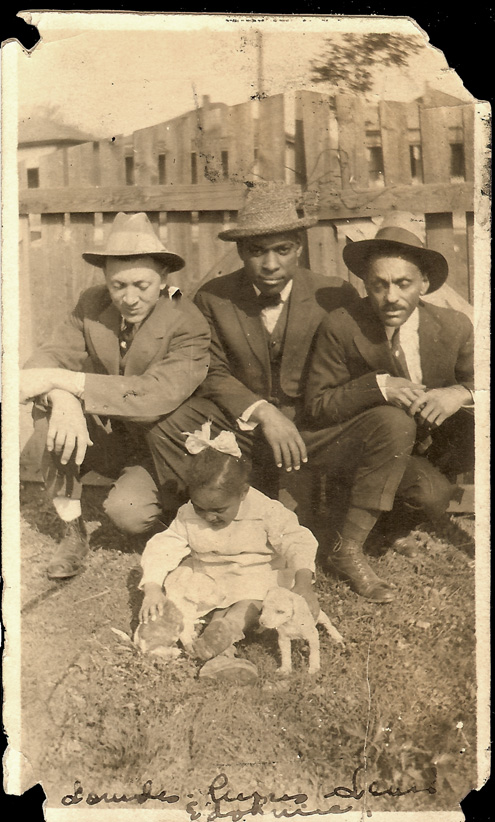
Lowndes Adams, Rufus Taylor and Lewis Gilmer, Lowndes niece Edoline with puppies.
The Emancipator Sat Oct 25, 1919.   A year later, more news! Birth of their first child, Iola.

“Mr. and Mrs. Louis Gilmer were recently made the proud parents of a little girl. Mrs. Gilmer was formerly Miss Annie Wimbs.”

Lewis Abram Gilmer was born in Montgomery, Alabama on May 18, 1885. He and his seven siblings were raised there by their parents Louis and Cornelia Gilmer.  His father was a porter, a butler and a chauffeur.    Lewis worked as a bank messenger in Montgomery.  He and his wife, Annie, had five children.  Iola was born in 1919 in Montgomery.  Cornelia was born in 1924 in Mississippi.  Ellen, Willese and Dolores were born in 1925, 1927 and1931 in Detroit.

Lewis worked as a waiter when he first came to Detroit and then as a porter in a department store. Annie worked as a teacher in Montgomery before she married and did not work outside the home afterwards. By 1930 they bought a house in the Conant Gardens neighborhood of Detroit.

Members of Lewis Gilmer’s family moved to Detroit and lived on Scotten Avenue, several blocks from my other grandparents, the Cleages who were not from Montgomery. Some of the Gilmers later returned to Montgomery.

Annie Gilmer died in 1948. Lewis lived another twenty years and died in 1969.  Their descendants are numerous and widespread.

_________________

I found this information on Ancestry.com in Census Records, Directories, Death Records, Military Records and Marriage Records. I also received some update through a descendant of the Gilmer’s who read an earlier blog post about her grandfather. The news item was found on Newspapers.com.

First Congregational Church Montgomery, Alabama

This year I am going through an alphabet of news items taken from The Emancipator newspaper, published  between 1917 and 1920 in Montgomery, Alabama.  Each item was found on Newspapers.com and is transcribed directly below the clipping.   Click on any image to enlarge.

___________

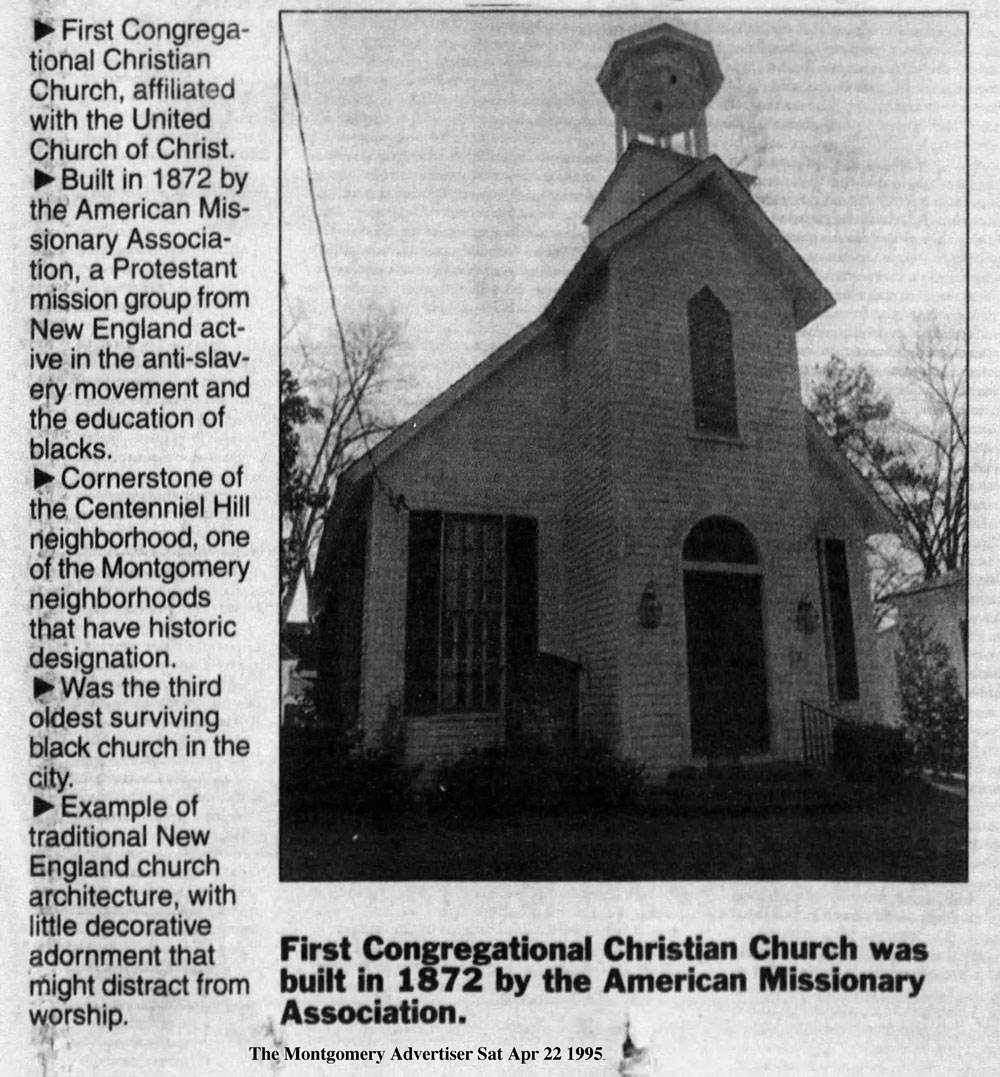
First Congregational Church was where my grandparents met and the church they attended when they lived in Montgomery.  My grandmother Fannie, her siblings and cousins also attended the school that the Congregational missionaries from the North started. It went from elementary through high school and became State Normal School.

The Emancipator – Sat – July 3, 1920

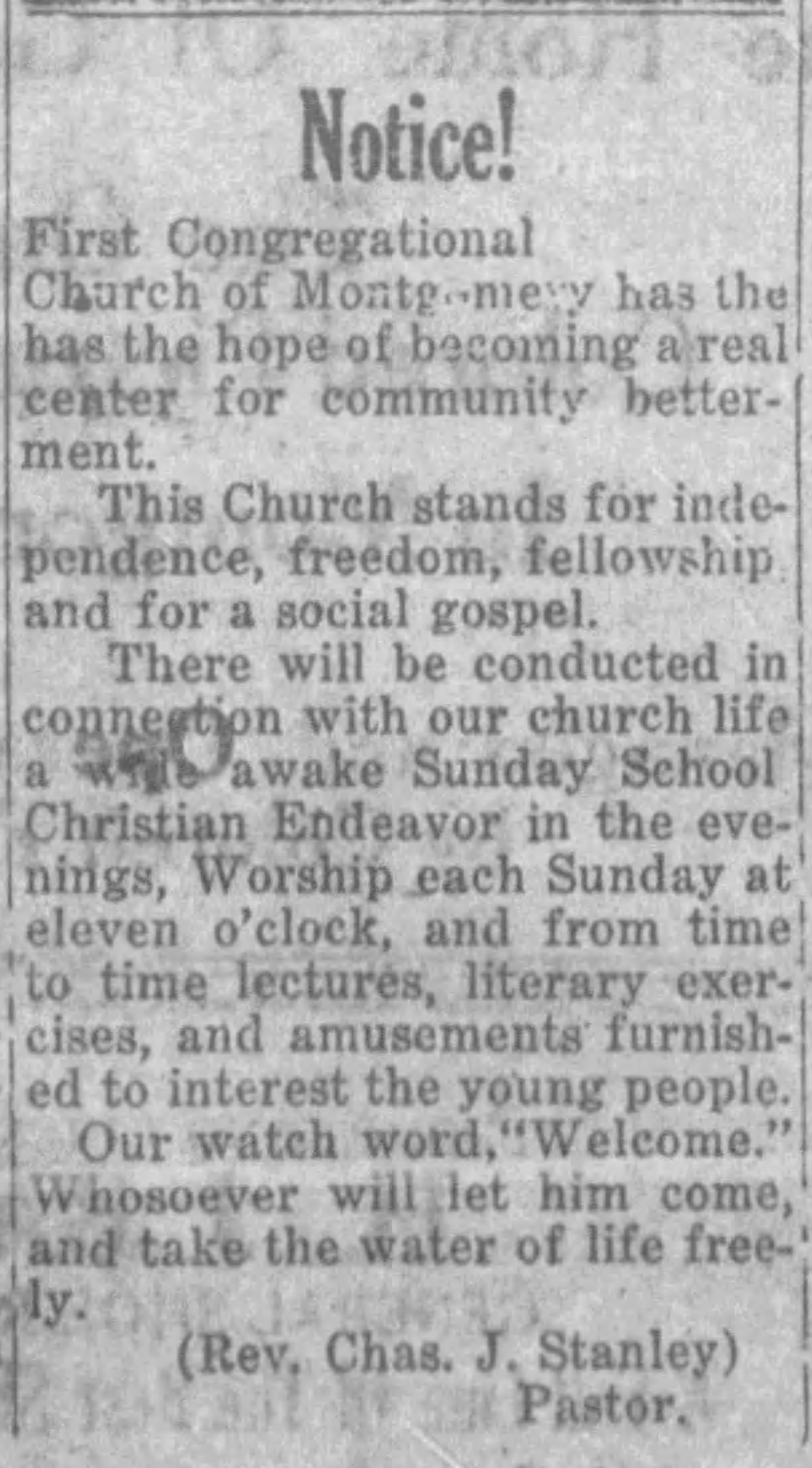
Notice!

First Congregational Church of Montgomery has the hope of becoming a real center for community betterment.

This Church stands for independence, freedom, fellowship and for a social gospel.

There will be conducted in connection with our church life a wide awake Sunday School Christian endeavor in the evenings, Worship each Sunday at eleven o’clock, and from time to time lectures, literary exercises, ad amusements furnished to interest the young people.

Our watch word, “Welcome.” Whosoever will let him come, and take the water of life freely.

(Rev. Chas. J. Stanley) Pastor.

____________________

The photograph below is of First Congregational Church, which later changed it’s name to First Congregational Christian Church, came from The Montgomery Advertiser. There is a bit of the history of the church in the sidebar.

The original building burned to the ground after a lightening strike in 1995. The congregation has rebuilt in the same spot.

Dandy, Stoudemire Wedding

This year I am going through an alphabet of news items taken from The Emancipator newspaper, published  between 1917 and 1920 in Montgomery, Alabama.  Most are about my grandparent’s circle of friends.  Each item is transcribed directly below the clipping.  Click on any image to enlarge.

________________

Herbert Lee Dandy and Queen Elizabeth Stoudemire were married by my grandparent’s pastor. They were probably also members of his church. Queen Elizabeth and my grandmother Fannie lived about four minutes apart.  Herbert and Queen Elizabeth were ten years younger than my grandparents and there is no indication that they were intimate friends.

The Emancipator_Sat_Jun_15_1918

“Dandy – Stoudemire Wedding

Mr. and Mrs. Stafford Stoudemire wish to announce the marriage of their daughter Queen Elizabeth, to Mr. Herbert Dandy, Tuesday night June, 12, 1918 at nine o’clock at their residence, 516 S. Bainbridge St. Rev. E. E. Scott officiating.”

Herbert Lee Dandy was born about 1894 in Mount Meigs, Montgomery County, Alabama.  His parents farmed rented land. Neither of them learned to read or write, but Herbert managed to attend school to the fourth grade while also working on the farm. Herbert’s mother gave birth to five children, two in a first marriage and three with her second husband, Herbert’s father. The first two boys did not live with her and her second husband. Herbert’s two full siblings were dead by 1910. By 1911, both of his parents were also dead.

According to Herbert’s WW I draft registration card, he was a tall and slender African American man with black hair and black eyes. He was working as a teamster for the Southern Ice Company.

On June 12, 1918 at age 25, Herbert married 18 year old Queen Elizabeth Stoudemire. She went by her middle name “Elizabeth” instead of “Queen”.  That August, Herbert was inducted into the army. He was out again in December of the same year.

In 1920 the young couple lived with her parents in a rented house. Elizabeth’s father, Stafford Stoudemire worked as a drayman for a wholesale grocery company. Herbert was a truck driver for the same grocery company. Elizabeth did not have a paying occupation. Her mother, Lucy, was a seamstress. Everybody in the household was literate. Elizabeth had attended school through the 8th grade.

By 1930 the Stoudemire’s were living with Herbert and Elizabeth in the house the younger couple owned. It was valued at $1,000. Over the years Herbert drove trucks, was a chauffeur, a pitman for the Alabama Power Company and finally a janitor. Elizabeth never worked outside of the house. After Mr. Stoudemire died in 1932, his widow continued to live with her daughter and son-in-law. She worked as a maid in a woman’s college and then did laundry for a private family. She died in 1943.

Herbert died in 1961. He is buried in Oakwood Cemetery in Montgomery. His wife, Elizabeth ordered a Veteran’s headstone. Elizabeth had a half brother, Reuben, who moved to Detroit for awhile but later returned to Montgomery.  She died in 1977.  They never left Montgomery, Alabama and never had children.

__________________

I found this information on Ancestry.com in Census Records, Directories, Death Records, Military Records and Marriage Records. The news item was found on Newspapers.com. I also used Google Maps to figure the distance between houses.

Clifton Graham

This year I am going through an alphabet of news items taken from The Emancipator newspaper, published  between 1917 and 1920 in Montgomery, Alabama.  Most are about my grandparent’s circle of friends. Each item is transcribed directly below the clipping.  Click on any image to enlarge.

____________

Clifton Graham was the best man at my grandparent’s wedding.

The Emancipator, Saturday, Jun 22, 1918

“Mr. Clif Graham, who has been residing in Detroit, Mich., for the the past year or more, is visiting relatives and friends in the city.”

Clifton Graham and his family were always referred to as my grandfather Mershell Graham’s adopted family.  He wasn’t raised by them and we all knew his birth family was in Coosada, Alabama. I never asked why he had adopted them as his family. I always assumed it was because he was friends with Clifton and they shared the name of “Graham”. Now everybody I could have asked is gone.

My grandfather is on the railing, Cliff is on the steps and mother Mary Graham is seated on the porch of the Graham home. 

Clifton Graham was born July 13, 1889 in Montgomery, Alabama. He was the fifth of the five children of Joseph and Mary (Rutledge) Graham – Callie, William, Joseph, Mattie and John Clifton. Four of the children survived to adulthood.

Callie married when she was 18 and remained in Perry County when the family relocated to Montgomery in the late 1880s. William disappeared after the 1880 census and never reappears. Joseph, Mattie and John moved with their parents to Montgomery.

Both Clifton and his older sister Mattie attended college for several years. He was drafted in July of 1918, married Gwendolyn Lewis the following month and was released from the army in March 1919. While Clifton was in the army and before their son was born, Gwendolyn taught school. Their first son, John Clifton Jr. was born in Montgomery. They moved to Detroit and the second son, Lewis, was born there. In the 1930 Census Clifton Graham worked as a prohibition agent. Later he continued to work for the government.

Clifton’s sister and mother also moved to Detroit. Gwendolyn’s brother, Lafayette Billingsly Lewis moved with their mother to Chicago around the same time.

__________________

I found this information on Ancestry.com in Census Records, Directories, Death Records, Military Records and Marriage Records. News items were found on Newspapers.com. I also use Google Maps. The photograph is from my family photos.

Blakley – Beckwith Marriage

This year I am going through an alphabet of news items taken from The Emancipator newspaper, published  between 1917 and 1920 in Montgomery, Alabama.  Most are about my grandparent’s circle of friends. Each item is transcribed directly below the clipping.  Click on any image to enlarge.

________________

Virgie and John were members of the same church that my grandparents attended.

“A marriage of interest to the many friends of both young people is that of Miss Virgie Dorsette Beckwith and Sergeant John W. Blakely, which was quietly solemnized Mar. 24 1919 at the home of the bride’s father, Mr. P.S. Beckwith, 517 South Street, Rev. E.E. Scott officiated, only relatives being present.

Miss Beckwith is a young woman of sterling qualities and has many friends who regret that her marriage will take her from Montgomery.

Sergeant Blakely left immediately after the ceremony for Evanston, Ill.

At home after June 10th at 1922 Wesley Ave, Evanston, Ill.”

_________________________

Virgie taught school  in Montgomery for several years before her marriage. She did not work outside of the home afterwards. The couple moved to Chicago and lived there for the rest of their lives. John continued to work as a barber until his death in 1952. Virgie died two years later in 1954. John and Virgie Blakely had no children.

I have found no siblings for John Blakely. Virgie was one of five. Four of them, moved north. Her father eventually moved north also and joined two of his children in Cleveland, Ohio. One daughter moved to Detroit and one daughter remained in Montgomery.

_______________

John W. Blakely was a friend of my grandfather, Mershell C. Graham. In 1918 about a year before his marriage, Blakely wrote the following letter to him.

Montgomery Ala Feb 27/1918

My Dear Pal;
Your letter of a few days ago was received, and I can assure you that a line from my old friend was highly appreciated.  I remember writing you some time ago and for some reason I did not hear from you until now, but failing to put my address on my letter naturally would leave you in doubt as to where to write me, all of which I am very sorry.  I was indeed glad to hear that you and the other boys were all enjoying the very best of health and that the government has used good judgment in classing all of you in class A-1 and I only want you to know that when ever you all get there, you can rest assured that you will have the opportunity of seeing me for I am now in the old city taking my examination, they passed me all OK.  So you can see it is very likely I shall soon be somewhere in a training camp, I do wish however that it was possible for me to train somewhere in the Northern camps instead of the southern camps.  I am sure you understand why.  I shall leave tonight for Atlanta where I shall wait until they are ready for me to report for duty.  I was out to see your Mother Monday afternoon.  Found her looking and feeling the very best of health and was very glad to see me and to know that I had heard from you.  Of course she is worried over the thought of you boys having to go to the army, but said that if there was no way to keep out of it, why she felt she would have to make some sacrifice which is indeed a fine spirit.  I also stopped by Gwen and her mother’s.  They were both looking fine.  She was sick when I was here Xmas so I didn’t get a chance to see her and of course you know I couldn’t leave the city without seeing the Fairest Lady of the land.  Glad to say that she is looking just fine said that she would like so much to see you.

Montgomery is as dry as a chip.  There is really nothing doing here, all of the boys of our push have gone away with the exception of four – Adams, Taylor, Gilmer and Nathan.  Mack; I wish it was possible for me to say just at present whether or not I will be able to come west or not this spring or even in the summer but as things are arranged now it is hard for me to say.  But if I am not called in to service real soon, why I shall have more time to think it over.

I am doing nicely in Atlanta.  I have the 5th chair in a 12 chair shop, which, of course is the largest shop there.  So far as getting along OK, why I really have no reason to complain, but there is a desire to have that privilege to breath for once in life one deep breath of pure free atmosphere as a man, as well as meeting again with old friends.

I wish to be remembered to Cliff and Chisholm and to you all.  I hope your every efforts will be crowned with success.

Trusting that I shall hear from you again real soon,
I am your friend,
J.W. Blakely,
#8 Central Ave.
Atlanta, GA

___________________

I found this information on Ancestry.com in Census Records, Directories, Death Records, Military Records and Marriage Records. News items were found on Newspapers.com. I also use Google Maps. The letter is from my family archives.

Announcement – 1919

This year I am going through an alphabet of news items taken from The Emancipator newspaper, published  between 1917 and 1920 in Montgomery, Alabama.  Most are about my grandparent’s circle of friends. Each item is transcribed directly below the clipping.   Click on any image to enlarge.

_____________

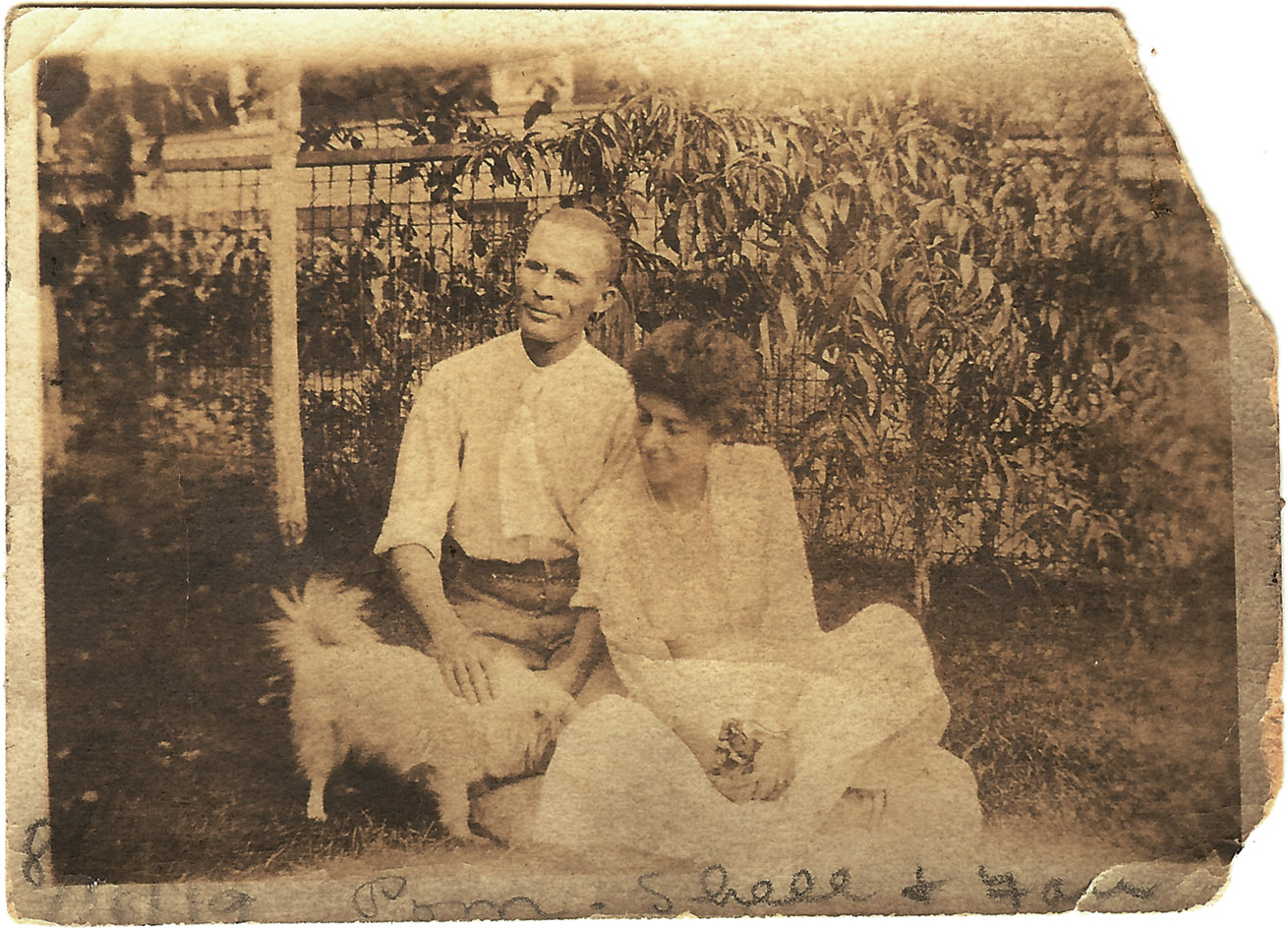
“Pom, Shell & Fan” My maternal grandparents, Mershell and Fannie (Turner) Graham. August 1919 Detroit, Michigan two months after their marriage.

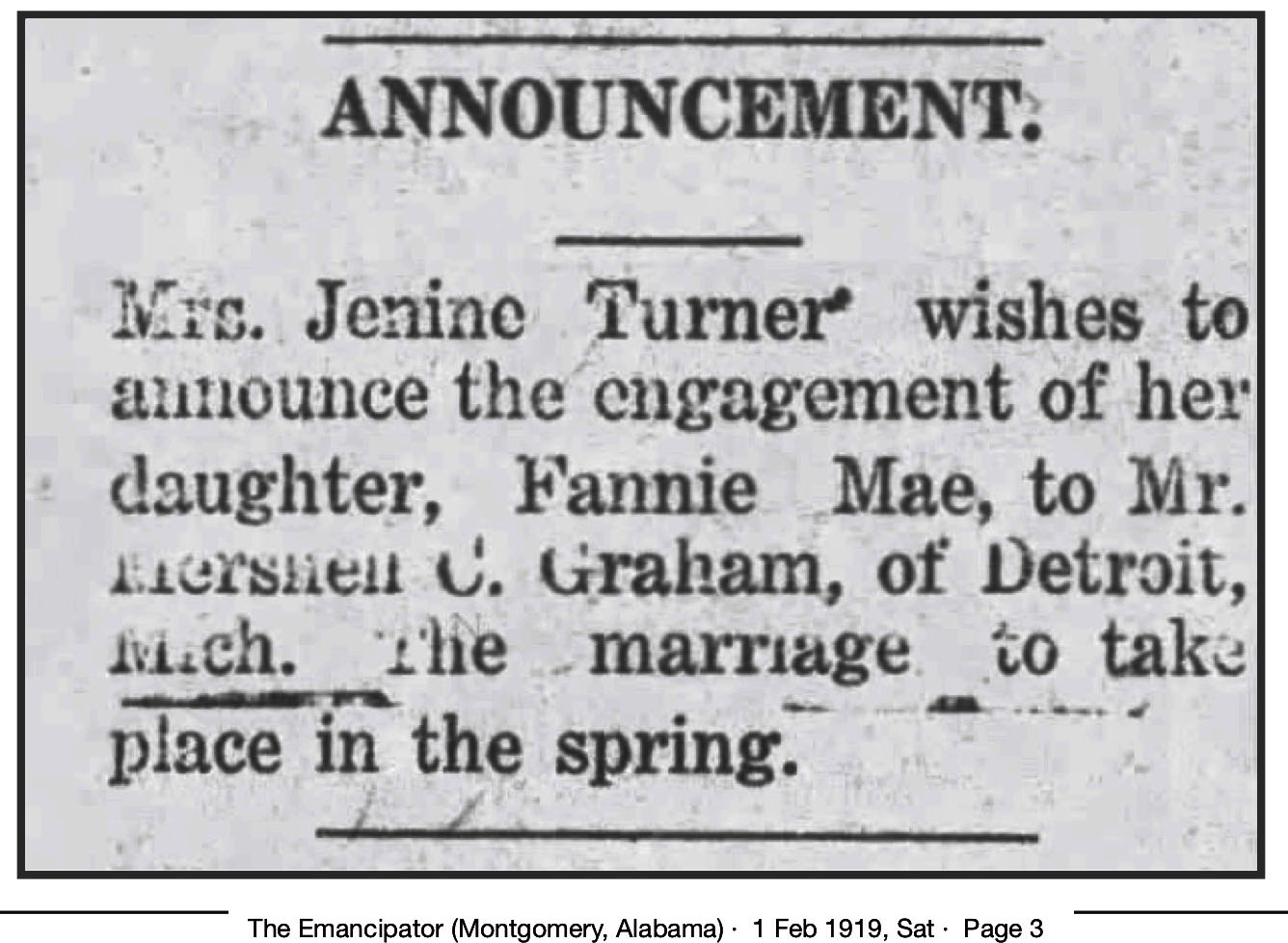
“Mrs. Jenine Turner Wishes to announce the engagement of her daughter, Fannie Mae, to Mr. Mershell C. Graham, of Detroit, Mich. The Marriage to take place in the spring”

The Wedding – June 1919
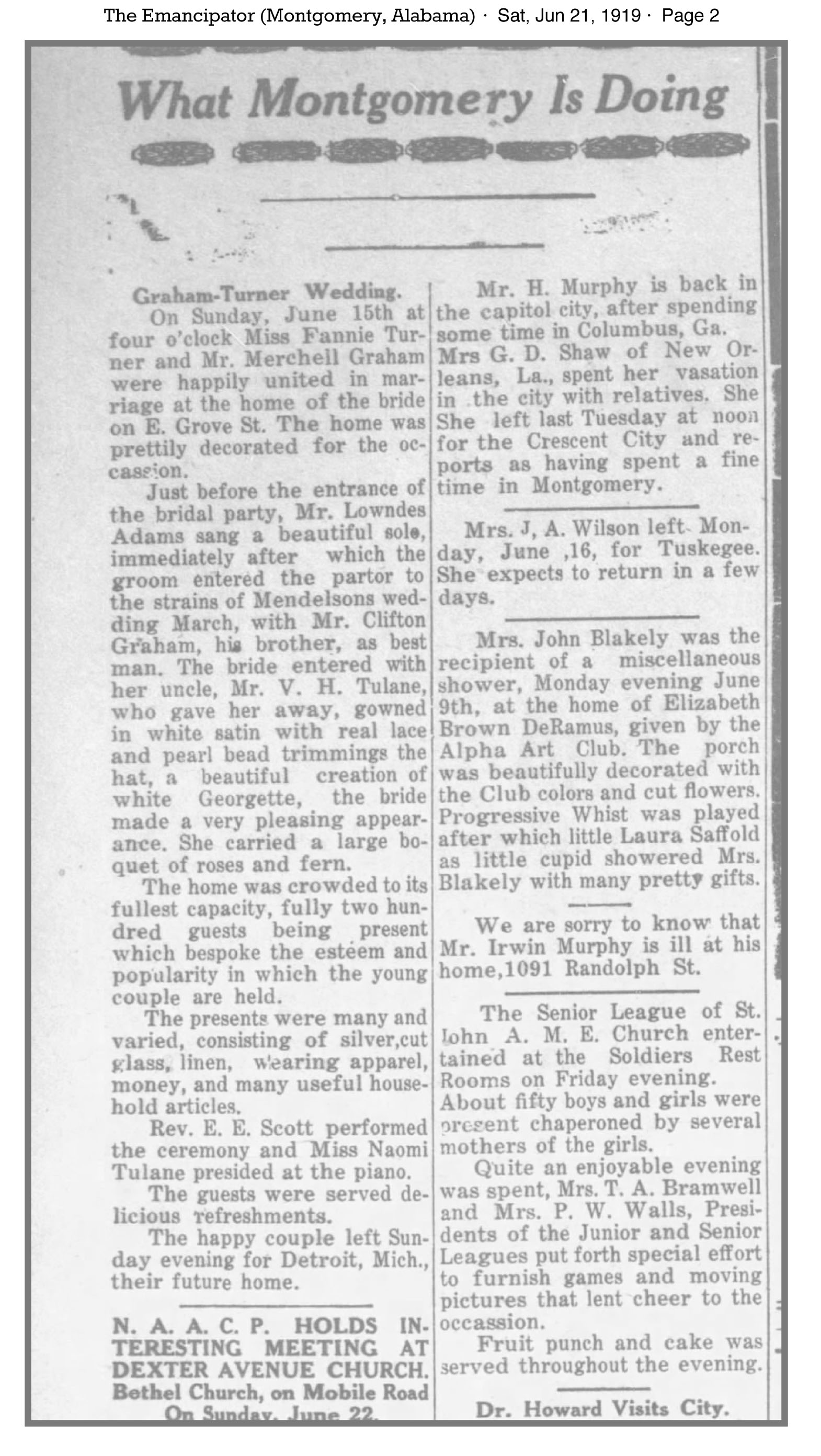
Graham-Turner Wedding

On Sunday, June 15th at four o’clock Miss Fannie Turner and Mr. Mershell Graham were happily united in marriage at the home of the bride on E. Grove St. The home was prettily decorated for the occasion.

Just before the entrance of the bridal party, Mr. Lowndes Adams sang a beautiful solo, immediately after which the groom entered the parlor to the strains of Mendelson’s wedding March, with Mr. Clifton Graham, his brother, as best man. The bride entered with her uncle, Mr. V.H. Tulane, who gave her away, gowned in white satin with real lace and pearl bead trimmings the hat, a beautiful creation of white Georgette, the bride made a very pleasing appearance.  She carried a large bouquet of roses and fern.

The home was crowded to its fullest capacity, fully two hundred guests being present which bespoke the esteem and popularity in which the young couple are held.

The presents were many and varied, consisting of silver, cut glass, linen, wearing apparel, money, and many useful household articles.

Rev. E.E. Scott performed the ceremony and Miss Naomi Tulane presided at the piano.

The guests were served delicious refreshments.

The happy couple left Sunday evening for Detroit, Mich., their future home.

Everybody mentioned in these articles will appear in this years challenge, plus a few others.

________________

I found this information on Ancestry.com in Census Records, Directories, Death Records, Military Records and Marriage Records. News items were found on Newspapers.com. I also use Google Maps. The photograph is from my family photos.
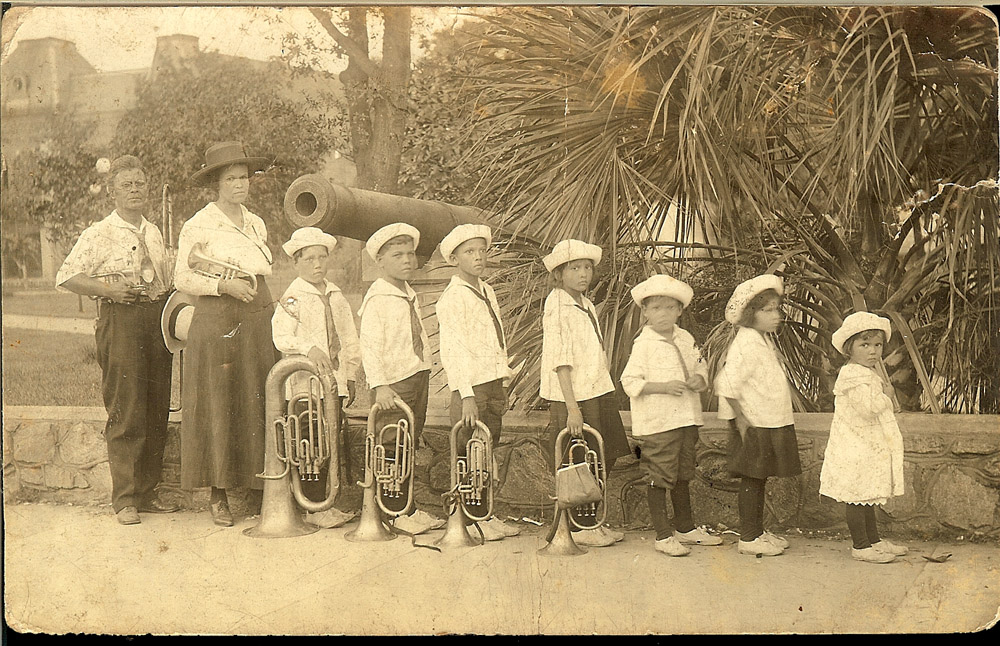
The Midget Band

"Martin Marching Band"
Edward Napier Martin, Anabel McCall Martin, and chlidren Estil Edwin, Edward Napier, Jefferson, Anna Marie, Edward McCall, Geneva, Thelma. In Florida.

This photograph is from my grandmother, Fannie Turner Graham’s album. On the back, my mother wrote “Cousins on mother’s side Annie Bell is first cousin (see her & husband on left – rest are their children!)” 

Until yesterday, I never found any information about the family band. Today I want to share two articles and what I learned from them about the family. Anna Belle is variously known as “Annie Belle”, “Anabel” and “Anna Belle”.

The Emancipator was published by James Edward McCall, Anna Belle’s brother, in Montgomery, Alabama from October 1917 to August 1920. While looking for the name “Martin” in The Emancipator, I found this item –

“Mr. and Mrs. E.M. Martin and their Midget and arrived in the city Sunday night en-route from Florida to Kentucky making the trip by road in their motor car.”

A mention of the band!   I also found when the family moved from Florida to Kentucky and that they traveled in their own car.  Next, I searched for “Midget Band”. Several articles come up, all in The Emancipator. The best was the one below, which included a photograph of the family. One thing that disturbs me about both photos is the forlorn look of all the children. Why don’t the boys in the photo below have on shoes? A barefoot marching band? Were they getting enough to eat?

In the article I found that their son, Edward McCall Martin  was born in Alabama because his father was teaching there. The article says that Edward Napier Martin had taught at the State Normal School six years before. That was the year young Edward was born – 1913.  All of the other children were born in Tennessee or Kentucky, while Edward McCall Martin was consistently listed as born in Alabama. I wondered why and how. Now I know.

Sat, Jul 5, 1919 – 7 · The Emancipator (Montgomery, Alabama) · Newspapers.com

“The musical, social and intellectual circles of the city are congratulating themselves upon the appearance of one of the most unique and highly interesting musical organizations that has ever visited Montgomery, namely Prof E.N. Martin’s Band which is composed almost entirely of midget musicians, the youngest being only three years old. It is the musical miracle of the age.

Prof. Martin, who six years ago was one of the teachers at the local Normal School, is a band master of rarest ability. He is accompanied by his wife who was formerly Miss Anabel McCall of this city, and their seven children ranging in age from three to eleven years. they are all trained musician and read notes at sight. They carry with them a brass band septette and two drums and is a revelation to listen to their music. Their director is only four years old and is a wonder. They are in the concert work and are already booked for a number of engagements in this city.

Prof. Martin’s Band carries with it many strong endorsements from some of the prominent citizens and musicians of our country. For example, Bishop Laine, founder of Laine College at Jackson, Tenn., says of them:- “I have never seen anything like this in my life, and in it I see the finest lessons in home-training that has ever come to my notice, and I have traveled all over this country.

While the band was giving an open air concert in Montgomery, some one asked of their nationality, whereupon Dr. M.B. Kirkpatrick who has offices are in the Bell Building, said “It matters not about their nationality. Just listen to the music.  It is the sweetest I have ever heard.”

They carry souvenirs from musicians of note, such as Sousa’s Band, Hawaiian Singers and others, who testify as to their talent and efficiency as musicians. Visit some of their concerts and be convinced.

Prof. Martin is a traveling representative for the Emancipator, the South’s leading Negro newspaper, which is being read all over America. This wonderful band will be in Montgomery for the next three weeks and churches or individuals wishing to have them fill engagements in near-by towns should write to Prof. E.N. Martin, 336 S. Jackson St., Montgomery, Ala. or in the care of the Emancipator.”

Other Posts about this family.

Oh, Dry Those Tears

Police Surprised “Uncle Ed”

More About Annabell’s Family

Click for more Sepia Saturday posts.

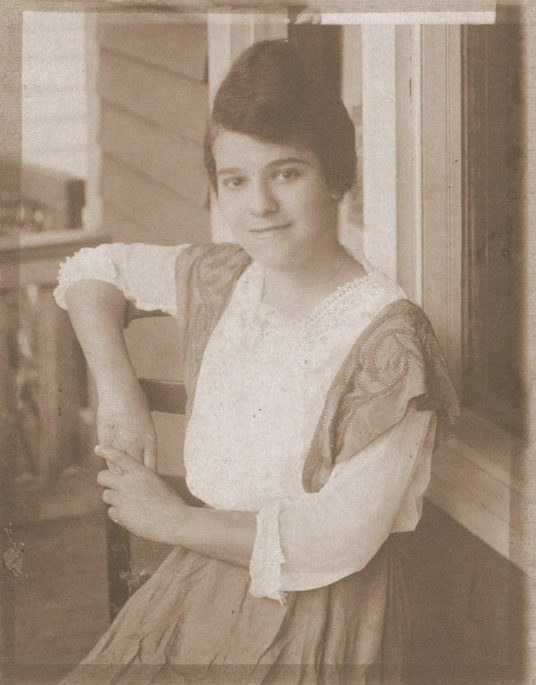
Daisy Turner and Duncan Irby

Daisy Pearl Turner, Montgomery, Alabama about 1913.

I always wondered about Duncan Irby, my Aunt Daisy’s lost love. Over the years I looked for him online, with no luck. Recently, I tried again. Lo’ and behold, I found Duncan Irby in Selma, Alabama.  There was a small item from The Emancipator. Records and more news items began to show up.

In 1980 my mother wrote her memories of family memories. They proved to be an invaluable source when I started my research. She wrote the following about her mother’s sister, Daisy Turner. Some of my mother’s memories were a bit off, but close enough that I recognized Duncan Irby when I found him.

“Maybe here a word about Aunt Daisy.  Look at her picture, sweet, soft, pretty, taught school awhile in Montgomery (with high school diploma)  loved Congregational preacher named Duncan Erby who loved her and waited for her for years.  Had the church in Buffalo, NY.  Whenever she really considered leaving, Grandmother did the old guilt trick “How can you leave me to take care of Alice all by myself?”  and “No man in this world is good enough to touch your little finger.  They are all no good except (maybe) Shell.” (note: Shell referred to my grandfather, Mershell Graham.)and Daisy listened and stayed and played numbers, studied dream books and drank a little apricot brandy.  I always found their house light, cheerful, full of magazines (McCall’s, Journal, etc.) which I loved to read, full of good things to eat.  All three were super cooks and they had always just had a bunch of friends to dinner and to play cards or just about to have.

Daisy took us downtown to the show every summer and to Saunders for ice cream afterward.  And I always ended up with a splitting headache.  Too much high living I guess.  She and Alice would buy us dainty, expensive little dresses from Siegel’s or Himelhoch’s.  They all went to church every Sunday,  Plymouth Congregational. Daisy always gave us beautiful tins of gorgeous Christmas candy, that white kind filled with gooey black walnut stuff, those gooey raspberry kind and those hard, pink kind with a nut inside, and chocolates, of course!  She loved to eat and to cook. Never seemed bitter or regretful about her lost love.”

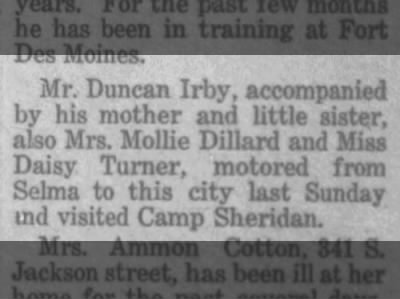
“Mr. Duncan Irby, accompanied by his mother and little sister, also Mrs. Mollie Dillard and Miss Daisy Turner, motored from Selma to this city last Sunday and visited Camp Sheridan.” The Emancipator, Montgomery, Alabama Sat. Oct 20, 1917.

Duncan Irby was five feet nine inches tall, stout, light complected with brown hair, brown eyes and freckles.

__________________

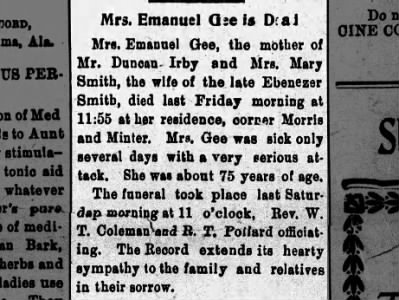
Duncan’s parents, Duncan Irby, Sr and Mary Smith were married in Selma, Alabama on Christmas Eve, 1890. Mary was the daughter of a house painter. Duncan’s mother, Emmeline Gee, inherited over 100 acres and a horse from a former enslaver Josiah Irby.  I do not know if Emmeline was enslaved on Irby’s plantation. At his mother’s death, Duncan was to inherit the property.

“Also I give and devise unto the said Emeline Gee, about fifty acres of land known as the Saw mill field, and bounded as follows to wit commencing at the point at which the P Bluff and Cahaba Road crosses the Athens and Parks Landing Road thence down the P Bluff & Cahaba Road to Chillatchie Creek at the Cahaba Bridge, thence up the said creek to a line between sections 11 and 12; thence West to Parks Landing Road; thence along said Road to the starting point in Township fourteen Range seven in Wilcox County. It is further my will and desire that at the death of the death of the said Emeline Gee, that all the land herein before desvribed and devised to the said Emeline Gee shall go to her and belong to her son Duncan. I also give and bequeath to the said Emeline Gee my Roan Horse named Tom”

After this, Duncan used the surname “Irby” instead of “Gee”. I do not know if they were allowed to take possession of the property. Both Duncan Sr and his wife Mary were literate. His mother lived with the family until her death in 1901. The Mary Smith mentioned in this article was Duncan Irby Sr’s older sister. It was very confusing to have three Marys (sister, wife and daughter) and two Duncans (father and son).

Selma Record, Selma, Alabama, Sat, Nov 9, 1901

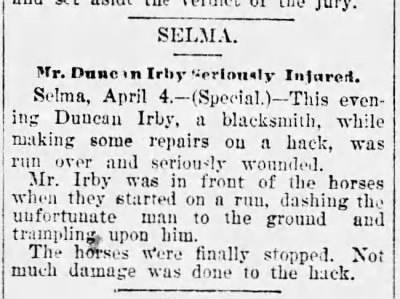
The younger Duncan Irby was born in 1892. The following year Duncan Sr, a blacksmith, suffered injuries when he was trampled by horses while making some repairs on a hack. He recovered.

Selma

Mr. Duncan Irby Seriously Injured.

“Selma, April 4.-(Special.)_ This evening Duncan Irby, a blacksmith, while making some repairs on a hack, was run over and seriously wounded.  Mr. Irby was in front of the horses when they started on a run, dashing the unfortunate man to the ground and trampling upon him. The horses were finally stopped. Not much damage was done to the hack.”   The Montgomery Advertiser Montgomery, Alabama Wed, Apr 5, 1893

Mary, Duncan Sr and Mary’s only other child, was born the following year. Both Duncan Jr and his sister Mary attended school. In 1908 they were both enrolled in  Talledega College, a boarding school,  in the College Preparatory Course. They studied Latin, Algebra, English  Literature, Ancient history and Drawing along with hands on courses in Agriculture and Wood-Turning for young men and Dressmaking and Nurse-Training for young women.

Mary became a teacher. She married Edwin Gibson, a teacher and a principal. They had one son, Edwin Gibson Jr.  They later divorced.

Duncan worked with his father in his blacksmith shop and later became a mechanic. The elder Duncan Irby died in November of 1915.

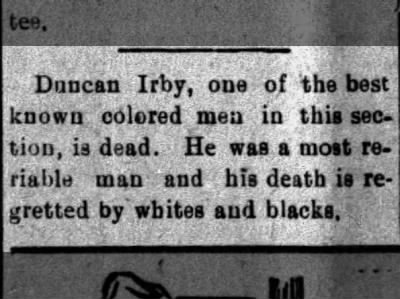
“Duncan Irby, one of the best known colored men in this section, is dead. He was a most reliable man and his death is regretted by whites and blacks.” The Selma Mirror, Selma, Alabama, Fri, Oct 15, 1915

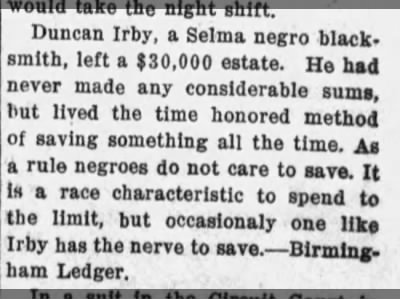
“Duncan Irby, a Selma negro blacksmith, left a $30,000 estate. He had never made any considerable sums, but lived the time honored method of saving something all the time. As a rule negroes do not care to save. It is a race characteristic to spend to the limit, but occasionaly one like Irby has the nerve to save. – Birmingham Ledger.”
Our Mountain Home, Talladega, Alabama, Wed, Oct 27, 1915

Duncan Irby senior, left everything to his wife Mary with the proviso that should she ever remarry, everything would go to their children.

Duncan Irby’s widow, Mary Irby,  remarried in 1921. She married Rev. Marshall Talley and that is where my mother got the minister. The family relocated to Homestead, Pennsylvania. This was the move to the northeast. Duncan was 35 in 1930 and worked as an auto mechanic in Homestead.

Several years later, they all relocated to Indianapolis, Indiana. Duncan, his sister Mary, who was divorced from her husband by this time and her son Edwin Gibson Jr. formed a household. Edwin Jr  grew up to become a well known architect and the first black architect registered in Indiana.

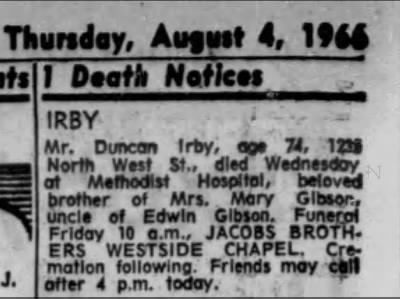
In 1966 Duncan Irby died of pneumonia brought on by lung cancer. He was 74 years old and had lived in Indianapolis for 34 years. He never married.

“Death Notices – Irby.  Mr. Duncan Irby, age 74, 1238 North West St., died Wednesday at Methodist Hospital, beloved brother of Mrs. Mary Gibson, uncle of Edwin Gibson. Funeral Friday 10 a.m., Jacobs Brothers Westside Chapel. Cremation following. Friends may call after 4 p.m. today.” The Indianapolis News, Indianapolis, Indiana, Thu, Aug 4, 1966

In writing this story I used writings by my mother, Doris Graham Cleage; Census, death, and other records from Ancestry.com and a surprising number of news stories found on Newspapers.com. I discovered I could share them by embedding them in the post and may have gone overboard.

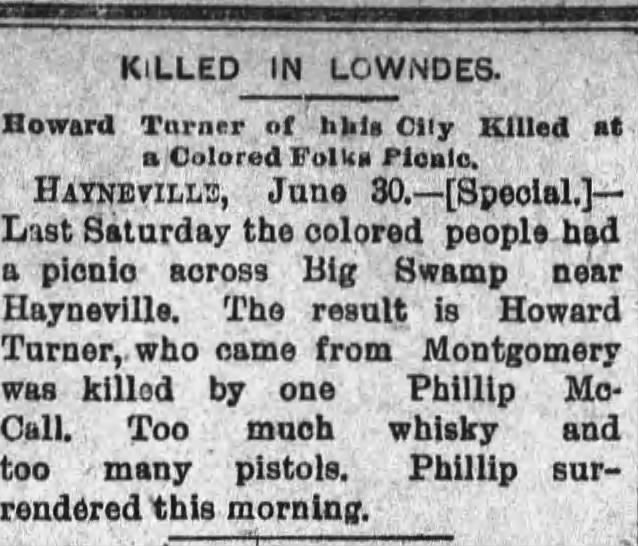
Howard Turner Killed in Lowndes County, Alabama

Killed In Lowndes

Howard Turner of This City Killed at a Colored Folks Picnic.

Hayneville, June 30. -[Special.]-  Last Saturday the colored people had a picnic across Big Swamp near Hayneville. The result is Howard Turner, who came from Montgomery was killed by one Phillip McCall.  Too much whisky and too many pistols. Phillip surrendered this morning.”  The Weekly Advertiser (Montgomery, Alabama) Thursday, July 10, 1891 Page 2

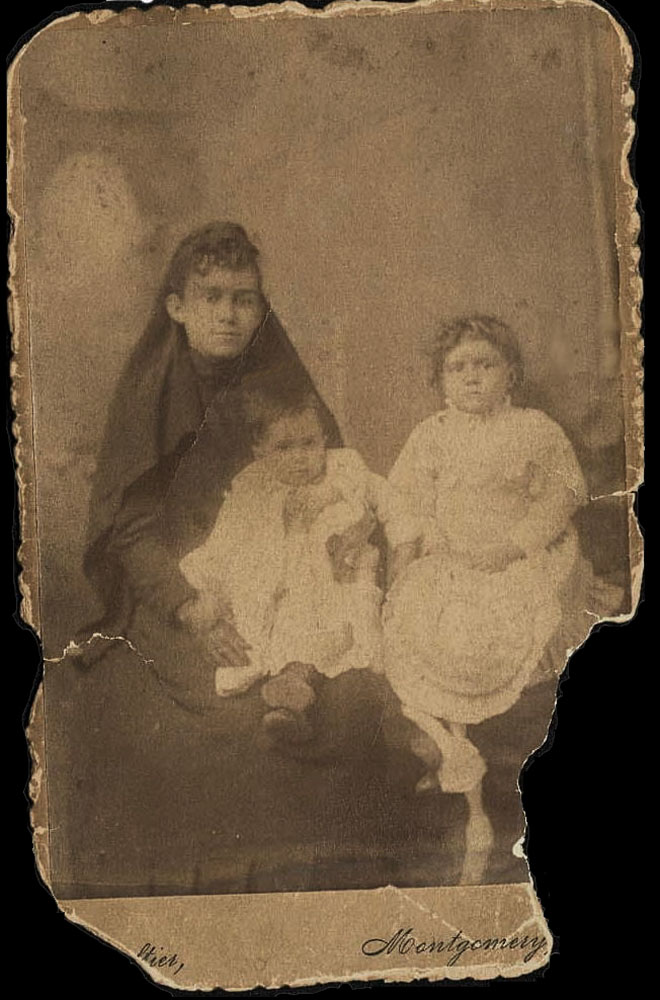
We were always told that my grandmother Fannie Turner Graham’s father was killed at a barbeque when she was four years old. After years of being unable to find any documentation, I found this news item on Newspapers. dot com today.  I was just looking for various people in the newspapers when I came across it.

Howard Turner’s widow with their daughters. Jennie Virginia Allen Turner holding Daisy Turner (my great grandmother) and my grandmother Fannie sitting there holding her hat.

I have found so much new information since I started this blog that I feel the need to go back and put it all together for the various branches. My project for 2018.