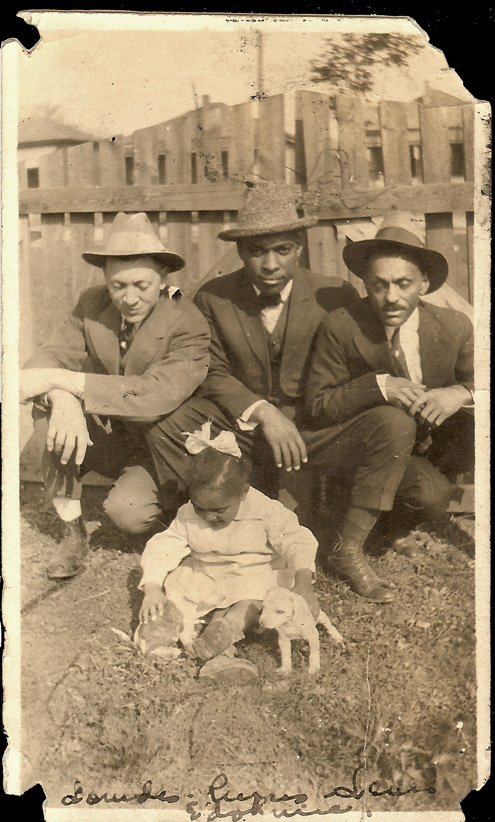
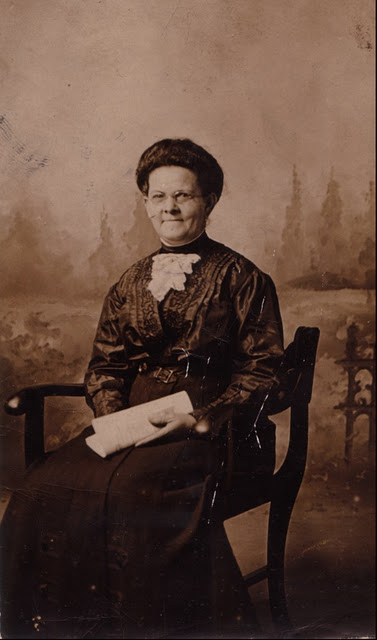
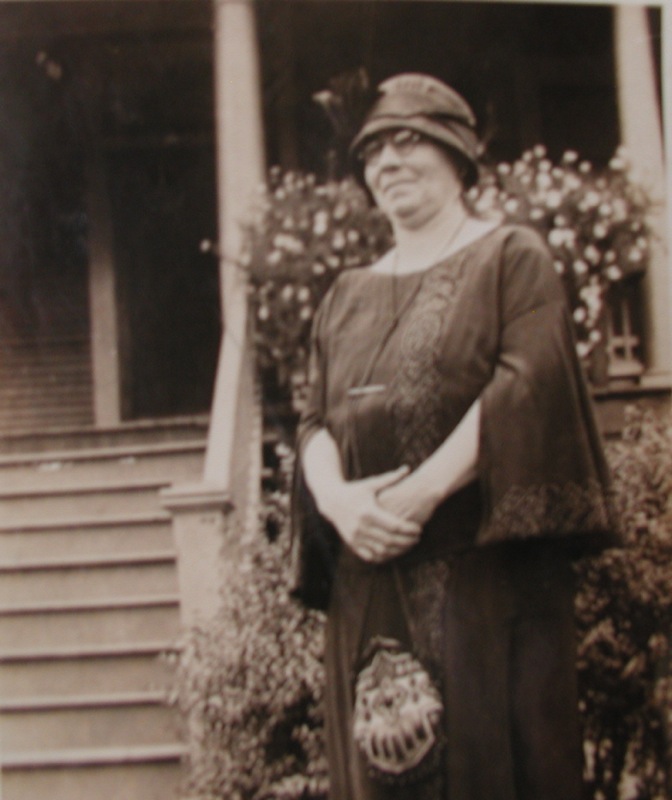
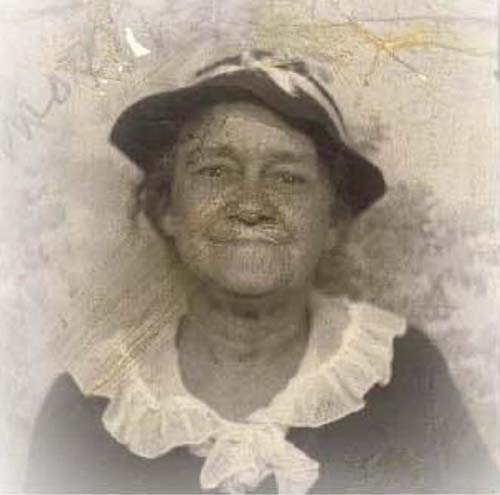
The photograph of three of my grandfather Mershell C. Graham’s friends was perfect for today’s Sepia Saturday prompt. To read about their lives, click this link – The Migration Part 3 – Those Left Behind. It turned out that some of them also left Montgomery, AL and moved north.
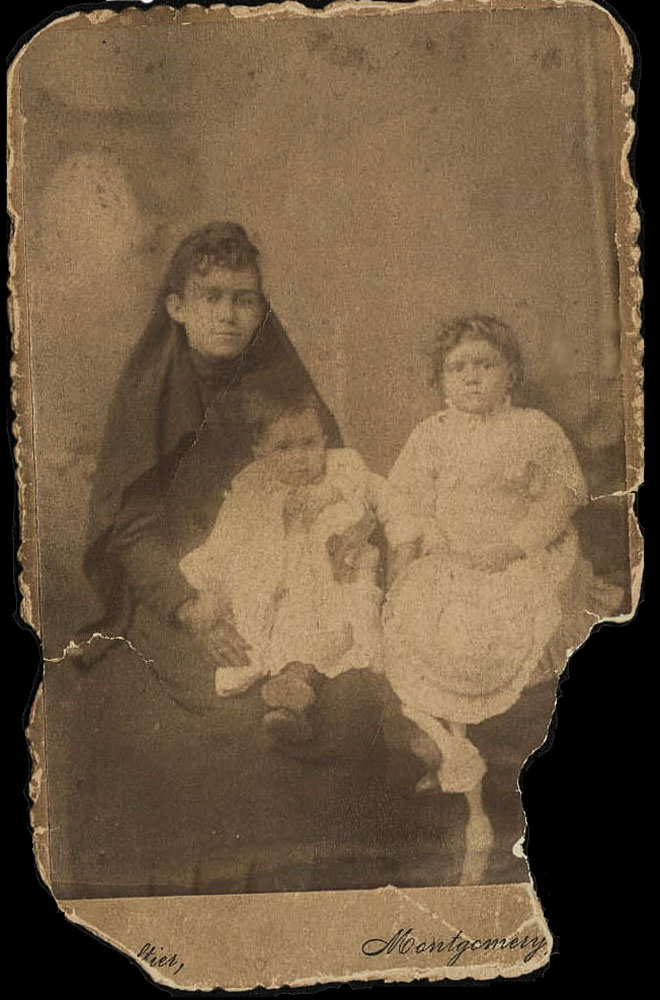
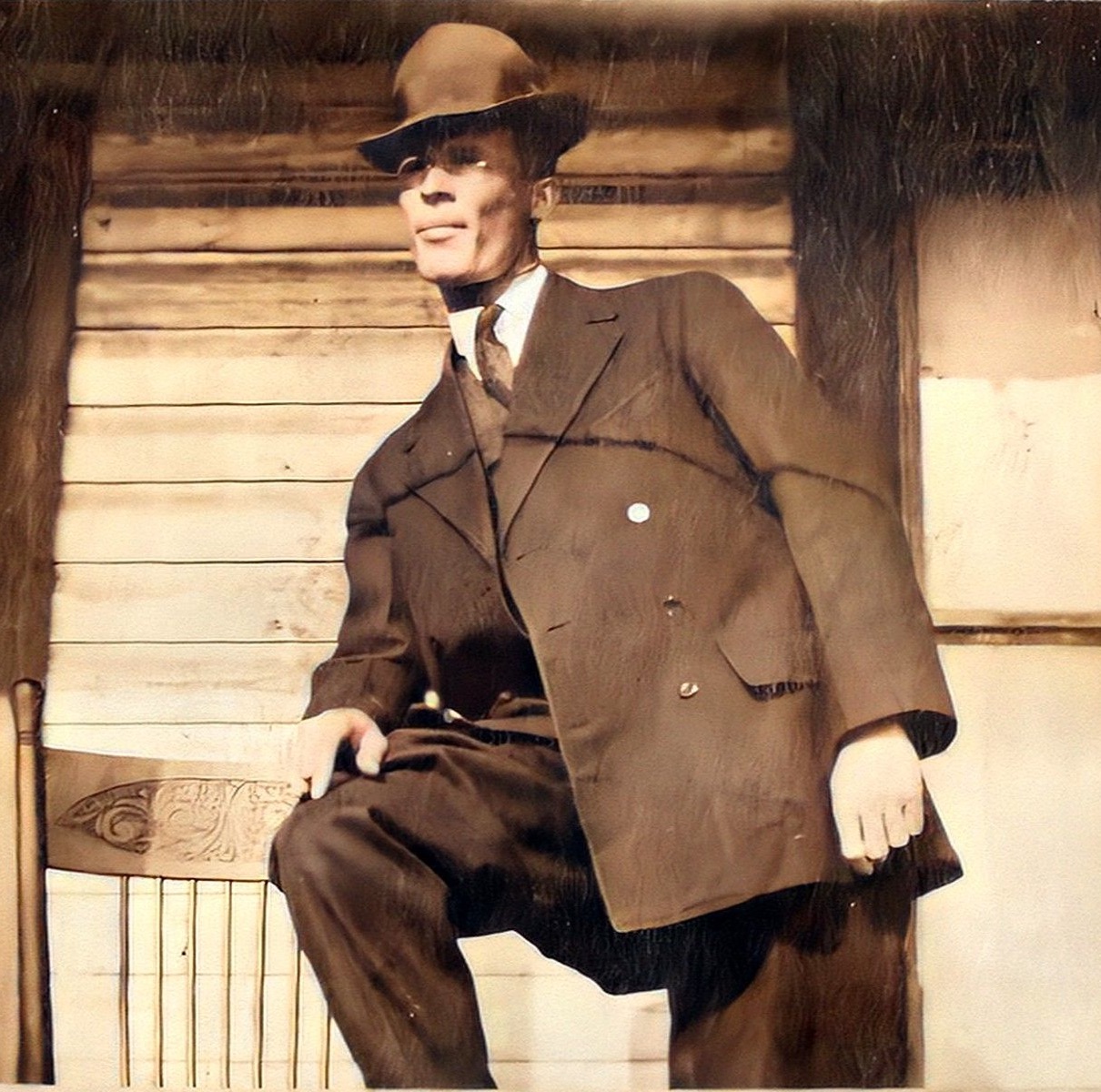
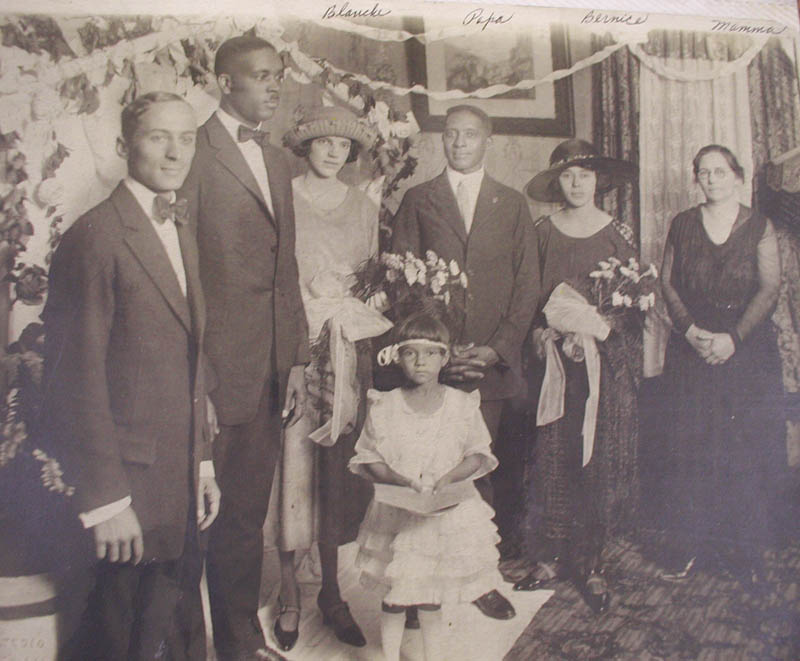
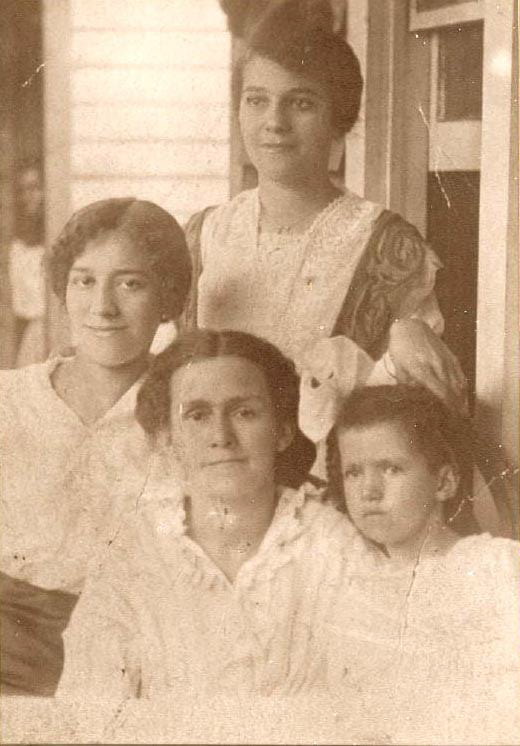
Lowndes Adams, Rufus Taylor and Lewis Gilmer & Lowndes little niece, Edoline.
After watching Episode 3 of Many Rivers to Cross in which the Civil War; black soldiers, contraband; freedom; 40 acres and a mule; suffrage and loss of it; the all black town of Mount Bayou, MS; lynching and finally Plessey vs. Ferguson were discussed, it took me a minute to come up with a tie in to my own family history to write about.
I began to think about my 2X Great Grandfather Joe Turner of Lowndes County, Alabama and how important land was to him and how it caused a riff between him and his son, my Great Grandfather Howard Turner. Something we always wondered about was how Joe Turner ended up with land at the end of the Civil War. Someone suggested it must have been Homestead Land. There is no indication that it was. I am going to write about Joe and Emma (Jones) Turner and their land.
As I started organizing materials, I looked to see if I could find any new information. In Mildred Brewer Russell’s book, “Lowndes Court House” on page 127 she says “Prominent Negro politicians during the carpetbag regime were Joe Turner, Oliver Marast, Jasper Cottrell, James Jackson, Tom Cook, Hamp Shuford, Frank Streety, Adam Lundy, Sam Robinson, Jule Cottress, Jerry Cook, Billy Spann, Cyrus Miles, Johnson Rambo, Robert McCord, Hope Harris, John W. Jones, and the three Carson brothers, Hugh, Will and Warren.” I wanted to find a record, another book, something that validates that the Joe Turner mentioned in the book, was my 2X Great Grandfather, Joe Turner.
I had no luck with the politics, aside from his name on a list of registered voters, but within 24 hours I found 2 new documents on Ancestry.com – the 1866 Colored Population Census and an Agricultural Census form for Joe Turner for 1880. Online I found a copy of a court case involving a land case between my 2X great grandfather and his son, my great grandfather.
__________________________
When shots were fired on Fort Sumter and the Civil War began in 1861, Joe and Emma (Jones) Turner were enslaved in Lowndes County, Alabama. I found Joe on the plantation of Wiley Turner but have so far been unable to find Emma and their children.
When the war ended and they were enumerated in the 1866 colored population census, they had 3 children under 10 – my great grandfather Howard who was three years old, his sisters, two year old Fannie and four year old Lydia. Joe and Emma were 25.
In 1870 they were farming. There were two more children, three year old Joe and 10 month old Anna. Neither of the adults could read or write. None of the children were old enough for school. Their personal estate was worth $300.
In the 1880 State Agricultural Census they farmed 76 acres, which they rented for cash. Farm implements and equipment were worth $100. Their livestock was worth $460 and included 2 milch cows; 12 other cattle (seven purchased in 1879 and one that died.); 20 swine; 36 barnyard fowl, who produced 100 eggs in 1879; one horse and four mules. They grew 25 acres of Indian corn, yielding 300 bushels; 50 acres of cotton yielding 12 bales and one acre of sugar cane yielding 48 gallons.
In 1880 US Census 16 year old Howard was clerking in a store. Joe Jr. was 13 and in school. Their sister Fannie no longer appears in the census and perhaps she was married or she may have died. I haven’t found a death record for her, I know that she died young. Several of her brothers named their daughters for her. My grandmother Fannie Mae Turner, was named for her Aunt Fannie. But that is getting ahead of myself. Another son, seven year old Alonza Turner, had joined the family since 1870.
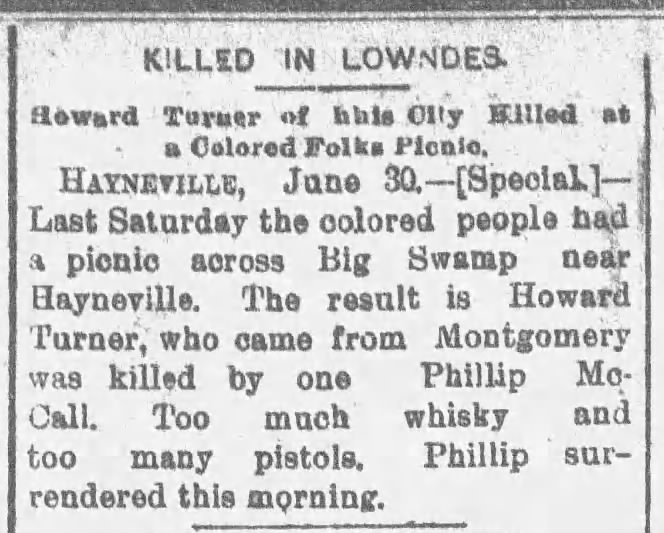
Howard Turner and Jennie Virginia Allen were married in June of 1887. My mother told me this story: Howard’s father, Joe Turner, gave them land to farm in Lowndes County, Alabama. Joe wanted the land to stay in the family forever. By 1890 Joe and Howard were arguing constantly about Howard and Jennie’s desire to sell the land and move to Montgomery. The day of the fateful barbecue, the arguments had been particularly violent. Jennie was in Montgomery visiting her parents with their two young daughters when word came that Howard had been shot dead at the barbecue.
According to the court record, Joe and Howard had agreed to purchase some land together. They both promised to pay an equal share. When it came time to pay, Howard refused and Joe paid all of it. In 1890, my 2X great grandfather, Joe took Howard to court to recover his money. During the trial, Howard died. His youngest child, Daisy, was not yet one year old. The Court case against Howard was revived against his heirs and the Court ordered Howard’s interest in the land sold to pay the lien Joe had gotten in the Chancery decree in 1897. In 1915 Daisy Turner brought a case before the Alabama Supreme Court to ask that she receive her inheritance from the sale of the land the original case concerned. By that time, 15 years had passed. Joe and Howard Turner were both dead. Joe’s second wife had moved to Montgomery with their children. Daisy lost her case. I think because her father hadn’t paid for his share of the land and so there was nothing to inherit. It seems that the land was sold after the first case. I will have to see if I can find the records of that case.
By 1900 Joe owned his own farm, although it was mortgaged. Emma could read and write, although Joe could not. She had given birth to 10 children. Only 3 were still living, Joe Jr., Alonzo and Lydia. Lydia’s two children, Anna Lisa and Joseph Davis, were enumerated with their grandparents.
Emma (Jones) Turner died around 1901. In 1902 Joe Turner, who was then 60 years old, married Luella Freeman who was 29 years old. He continued to farm and they had 9 children before he died at about age 80 in 1919. By 1930 Luella and most of her children were living in Montgomery. They ended up in Chicago, Illinois.I hope the land went to one of the older boys but I don’t think so.
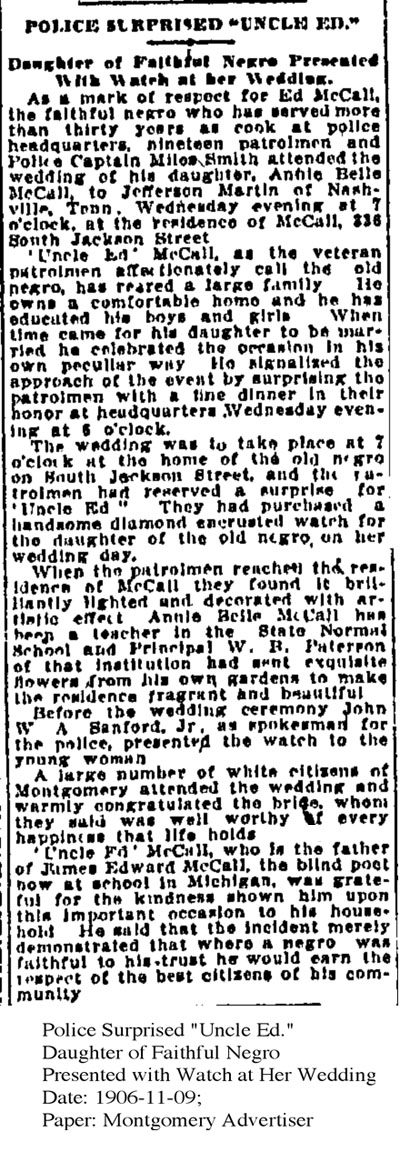
Here is another article I found recently on Genealogy Bank about Edward McCall and his family. I appreciate the information I find in these articles, I had been unable to find the date of Annie Belle’s marriage to Jefferson Martin before. I appreciate the atmosphere of the times that I get but I find the condescending racism very grating. At any rate, this article certainly gave me a picture of their large house decorated with lights and flowers and glowing for their oldest daughter’s wedding. Annie Belle was the first of the McCall children to marry and the first of Eliza’s grandchildren to marry. Mary Allen McCall was a fine seamstress and I’m sure the wedding gown was beautiful. Maybe one day a photograph will surface!
POLICE SURPRISED “UNCLE ED.” ________________ Daughter of Faithful Negro Presented With Watch at her Wedding.
As a mark of respect for Ed McCall, the faithful negro who has served more than thirty years as cook at police headquarters, nineteen patrolmen and Police Captain Miles Smith attended the wedding of his daughter, Annie Belle McCall, to Jefferson Martin of Nashville, Tenn. Wednesday evening at 7 o’clock, at the residence of McCall, 336 South Jackson Street.
“Uncle Ed” McCall, as the veteran patrolmen affectionately call the old negro has reared a large family. He owns a comfortable home and he has educated his boys and girls. When time came for his daughter to be married he celebrated the occasion in his own pecullar way. He signalized the approach of the event by surprising the patrolmen with a fine dinner in their honor at headquarters Wednesday evening at 6 o’clock.
The wedding was to take place at 7 o’clock at the home of the old negro on South Jackson Street, and the patrolmen had reserved a surprise for “Uncle Ed”. They had purchased a handsome diamond encrusted watch for the daughter of the old negro on her wedding day.
When the patrolmen reached the residence of McCall they found it brilliantly lighted and decorated with artistic effect. Annie Belle McCall has been a teacher in the State Normal School and Principal W.B. Paterson of that institution had sent exquisite flowers from his own gardens to make the residence fragrant and beautiful.
Before the wedding ceremony John W.A. Sanford, Jr, as spokesman for the police, presented the watch to the young woman.
A large number of white citizens of Montgomery attended the wedding and warmly congratulated the bride, whom they said was well worthy of every happiness that life holds.
“Uncle Ed” McCall, who is the father of James Edward McCall, the blind poet now at school in Michigan, was grateful for the kindness shown him upon this important occasion to his household. He said that the incident merely demonstrated that where a negro was faithful to his trust he would earn the respect of the best citizens of his community.
This article appeared in The Montgomery Advertiser, November 9, 1906 For photographs and more information about Annie Belle McCall Martin and her family click Their Own Marching Band and More About Annabell’s Family.
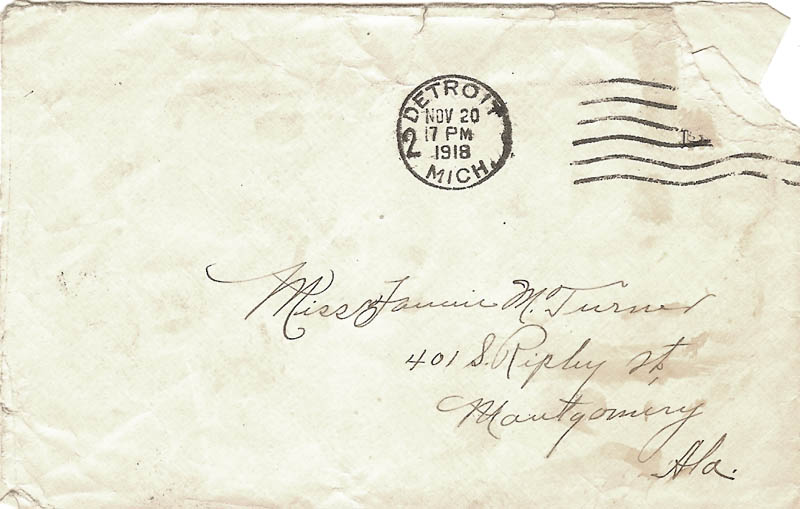
I am feeling fine today and I hope that this will find you and all at home well. I am off from my work today. No, not sick just felt like taking a bit of rest and too it has been raining all day and it was such a fine day for sleep before taking my midday nap I had to talk a little to my sweetheart, I only wish I could hear her voice and be made to feel happy. Dear I don’t know anything of interest to write about just now. Things are pretty quiet in Detroit, the factories are all getting ready for a big after war business and I think this city will get her share of it. I am sorry that your mother has been sick, I hope she is O.K. and her self again.
Miss Snow formerly of Montgomery now Mrs. Kelly of Detroit lost her husband last week, I think she will bring the body home for burial. They have him now in storage until she is ready to leave for home with him. Now dear I wrote you sometime ago and told you that I had something to tell you when I saw you, but I just can’t keep it any longer, what I want to tell you dear is this, I feel as if I have tried a single life long enough and now I am going to ask you to become my wife. Now dear, if you will commit to the above request let me know right away and I will write and ask the permission of your mother to marry you, and with her consent we will then fix the time of the wedding. Now I hope you won’t let this shock you any, and please answer me as soon as possible, if we should get married I shall want you to come to this city to live after the wedding, so dear while you are considering the questions of marriage you may also consider the question of residing in Detroit, also.
Mershell “Shell” Graham
Now dear please don’t keep me waiting too long for an answer to this letter, as I am over anxious to hear what your answer will be. Remember me kindly to your mother and sisters, with lots of love and many thousand kisses I close, looking to receive an early and favorable reply
Mattie Saffold Harris with family. Sayde little girl, front. Her mother, Mattie, is on the far right.
Mary Allen McCall on left. Granddaguthers Victoria and Margaret, front.
This is an email conversation that took place between Janis M. and me. We shared a cousin, Margaret McCall. It was from information that Janis gave me from her mother that let me piece together the story of Eliza and her first daughter, Mary. It was so exciting to have the story unfold through her mother’s memories and the records I found online and things my mother had told me. Both Margaret and Janis’ mother Sayde have died. It was really one of those strange happenings where people are in the right place at the right time and can share the important information. Margaret and Sadye were related through the daughters Milton Saffold had with their grandmothers during and soon after slave times.
Date: Thu, 16 Oct 2003 Hi Janis,
You talked to my sister, Pearl, recently in Chicago at a book signing and gave her a chart. Have you ever been in touch with Margaret or Victoria? I can fill in the missing information for you from Mary McCall’s side. This past year I’ve been doing some research for Margaret about Milton Saffold. I found he married the daughter of Col. Edmund Harrison, who was the owner of Eliza Harrison who was Mary’s mother. Eliza’s mother was also named Annie and I remember my great-great aunt Abbie, who was Mary McCall’s half sister, saying that Annie was African but I can’t find a record yet of anyone before the 1870 census. Margaret and I have been trying to find some records to place Eliza and Annie on the Harrison plantation. I was wondering, after seeing your chart, if maybe they, or Eliza went with Harrison’s daughter (Eliza was also his daughter) when she married Saffold. Do you have access to any records from slave times for the Saffolds?
Eliza married Dock Allen and they raised 9 children. How do you know about Mary being a Saffold? Margaret said it was all very hush hush when she was growing up and it’s making it very hard to find information now.
Let me know if you want more complete info for Mary and descendants. I’m so glad you saw Pearl! I will pass on any information you send me to Margaret. Right now I’m at my daughter’s in Seattle helping her with her newborn twins and most of my information is back in Michigan but I’ve got all the basic info on Dock Allen and Eliza. Looking forward to hearing from you. Kristin
Date: Thu, 16 Oct 2003 22:45:31 EDT Hi, Kristin: Wow, I will have to contact my cousin in Birmingham. He is the family historian and if any information is forthcoming about the Saffolds it would be from him. I only know that Milton Saffold was my maternal grandmother’s father. Seems the judge “traveled” a lot! Will send my cousin your email and hopefully he can help us out.
Milton Saffold. Mattie’s family photos.
As it is late, I will have to take in all that you have written tomorrow. Janis
Date: Thu, 16 Oct 2003 22:58:25 EDT Kristin: Forgot to tell you that I talked to Pearl at a reading in Bowie, Maryland. No, I haven’t talked to any other member of your family. My mother, Sadye Harris James told me that you have a relative who lives near me in a neighborhood called Kettering. She is the daughter of Hugo Howard. If this is accurate, I would like to contact her. My Mom got this information from Margaret Ward this past August. Until then I never knew that Milton Saffold had any children other than Mattie (my grandmother), and Frank. I look forward to you filling in the blanks in my chart. Janis
Date: Fri, 17 Oct 2003 10:09:29 -0700 (PDT) Janis, That would be great if your cousin can give me some more information. I’ll get the information I have together and email it later today. I’ll also check with another cousin of mine who grew up in Chicago and might know about the daughter of Hugo Howard and let you know. Kris
James and Margaret McCall visit his sister Tillie Howard in Chicago.
Date: Sat, 18 Oct 2003 10:03:20 EDT Hi Kristin, I spoke with my mother, Sadye Harris James, the last surviving child of Mattie Saffold Harris. Mom told me that in l933 she visited her sister Blanche in Chicago. Blanche was living in an apartment building owned by Tillie and her husband Dr. Howard. Tillie and her husband lived in a unit of the building. Blanche told my mother that Tillie’s mother, Mary McCall, was visiting from Mississippi, and that she looked like their mother, Mattie. She was described as a little “white lady” dressed in a long white old-fashioned looking dress. (My mother only saw her from a distance). When Sadye returned home to Birmingham, she told her mother about Mary McCall. Mattie said she knew about a Mary McCall, and that she was her half sister. Mattie decided to visit Mary in Chicago and confirmed that indeed she was Mary Saffold McCall.
This seems to be in conflict with your information. According to your records, Mary McCall was the child of Eliza Harrison and Dock Allen. Perhaps Milton Saffold fathered Mary and Dock Allen reared her as his own. By the way, Mattie was born in Selma, Alabama. Janis
Date: Wed, 29 Oct 2003 22:05:05 -0800 (PST) Hi Janis, Today I decided to look for Eliza in the 1860 census as a free person in Dallas county. I searched by her first name since I have looked in Montgomery and Lowndes county before with various last names. I found a 25 year old Eliza Williams with a 3 year old Mary Williams in Dallas county living with a 27 year old woman named Nancy Morgan and several of her children. All are listed as white. But Williams is the last name of Anne, Eliza’s mother and they are the right ages. It wouldn’t be the first time family members were listed in the census as white.
Now I need to find out who Nancy Morgan is and connect her with the Saffolds or Harrisons. Another day. Nancy Morgan appears in the 1860, 1870 and 1880 census. She is listed as single in the first two but always has another child or two and in the last one she’s listed as widowed. She doesn’t have any occupation listed. Eliza Williams isn’t listed again as Eliza Williams but appears as Eliza Allen with her husband, Dock Allen. Her mother, Annie Williams lived with them in 1870 and with Mary McCall in 1880.
Anyway, I’m going to bed. Just wanted to share that. Kris
2005 – Janis taped an interview with her mother Sayde. In it she talked about her mother and Mary McCall being half sisters and their meeting in Chicago.
Mary Allen McCallMattie Saffold Harris
“Sadye: Okay. It was the summer of 1933 when Walter, my brother and I drove in his V-8 Ford (It was red) to Cincinnati where he married Edna Gaither and from that we went to Chicago to visit Blanche, my sister, and there she said to me, “Sayde, there’s a little old lady up on the third floor and she sits on the back porch and I think she looks a lot like Mama. And I’d like for you to meet her.” So I went out in the backyard and looked up on the 3rd floor and there she sat in her long white dress and white hair, but I don’t remember ever being introduced to her. However her granddaughters Margaret and Victoria McCall, they came to visit their Aunt Tillie Howard and I got to meet them, but I never did meet Miss Marry Saffold McCall. No her name was not McCall….her name was McCall. So Mama went up to Chicago, not just to see this woman that was one of the highlights of her visit to Blanch. I don’t think it was that summer, but may have been the next summer. And they had quite a delightful celebration because they were half sisters. And I remember Mama telling me she had a half sister named Mary in Mississippi. And I could not understand a half sister in Mississippi, but as time progressed I realized that her father, Judge Saffold, made visitations involving his work as a circuit court judge and this took him to a part of Mississippi. Now who the mother was of Mary, I have no idea. Perhaps Victoria or Margaret will have some information as to who was the mother of Mary.”
I still haven’t found out who Nancy Morgan is. I did find a marriage certificate between a Nancy Wiggins and an Isom Morgan in Dallas County. William Wiggins was the overseer of Edmund Harrison in the 1850 census but I haven’t found any records connecting William with Nancy yet.
When I attended cousin Victoria McCall Davenport’s 90th birthday celebration in Detroit she told me that her grandmother Mary told her she was about 10 at freedom. This fits in with the child Mary in the 1860 census.
You may be wondering when I am going to find Eliza. I decided to post the information in the order that I received it. We’ll get there eventually. Today I am posting another writing by my mother. I also posted the personal parts of the letter she wrote to give you some idea of my mother as a person.
5 Nov 1980 by Doris Graham Cleage Dear Kris, Election Day! Did you ever? Here is a joke that sums it up for me: Man, traveling on horseback down a road toward a certain town, comes to a farmer working in a field. Just ahead was a fork in the road. The man hollered to the farmer, “Does it matter which road I take to _______, ” and he named his destination. “Not to me it don’t, ” said the farmer, who hardly looked up from his work. You don’t get it? That’s OK. It gives us a good laugh every time we tell it.
Grandmother Jennie Virginia Turner -1866 – 1954
Today I’m going to write about Grandmother. Grandmother Turner was born about 1872, (Note: she was actually born in 1866) nine years after the Emancipation Proclamation. Don’t know if she finished high school – but she did go. Her mother taught her to sew and it was a good thing she did because grandmother worked the rest of her life supporting herself and her children at sewing. That is, she worked after husband Howard Turner died. They married when she was about sixteen. Don’t know his age. He looked something like grandmother’s father and also like my father, mother said. He was a farmer’s son from around Hayneville, AL, but he preferred the big city – Montgomery. His father had three sons and planned to give each one a large share of the farm when they married. Howard and Jenny received their farm, but neither one liked the country. One day they were in Montgomery. He was at a Bar-B-Q. She was at her parents with their daughters, Fannie Mae, 4, and Daisy Pearl, 2. someone brought word that the had been shot dead. Apparently no one ever knew who did it, but mother always said grandmother thought his father had it done because he was angry that Howard would not farm and had even been talking about selling his part. The father did not want the land sold, but wanted it to stay in the family forever. (Bless his heart!). He and the son had had some terrible arguments before they left to come to the Bar-B-Q. I often wondered why he was there and grandmother wasn’t. She always seemed to like a good time.
I remember her laughing and singing and dancing around the house on Theodore. She was short, about five feet I guess, with brown eyes, thin dark brown hair that she wore in a knot. She was very energetic, always walking fast. She always wore oxfords, often on the wrong feet, and never had time to change them. We used to love to tell her that her shoes were on the wrong feet. (smart kids!)
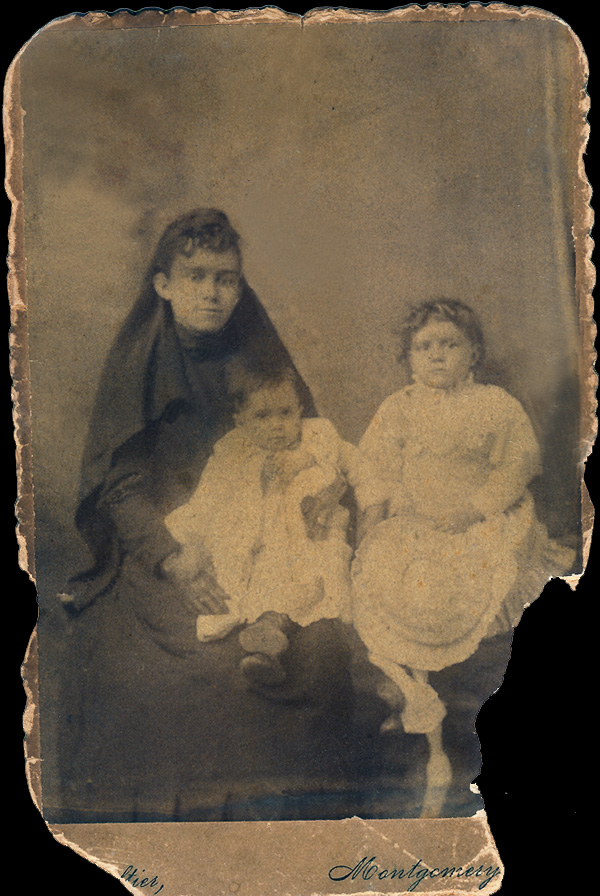
This photograph was taken in Montgomery during 1892 while the family was in mourning. Jennie holds two year old Daisy while four year old Fannie stands beside her.
She never did thing with us like read to us or play with us, but she made us little dresses. I remember two in particular she made me that I especially liked. My “candy-striped” dress – a red white and blue small print percale. She put a small pleated ruffle around the collar and a larger one around the bottom. I was about Deignan’s (note: that would have been about 5) size, I guess, and I really thought I was cool! The other favorite was an “ensemble” – thin, pale green material with a small printed blue green and red flower in it – just a straight sleeveless dress with neck and sleeves piped in navy blue – and a three – quarter length coat of the same material – also straight -with long sleeves and lapels – also piped in navy blue. She never used a pattern. Saw something and made it! She taught us some embroidery which she did beautifully but not often. She never fussed at us – never criticized – and I think she rocked me in the upstairs hall on Theodore when I was little and sick. The rocker Daddy made stood in that hall. I remember lots of people rocking in that chair when I was small.
Grandmother went to work when her husband was murdered – sewing for white folks – out all day fitting and sewing – and sewing all night – finishing while mother and Daisy stayed with their Grandfather Allen, who would tell on them when Grandmother came home and she would spank them. Mother said she remembered telling Daisy to holler loudly so Grandmother wouldn’t spank them hard or long and it worked!
Grandmother stayed single until she was about 37 or 38 when she married someone Mother hated – looked Italian, hardly ever worked. Liked a good time. Fathered Alice and left when she was very small. Somehow when mother spoke of him I had the feeling he would have like to have taken advantage of her. She was about 20 and had given up two college scholarships to stay and help Grandmother.
Sometimes after her husband’s death, Grandmother took the deed to the farm to a white lawyer. (was there any other kind?) and told him to sell it for her. He went to see it and check it out – told her to forget it – her title wasn’t clear, but he never gave the deed back and she figured he made a deal with her father-in-law.
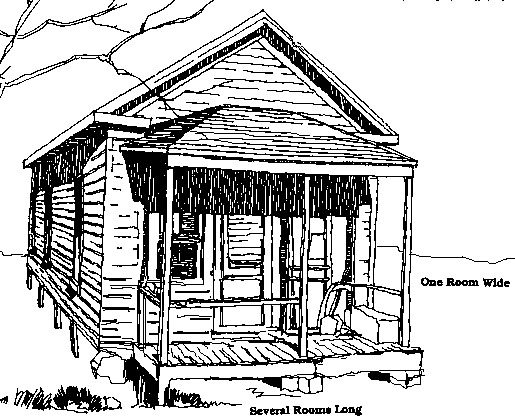
A shotgun house. My mother’ description is off. She describes a dog-trot house.
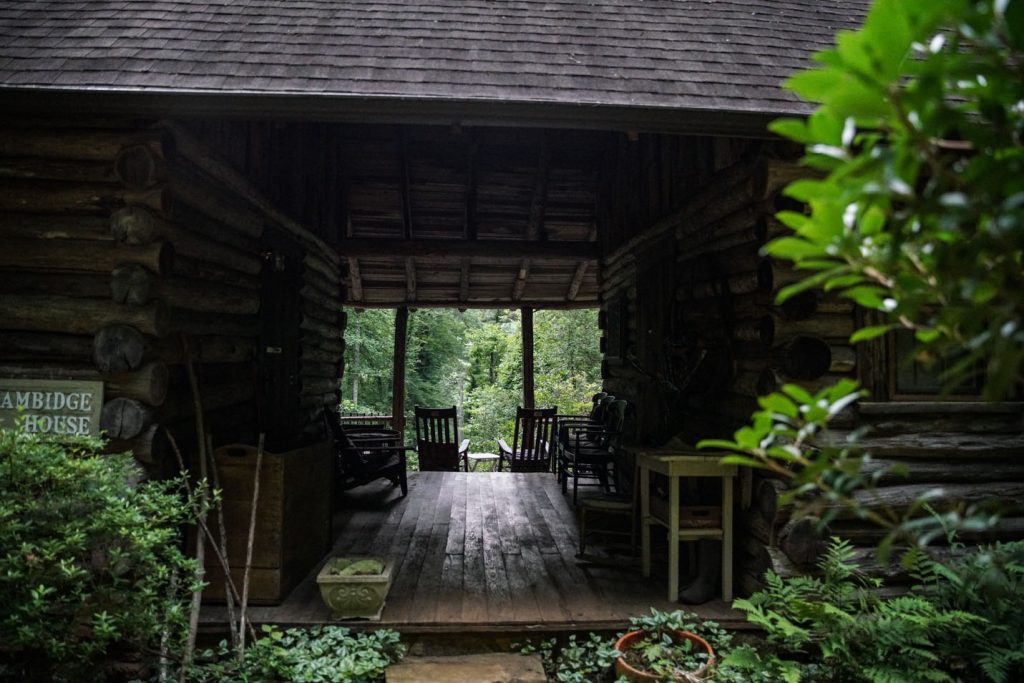
A dog trot house. Hambidge Center, Georgia.
Aunt Abbie said the father-in-law built Grandmother and Howard a “shotgun” house on the farm. She would turn up her nose as she said it. You know that is a house like this – no doors on front or back, you could shoot a gun through hall without damage. Animals (pigs, dogs) would wander into the hall and have to be driven out. Aunt Abbie only stayed there when the plague was raging in Montgomery. Yellow fever (malaria) and/or polio every summer. Many people sick or dying. Huge bonfires in the streets every night to ‘purify’ the air”, and closing the city if it got bad enough – no one in or out. More than once they fled the city in a carriage through back streets and swamps because they were caught by the closing which was done suddenly to keep folks from leaving and spreading the “plague”
In Detroit, when they came in 1923 when Mother and Daddy had bought the house on Theodore and had room for them (room? only 5 adults and 3 children!) Grandmother, Daisy and Alice got good jobs, (they were good – sewing fur coats, clean work and good pay.) at Annis Furs (remember it back of Hudsons?) and soon had money to buy their own house much farther east on a “nice” street in a “better ” neighborhood (no factories) on Harding Ave. While they lived with us I remember violent arguments between Alice and I don’t know who – either Grandmother or Daisy or Mother. Certainly not Daddy because when he spoke it was like who in the Bible who said, “When I say go, they goeth. When I say come, they cometh.” Most of the time I remember him in the basement, the backyard or presiding at table. Daisy and grandmother were what we’d call talkers.
Fannie, GM Turner, Alice. Standing: Daisy
Maybe here a word about Aunt Daisy. Look at her picture, sweet, soft, pretty, taught school awhile in Montgomery (with high school diploma) loved Congregational preacher named Duncan Erby who loved her and waited for her for years. Had the church in Buffalo, NY. Whenever she really considered leaving, Grandmother did the old guilt trick “How can you leave me to take care of Alice all by myself?” and “No man in this world is good enough to touch your little finger. They are all no good except (maybe) Shell.” and Daisy listened and stayed and played numbers, studied dream books and drank a little apricot brandy. I always found their house light, cheerful, full of magazines (McCall’s, Journal, etc.) which I loved to read, full of good things to eat. All three were super cooks and they had always just had a bunch of friends to dinner and to play cards or just about to have.
Daisy took us downtown to the show every summer and to Saunders for ice cream afterward. And I always ended up with a splitting headache. Too much high living I guess. She and Alice would buy us dainty, expensive little dresses from Siegel’s or Himelhoch’s. They all went to church every Sunday, Plymouth Congregational. Daisy always gave us beautiful tins of gorgeous Christmas candy, that white kind filled with gooey black walnut stuff, those gooey raspberry kind and those hard, pink kind with a nut inside, and chocolates, of course! She loved to eat and to cook. Never seemed bitter or regretful about her lost love.
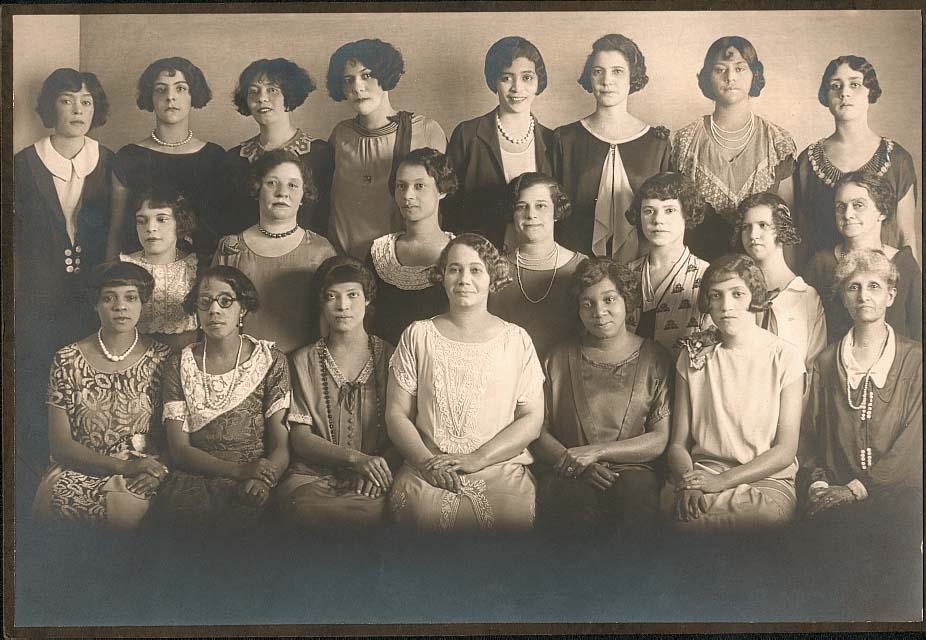
Grandmother got old, hurt her knee, it never healed properly. Daisy worked and supported the house alone. Alice only worked a little while. She had problems getting along with people. Grandmother was eventually senile. Died of a stroke at 83 or so. Alice spent years taking care of her while Daisy worked. Daisy added to their income by being head numbers writer at Annis!! Did I ever show you the picture of the “coloreds” who worked at Annis? Will send if you like. Looks like people from Mr. Polks book, were supposed to be the “best looking colored girls in Detroit” Mr. Annis had a colored mistress, of course.
Seamstresses at Annis Furs, Detroit 1920’s. Grandmother Turner far right, 2nd row. Alice next to her. Skip 1 + it’s Daisy.
15 Nov 1980 Dear Kris and Pearl, Figured I’d make a carbon of the stuff about the family and send you each one…this is a sort of wrap up of Grandmother….but first something the Snoopy cartoon (from Pearl) made me remember….about four blocks around the corner and down the street from Theodore was a vacant lot where for some years they had a small carnival every year…. I don’t remember the carnival at all… I never liked rides anyway… not even the merry-go-round..but I remember it being evening, dark outside…and we were on the way home….I don’t remember who was there except Daddy and I….he was carrying me because I was sleepy so I must have been very small…I remember my head on his shoulder and how it felt…the best pillow in the world…I remember how high up from the sidewalk I seemed to be…I could hardly see the familiar cracks and printings even when the lights from passing cars lighted thigs…which was fairly often because we were on Warren Ave. I remember feeling that that’s the way things were supposed to be. I hadn’t a worry in the world. I was tired, so I was carried. I was sleepy, so I slept. I must have felt like that most o my childhood because it’s still a surprise to me that life is hard. Seems that should be a temporary condition.
Jennie Virginia Turner about 1936.
Now as to Grandmother and her sewing… you know how long and voluminous dresses were either side of 1900… how many stitches there were in one I hate to think… machines were available at that time but whether or not she had one I don’t know… this is what she did… she was a seamstress. Let’s say you could afford to have someone make your clothes and she was your regular person. Every July she came to your house and sewed for you and your children, making everything, including winter coats, suits, dresses, sleepwear, underwear, everything except knitted stuff like socks and hats. She might have made shirts for the man of the house too. She had no patterns. She made a pattern or just cut the material if it wasn’t complicated, basted it together, fitted it, made corrections, got it ready for final sewing. All this she did at your house, all day. When she finally went home about supper time, she took with her the things ready to be sewed and worked on them all night, because the faster she finished things the faster she got paid and the more jobs she could take. She did plain stuff if they wanted it or she could tailor a suit (easy tailoring, she always said, and she didn’t like it. Too exact, she said) Or she could make fancy like smocking, the gathery stuff across the front of little girls dresses or nightgowns or ladies fancy blouses, or embroidery or ruffles or lace trim. She could even make the lace (tat, that is), put fur collars and cuffs on coat or suit, she could do it all and she did it all all the time.
One thing she liked about her work, it was not dirty. She was not a maid of any kind. She could choose her customers to some extent, because she was good, I guess., and there were people for whom she would not work. Usually referred to as “white trash” meaning in this case I guess that they were rude to her since they could not have been poor and had a seamstress. Another thing she liked was that she could talk while she worked and she loved to talk. I remember her talking all the time when she lived with us. And Daisy was a talker too. Grandmother would talk sometimes about the folks she had sewed for. Some were Jewish. I remember only two specifics. One who advised her to cut her long hair because it would “sap her strength” and also not to take hot or long baths for the same reason the other was complaining about life and GM said (with a mouth full of pins all sticking out and her talking through them as I remember) “Well, when we get to Heaven we won’t have to worry about that any more” The lady was horrified and said “Surely, Jennie (her name was Jennie Virginia and I almost named one of you after her) you don’t think you and I will go to the same Heaven”. Grandmother always laughed at that story and said she wouldn’t mind dying so much if she would just remember that she would see that lady in Heaven and enjoy her consternation at seeing Grandmother there too with NO segregation. Mother and Daisy always shook their heads at this and said she shouldn’t talk like that about dying. Grandmother laughed some more. She liked to shock them.