For the past week I have been immersed in the Turners who came off of Wiley Turner’s plantation in Lowndes County Alabama. My 2X great grandfather, Joe Turner, came off of that plantation. Wiley Turner died in 1851 without a Will and so his estate was probated. The case dragged on for twenty years. There are multiple lists of the enslaved, the first in 1852. I wrote about the one from 1853 here. The others were from 1856, 1857 and 1865. There were also the 1850 and 1860 slave censuses, which give no names but age, sex and color (“mulatto” or “black”)
There are also records of doctors visits, some patients named and some not. There are records of how much and what was sold from the plantation during this time. There were several changes of administrators due to deaths and some disputes among members of the family about what was due them.
After the Civil War was over and Freedom came, there were new records for the formerly enslaved and now free, the 1866 census for the first time named the formerly unnamed heads of households. In the 1870 census, the whole household was named. In 1880, relationships to the head of the household were given. There were also marriage and land records.
By investigating the community and households, I want to see what happened to the people and families, both before and after slavery. Right now I am going through the material and figuring out how to present it. At first, when going through the probate record, I just looked for the names of the enslaved. Going over it again, I realized that I could not give a picture without knowing more about what was going on around them, what crops were grown, what was sold, what was bought and the rest of the turmoil swirling around them during that time period. Maybe I need to start by printing out the whole file.
I have never done a project like this outside of a time crushing challenge, so we shall see how it goes.
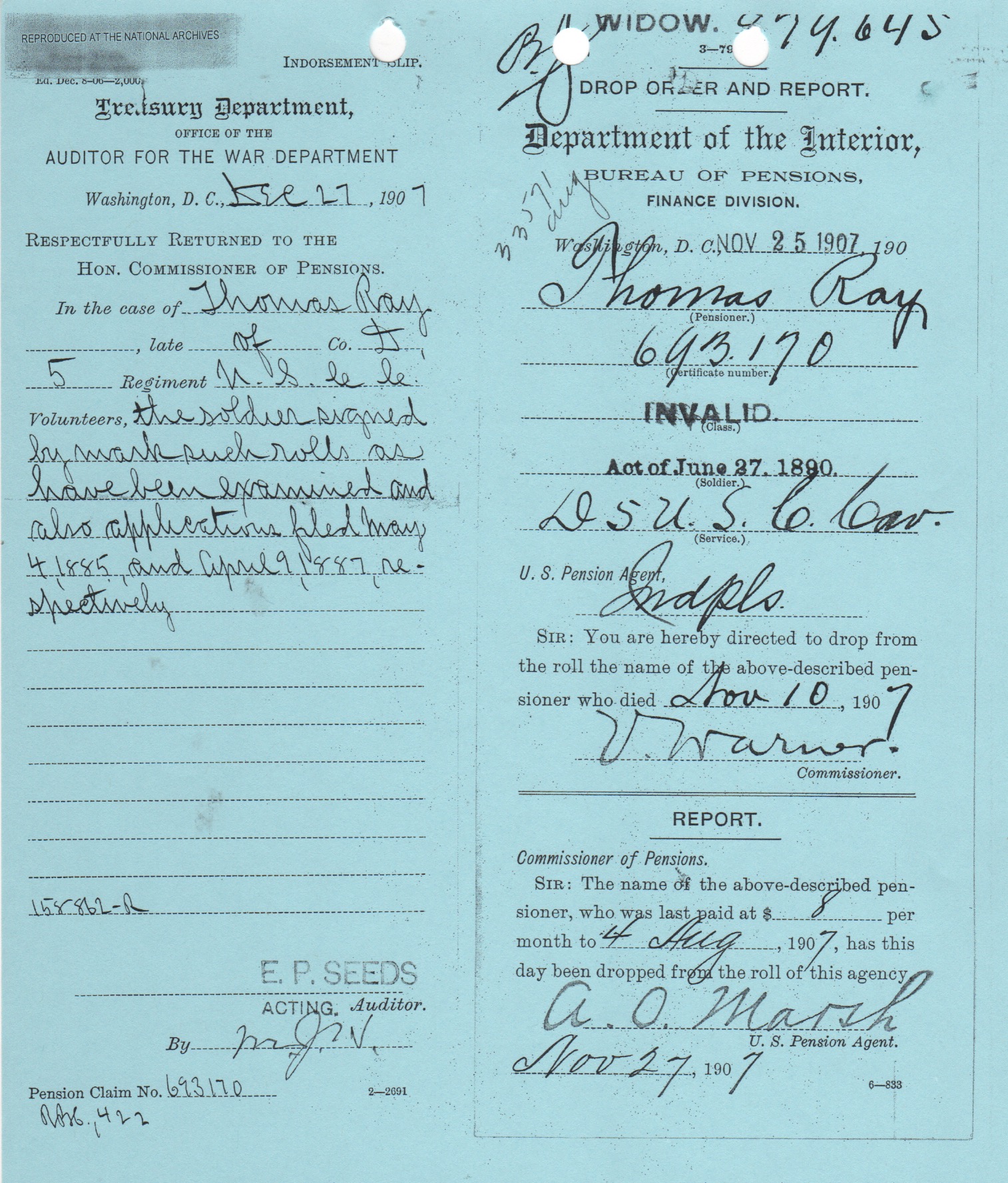
This year for my 5th A to Z Challenge, I used my 2Xs great uncle, Thomas (Ray) Allen’s pension file as the basis for my blog posts. Thomas served in the United States Colored Calvary during the Civil War. In his 115 page pension file, I was able to find family members, friends and veterans who served with him during the war, plus the name of the man who had enslaved him.
In spite of pledging myself each year after the challenge to prewrite my posts, I found myself once again doing last minute research and writing most of the posts on the day I published them. Towards the end of the month it came to me that I should pick a topic that doesn’t require research and is guaranteed to produce short posts. “Fleeting Memories” is the topic I am thinking about for next year. I have already filled a tiny notebook with them.
A big difference this year was the lack of a list including everybody who signed up where we could go and find blogs to visit. Instead there was a post each day where we could reply with our blog url, twitter with #atozchallenge and a fb page. Not to mention our own fb pages and google+. What worked best for me was visiting blogs I had enjoyed in previous A to Z Challenges and visiting people who commented on blogs I enjoyed . I ended up following about 30 blogs during the challenge, with one time visits to others. I visited as many of these as I could each day and commented. I visited those that visited me and I tried to reply to all comments on my posts. Looking back over my posts and comments for this year and years past, I received about the same number of posts this year.
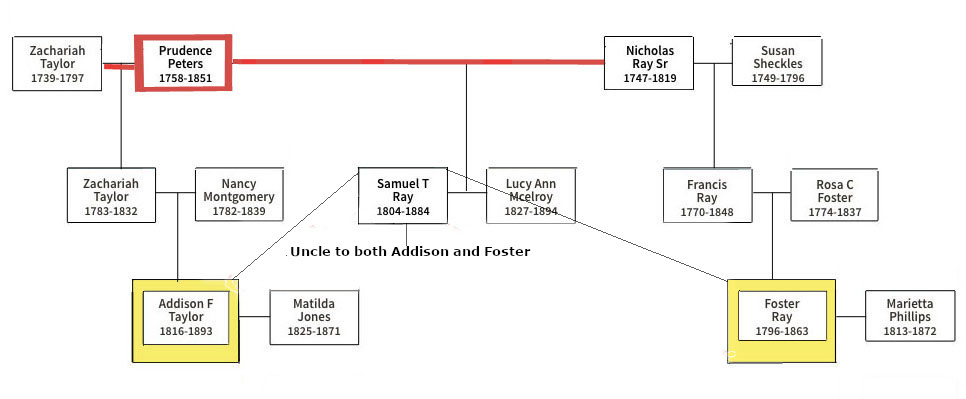
Zachariah Taylor’s son, Addison is listed as the “owner” of Thomas Allen on his military file. Thomas Allen listed Foster Ray as his former enslaver on all of his official papers. Why? What was the connection between Taylor and Foster?
After looking for a marriage between their children and finding none, I looked for a relationship between their wives. Again, none.
Then I noticed that a Prudence Peters showed up on both of the trees. I went back several generations, I found that Addison Taylor’s paternal grandparents were Zachariah Taylor and Prudence Peters. After Zachariah died in 1797, Prudence married Foster Ray’s widowed grandfather Nicholas Ray. Nicholas’ first wife Susan Sheckles, was Foster Ray’s grandmother.
Nicholas Ray and Prudence had one child together, Samuel Taylor Ray. Both Foster’s and Addison’s fathers were Samuel’s brothers and he would have been both Addison’s and Foster’s uncle, making them cousins by family if not by blood.
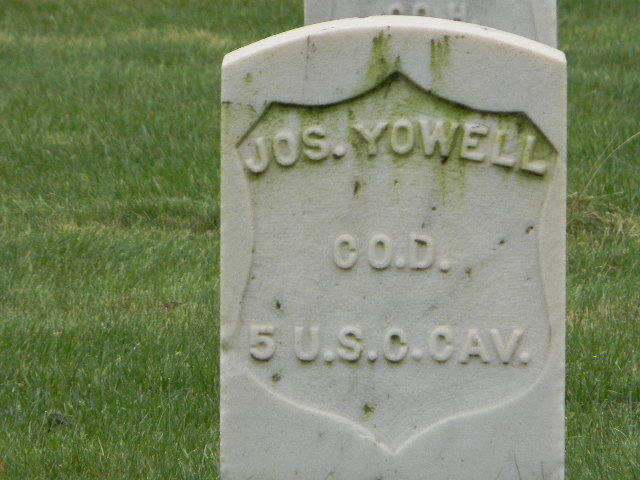
After spending half the day wondering around among Joseph Sharp Yowell’s records and family members, I decided I would not even try to just write up his story. This will be the story of how I researched just about everybody that appeared in this year’s A to Z Challenge.
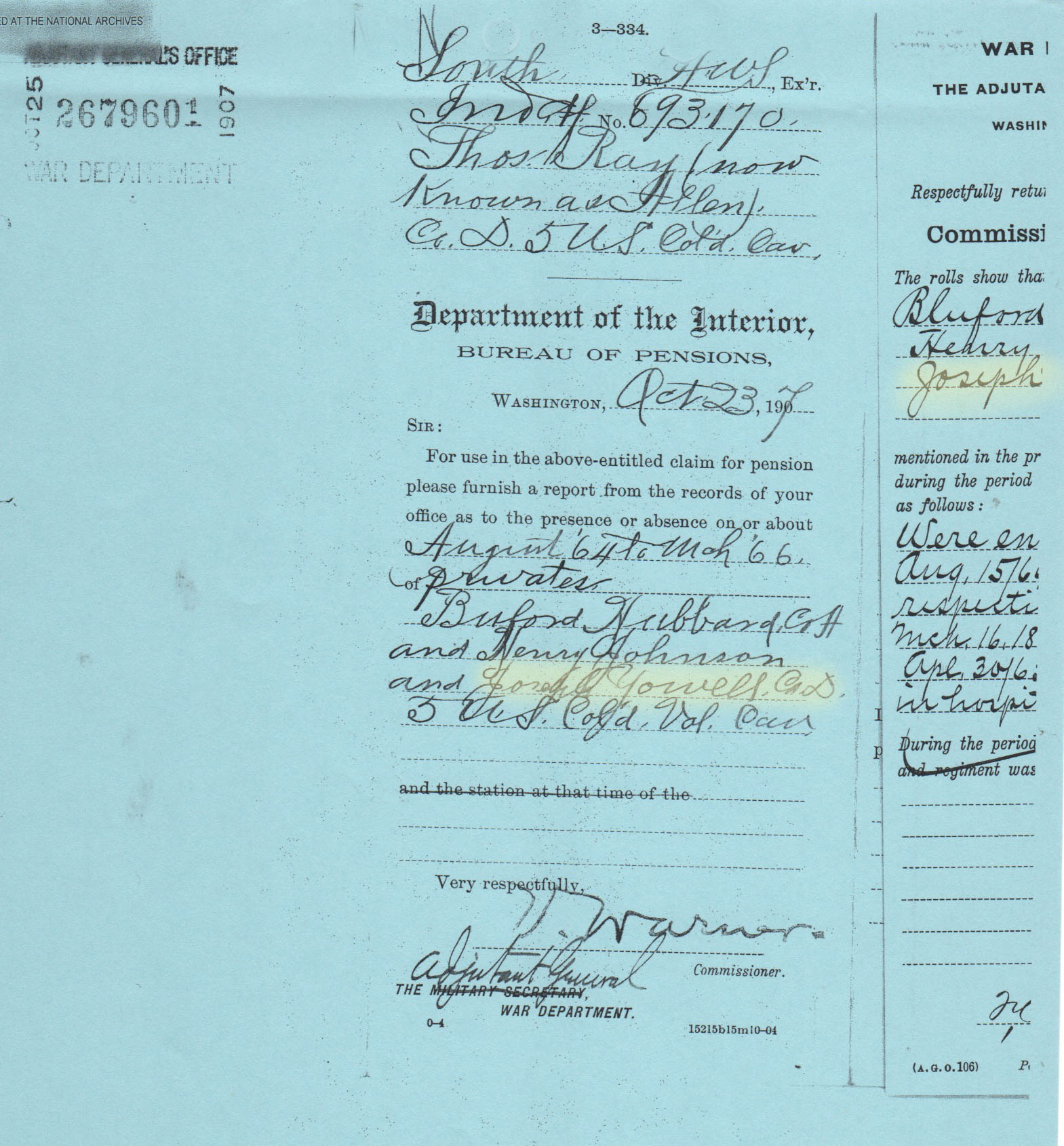
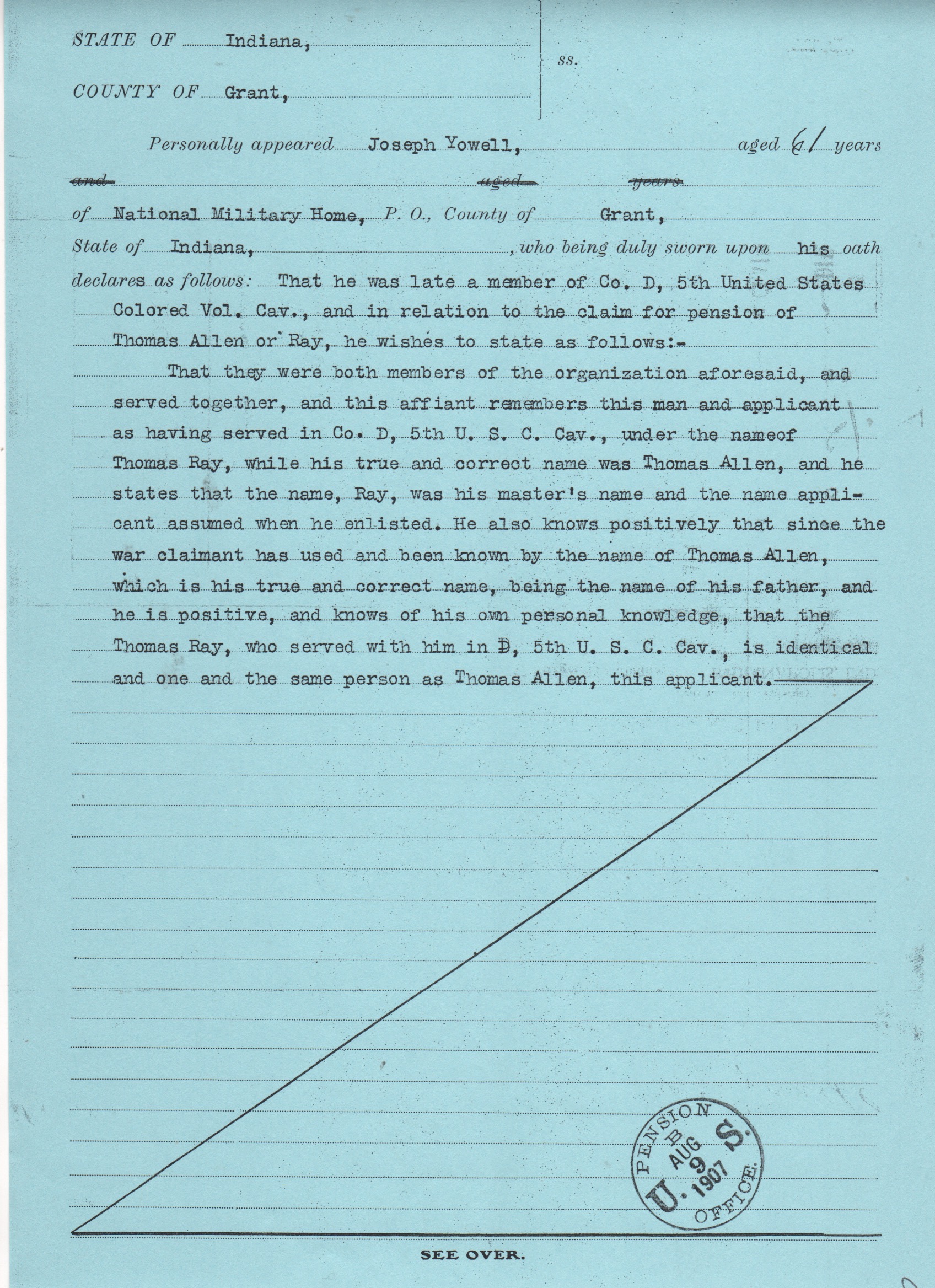
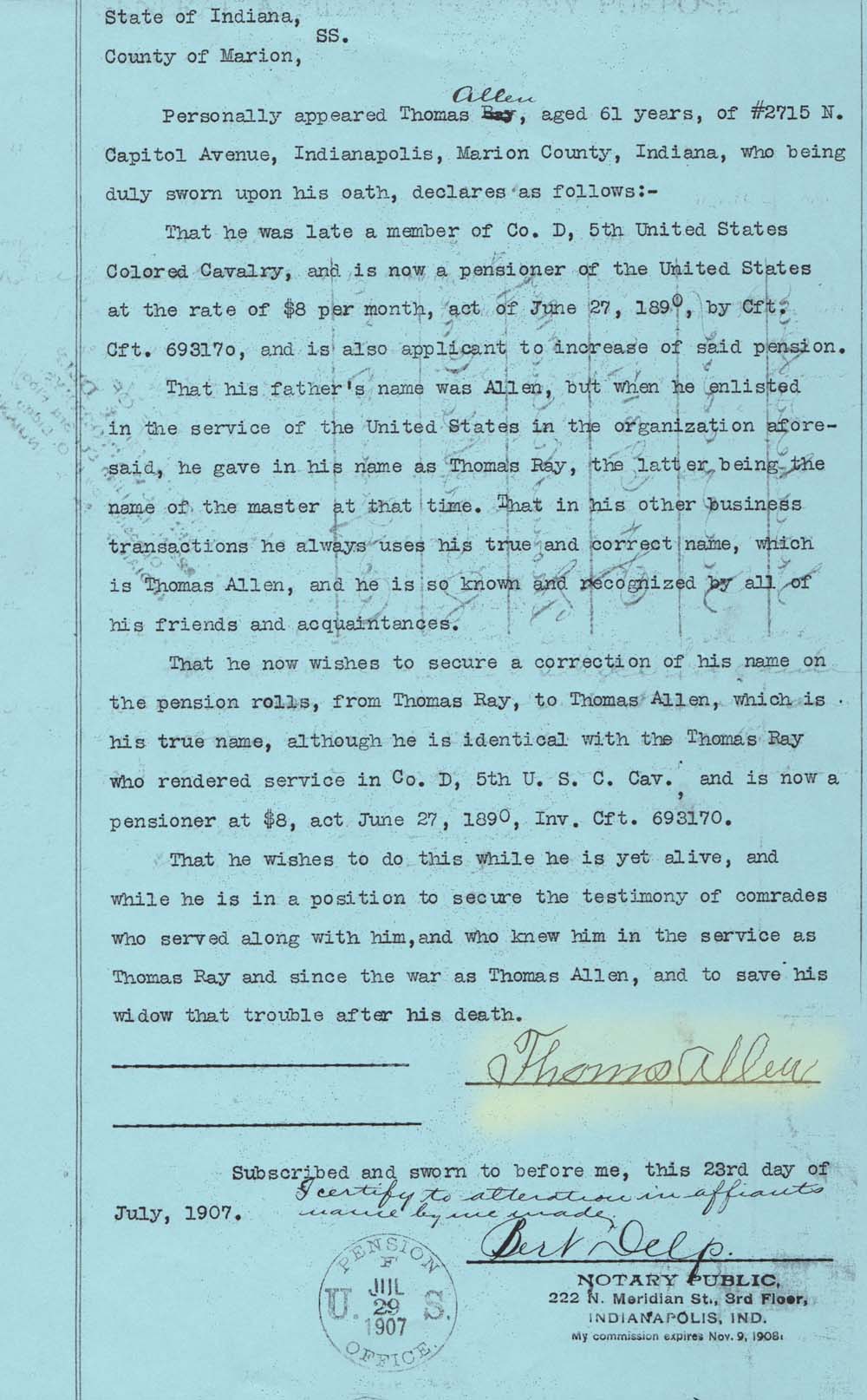
I found his name when I was looking through Thomas Ray Allen’s pension file for names to use in this challenge. “Yowell” was perfect for “Y”. Then I copied all the pages with his name. I am not using all of them in this post because some just have his name and there are others with more information.
This is my favorite piece from the pension file that mentions him, because it gives the names of the three witnesses that served in the same company with Thomas, even though half of it is missing.
Next I set up a tree for Joseph Yowell on Ancestry.com. I did this for all the people that I wrote about during this A to Z Challenge. That way I am able to find and save their records.
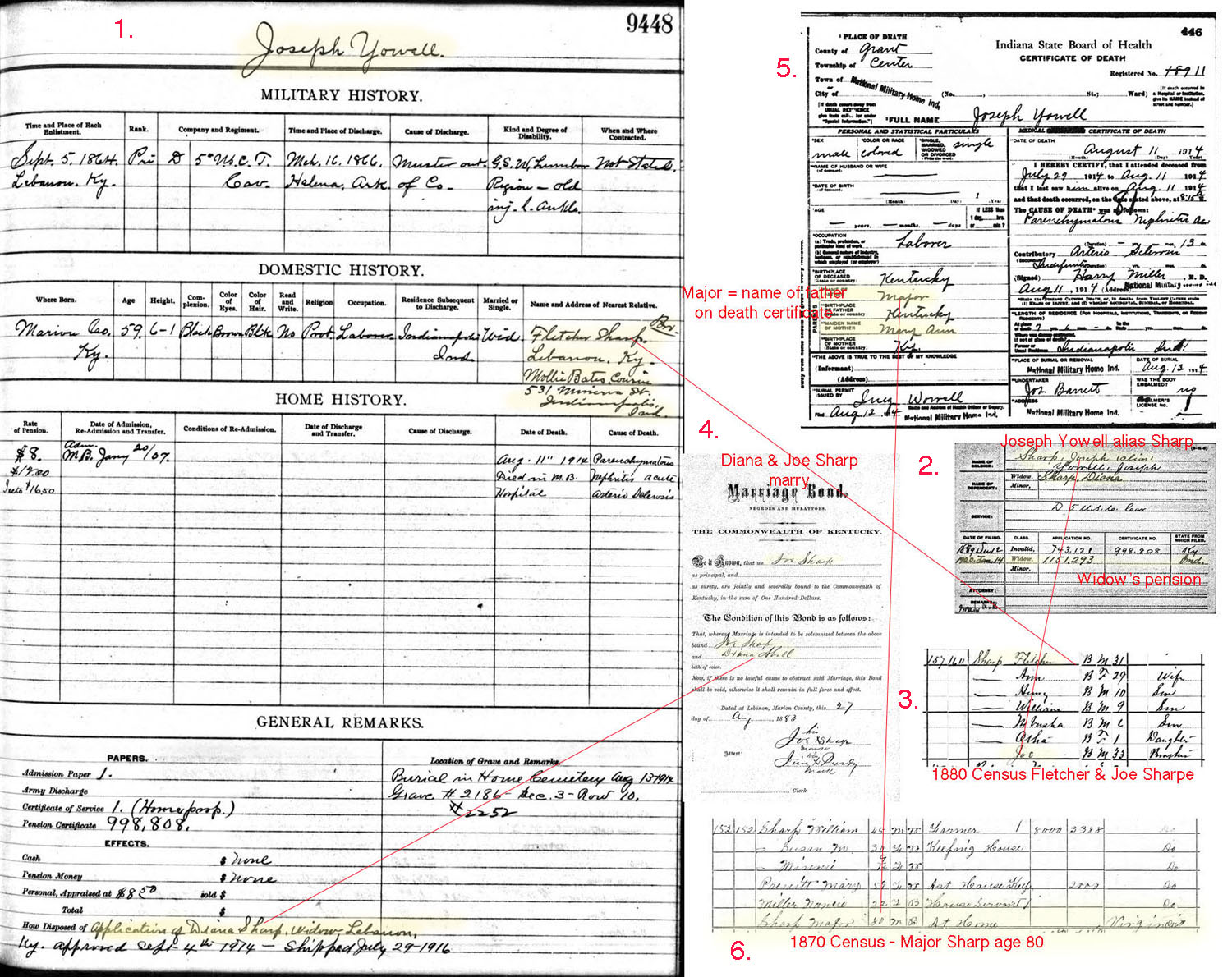
Below is a chart with various records I found for Joseph Yowell and how they relate to each other.
I found all of these records on Ancestry.com Click to enlarge so you can read it.
1. on the left, is a record from the U.S. National Homes for Disabled Volunteer Soldiers, 1866-1938. On the top right of the form they list his closest relatives. First is his brother Fletcher Sharp who lived in Lebanon, KY. The second is his cousin Mollie Bates who lived in Indianapolis. At the bottom of the form they mention his widow, Diana Sharp, who ordered his grave stone. She lived in Lebanon, Kentucky.
2. The pension card says that Joseph Yowell also used the name Joseph Sharp. It also has his widow’s name, Diana Sharp.
3. 1880 Census, Lebanon Kentucky. When I found a Joe Sharp in the 1880 census, I was not sure if it was my Joe (Yowell) Sharp. When I saw that he was living with Fletcher Sharp and his family and was listed as Joe Sharp, brother, I knew I had found the right Joe Sharp.
4. Marriage record of Diana Abell and Joe Sharp. Diana was named as his widow in the first document.
5. Death Certificate. In addition to telling us what he died of, it gives his parent’s first names. His father’s name was Major.
6. I followed Joseph’s brother Fletcher around in the records for awhile, then I looked at his wives. He was married twice. First to Ann and second to Nancy, both with the surname of Miller. I wondered if they were sisters, so I followed them around. I found Nancie Miller in the 1870 census living as a house servant in the large household of a white couple, William and Minnie Sharp. Also living there was 80 year old Major Sharp, probably Joseph Yowell’s father.
I did find his cousin Mollie living with her husband in Indianapolis but did not find Joseph living with them. I did find her family a few pages away from the Sharps in one of the census records from Kentucky.
I never found Joseph Yowell and Diana living together. He was listed as “single” in several records and as married or widowed in others, even though she survived him.
Joseph Sharp Yowell’s name – his father was Major Sharp and his owner during slave days was John Yowell. This name appeared on his military records, however I was unable to find a John Yowell who owned slaves in 1850 or 1860 in Taylor or Marion county.
Joseph Yowell appeared in the Indianapolis as “Joseph Yowell” in 1899. In the 1900 Census he appeared as Joseph Sharp. In 1910 he was in the Soldier’s Home and was Joseph Yowell in that census and in the records that he generated there.
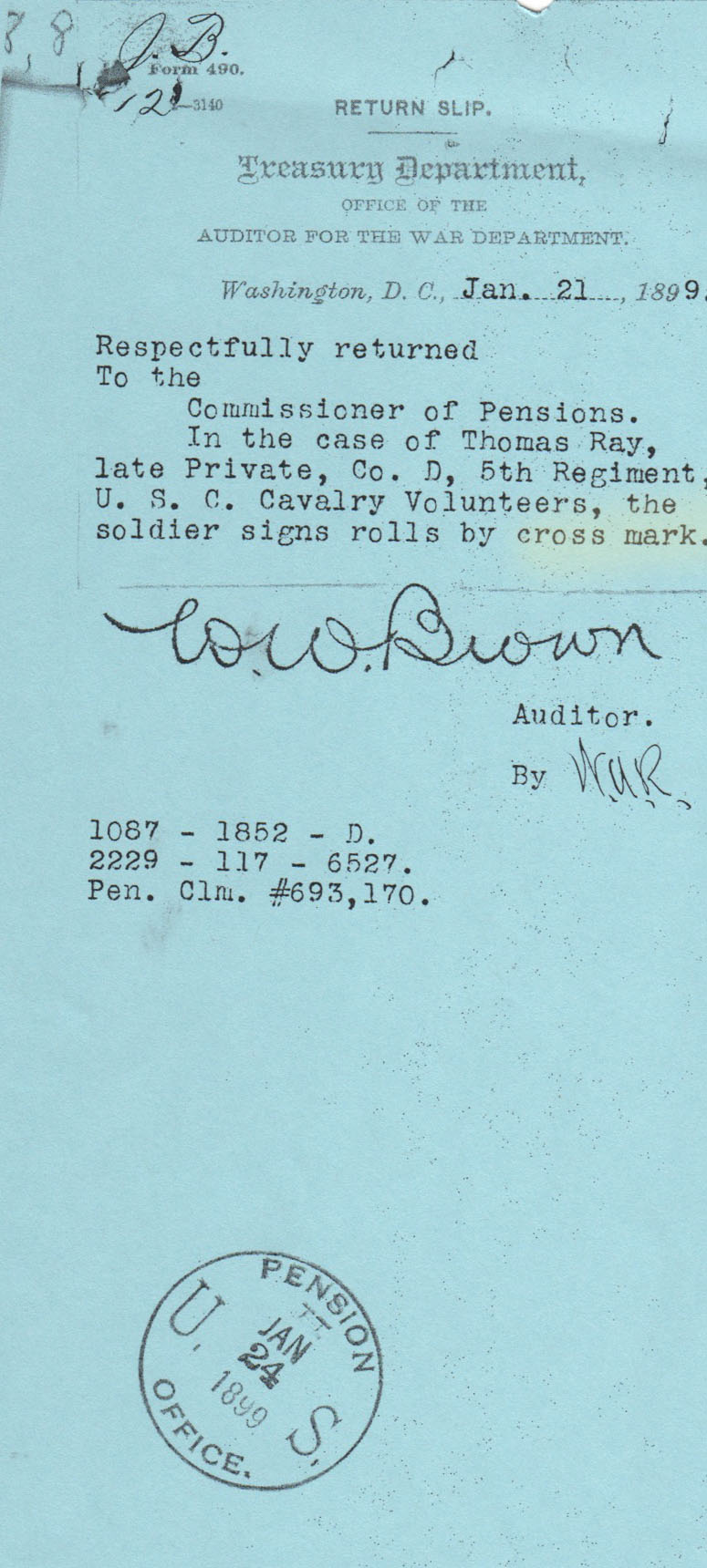
When Thomas Ray Allen joined the military in 1864, he was unable to sign his name. I wonder how he learned to read and write. Did he attend classes? Did his wife, who had attended school as a child teach him? Either way, I was very glad when I first received his file and saw that he could sign his name.
Henry Wiley, younger brother of Kate Wiley, was born free in 1855 to Woody and Sarah Wiley. Soon after he was born, the family moved from Virginia to Athens Ohio. He was the middle child. Henry attended school along with his brothers and sisters and learned to read and write.
When his father Woody, died in 1873, Henry was 18. His father asked him to make sure that all his just debts were paid, he thought they could be paid by the sale of his horse and wagon, but if not Henry should pay them and get reimbursed from the sale of the land. He was left one of the beds and bedding, with the remainder of the household goods going to his sister Sarah. He also appointed Henry as executor and stated that the property be divided between three of his children, Henry, Sarah and Armintha, when Armintha came of age.
!n 1884, at the age of 29, Henry married 23 year old Polly Fish. They lived in Springfield, Ohio where they owned their own home free from mortgage. Henry was a brick mason, an occupation he followed for the rest of his life. Polly kept house. They had only one child, a daughter, Glenna Belle, born in 1885. Sadly, Glenna Belle died when she was just six years old.
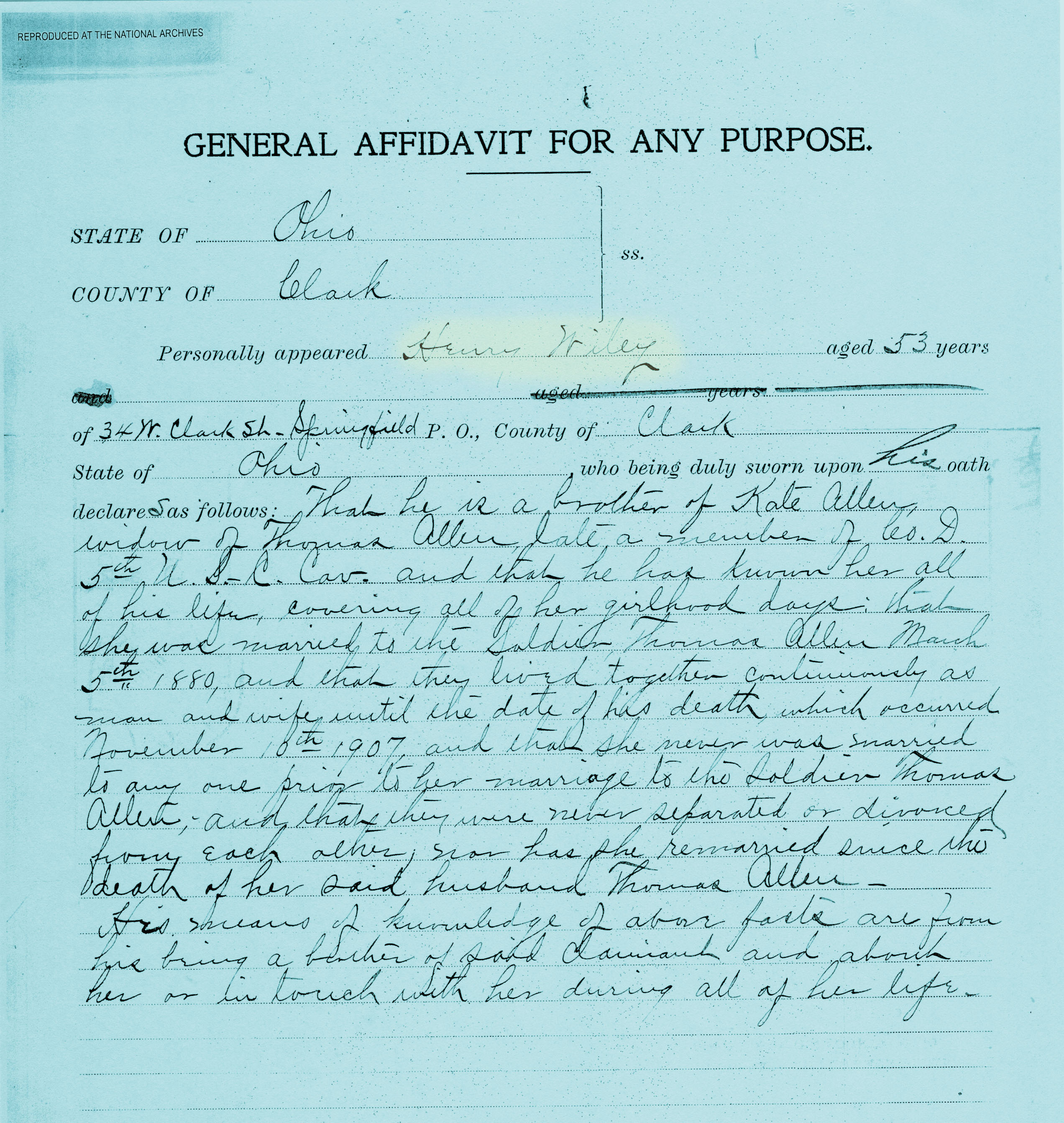
He testified for her when she was applying for her widow’s pension on February 4, 1908.
Click to enlarge.
“Henry Wiley aged 53 years of 34 W. Clark St. – Springfield P.O., County of Clark State of Ohio who being duly sworn upon his oath declares as follows: That he is a brother of Kate Allen, widow of Thomas Allen late a member of Co. D. 5th USCCav. (United States Colored Calvary) and that he has known her all of his life, covering all of her girlhood days: that she was married to the soldier Thomas Allen March 5th 1880, and that they lived together continuously as man and wife until the date of his death which occurred November 10th 1907 and that she never was married to any one prior to her marriage to the soldier Thomas Allen, and that they were never separated or divorced from each other, nor has she remarried since the death of her said husband Thomas Allen – His means of knowledge of above facts are from his being a brother of said claimant and about her or in touch with her during all of her life.”
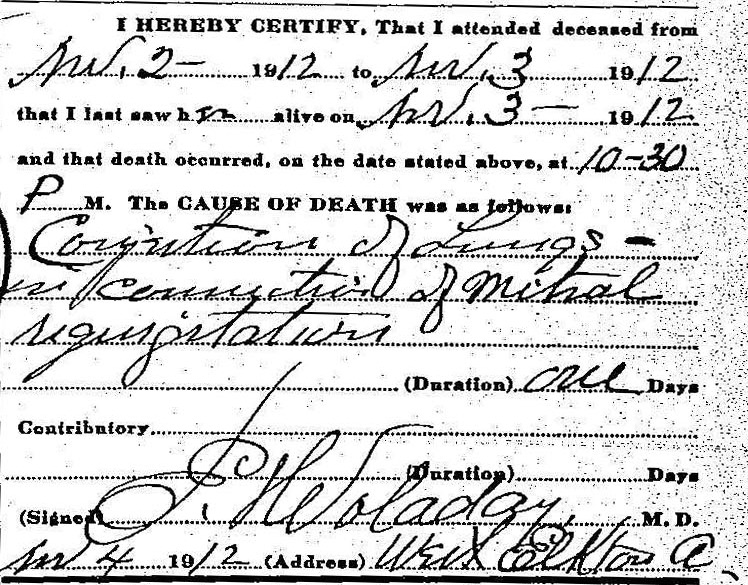
In 1912 Polly was 60 miles from home in West Elkton, Preble, Ohio visiting her eldest brother James and his family, when she died. She had been there for two days. Cause of death was congestion of lungs with ??? mitral regurgitation. She was 50 years old. Her niece Janey was the informant.
Perhaps you can make out what that word is before “…of mitral regurgitation.”
Two years later Henry married Martha Johnson Edwards, a widow with six children. The children were pretty much grown by the time of the marriage with only two remaining at home by 1920, a 20 year old daughter who worked as a servant and a 16 year old boy who wasn’t in school or working.
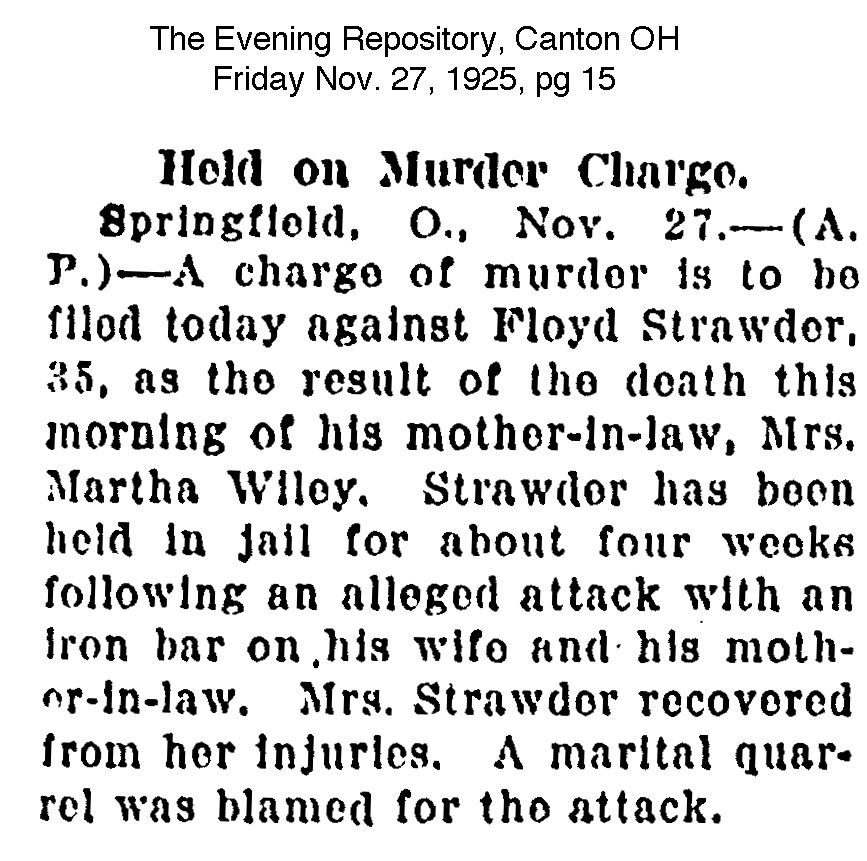
Tragedy struck again in November 1925 when Martha’s son-in-law, Floyd Strawder hit her over the head with an iron bar and killed her. Her skull had been fractured. I expected to find him in prison in 1930, but he was living as a divorced (no surprise there) cement worker in a boarding house.
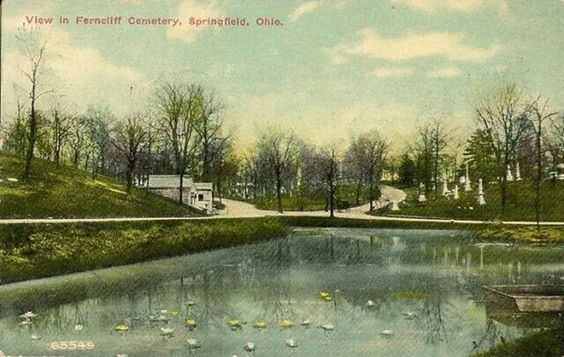
In 1933, Henry Wiley died at his residence of a heart attack, influenza being a contributory factor. Mrs. Will Jones was the informant and she did not have much information about him. He was 78 years old and was buried in Ferncliff Cemetery and Arboretum in Springfield Ohio, a 240 acre combined arboretum and cemetery.
As I went through Thomas Ray Allen’s pension file, I wondered why it was so difficult for him to get his pension raised when his medical reports showed how debilitated he was. There were those who thought that many of the veterans were not really in need of their pension money, that it was a drain on the Federal coffers.
I have shared some quotes below with some of the hows and whys of this state of affairs. After reading about Arthur Bull, another Civil War Veteran trying to get his pension, on the blog Molly’s Canopy, I realized that Thomas was fortunate in not having to travel long distances to a doctor as some of the rural veterans did.
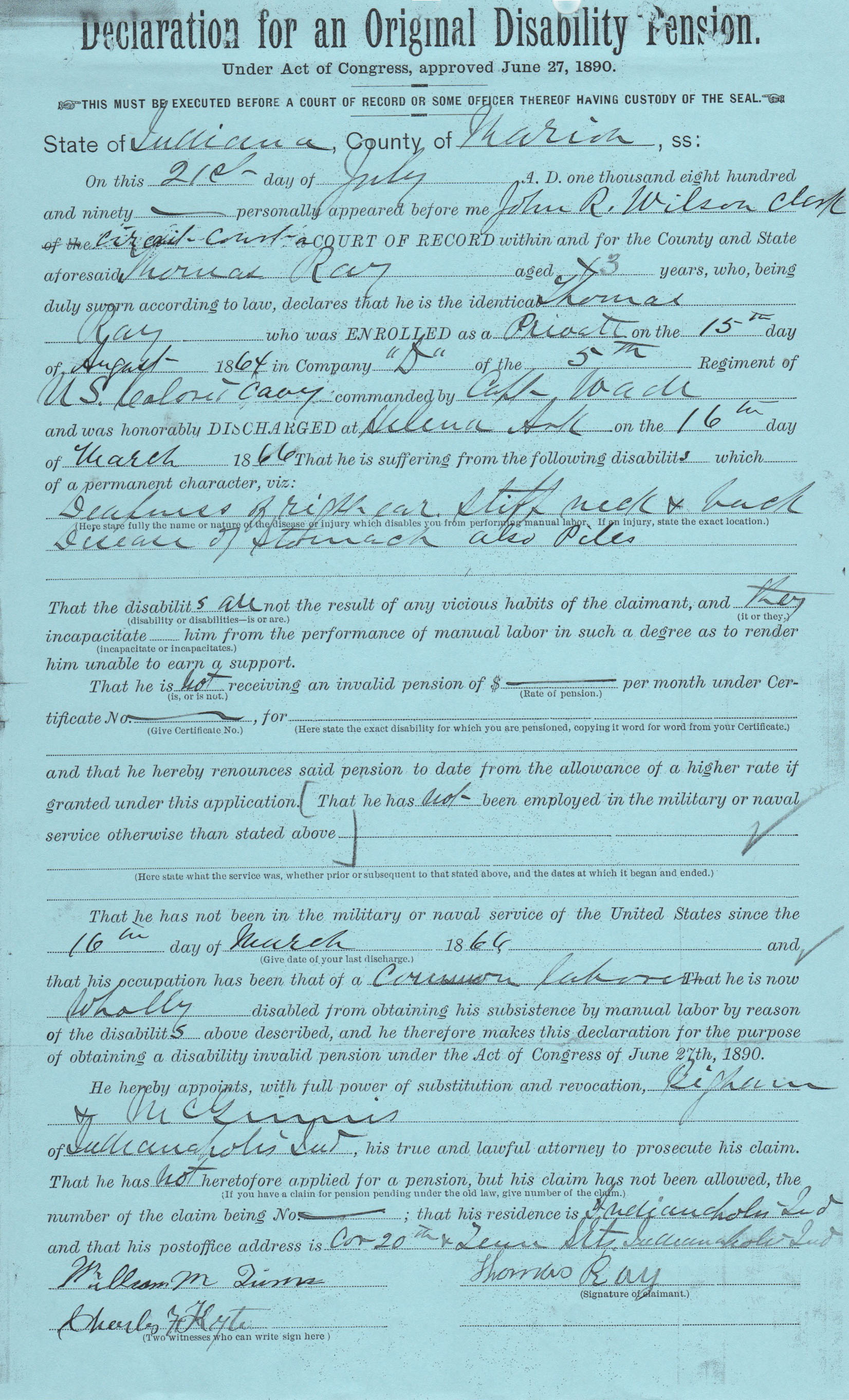
Thomas starts the process of receiving an Invalid pension a month after The Dependent and Disability Pension Act passed and was signed on June 27, 1890.
“The Dependent and Disability Pension Act was passed by the United States Congress (26 Stat. 182) and signed into law by President Benjamin Harrison on June 27, 1890. The act provided pensions for all veterans who had served at least ninety days in the Union military or naval forces, were honorably discharged from service and were unable to perform manual labor, regardless of their financial situation or when the disability was suffered. The bill was a source of contentious debate and only passed after Grover Cleveland had vetoed a previous version in 1887.” From Wikipedia, the free encyclopedia Dependent and Disability Pension Act
“The biggest single change to the pension system came in 1890 with the Dependent Pension Act. Because most veterans did some kind of manual labor to support themselves and their families, and their ability to do so declined over time, political pressure for more help increased (as did the public pleading and private, desperate letters). The 1890 Act expanded eligibility to veterans who were disabled and unable to do manual labor even if that disability was not a direct result of the war. They just had to have served ninety days and been honorably discharged. The result was a huge increase in expenditures and numbers of veterans receiving a pension. More than a million men were on the pension rolls by 1893 and pensions ate more than 40% of the federal government’s revenue. One of the side effects of this legislation was a large number of men transferring their pensions from their previous disability pensions to these new service pensions because the new pensions paid more.” Civil War Pensions by Kathleen L. Gorman
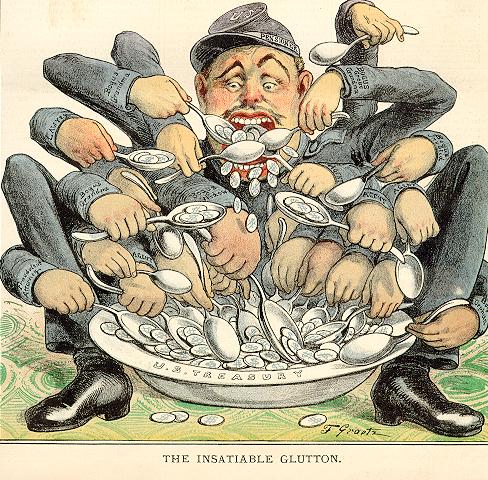
Public opinion eventually formed against the pensioner, believing that many were trying to scam the government out of money they didn’t deserve. Cartoon from the the Social Security History page about the pensions. Click the photo to go to the page.
“Those pensioners most often labeled as frauds were widows, especially young women who had married veterans much older than themselves, supposed “cowards,” and, in the Federal system, black veterans.” Civil War Pension…
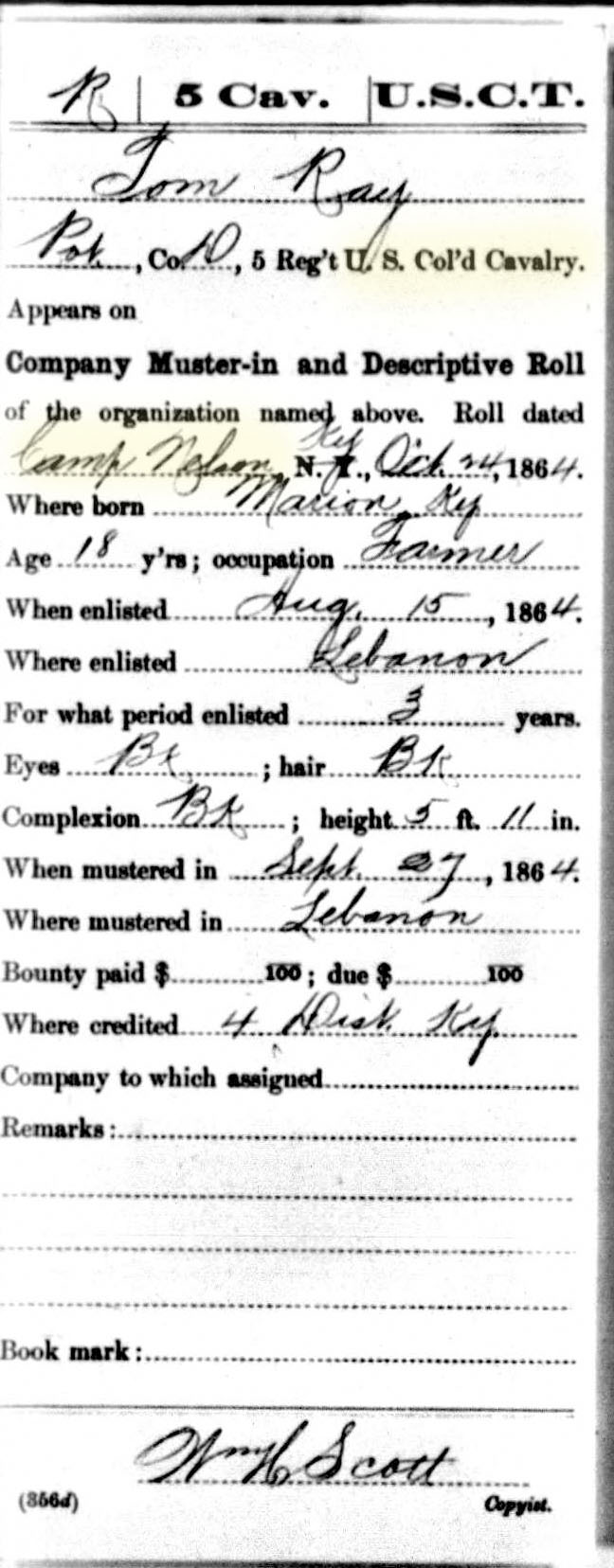
“Eight U.S. colored regiments, as they were called during that time were founded here and three others were trained here. So roughly ten thousand African American men became soldiers at Camp Nelson. In 1864 and 1865. The significance of those recruitments, first of all, was that it was the beginning of the end of slavery in Kentucky. Second of all, these men made a significant contribution to the union victory in the Civil War. A number of regiments were involved in large and small engagements. A number of soldiers were stationed at critical transportation nodes where they protected garrisons, they protected bridges, they protected supply depots.
The Camp Nelson a refugee camp was started in December 1864. And it began, had kind of a mixed beginning because these refugees, who were initially the wives and children of the enlisting U.S. colored troops, were not really supposed to come in the camp, but soldiers brought them them in because they were afraid their owners, former owners would retaliate against them. They also were hoping that the wives and children would also gain their freedom. So, they brought them into camp with them. They set up a lot of shanties throughout the camp. And finally in November 1864, the commander General Speed Fry, ejected all of the refugees from camp. Took them in wagons up towards Nicholasville on a very very cold November day. Many of them were exposed to very cold weather through the night. And out of the four hundred that were ejected, roughly one hundred died within a few weeks of this event. This created a large uproar. And the Army changed their policy. And in December a month later, constructed what they called the come home for colored refugees. Their families, the families of the enlisting soldiers, came to Camp Nelson to escape slavery themselves. They escaped the immediate condition of slavery, and they also hoped to gain their freedom.”
Thomas Allen appears in the 1888 Indianapolis City Directory living at 2715 N. Capital street. He continued to live there until his death. His wife Kate lived there until at least 1913, her last appearance in the City Directory before moving back to Ohio.
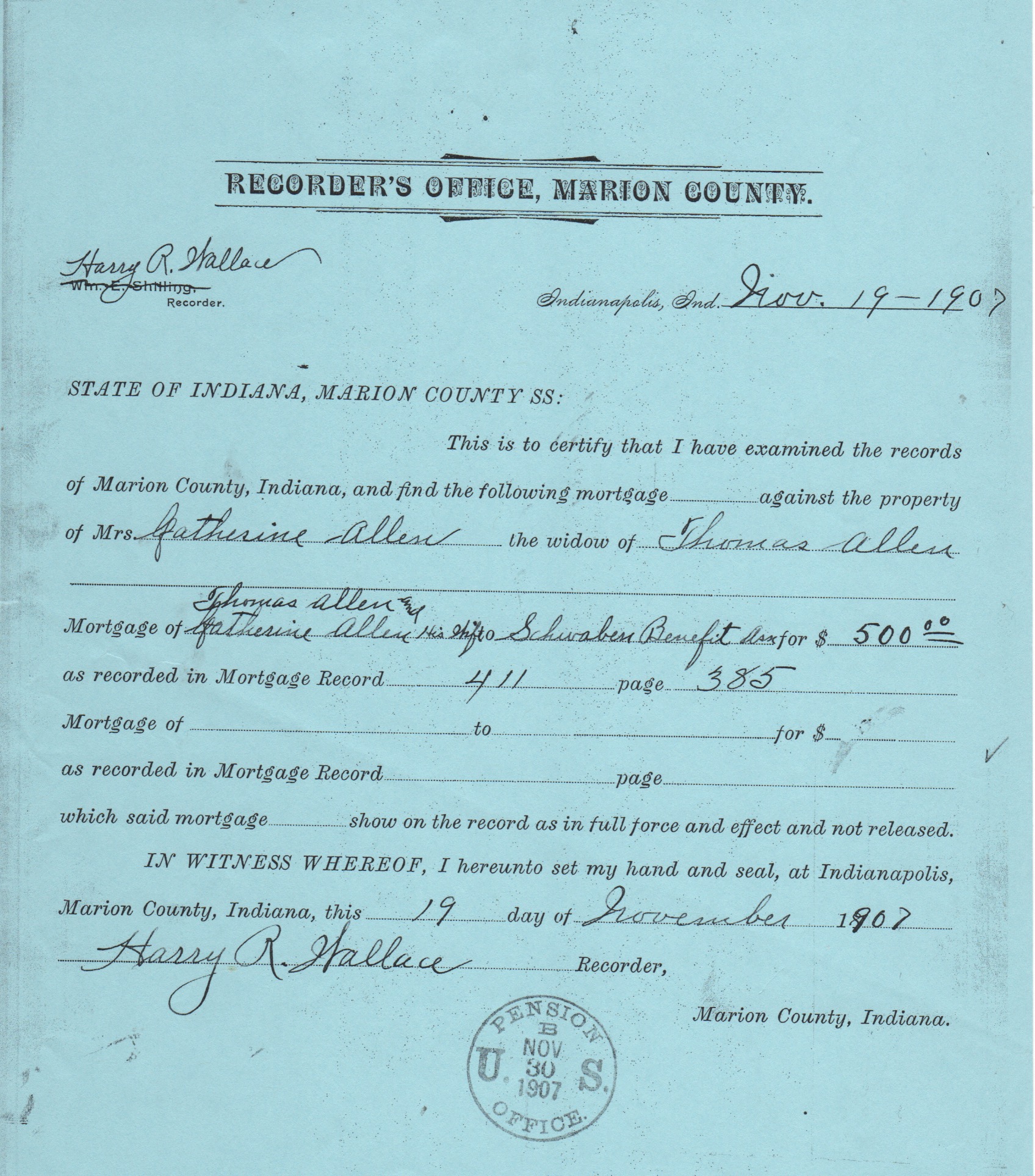
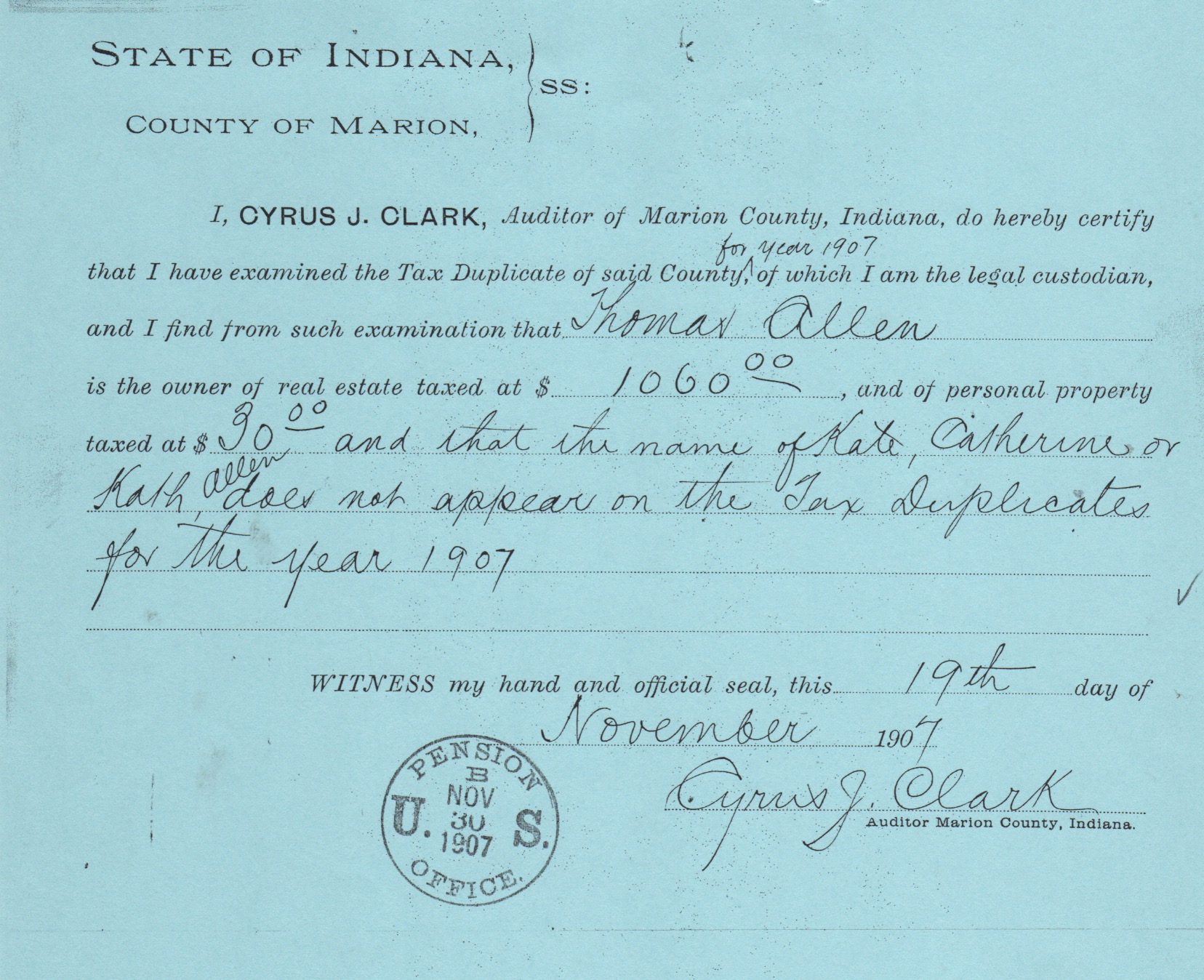
It appears the house had been mortgaged by 1907.
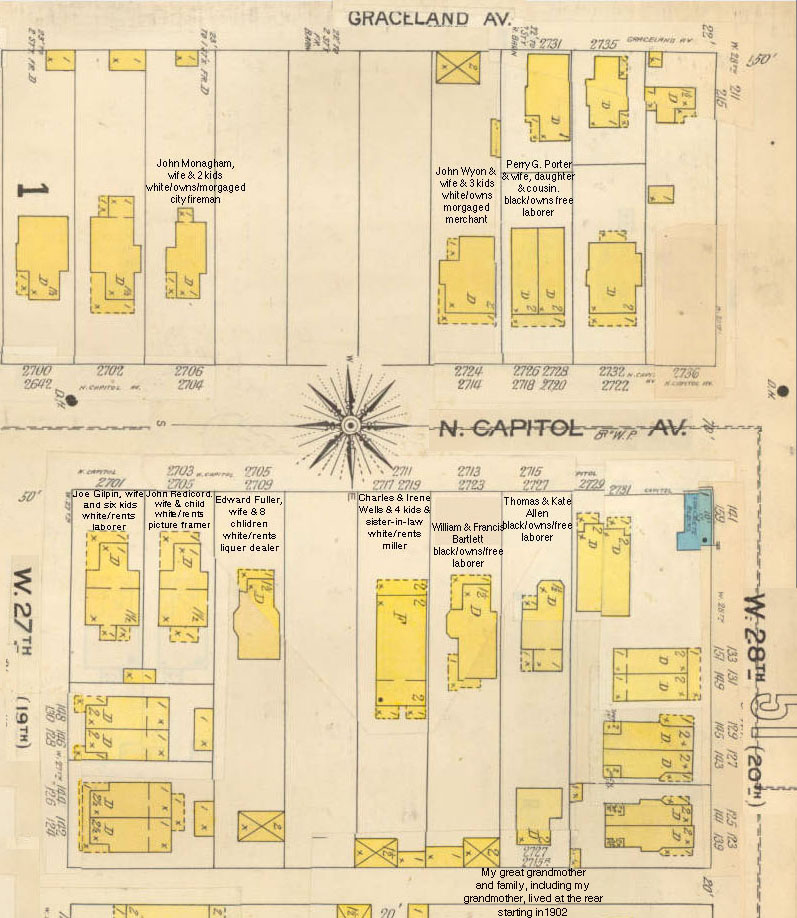
The diagram below is taken from an Indianapolis Sanborn map from 1887. A Wikipedia entry says “The Sanborn Maps were originally created for assessing fire insurance liability in urbanized areas in the United States.” Thomas and Kate Allen’s frame house had 1.5 stories. The half a story meant that the upper story was under the roof and so only half as large as the first story because the eaves take up some of it. The dotted lines indicate a porch.
Thomas’ house is 1.5 story frame house. There are two rooms downstairs and two small porches, one in the front and one in the back. It seems to be the smallest house of those shown above. On the back of the lot was another dwelling, numbered 2715 r, where my great grandmother, and her family – including my grandmother, lived in 1902. I thought it was interesting that the three black residents, all laborers, owned their houses free of mortgage. And that everybody on this chart was literate.
Looking through the enumeration district where the house was located in the 1900 Census, it was a mostly white district. There were a fair number of naturalized citizens and a number who had been born in Ireland or Germany or who had parents born there.
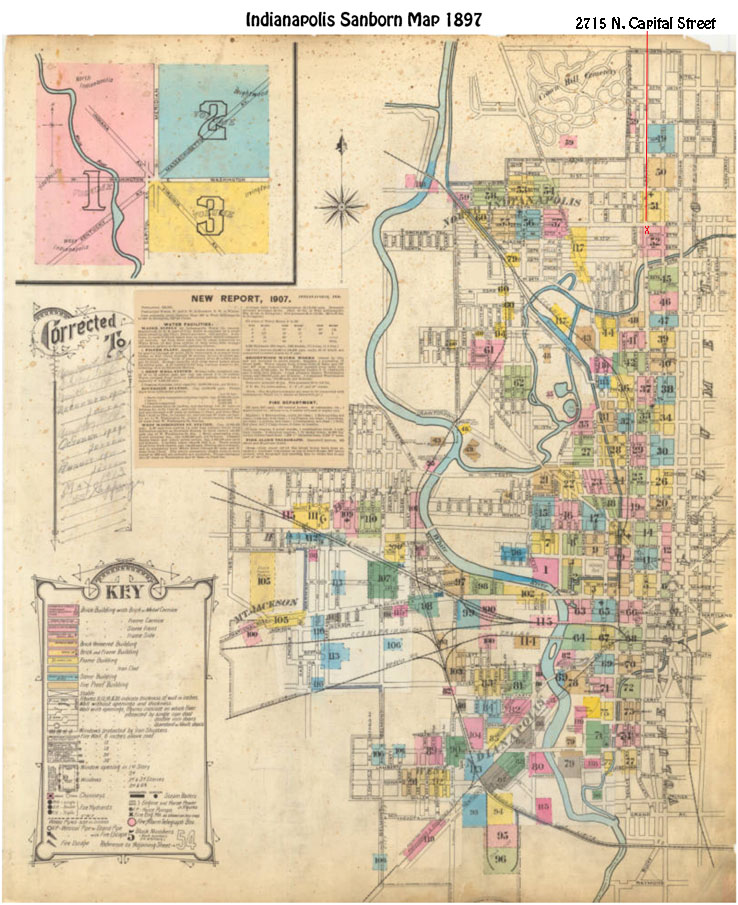
This map shows the location of Thomas’ & Kate’s house in the city in 1897. Go to the address at the top and follow the red line down to the “X”.
__________________________
I found the information here in Thomas and Kate Allen’s pension file, the 1900 census on Ancestry.com, the 1897 Sanborn map at this link, and Wikipidea.
Sarah Wiley was the oldest of child of Woody Wiley, a farmer. She was born free to a free family of color in Virginia February 2, 1841. Her mother, Susan Freeman Wiley, died before she was one year old. Her father married Sarah Daniels soon after. Nine more children were born.
We find Sarah “Sallie” Ann Wiley described in the Pittsylvania County Virginia, Register of Free Negroes.1807-1865. Reg # 467, Sept 24, 1852.“SALLY ANN WILEY, a free negro born free in Pittsylvania County, is of yellow complexion, eleven years old the 2nd day of February last.”
The extended Wiley family moved to Athens County Ohio, probably soon after the descriptions were taken in 1852. It is about 329 miles. I wonder how they traveled, but do not have time to investigate today!
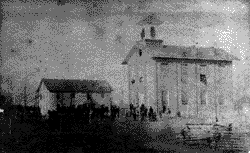
The academy
Sarah and the other Wiley children attended Albany Academy until 1862 when a religious group took over the school and banned black children. The following year her father, her uncle and a group of other African Americans started their own school, The Albany Enterprise Academy,
“After being taken over by the Disciples of Christ, Christian Church, the Albany Manual Labor Academy “refused further admission to the black community,” according to Getting to Know Athens County by Elizabeth Grover Beatty and Marjorie S. Stone.
As a result, in 1863 the Albany Enterprise Academy was founded. The school’s first trustees included Thomas Jefferson Furguson (co-founder of the Ohio Colored Teacher’s Association, member of the Albany City Council and the first black to serve on a jury in Athens County), Cornelius Berry (father of Edward Berry of the Berry Hotel), Philip Clay, David Norman, Woodrow Wiley and Jackson Wiley.”
When Sarah was 25 years old, her youngest sister was born and her step-mother died. There were still six other children at home. Sarah stepped into the role of mother and housekeeper.
In July 1873, her father Woody was suffering from consumption and made out his will. He left everything to the three children that were still alive and living at home, Sarah (31), Henry (18) and Armintha (12).
Woody charged Sarah with seeing that Armintha received a good “common school” education and was taken care of materially.
When Armintha was 22, she married William Green Simpson, a neighbor. Armintha died within the next few years and William married again. Sarah never married.
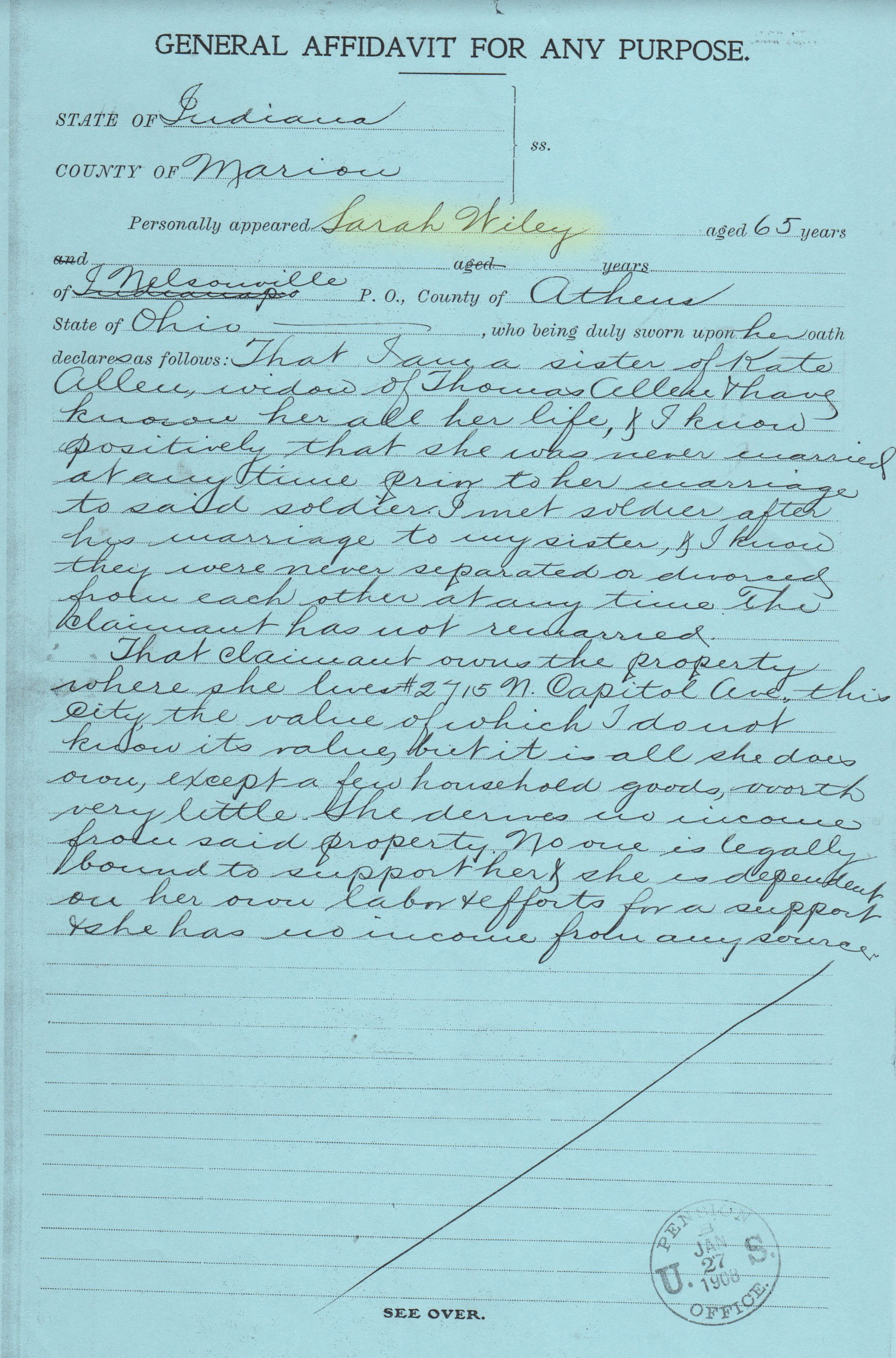
Click to enlarge. Sarah states that she is Kate’s sister and that Kate has nothing aside from her house and goods and that no one is bound to support her.
In 1908 Sarah gave testimony for her sister Kate Wiley Allen, who was trying to get her widow’s pension after her husband Thomas Ray Allen died. After Kate began to receive her pension, Sarah moved to Indianapolis and they shared Kate’s house for several years. They then returned to Ohio where Kate died in 1915.
In 1920, Sarah was living with her former brother-in-law, William Green Simpson, who had been married to her younger sister Armintha. His youngest son was still at home. They were both coal miners. Sarah was the housekeeper. In 1924 William married a 3rd time, to Dora Parker, a widow with four children under ten. Sarah was 82.
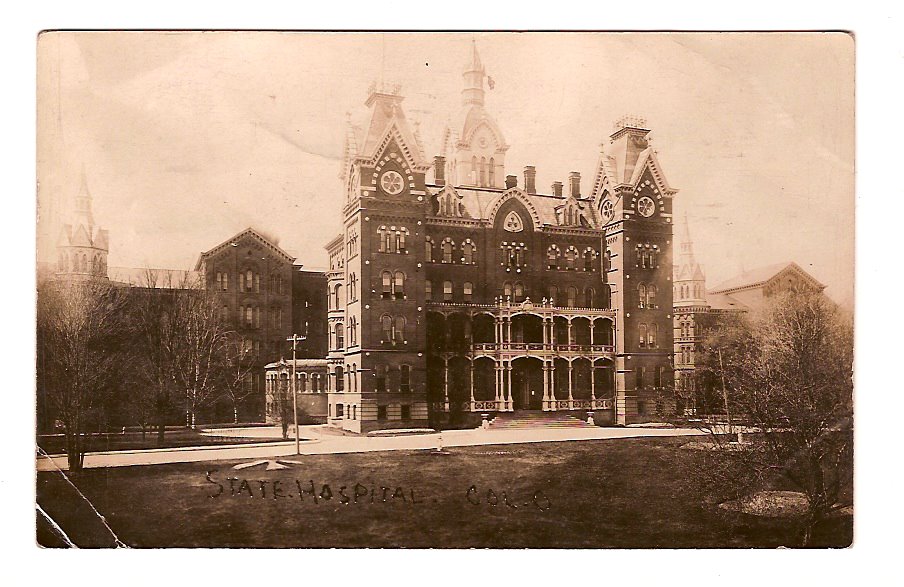
By 1928, Sarah was an inmate in the Columbus State Hospital, a mental hospital in Columbus Ohio. Sarah died in the State Hospital in 1932, of atherosclerosis. She was 93 years old.
Her brother-in-law Henry Simpson was the informant on her death certificate. He died in April of 1935. He had been a miner for most of his working life and died of “miners’ asthma” also known as “black lung disease.”
________________________
I found this information on ancestry.com, familysearch.org and places on the internet linked to above. Using the information that I found, it is easy to fill in the blanks to make a story. The problem is, I do not really know the ends and outs and the personalities and the reasons involved. I hope that I have, at least, gotten the “facts” right.