A Transcribed Interview with Stella Brown McCall – Part 1

Margaret McCall Thomas Ward

This is partial transcription of a very long interview that my cousin Margaret McCall made with her Aunt Stella Brown McCall in 1986. Margaret was Mary McCall’s granddaughter. Mary McCall was Eliza Williams Allen and Milton Saffold’s daughter. Stella Brown McCall was married to Margaret’s father’s brother. Margaret’s father was James McCall and his brother was Roscoe McCall. Louise was Stella and Roscoe’s daughter. Joe was Margaret and Stella’s cousin.

Part 1

Margaret: I’m doing family history now and I’m on the McCall side. And I want to learn as much as I can because there are some gaps in things that I have been able to find.
Stella: Well, I don’t know too much about the…
Louise: She doesn’t know about the McCall side because she’s given me all the memories of her side. I have all those you know…
Margaret: On the Brown side?
Stella: Yes.
Louise: Oh yes.
Margaret: But it’s the McCall side I’m interested in.
Louise: Mother you can tell her one thing I remember you told me about the McCall side, you told me that Daddy, that Daddy’s father was a jailor
Stella: He worked at the jail, the Montgomery jail down in Montgomery.
Louise: and they used to have him…he was the whipper and, you know, he was supposed to whip the prisoners, you know the black prisoners. And he would pretend that he was whipping them and you know, make them yell and he would make the whip sound. Isn’t that interesting? I can just picture that.
Stella: Well he had to pose to keep from whipping the prisoners.
Louise: Oh and mother you can also tell her about how Daddy was getting that man out of Montgomery for looking at the white girl. And then they were going to hang him and Daddy had to take him out on that lonely road and get him out of town. And …
Stella: they got stopped on the road.
Louise: The police, the posse, don’t they call it a posse? Or whatever.
Stella: Yes.
Louise: came after him and then when they shined the light on Daddy. They were in a field and they saw that it was Mr., your grandfather McCall’s son and they said “Oh Rossie…”
Stella: Because his father, not cutting you off, Ross’s own, father had worked at the jail and had charge of the colored prisoners. They would have him punish the colored prisoners and he never punished not one. Because he could do it like he wanted to do it. He just posed… Had a whipping place and made the noise like he was whipping them but he didn’t touch a one of them.
Margaret: So this incident of Uncle Ross in the field, what happened?
Stella: They stopped him, right at that field.
Louise: No mother, start with how they were standing outside the drugstore… he and that other one, that Watkins boy and the white girl came by and she told her boyfriend that they had, that this Watkins fellow had winked at her and that started a riot in the city.
Stella: Winked at her.
Margaret: Is that right?
Stella: A riot.
Margaret: Well, how did Uncle Ross get him out of the city?
Stella: Out of the city?
Margaret: You said that they were in the field and the police came and said…
Stella: Now all before this started, Ross had a friend out in the country. This man was a good friend of his and they would go hunting out there. And that’s why he knew the man… his name… I can’t think of his name… what was his name…anyway, well he had a home down in the country and he would go down there every summer you know, just take a week off and hunt and…
Louise: A good place to hide out.
Stella: To hide out. Yes.
Margaret: That’s all?
Stella: And there was a railroad train coming out of Montgomery going on to Atlanta and Ross got this man out of Montgomery and had this porter on this train to stop at this little station down there in the country and nobody would ever think a train would stop there and he stopped just like he got him to do and he put this man on this train in the back and had a place for him to stay and stay shut up and he did that until he got to Atlanta and he was safe.
Margaret: And did he stay in Atlanta or did he leave Atlanta?
Stella: Oh he left Atlanta. We didn’t hear any more of him. But Ross saved his life! They were going to lynch him uh huh, oh yes. Ross had some narrow escapes in that time.
Margaret: He did?
Stella:Yes, because you see this one was taking him for that and that one was taking him for this and it was terrible.

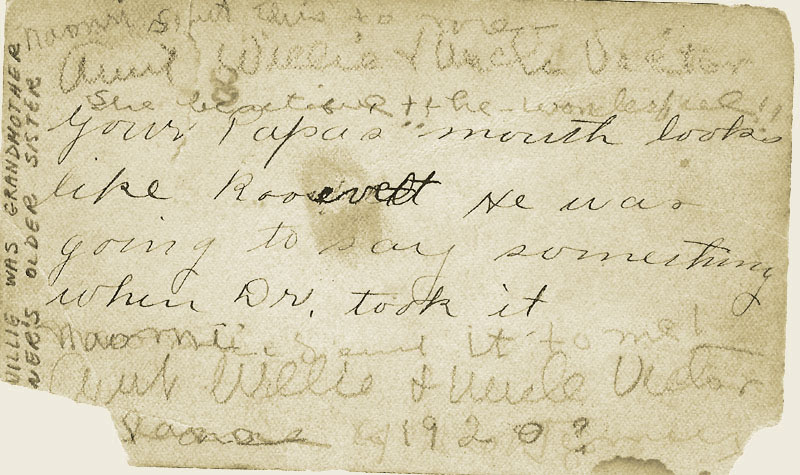
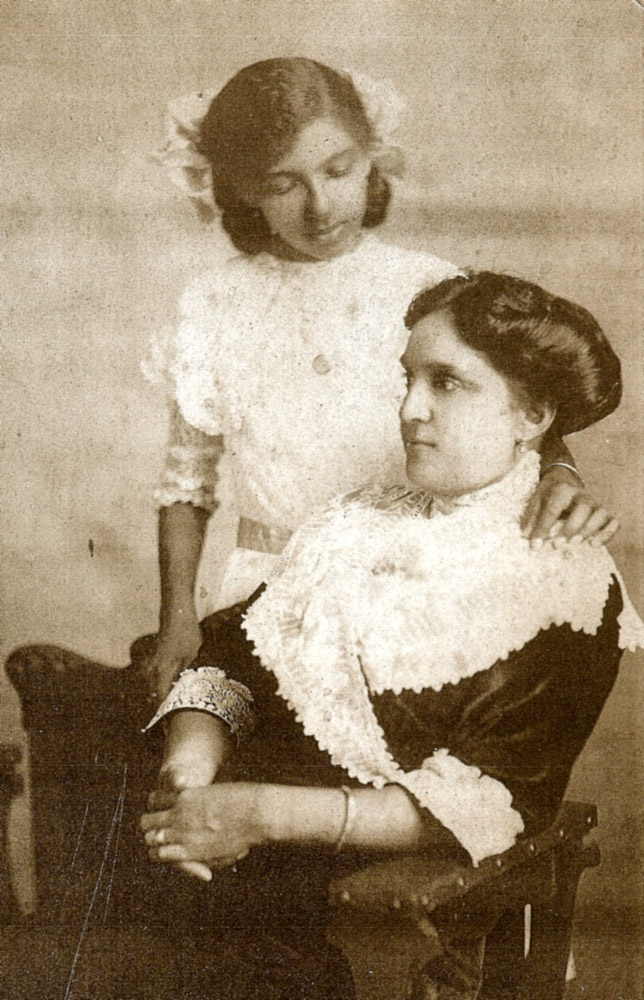
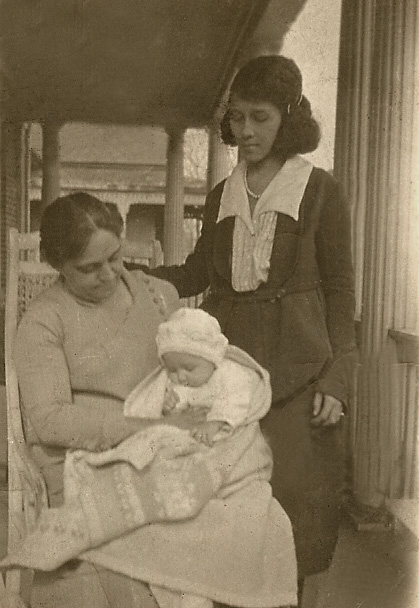
Stella McCall and Roscoe Jr.

Margaret: Now tell me, you and Uncle Roscoe married in Montgomery?
Stella: Montgomery, yes I married in Montgomery,
Margaret: Where did Uncle Roscoe go to school?
Stella: At State Normal School in Montgomery. And he went to the senior class and some girl got him in trouble and he had to jump out and go and that’s why he didn’t get his papers, you know.
Margaret: How did she get him in trouble?
Stella: Well she was… I guess something was wrong with her…. pregnant. That’s why he had to leave Montgomery. He left Montgomery.
Margaret: And where did he go?
Stella: Where did he go? New York.
Louise: Who are you talking about Daddy?
Stella: And then later he came on down.
Louise: Married you.
Stella: yes came back. Stayed away a long time though. I didn’t hardly…I was his little sister’s dearest friend and I didn’t know anything about him. Nothing. I’d heard of him because he was my brother, he was the age of my oldest brother Scott.
Joe: Was Jeanette your friend?
Louise: Um hum. Jeanette was your friend.
Stella: Jeanette was my best friend all the way from the first grade. And I didn’t know anything about him. I didn’t know there was a brother because he was away. Finished the senior class and everything and gone. Got in trouble and gone.
Margaret: Where did you go to school?
Stella: Same place he did – State.
Margaret: You went to State?
Stella: Yes, same thing. Same school but many years later, you know.
Margaret: Afterwards.
Stella: Now I was Jeanette, his sister’s age, his baby sister. And I didn’t know anything about him (laughs) he came on the scene later. And we were swept away (laughs again. He’d come to the house everyday..
Margaret: Uncle Ross would come to the house everyday, uh?
Stella: Everyday. Every evening. I can see him coming now.(laughs) Well, and that went on so far and we decided to marry.
Margaret: How did you happen to leave Montgomery?
Stella: Oh people were leaving Montgomery like mad at that time.
Margaret: Why?
Stella: There was kind of a thing going then, getting out of the South. That’s when all this uproar started down there. Started changing schools and everything and getting the different things in order for the blacks to go to one school and the whites to another school and they had to fight that and different things and it made an uproar in the city. And then many many of the… all the important families in the city just packed up and said they were going to leave the city and that’s what was happening.

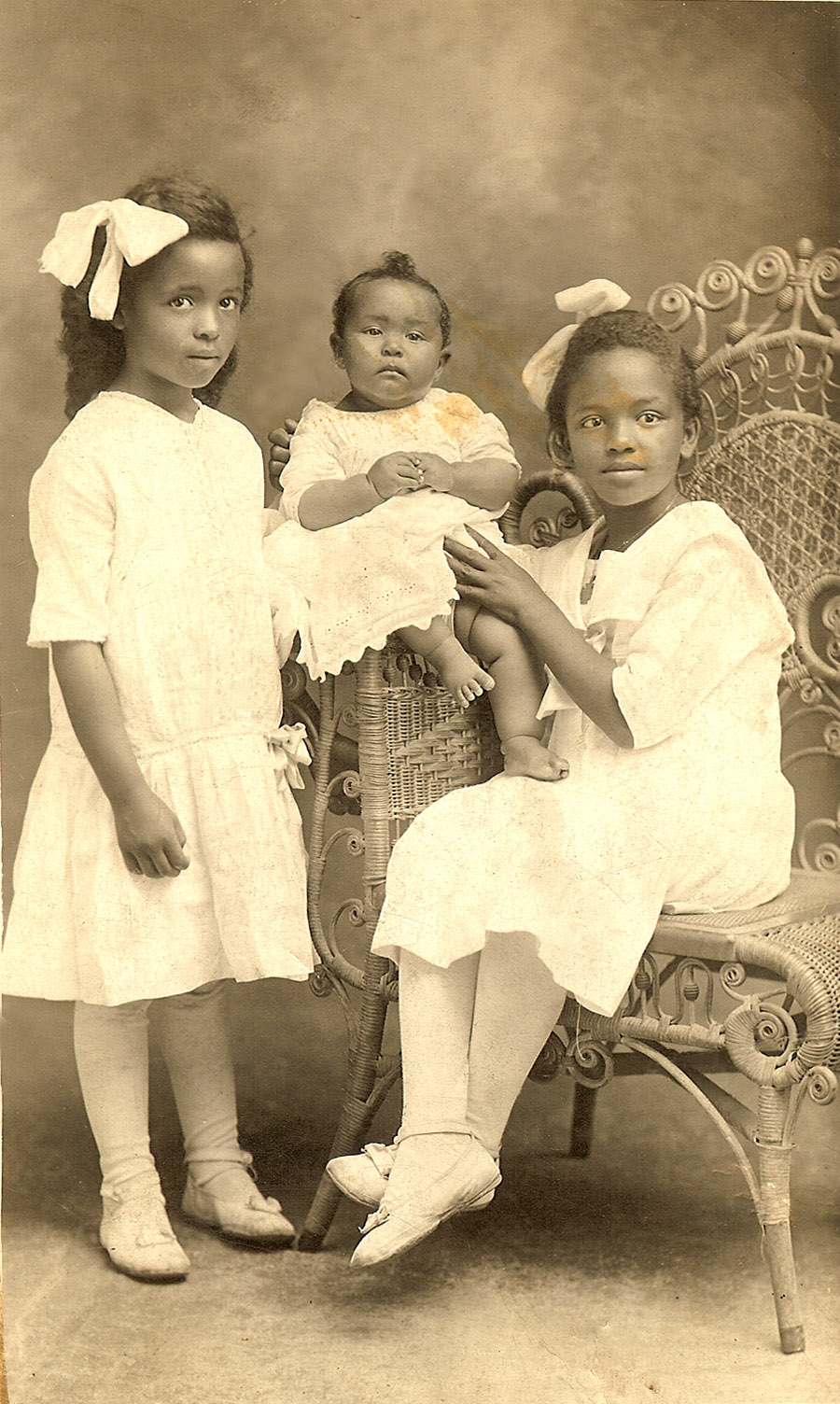
Roscoe McCall holding Roscoe Jr & Louise. Detroit 1921.

Margaret: When you were going to school, where did you go before Normal?
Stella: One school for me. One school for him. Same school.
Margaret: What was that?
Stella: State.
Margaret: No, but before State Normal for your early education where did you go?
Stella: The only education they had from the cradle to the top floor.
Margaret: Oh, State went all the way.
Stella: Yes, they had buildings on the big grounds and the grammar school buildings were around on the circle ad then the juniors and then the seniors.
Margaret: Now was it integrated then or was it all black or…
Stella: All Black
Margaret:All Black
Stella: All black.
Margaret: Okay, what about the teachers. Who were the teachers?
Stella: White. They started off with all white. Now I remember when I was down in the grades there was one teacher that they had kept, teacher name of Mrs. Foster and she was an excellent first grade teacher. And they kept her. But then later on they started putting the white people in and they’d keep them in, then they’d kick about it and then had to give them recognition you know and finally they got the school like they wanted it and then they… it was a black school. Had it turned black, see, but in the beginning it had all white teachers. Yes because when Ross was there now he graduated, well I’d say, a good eight or ten years before I was in there and he had a teacher that I remember a Mrs. Stuart. She had been teaching there from the beginning and she was there until the end. She was from up North. They brought those teachers down from the north. That’s the way they did. The whole school was white but then finally turned right back because they were fighting it so. They wanted colored teachers in there.
Margaret: Who are they who were fighting?
Stella: The people.
Margaret: The black people?
Stella: Yes, that’s who fought. They had… I can remember the teachers, they were crazy about Ross. He was always such a good friend to them. (laugh) Getting in with everybody. He always was on the good side. Yes, Ross was a sight.
Joe: You remember…one day…he was the first one I ever did see ride a motorcycle.
Louise: That’s right. You know everything.
Stella: Nobody had a motorcycle in the city but Ross.
Louise: You remember that?
Joe: First time I ever remember seeing him.
Margaret: Where was this, Montgomery. He had a motorcycle?

Stella: He used to ride that motorcycle out to my house everyday and ride it back downtown to the drugstore where he was working. They had opened up a drugstore.
Margaret: Who had opened up a drugstore?
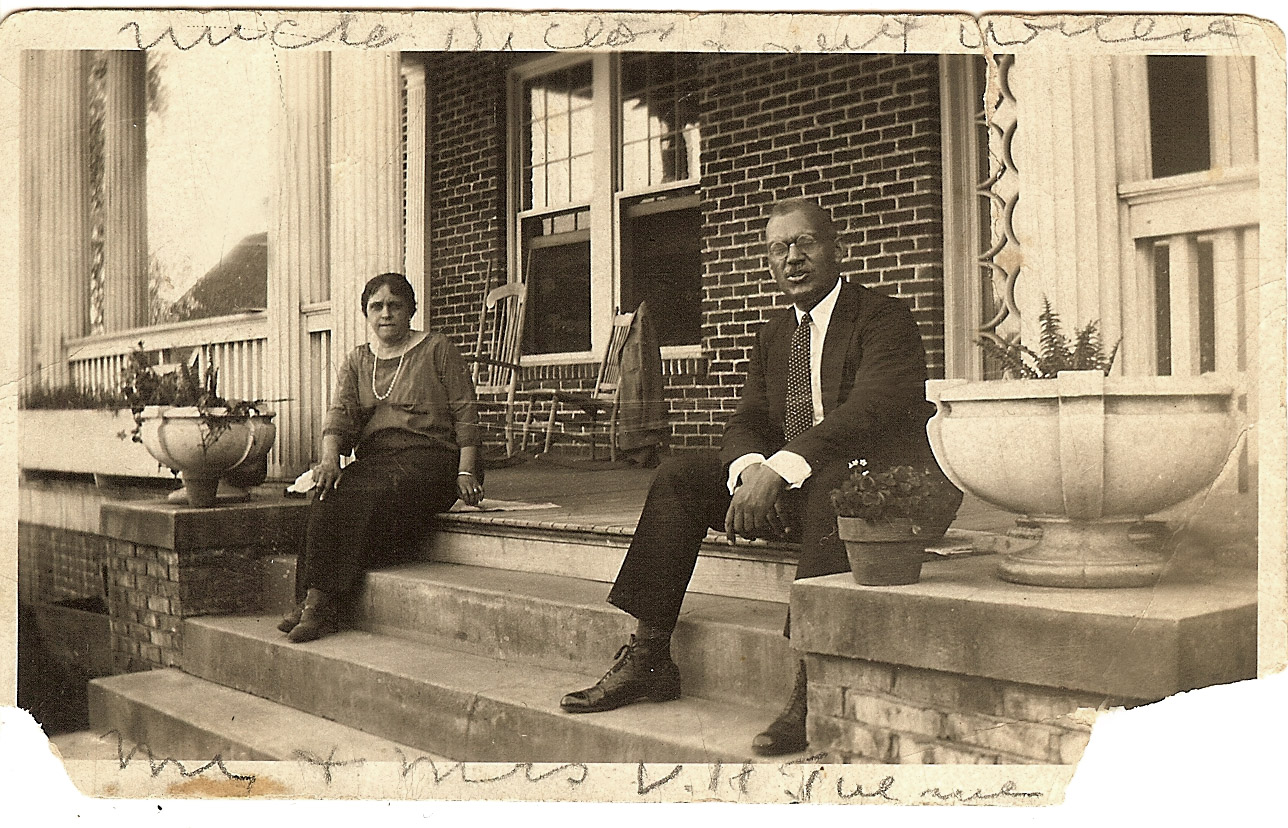
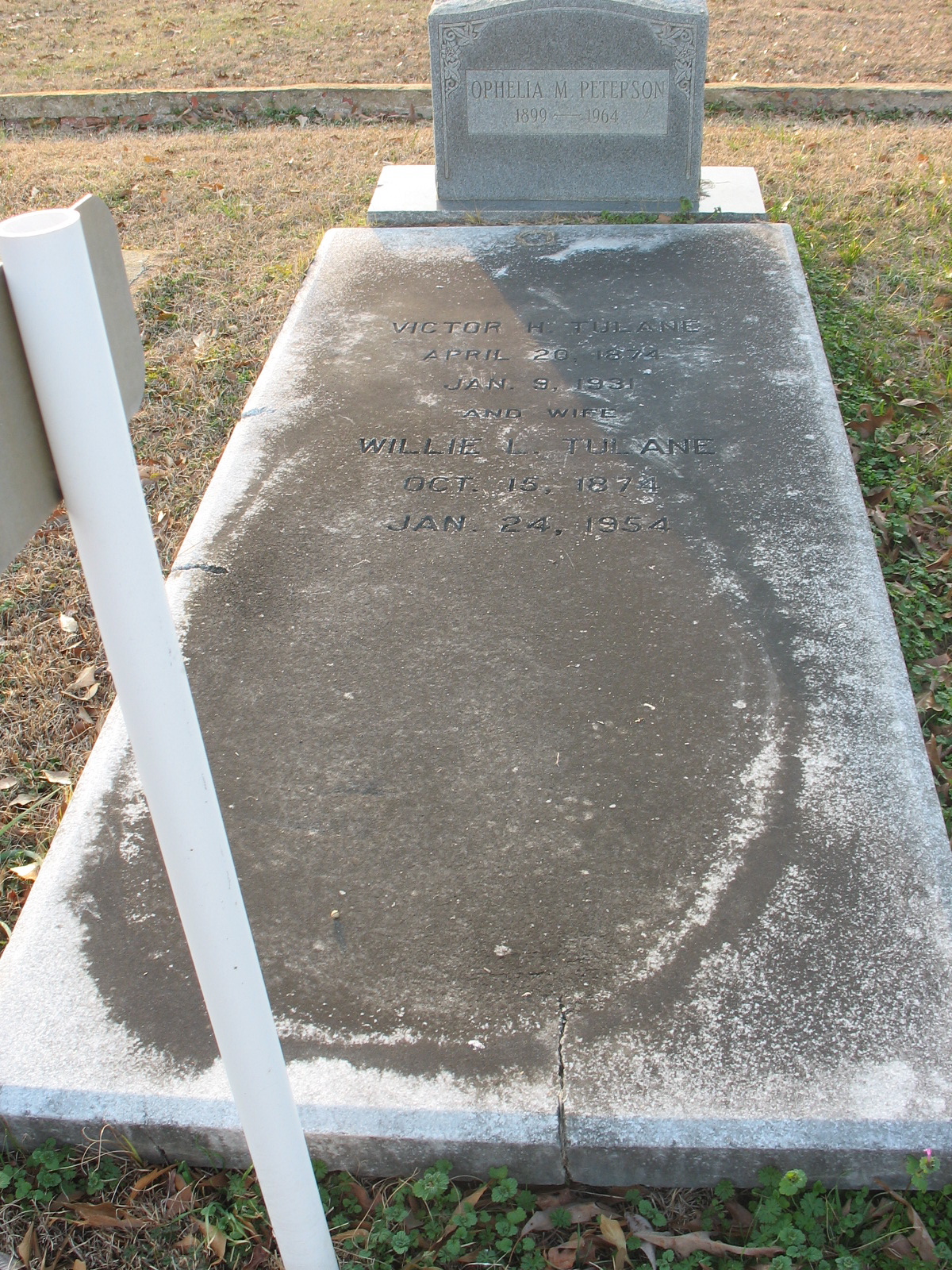
Stella:Mr. Tulane, his uncle and they all were working in it It was a nice big, good business and everybody would be so congenial and everything when you would go in. You remember the drugstore? You used to hang out around the drugstore every Sunday. You could find anybody you wanted at the drugstore (laughs) when you’d court.

Backyard Photos – Theodore St. Detroit, Michigan

While going through my grandmother’s photographs awhile ago I noticed that they had photos of people lined up in the backyard.  When I looked closer I found some of the relatives I had not realized we had pictures of.  One lingering question is why was cousin Alphonso the only relative I met?

"theodore backyard"
May 1940. My grandparents, Mershell and Fannie Graham, with unidentified visitors.

"theodore backyard alphonso"
Summer 1960

Left to right:  Abbie Allen Brown, Mershell Graham (my grandfather), Alphonso Brown(Abbie’s son), me, Doris Graham Cleage (my mother)  Back – Fannie (my grandmother)  Henry Cleage (my uncle & step-father).  Abbie was my 2 x great aunt and Dock & Eliza’s daughter.

"theodore backyard roscoe and stella"
“Stella + Ros 1960 Our back yard. On visit from Chicago.”

Left to right: Roscoe, Fannie, Stella, Abbie. Roscoe McCall was Mary Allen McCall’s son. Stella was his wife. Mary was Eliza’s daughter.

"theodore backyard bobbie visits"
 “Right to left:  Bobbie, unintelligible name, Mrs. Bishop, Daisy, Fan, Alice, Abbie.  Taken by John Wesley Allen.  Our back yard.  9-21-61.  Daisy passed 11 – 24-61.  Her last picture.”

John Wesley Allen was Ransom Allen’s son.  Ransom was Eliza and Dock’s son.  Abbie was Dock and Eliza’s daughter.  Alice was my grandmother Fannie’s youngest sister.  Daisy was my grandmother’s sister. Bobbie was John’s wife.

"theodore backyard Rance and Bobbie Allen visit."
Same day as above with John Wesley Allen on the right.

"Theodore backyard Ruth Pope visits from Chicago. 1963."
“Alice , Abbie , Ruth , Mother, Daddy. Ruth Pope age 15”

Ruth is Beulah Allen Pope’s granddaughter and Robert Pope’s daughter. Abbie and Beulah were Dock and Eliza’s daughters.  Robert Pope, Fannie and Alice were Dock & Eliza’s grandchildren. Ruth is Eliza’s great granddaughter.  August 1963.

Emma and Joe Turner of Gordensville, Lowndes County, Alabama

My grandmother Fannie Turner Graham’s father was named Howard Turner. She did not have a photograph of him but said he looked like her grandfather, Dock Allen and my grandfather, Mershell Graham. Both pictured above. When my grandmother was four, her father Howard was killed at a barbecue. Her parents, Howard and Jennie (Allen) Turner had been talking about selling their portion of the Turner land and moving to Montgomery. Howard and his father had an argument before the barbecue and my great grandmother, Jennie, believed that Howard’s father had him killed so that he could not sell the land. Jennie took the deed to a lawyer and asked him to look over the deed because she wanted to sell the land. When she returned he told her the title wasn’t clear and she didn’t own the land. She figured her father-in-law had gotten it back. Jennie moved back to her parent’s home in Montgomery with her children and went to work as a seamstress. You can read her story here. Years later, my grandmother met one of her cousins on the street and learned that her grandfather did not get the land after all and had not had her father killed. This is all the information I had.

When I began searching online all I knew about my Turners was that they lived in or near Hayneville, Alabama: that my great-grandfather owned his farm: that my great grandfather’s name was Howard and that he was born about 1864. The 1880 census was available with an all name index through Family Search and I found Howard Turner, age 16, living with his family in Hayneville. He was a clerk in a store. It was a very emotional moment to find my great, great grandparents names. Joe and Emma Turner. The family included Lydia 18 born about 1862, Howard 16, born about 1864, Joe age 13 and at school, Annie 11 and Alonza 7. Joe senior and Emma were listed as 39. Below is the family sheet for Joe and Emma Turner.

With this information I was able to find them on Ancestry in the 1870 census, which was indexed only by head of household at that time. They were enumerated In Hayneville Beat 1, Lowndes County. Emma was and her parents were born in SC. Joe was born in Alabama. Joe was a farmer with $300 worth of personal goods. Neither he nor his wife Emma could read or write. The children were Lydia, 8, Howard 7, Fannie 6, Joe 3 and Annie born in August of that year. Joe Turner is in the 1866 census with 5 in the family living in Lowndes County, AL. From son Joe’s death record I learned that Emma’s maiden name was Jones. Or so the informant said.

In 1900 Joe and Emma owned their farm. Two of their grandchildren, Anelyzor (Annie) and Joseph Davis were enumerated with them. Emma had given birth to 11 children and only three were still alive. Those three were Joe, Alonza and Lydia parent of the above Annie and Joe. They had been married 39 years, which would place their marriage during slavery.

Emma died soon after the 1900 census. Joe remarried in 1902 to Luella Freeman, 40 years his junior. They went on to have 8 children – John, Anna, Daniel, Buck, Josephine, Talmudge, Luella, and Selena who was born after Joe died February 7, 1919 of “prostatic trouble and old age.” Luella died in Chicago in July of 1977. I think, but I need to send for the death certificate to check.  Below is the family sheet for Joe and Luella Turner.

Now I need to find estate records, a will…. something that will give me names and places. I want to look at land records too. And newspapers from Lowndes County, Hayneville from 1892 when Howard died. This means a trip to an archive. Something I have never done. I need to check something else too, in Mildred Brewer Russell’s book “Lowndes Court House” it says that Joe Turner was one of a number of “prominent Negro politicians” during reconstruction. I have yet to find anything else about this, such as what office he held. It would be great to meet some of Joe Turner’s other descendants too – hopefully with some photos and able to tell me where Moss cemetery is since it seems to be no where but on their death certificates. I picture a lonely, deserted place in the woods with no markers. Just sunken areas.

Dock Allen’s Story

Dock Allen’s Story
As told to me in a phone conversation with my cousin Jacqui Vincent

Dock Allen was a white man’s son but not the one he ran away from.  His owner was a mean man who kept vicious dogs so that the slaves would be afraid to run.  Dock decided he was going to escape anyway but he did some things to throw the dogs off of his track. He walked through a wet field of wild ramps. He rubbed himself with them, poured the water on himself and practically rolled around in the field so the onion smell would hide his own.

Further along he came to a farm.  By that time he was very tired so he climbed up into the hay loft and covered himself with hay.  The tracking dogs came and he could feel their breath as they walked over him, but they didn’t find him because of the onion odor.  Eventually they left.

This was the same place where Eliza lived.  Later he decided to give himself up and the white people at the house send a message his master.  When he came to get Dock he said that no one had ever out smarted his dogs and that any man who was smart enough to do that deserved to be free and he freed him.  Dock stayed on that place and married Eliza.

Doc Allen in the record.

I found Dock Allen in in the 1867 voter registration database living in Montgomery, AL.  He appears with his family in the 1870, 1880 and 1900 census in Montgomery.  According to the records he was a carpenter born in Georgia.  He owned his own home.  In the 1900 census he and Eliza had been married 40 years which puts the beginning around 1860.

I have three addresses for him, 237 Clay street, 216 Holt street and finally 444 S. Ripley street where he lived for the five years before he died March 29, 1909 of “inflammatory bowels” after being ill for several weeks.  His mother is listed as Matilda Brewster on his death certificate.  No father is listed. He is buried in Oakwood Cemetery in Montgomery.

I would like to find information about a runaway matching his description in the Dallas/Lowndes county area around 1860.  Probably that will have to wait until I am able to go to Alabama and do some research there.

Eliza and the people in her life – A Chart

Before I continue with the story of Eliza’s husband, Dock Allen and the rest of her children, I thought that a chart might make the story more understandable.

Eliza is in the largest photo towards the center of the chart.  Her mother is Annie Williams.  Both were enslaved by Edmund and Jane Harrison of Lowndes and Montgomery Alabama.  Later, I hypothesize, Eliza went with the Harrison’s daughter, Martha when she was married to Milton Saffold.  Milton and Martha (she and her children are in the violet boxes) had three sons and then Martha died.  Eliza had a daughter, Mary with Milton.  Later Milton married Georgia Whitting (She and her sons are in the green boxes).  Oral history says that Eliza and Mary were freed soon after this.  Eliza later married Dock Allen, a free man and a carpenter.  They had 8 children that survived to adulthood (blue boxes).  Around 1874 Milton Saffold had a relationship with Clara Bolten (peach boxes) and they had two children together.  Clara had a third daughter with an Irwin.  Milton Saffold went to California and died there in 1879.