This is my 13th year participating in the A to Z Challenge. This year I will be writing about the families that were once enslaved on the plantation of Foster and Marietta Ray in Lebanon, Kentucky.
I first learned what plantation my grandmother Pearl’s family were enslaved on when I discovered her uncle Thomas Allen who was part of the United States Colored Troops during the Civil War. The information was in his petition file. Since then I have found more information and more names of the members of that community.
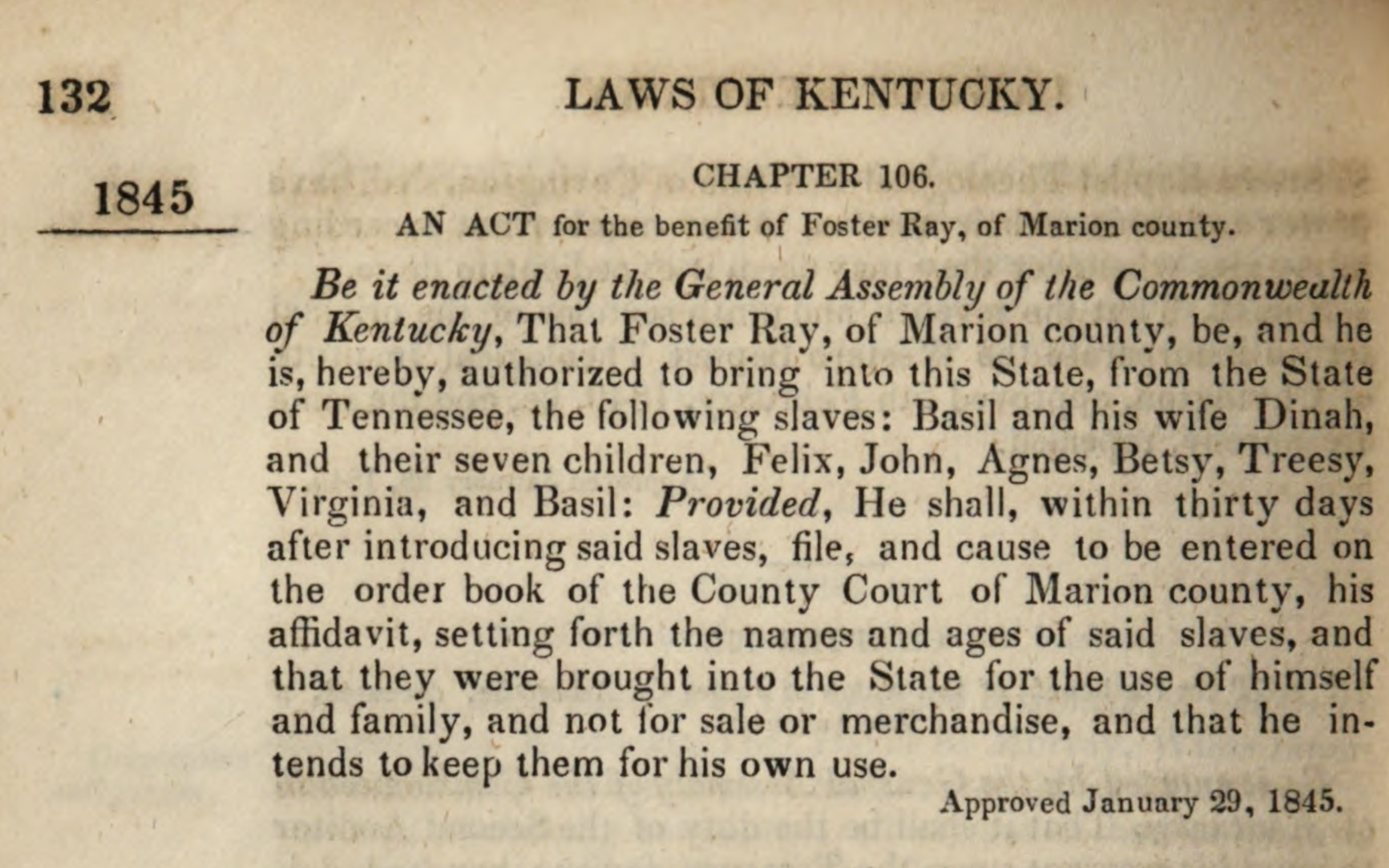
I found several news items from 1845 that appeared in the local Lebanon paper and mentioned that Foster Ray had asked for and received permission to bring in nine enslaved people for his “personal use”. At this time it was illegal to bring people into Kentucky and resell them, but keeping them for yourself was okay. I assumed that these were nine unrelated people until I found another item saying that the group was a family, Basil and Dinah and seven of their children – Felix (12), John (11), Agnes (10), Betsy (8), Treesy (6), Virginia (2) and Basil (1).
I found Basil and Dinah in only one record, a baptismal record for Basil at St. Augustine Catholic Church. I assume they died before slavery in Kentucky ended with the ratification of the 13th Amendment on December 18, 1865. It was one of the last places in the U.S. to emancipate enslaved people.
All the children survived to be free and I found records for them – census, marriage, death records and the Will of Marietta Ray Foster, who left bequests to several of them along with two of my family members. I had assumed that all of them were unrelated and started separate family trees for each. I also assumed that they took the name of “Ray”. They didn’t. All but Basil took the name “Primus”. Which I assume was the name their parents used.
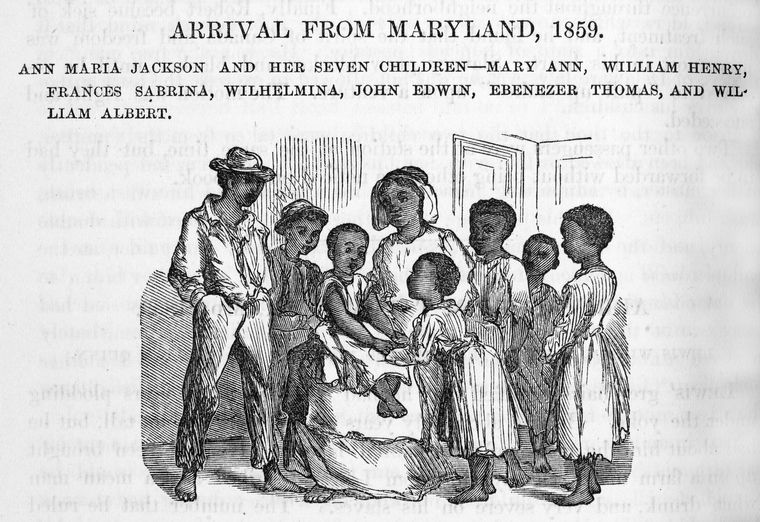
While looking for a picture to illustrate this post, I came across the one below. It was another mother with seven of her children. They were born in Maryland, as was the Primus family. You can click on the picture for more information about Anna Marie Jackson and her family who were not from the Foster Ray plantation.
I will write about several members of the Primus family during this challenge.
_______________________
Previous posts in this series.
Foster Ray – Slaveholder
Marietta Ray Foster’s Death and Will – 1872
Thomas Ray Allen 1847 – 1907
Agnes Primus
Clara Hoskins Green – Thomas’ Mother
I’m looking forward to reading more about your enslaved ancestors. It’s great that you have found documents about their lives!
Not all will be my ancestors, but all will have some off of plantations where my ancestors were also enslaved.
I have been very lucky in finding documents!
Amazing that you can trace your family through those horrible years. Looking forward to learning more.
It takes lots of searching and becoming familiar with what is out there. That and being in the right place in the right time when some important information is shared.
Great post mommy. I appreciated the picture of the mom and her seven children it helped ground me in the reality of SEVEN children in the midst of it all.
And I didn’t know Kentucky was one of the last places to emancipate enslaved people…. Quite a loophole that allowance to bring people in for personal use 🤬
It seems like in genealogy research assumptions may play a role similar to the one that hypotheses play in scientific research – they give you someplace to start but often you will find something different than what you expected.
Kentucky was a border state and didn’t secede from the Union and join the confederacy, therefore when Lincoln symbolically freed the slaves of the confederacy, it didn’t include Kentucky.
Kentucky later changed that rule, allowing someone to bring in enslaved people and then sell them.
I felt the same way about the picture of the mother and her seven children.
This is very true. And you have to be open to have your assumptions challenged.
I loved your posts last year and look forward to reading all of them this year!!
I hope they live up to last year!
Hi Kristin,
I’m back to “A to Z-ing” this year, and so happy to find you here again this year. Will try to catch up with your writings.
Happy to be here. I’ll be writing on the go this year.
I wish I could plunk down in my chair and have the time to do the research that you have ahead of you…so interesting when you can find the information about the past…. I’ll nudge ya every now and again not to forget to stand up and stretch.
Cheers,
Barbie
Thanks! LOL We just did our 10 minute gigong after weeks of neglect, so I hope we keep it up!
Hi Kristin, hope all is well with you.
Is there a way to use this new information to talk about Abram Cleag and his family this year?
Unfortunately the director of Parks & Rec who signed the request for the headstone and the warehouse manager who would’ve received the delivery both retired earlier this year. But the person who took the place of the director is familiar with the cemetery tour. Maybe we can try again to get information about the headstone. And tell the Cleag story again. What do you think?
And thank you for doing this series, the things you talk about and the images you find are always fascinating.
I have the bill of sale from Hurst to Alex Cleage for Abram, Katie and five others. I am featuring Catherine aka Katie for C.
What were you thinking about for Abram?
I thought that marker was on the way years ago! Grrrr
I suspect the marker was delivered but nobody knew what to do with it and it just got put to the side and is still in the warehouse, which is also a Grrrr. And now the retirements mean we’ve lost the connection. I didn’t find out about Brent Dennis (who signed it on behalf of the city) retiring until a few months after it happened.
As for Abram, had no thoughts other than if there was new information, we could rewrite the script to include it. It will be two women doing the presentation, still Zadie and Tara, but there’s no rule about whom they portray so maybe it’s Catherine aka Katie and Amanda or Avalon.
It’s early, we’ve got months to think about the direction to go.
Emailed you.
That’s amazing that you could find those records and regain a personal connection to the family. I look forward to hearing the details you’re able to uncover about all these people who were almost erased.
https://nydamprintsblackandwhite.blogspot.com/2026/03/a-is-for-apotropaic.html
It is kind of amazing to me too.
Assumptions–a good subject, and title! How on earth you find people and then discover the connections between them never ceases to amaze me. That’s hard enough, but then finding out still more by recognizing what assumptions one has been making must be even more difficult. How can one ever get past one’s assumptions? How can one even begin scour through all these different historical records to find people?
I’m looking forward to learning more about the community on that plantation.
It’s easy to get past my assumptions once I get more information that throws new light on what happened. I wonder what I am still making wrong assumptions about. There must be many.
All my work is done online using Ancestry.com, Familysearch.com, newspapers.com, exchanging information with other people also researching the same people and finding other written material online in books or historical websites.
Great to see you back in the challenge and sharing more stories. I look forward to joining you during April.
I’m glad to be back. Writing as I go this year. Whew!
Writing about those on the plantation is a one place study I guess. I think it is fascinating to have to revisit assumptions as we come across new records. Good luck with the challenge.
I agree and good luck on your ambitious AtoZ also